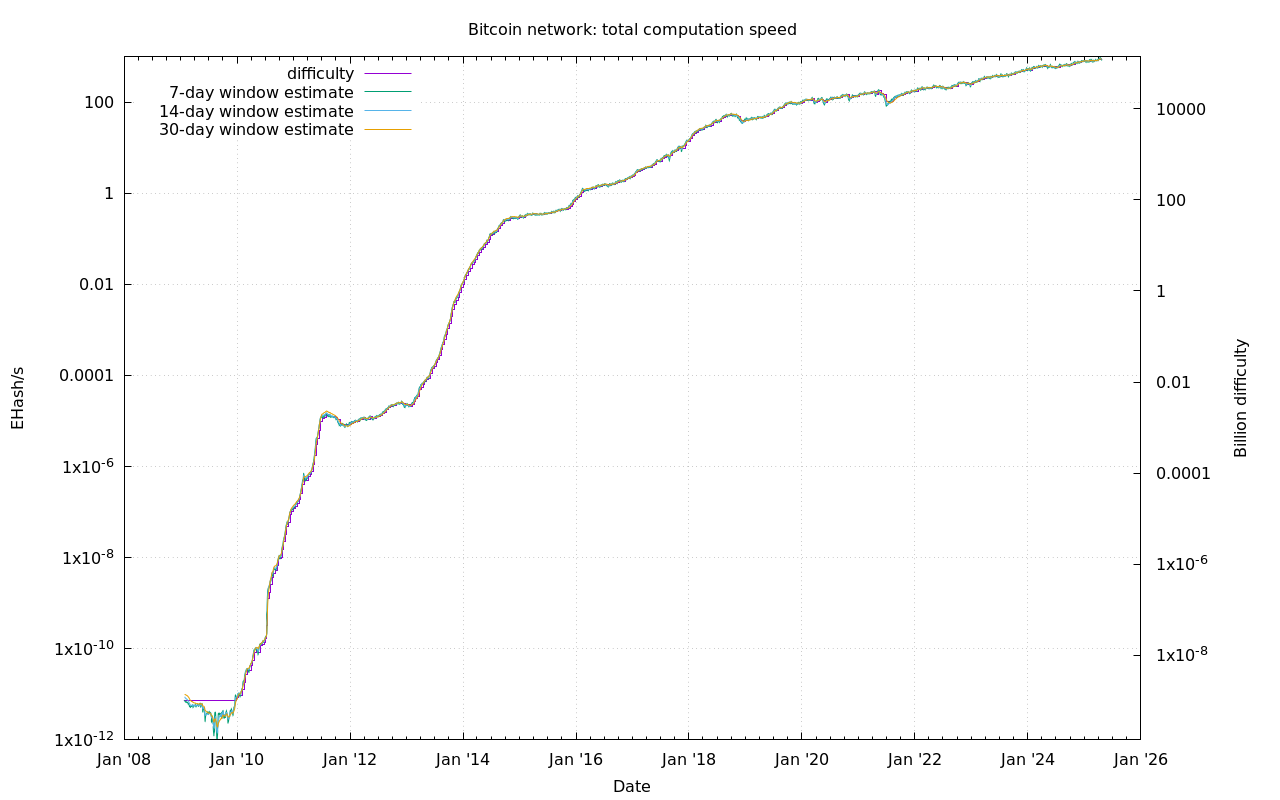
Hash rate is about 1,200 PH now. The most efficient ASIC miner today is the AntMiner S7 [1], which does 4.86 TH at 1.21 KW. This gives us a power consumption of the entire Bitcoin network of at least 300 MW. Actual power will easily be double that, given that not everybody is using the latest miner. So let's say total power consumption is about 600 MW. This is the output of a small power plant.
Therefore the hashing chips must be considerably more efficient than the latest commercially available products. I think the major players get hashing chips manufactured at scale on smaller nodes for significant power savings.
First of all, 28% could almost entirely be attributed to noise.
Second, the fastest hash rate increase recently observed occurred between Nov 2015 and Feb 2016, not during the last month.
See alltime log scale: https://kaiko.com/statistics/hash-rate?logscale=true&range=1...
The gain just plateaued out after the mid 2013 to mid 2014 rush. The current rate is note even half of that.
I know that sounds snarky, but it's how proof-of-work systems like bitcoin work: "miners" all attempt to generate a specific hash which just means lots and lots of computation. The number of transactions per second the bitcoin protocol can handle is essentially capped and completely unrelated to hash rate as the difficulty of producing a correct hash is adjusted based on the hash rate.
You're assuming hashrates and electricity consumption are 1:1, ignoring improvements in efficiency.
> The number of transactions the bitcoin protocol can handle is essentially capped and completely unrelated to hash rate as the difficulty of producing a correct hash is adjusted based on the hash rate.
That is true, but one must also consider that transactions & value transfer is not necessarily 1:1 either. A transaction can carry information which refers to multiple transactions, or is a transaction for a billion dollars. So value transfer is not necessarily capped, although in practice of course it is right now.
Further, to say there's no relation isn't true, either. Transactions are not dependent, but they are related to hash rates to some extent, and by virtue of the protocol this will increasingly become so, as transactions will be the main source of income that funds hash rates, there is indeed a relation.
Not true at all. The total hash rate has gone up a factor of 10^11 since the early days of Bitcoin, but total electricity consumption certainly hasn't gone up by that much. Data here: http://bitcoin.sipa.be/speed-ever.png
Most of that can be attributed to efficiency gains. More efficient miners are coming on the market all the time, and in any given year, the vast majority of increased hash rate can be explained by better hardware, not another 100-1000X in electricity consumption.
This latest hash rate increase is most likely caused by the release of the latest batch of mining hardware, see, e.g., Antminer: https://bitmaintech.com/productDetail.htm?pid=00020150827084...
The relevant number is bitcoin's price*the block reward. That's exactly how much one block is worth, and so that's how much it should cost to mine one block. If it diverges from that number then either miners will turn off or new miners will turn on.
For more information about mining, you can refer to this description: https://kaiko.com/learn/mining-blockchain
This isn't totally accurate. You need a lot of different miners and a high hash rate for security. The least secure place bitcoin can be is when a single miner controls most of the hash rate.