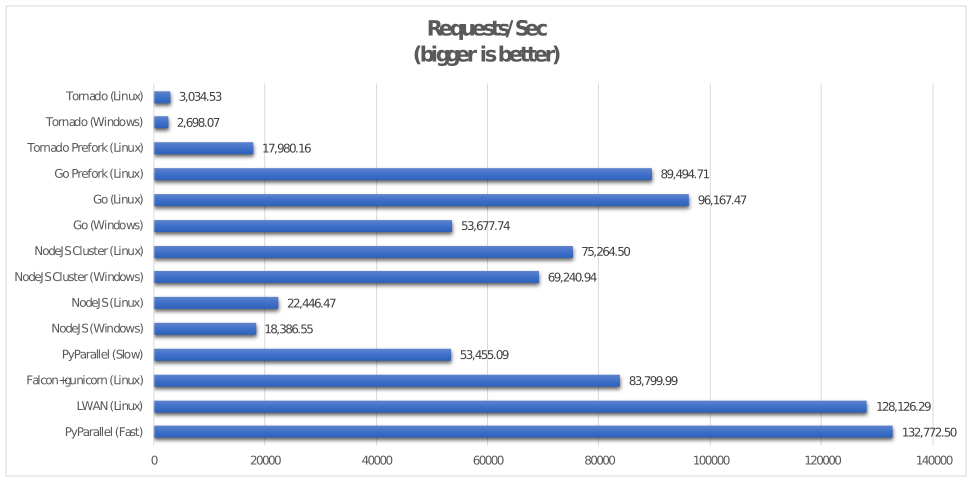
> The “Why Windows?” (or “Why not Linux?”) question is one I get asked the most, but it’s also the one I find hardest to answer succinctly without eventually delving into really low-level kernel implementation details. >
> You could port PyParallel to Linux or OS X -- there are two parts to the work I’ve done: a) the changes to the CPython interpreter to facilitate simultaneous multithreading (platform agnostic), and b) the pairing of those changes with Windows kernel primitives that provide completion-oriented thread-agnostic high performance I/O. That part is obviously very tied to Windows currently. >
> So if you were to port it to POSIX, you’d need to implement all the scaffolding Windows gives you at the kernel level in user space. (OS X Grand Central Dispatch was definitely a step in the right direction.) So you’d have to manage your threadpools yourself, and each thread would have to have its own epoll/kqueue event loop. The problem with adding a file descriptor to a per-thread event loop’s epoll/kqueue set is that it’s just not optimal if you want to continually ensure you’re saturating your hardware (either CPU cores or I/O). You need to be able to disassociate the work from the worker. The work is the invocation of the data_received() callback, the worker is whatever thread is available at the time the data is received. As soon as you’ve bound a file descriptor to a per-thread set, you prevent thread migration >
> Then there’s the whole blocking file I/O issue on UNIX. As soon as you issue a blocking file I/O call on one of those threads, you have one thread less doing useful work, which means you’re increasing the time before any other file descriptors associated with that thread’s multiplex set can be served, which adversely affects latency. And if you’re using the threads == ncpu pattern, you’re going to have idle CPU cycles because, say, only 6 out of your 8 threads are in a runnable state. So, what’s the answer? Create 16 threads? 32? The problem with that is you’re going to end up over-scheduling threads to available cores, which results in context switching, which is less optimal than having one (and only one) runnable thread per core. I spend some time discussing that in detail here: https://speakerdeck.com/trent/parallelism-and-concurrency-wi.... (The best example of how that manifests as an issue in real life is `make –jN world` -- where N is some magic number derived from experimentation, usually around ncpu X 2. Too low, you’ll have idle CPUs at some point, too high and the CPU is spending time doing work that isn’t directly useful. There’s no way to say `make –j[just-do-whatever-you-need-to-do-to-either-saturate-my-I/O-channels-or-CPU-cores-or-both]`.) >
> Alternatively, you’d have to rely on AIO on POSIX for all of your file I/O. I mean, that’s basically how Oracle does it on UNIX – shared memory, lots of forked processes, and “AIO” direct-write threads (bypassing the filesystem cache – the complexities of which have thwarted previous attempts on Linux to implement non-blocking file I/O). But we’re talking about a highly concurrent network server here… so you’d have to implement userspace glue to synchronize the dispatching of asynchronous file I/O and the per-thread non-blocking socket epoll/kqueue event loops… just… ugh. Sure, it’s all possible, but imagine the complexity and portability issues, and how much testing infrastructure you’d need to have. It makes sense for Oracle, but it’s not feasible for a single open source project. The biggest issue in my mind is that the whole thing just feels like forcing a square peg through a round hole… the UNIX readiness file descriptor I/O model just isn’t well suited to this sort of problem if you want to optimally exploit your underlying hardware. >
> Now, with Windows, it’s a completely different situation. The whole kernel is architected around the notion of I/O completion and waitable events, not “file descriptor readiness”. This seems subtle but it pervades every single aspect of the system. The cache manager is tightly linked to the memory management and I/O manager – once you factor in asynchronous I/O this becomes incredibly important because of the way you need to handle memory locking for the duration of the I/O request and the conditions for synchronously serving data from the cache manager versus reading it from disk. The waitable events aspect is important too – there’s not really an analog on UNIX. Then there’s the notion of APCs instead of signals which again, are fundamentally different paradigms. The digger you deep the more you appreciate the complexity of what Windows is doing under the hood. >
> What was fantastic about Vista+ is that they tied all of these excellent primitives together via the new threadpool APIs, such that you don’t need to worry about creating your own threads at any point. You just submit things to the threadpool – waitable events, I/O or timers – and provide a C callback that you want to be called when the thing has completed, and Windows takes care of everything else. I don’t need to continually check epoll/kqueue sets for file descriptor readiness, I don’t need to have signal handlers to intercept AIO or timers, I don’t need to offload I/O to specific I/O threads… it’s all taken care of, and done in such a way that will efficiently use your underlying hardware (cores and I/O bandwidth), thanks to the thread-agnosticism of Windows I/O model (which separates the work from the worker). >
> Is there something simple that could be added to Linux to get a quick win? Or would it require architecting the entire kernel? Is there an element of convergent evolution, where the right solution to this problem is the NT/VMS architecture, or is there some other way of solving it? I’m too far down the Windows path now to answer that without bias. The next 10 years are going to be interesting, though.
https://groups.google.com/forum/#!topic/framework-benchmarks...