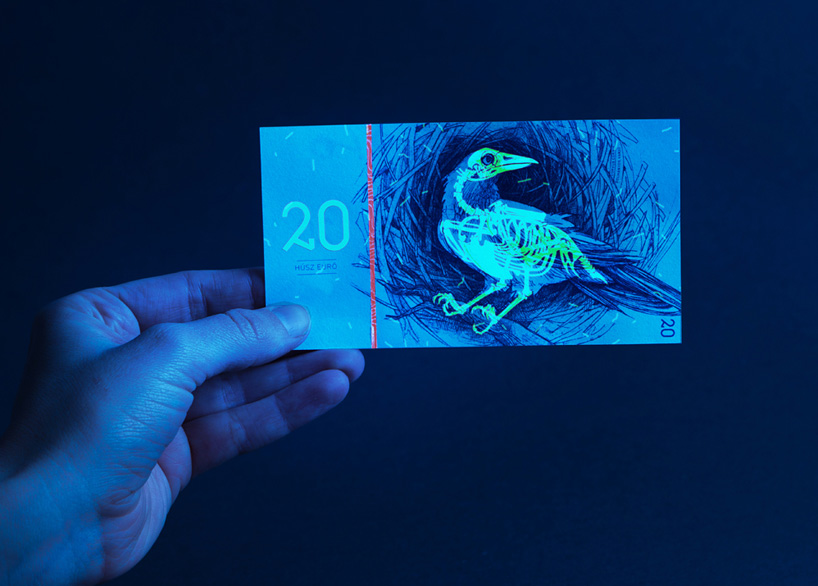
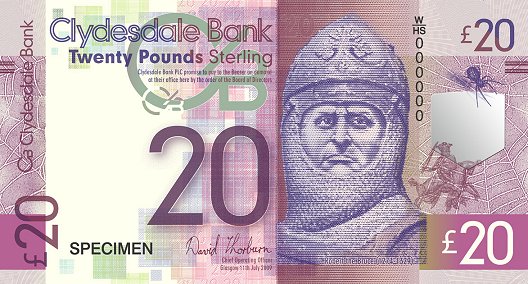
And a couple of concepts from US based designers[3][4] for US currency designs.
[1]http://www.metricdesign.no/work/norges-bank
[2]http://snohetta.com/projects/200-design-proposal-for-norway3...
[3]http://www.travispurrington.com/2014-usd-proposal
[4]http://tyznik.com/currency/
Edit: I thought Travis Purrington was US based but he is actually Zurich based.
I learnt this from the Bank of England museum.
https://web.archive.org/web/20150518212006/http://buzzit.no/...
Edit: Saturday-night-whisky spelling mistake.
Edit: Here's an additional concept for the British Pound that I forgot to add to my above post.[1]
[1]http://www.travispurrington.com/-2022-british-pound-concept
I wasn't able to find an image of all the notes, here is the new 50 franc note:
http://www.snb.ch/n/mmr/picture/3a29e64cf82f471d00257f8d0021...
[0] http://imgur.com/gallery/3u8xP [1] http://www.designboom.com/wp-content/uploads/2015/02/barbara...
The article notes that under UV light the pages of the new/future norwegian passport switch from day view to "northern lights" night view. The first two pictures in TFA are the same page viewed under normal light and UV.
http://www.twenty.si/uploads/pics/Licul.6_01.jpg
Much easier to spot removed pages than with the subtle Finnish design.
I've used French in some weird remote corners of the world where English didn't work.
The ICAO still recommends to issue passports in English and French _or_ in the national language plus English or French although using the national language(s) plus English and French is still common in Europe.
European Union passports even use all official EU languages as far as I know (I cannot check right now).
My British one has English and French on the data page, and a number to look up the translation.
http://news.bbcimg.co.uk/media/images/48863000/jpg/_48863568...
- Australian: English/French for the photo page, page for restrictions, and the contact info. All the rest (bit where the GG requests in the queen's name (!) that you be allowed to travel, advice if you get arrested on drugs charges (!!) etc is in English
- USA: English/French/Spanish for name, address and other meta info. Advice on not violating ag rules etc in English. Request for free entry also trilingual
- German: "German Passport", number of pages, other meta info in all EU languages; name, etc in German / English / French. No request for free passage, no advice about being arrested.
I just realised I'll end up with one of the first ones - my current spare passport expires on March 31st, 2018.
Depending on the country, it might be more difficult to renew it after it has expired than shortly before.
Or it might make no difference whatsoever.
I renewed both my passport and my "origin" ID card ~6 months after they expired, through the consulate (though both my country of origin and my country of residence are in the EU). There was no issue whatsoever renewing them (I did cut it a bit short as I realised my passport was expired 2 weeks before leaving the EU for holidays, but the passport took under a week to renew and reach the consulate).
However, there's a bit of a calm period in my industry now, so I manage well on only the main passport (which doesn't expire until 2026, I got a new one last year - your 1st passport is issued for ten years, the spare for two.)
https://www.passportindex.org/
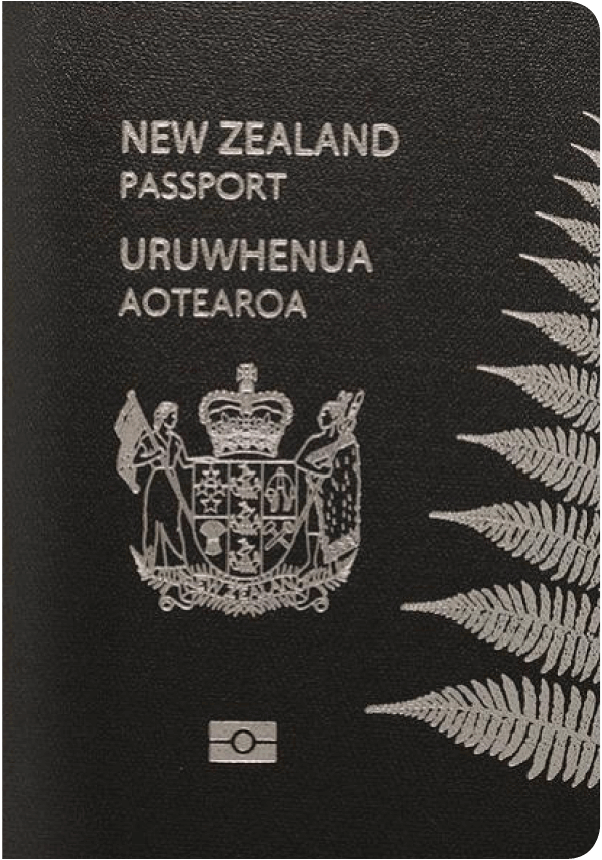
Here's New Zealand's distinctive design:
https://www.passportindex.org/countries/nz.png
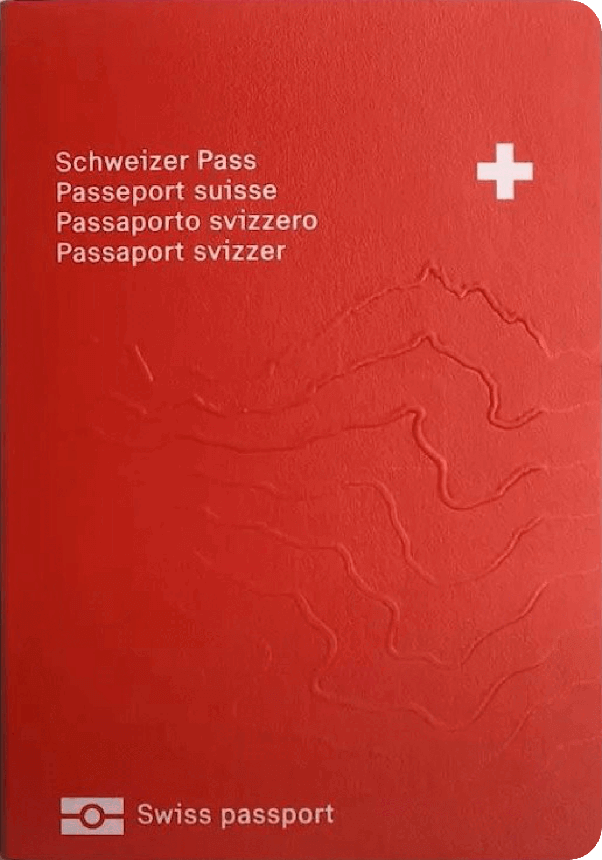
But I prefer the elegant minimalism from Switzerland:
https://www.passportindex.org/countries/ch.png
De gustibus non est disputandum. :-)
https://www.udi.no/en/want-to-apply/immigrants-passport-and-...
American passports are so drab in comparison. Another nice passport design is Swiss, but that shouldn't be surprising.
Of course, the path to that stuff also includes language learning and civics and all that stuff too.
Let me explain this with typical cases where a passport is used:
(1) You're entering your home country with your passport. Pretty much at every secure border crossing, they're going to use your passport number to pull up absolutely every bit of info that appears in your passport, including your photo, plus a lot more info from the home country's computers. The passport serves at most as a "something you have" security token. They already have your photo, so the only case where the physical passport helps is avoiding impersonation by someone closely resembling you.
(2) You're traveling to a foreign country that needs a visa. In that case, you will have submitted a ton of information, including your photo, to the foreign country in advance to get the visa. When you arrive at the foreign country, it's just like case (1) above.
(3) You're traveling to a foreign country that doesn't need a visa from citizens of your home country. In this case, the proof you need is that you are a citizen of that country. It is likely that the two countries have exchanged a mass of information to make the visa-free travel possible, or they can share the info about visitors in real time as they arrive.
It's really the edge cases that the physical passport helps. Like obscure border crossings where they don't have an electronic feed, or very third-world countries, or as a recognizable document to show to hotels/banks/airlines within a foreign country.
By the way, I'm not saying that this is a good development. In fact, it's a terrible loss of privacy and furthering of worldwide surveillance. But it seems to be the trend, like the elimination of cash.
However, in my experience, truly electronically equipped borders are the edge case. The countries that take e-passports without any agent interaction are fee and far between, and typically only service citizens of that country.
Perhaps you're fortunate enough to travel in a selection of bleeding edge countries, via plane. Many, many people use land borders, and most land borders don't have electronic systems.
For an electronic system to work, you'd need 100% coverage of every border, or the system breaks - and that's hard to pull off.
The flip side is that there are security flaws with partial electronic systems. My country passed a law against travel to Iraq / Afghanistan for citizens, and yet, because they have 100% electronic border control for citizens, (and Iraq / Afghanistan don't..) - my passport has never been checked, despite having 'illegal' visas plain to see.
And therein lies the true absurdity of it. All travel stops if the internet goes down?
The thing you describe essentially also exists in many countries as a ID already, which I.e. can be enough for EU citizens to travel within the EU.
U.S. Government won't upload a dump of personal data of its citizens to Thailand or Indonesia, would it?
Moreover, if local governments would want this data from everyone let in without a visa (for TH and ID it's almost every country in the world except, probably, Africa) they'd end up with data on roughly 3 bln people. They don't have IT infrastructure to deal with it. This data will also be out of sync the second it's dumped from origins.
So, when you're being processed in Bali by border control on your first entry, the only thing they can do is confirm the validity of your document's physical properties, but not the identity it represents.
But the Federal government can't mandate having these machine-readable identifiers on the State-issued drivers licenses, so we're stuck with Passport Cards and Passport Books in addition to the EDL.
There are 180-200 countries in the world. You characterisation of the vast majority of them as "very third-world" is rather crass. You are also ignoring possible police stops inside of foreign countries. In order to ask for a bribe, they check that you have all of your paperwork in order.
For (1), The Schengen area has already implemented this for EU countries with national identity card schemes. In contrast, the US doesn't have a national identity card scheme so you still need a passport (booklet by air, card by land or sea). Even illegal immigrants can get an ID card or Driver's license in California, for instance.
For (2), some countries just want to collect a little fee and don't care much beyond that as long as you stay for less than 30 or 90 days.
For (3), the US, for instance, extends the Visa Waiver Program to any country when the Visa reject rate drops low enough. I think you are greatly overestimating the level of cooperation between countries on visa policy.
it seems to be the trend, like the elimination of cash.
Again, this trend is limited to very first world countries. In most of the world, cash is still king.
Each country definitely has something like this for their own citizens, and within the EU this information is shared (probably quite freely) between frontier agents and the police. A driver's license from the Netherlands can quickly be checked for authenticity/validity in Germany for example...
They don't need that much data, just photo and name, ID numbers, maybe the registered address(es).
Based on that, if you have any criminal history, you can bet they'll see it anywhere as it is priority information.
You rob individuals of agency, when you start dictating to them who you've declared them to be.
If two identical twins appear becore you, wearing sunglasses and gloves, are you going to demand that they remove their accessories, so that your special machine can declare them honest?
Sounds like an alienating place. How far will this go, once a person crosses the threshold, and steps into such a zone of absolute identity? Smart people might wish to stay the hell away from such a place.
Smart people might prefer a place that permits them the dignity of producing an artifact from their pockets, rather than acquiescing to a medical inspection.
In your quasianonymous utopia, which twin is to blame when one of them comes to my country and injures someone? Neither?
> Monday 17 November 2014 15.29 GMT
> Last modified on Monday 17 November 2014 18.40 GMT