This incident brings the Reduced Vertical Separation Minima (RVSM)[5] into question. Strategic Lateral Offset Procedure (SLOP)[6] can be used used to avoid such incidents.
[1] https://www.youtube.com/watch?v=E1ESmvyAmOs
[2] https://www.youtube.com/watch?v=dfY5ZQDzC5s
[3] https://www.youtube.com/watch?v=uy0hgG2pkUs
[4] https://www.youtube.com/watch?v=KXlv16ETueU
[5] https://en.wikipedia.org/wiki/Reduced_vertical_separation_mi...
[6] https://en.wikipedia.org/wiki/Strategic_lateral_offset_proce...
On a humid day, the lowering of the pressure over the wings can basically force the air temperature at that point to lower and reach dew point temperature, essentially forming temporary clouds that are whipped around by the moving air vortices.
Once the aircraft has passed that point, the temperature generally stabilises and conforms to surrounding air temperature, which usually dissipates the temporary condensation.
The 'twirly' bits on the wingtips is basically spillover from the high pressure under the wings to the low pressure above the wings, creating that mini tornado vortex. This is also the reason that many modern aircraft have those 'winglets' on the wingtips, to try and minimise these spillover vortices which can cause problems for trailing aircraft, as well as induce extra drag on the source aircraft.
Similar phenomenon to boiling water at high elevations. Walking up the mountain isn't heating the water, but the boiling point drops as air pressure drops.
If I remember correctly, the trails from the outboard edges of the flaps are just like wingtip vortices. The airfoil's geometry suddenly changes, acting like a wingtip and creating a vortex.
> In addition to mitigating en route midair collision hazard, SLOP is used to reduce the probability of high-altitude wake turbulence encounters. During periods of low wind velocity aloft, aircraft which are spaced 1000 feet vertically but pass directly overhead in opposite directions can generate wake turbulence which may cause either injury to passengers/crew or undue structural airframe stress. This hazard is an unintended consequence of RVSM vertical spacing reductions which are designed to increase allowable air traffic density. Rates of closure for typical jet aircraft at cruise speed routinely exceed 900 knots.
Seriously, "unintended consequence"? It seems quite obvious in retrospect.
It's an incredible feeling, lots of fun, and if you have to walk up the mountain first it's a nice nature experience as well. Yes, it can be dangerous, but it's a risk you can manage yourself. So it doesn't have to be very dangerous if one follows common advice and also don't ski where there is a high risk of avalanches.
Keep your seatbelt buckled, even when the sign is off.
Case in point: Chapecoense.
- Each year, approximately 58 people in the United States are injured by turbulence while not wearing their seat belts.
- From 1980 through 2008, U.S. air carriers had 234 turbulence accidents, resulting in 298 serious injuries and three fatalities.
- Of the 298 serious injuries, 184 involved flight attendants and 114 involved passengers.
- At least two of the three fatalities involved passengers who were not wearing their seat belts while the seat belt sign was illuminated.
- Generally, two-thirds of turbulence-related accidents occur at or above 30,000 feet.
Edit: These stats do not include general aviation (private jets, etc...).
It was hard to find good stats with quick googling, but this old source[1] suggests that blood clots during flights are the greater risk, killing at least 2,000 people in the UK per year. I suspect that keeping a seatbelt off while cruising lets you shift around more mid flight and would give a small decrease in the frequency of clots.
I guess it depends on (the size of) your aircraft.
In other parts of the world (with more sense) such as Europe, Australia, we're conditioned to always using it due to strict enforcement and as such it's not such a novelty.
https://www.scientificamerican.com/article/what-happens-when...
There is a balance between annoyance and utility. I personally have no problem wearing a belt for the entire flight, including while sleeping. But I'm not to dismayed by those who leave it off, walk around the cabin, go hang out near the cocktail lounge in business class, etc...
Your skull is vulnerable to impacts at speeds that are relatively low compared to full-speed cycling.
On a few occasions I've witnessed a cyclist panic and wobble after being passed far too closely by a car traveling far too fast for such a manoeuvre. This has caused such cyclists to wobble, inadvertently clip the curb and mount the pavement, fall off sideways and subsequently strike their head on a nearby wall whilst falling.
The resulting injury can be very harmful.
Another example of slow-speed head injury: off-road biking down a very steep incline with a loose surface. I've seen people fall and tumble at almost stationary speeds.
Having personally done a header over the handlebars onto my helmet, resulting in a dented helmet and an un-dented head: yes, I'd recommend it.
    > anyone riding a bicycle,
    > even if they aren't going at
    > high-speed on road, should
    > wear a helmet "just in case"
I think the cost of wearing an aircraft seatbelt while you happen to be seated is rather lower than the cost of having to wear a bicycle helmet, though.
Kinetic energy is also the reason why the flight attendants try to lock as much as possible of the loose items to the overhead bins or under the chairs.
Speed only makes a difference if your head hits something whilst moving at that speed. Or you can just fall off at a walking pace, and the acceleration between the top of your head to the ground is enough to kill you. Happened to a guy on the local trail a few years ago, as happens elsewhere as well.
I don't think one needs to be confined to the seat for the whole flight duration, but when sitting down, there is no good reason not to wear a belt either.
I kind of want the helmet-in-public fashion trend to kick in.
In a car you usually fasten your seatbelt all the time so that you don't have to guess when the risk is going to occur. In a plane there's no reason not to act the same way.
Sure there is. The chances of dying in a car accident are around 1% whereas the same in an air accident is, like, 100x less likely?
It's like how you wear a helmet when you're in a construction zone but you don't wear a helmet when walking around the city despite the nonzero chance that something might fall on your head. (Or do you?)
Also, it's not like they never have no idea which airplanes are around them until they visually see the airplane. They could turn on the sign earlier if they know earlier.
On another note, I fly every week for work, can't imagine rolling five times and engines losing power with a drop of 10k feet. That's absolutely insane. I've had engines lose power before, but it was quickly regained such that the drop was more moderate.
The wing is deflecting air downward to provide lift; this creates a volume of downward-moving air behind the aircraft.
There's higher pressure under the wing and lower pressure on top, so air from below tries to get above the wing at the wingtips. This causes circulatory motion, yielding wingtip vortices (see my top-level comment for some visualizations).
[1]: https://upload.wikimedia.org/wikipedia/commons/d/d6/US_Navy_...
Considering the Challenger's encounter with the A380's wake, it took 1-2 minutes for the Challenger to hit the wake, so the wake probably had 1-3 minutes to make the 1000-foot descent. That very roughly fits the expected "several hundred feet per minute" descent rate.
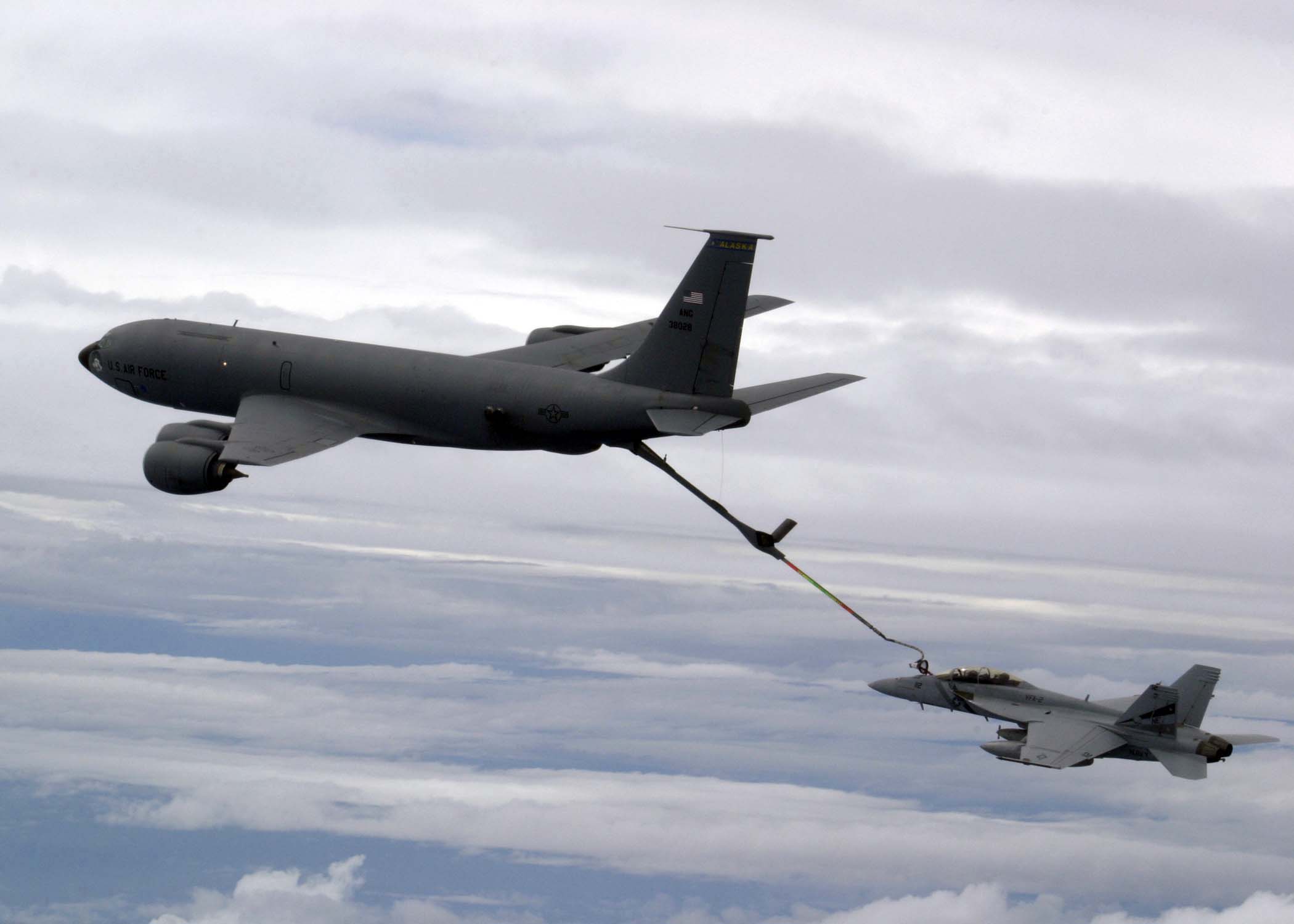
Considering the case of refueling, the wake's motion downward is much slower than the aircrafts' horizontal motion, so it wouldn't have descended much by the time it's left behind entirely.
[1] Available for free at https://www.faa.gov/regulations_policies/handbooks_manuals/a...
https://aviation.stackexchange.com/questions/9572/how-do-air...
http://cfile29.uf.tistory.com/image/145D430D4CFE23D50A5BD0
being close is relatively safe from wortexes - there still is some other turbulence to consider, but the standard turbulent flow caused by drag is chaotic so it'll shake you but will 'even out'
I think it's also interesting to point out this is also the explanation for the trend of adding winglets to the tip of the wings.
They help reduce the wingtip vorticies, and in turn, reduce parasitic drag and improve fuel efficiencies.
[1] http://www.boeing.com/commercial/737max/737-max-winglets/
I'm familiar with the roar of jets taking off. Some years back I happened to be biking past an airport, at the end of the runway, just as a passenger jet was lining up for takeoff, headed away from me. I thought I'd pause to watch.
Only as the engines spooled up did I think, "hrm, this could get loud".
It didn't.
Instead, what I heard was ... the engines spooling up. Loud, yes, but not a roar, just an increasing pitch, until the airplane started accelerating down the runway.
It wasn't until some 15-20 seconds later that I heard the familiar roar, echoing off of hills five or so miles away. That's when I realised that the whine was the sound of the turbines, but the roar was the sound of exhaust gas, streaming out of the engines, hitting stationary air and generating intense turbulence, and radiating outward in a perpendicular line to that jetwash. So I didn't hear it directly (it was moving away from me), only the reflection (as that wall of noise, now reflected off the hills, was directed back toward me.
I doubt the vortex would make any particularly loud sound, though you might hear the rushing of air. Speeds are in the tens of miles per hour rather than hundreds as with jetwash.
Woah, the soviets shot down a Korean airliner with air-to-air missles killing 269 people? Never heard that story. Crazy.
There's also an episode ("Phantom Strike") of the TV series Mayday about the incident; it's probably on youtube.
May I also recommend strong radiation source mishandling accidents?
https://en.wikipedia.org/wiki/American_Airlines_Flight_587
Is another example (though pilot error likely made a bad situation worse in that particular incident).
Wingtip vorticies can sit over a runway (or even drift over to parallel runways) for minutes after a takeoff. They are very dangerous to smaller aircrafts.
The key to avoiding vorticies is to take off at a point earlier than the previous aircraft and to climb at a steeper angle (vorticies travel behind and downwards from the aircraft that made them).
Example: http://www.boldmethod.com/images/learn-to-fly/aerodynamics/a...
Helicopters can also produce serious turbulence as well!
The A380 is a lot more like 3 boxes (based on A380-800: http://www.airbus.com/fileadmin/media_gallery/files/tech_dat...):
1) A fueselage box with a cross section of 2067 ft^2
2) A wing box of ~1200 ft^2 (a very broad approximation because of engines, the actual wing box - the part of the plane where the wings meet the fueselage - and the curve of the wings),
3) A tail box with a cross section of 144 ft^2
So a total cross section of ~3411 ft^3 * 827 fps = ~3 million ft^3
Point being, the plane isn't moving 11 million cubic feet just to move forward, it pushes on a little more than a quarter of that directly. These wake effects happen because it's disrupting so much air outside of the zone it actually travels in, mostly below and behind it.
It's not an approximation. I'm giving a sense of scale, not saying how much volume the plane has. The point is that while 11 million cubic feet sounds like a lot, if you put it in a big box next to the plane then they would be on the same scale.
> the plane isn't moving 11 million cubic feet just to move forward, it pushes on a little more than a quarter of that directly
That's jseip's post's problem, not mine.
The weight of the airplane is a force downward, the air must match that force, either by throwing a lot of air with little velocity, or a less air, faster.
Also, an invisible vortex is no less turbulent for its invisibility.
Those little jets man... they're fine most of the time but what a spooky experience that was.
It's fucking wild how small of a wing can put off a sizable wake. With wingsuits, if you fly behind and slightly above a buddy, you're going to hit his burble and you're going to immediately lose lift and possibly start spinning. There's a clip floating around of a bunch of us on a training jump in race suits and one of the guys hits a burble from the group and just gets dropped a few hundred feet damn near immediately.
EDIT: Found it - http://giphy.com/gifs/cBP3YE9hf9oVa
Here's a solid article that touches on it w/r/t lift - http://base-book.com/speed-to-fly
...and here's one that's a bit more applied that has to do with how burbles affect canopy deployments - http://base-book.com/some-thoughts-on-wingsuit-openings
By contrast, the horizontal separation minima vary dramatically based on the size of the leading aircraft.
https://en.wikipedia.org/wiki/Reduced_vertical_separation_mi...
Will nearby aircraft be warned when crossing right under an A380 that they are basically on a collision course, while had it been a small aircraft it wouldn't be a problem?
Are the imperial units of measurement an aviation thing, or an American thing, or a bit of both?
EDIT: ahahaha <3 HN commenters
Global, impossible to upgrade standards that mean we are stuck with imperial units for a hundred years yet or more.
You'll hear them referred to as Flight Levels or Angels as well (Angel 15 == 15,000feet).
EDIT: there was a reply (since deleted) that indicated I may not be completely correct on stating FL200 as the lowest number used. I contend that I am still basically correct for North America, but there is some subtlety:
Generally, you'll use flight levels until either you hit the transition level specified in the approach plate or ATC clears you beneath that level, at which point they'll switch to using feet and give you the QNH (atmospheric pressure at sea level) to calibrate your altimeter.
For example, the ILS/DME approach for 26L at Gatwick has a transition of 6000 ft (http://www.ead.eurocontrol.int/eadbasic/pamslight-48EDD962FD...)
From your wiki link:
> In the United States and Canada, the transition altitude is 18,000 ft.
1. The nautical mile is an SI derived unit, now fixed at 1852 meters.
2. It's a more useful unit than the kilometer for long-distance navigation due to its historical definition in terms of arc along a line of latitude making it easy to work with on charts.
I believe the eastern block used to use meters, I doubt 300m was much more difficult to deal with mentally than 1000 feet!
Any more info on that??
If the engines fail, you still need to be able to control the plane, so there is something called a ram air turbine[1] which can be deployed out of the side of the aircraft. It is basically just a little propeller which spins in the breeze, which powers a pump, which supplies the hydraulic pressure to control the plane. So if the power goes out, you can still deploy that thing and have "power" assistance in controlling the plane.
The article says the ram air turbine did not deploy, possibly because the g-forces were holding it in, or perhaps because the g-forces or aerodynamic stresses were flexing the body of the plane so much that the turbine was held in place by the bending. So the pilots did not have "power steering" on the plane, and had to pull on the controls with "raw muscle force".
There is probably some mechanical advantage, probably both from the leverage afforded by the mechanics of actuation, and from the aerodynamics of the wing, that allow a single human to move the whole plane around. But it would still be very, very hard to control the plane without power assist, especially under such extreme conditions.
(Any pilots/aerospace engineers feel free to chime in/correct mistakes here).
The physics of flight produce a very useful convenience: the amount of force needed to effect a particular degree of attitude change (e.g. a 10 degree bank) remains the same, regardless of speed. Planes up to the size of small jets (the Cessna Mustang, for instance) use fully manual controls with no power assistance. The Challenger is a bit bigger, but even after the remaining pressure in the hydraulic system completely dissipated, I doubt more than 30lbs of pressure would have been required to actuate the controls. And the rotational inertia of the turbines should have provided at least some assistance on top of that. (I have no idea what would have happened if an airliner lost both engines simultaneously in a stall.)
A380s are HUGE, so this isn't surprising. wake turbulence is a killer
It appears that there is a section of air between 29,000ft and 41,000ft, where flights are allowed to be closer than is normally allowed. Instead of 2,000ft apart, they are allowed to fly 1,000ft apart. In order to operate continually in this airspace, a plane must be "RVSM approved". Otherwise they have to either request special permission or make a continuous climb through said airspace while complying with their usual 2,000ft requirements.
The article mentions that the A380 and Challenger 604 were 1,000ft apart. So, I would assume they were both RVSM approved. This event could call the RVSM into question.
I am always impressed at how they look like a big chunk of metal from the outside, but they are in fact mostly made out of air and very thin and light materials.