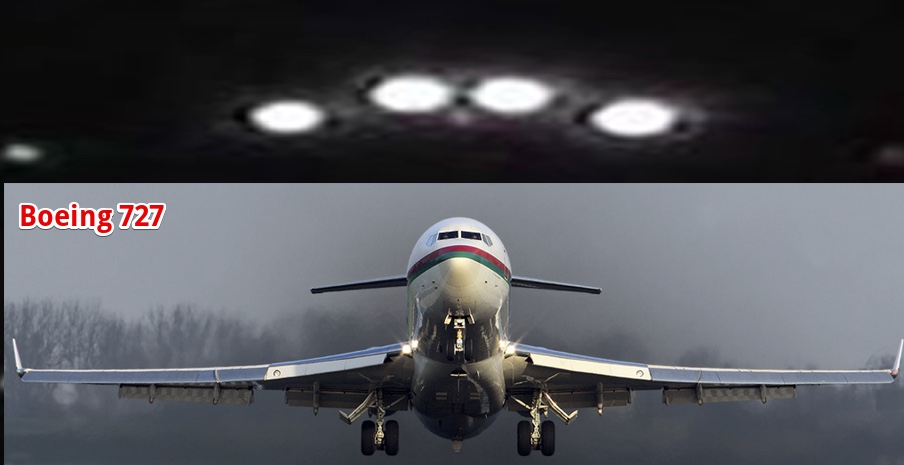
On a humid day, the lowering of the pressure over the wings can basically force the air temperature at that point to lower and reach dew point temperature, essentially forming temporary clouds that are whipped around by the moving air vortices.
Once the aircraft has passed that point, the temperature generally stabilises and conforms to surrounding air temperature, which usually dissipates the temporary condensation.
The 'twirly' bits on the wingtips is basically spillover from the high pressure under the wings to the low pressure above the wings, creating that mini tornado vortex. This is also the reason that many modern aircraft have those 'winglets' on the wingtips, to try and minimise these spillover vortices which can cause problems for trailing aircraft, as well as induce extra drag on the source aircraft.
https://s-media-cache-ak0.pinimg.com/236x/09/de/53/09de53063...
https://s-media-cache-ak0.pinimg.com/736x/0a/a1/80/0aa180ef6...
If you're near Austin, the Texas Memorial Museum on the UT campus had a mounted skeleton.
I think maybe the GP is more amazed about the (self-) generated lift and assorted scale. Seems like humans have a thing for hurling self-propelled heavy metal boxes at ridiculous speeds, whether on ground, in the air, or in a vacuum.
"and then he said, 'ounces'"
Similar phenomenon to boiling water at high elevations. Walking up the mountain isn't heating the water, but the boiling point drops as air pressure drops.
The fact that air gets deflected downward is a necessary (c.f. conservation of momentum) effect too. So it's not incorrect to do the analysis that way. But it's absolutely wrong to correct someone saying that "lift is pressure" with "lift is actually deflected air".
This is clearly demonstrated by this incident. Many tons of air deflected downwards by the A380's wings had enough force to flip the unfortunate plane below several times.
The air "sticks" to the surface of the wing and leaves the trailing edge in a partially downward direction i.e the air is deflected downward by the top of the wing not just the bottom.
For a quick demo of this, hold the bowl of a spoon under a running faucet and see how it pulls the spoon into the stream.
The "equal transit time" theory that you appear to be referencing here (air over the top takes a longer path, thus it must go faster and air under the bottom takes a shorter path thus it goes slower) is a complete fallacy. There is no mechanism in physics that requires the air to "meet up" at the trailing edge of the wing.
If pure 'flat plate' theory was valid, then all those aircraft speeding down the runway with the leading edge of their wings canted downwards 20 or so degrees would result in the airplanes simply being pushed towards the ground and never lifting off...
And Boeing, Airbus et al would build planes with flat slab wings mounted at a 45 degree angle to the airflow, because that would give the maximum lift by the 'flat plate' theory, wouldn't it?
Not that I disbelieve that a flat slab cannot generate lift - but that it is probably a very inefficient way to generate lift compared to the standard aerofoil shape.
[0] - https://upload.wikimedia.org/wikipedia/commons/thumb/3/3b/Bo...
Explanation of why aeroplanes fly to airhost: https://youtu.be/AaE9j7u3XJA?t=642
From Captain to Airhost: https://youtu.be/AaE9j7u3XJA?t=1031
From First Officer to Airhost: https://youtu.be/AaE9j7u3XJA?t=1458
Hence the high pressure under the wing and the low pressure on top of the wing. The very act of 'deflecting' millions of cubic metres of airflow generates high/low pressure points. Hence at the end of the day, we could argue that the pressure differential is what is causing the lift?
Disclaimer: Not an aeronautical engineer, just a former commercial pilot.
Deflecting air downward is the way they create that pressure difference.
Get a piece of A4 or Letter sized paper and try this experiment with it [0]. For best effect, hold both the edges closest to you in each hand and twist the front edge downwards to keep it straight and prevent the paper twisting which could inadvertently straighten it. (i.e. Not with one hand like he is doing in the video).
The Bernoulli principle with postulates the Venturi effect is about the only theory that can explain why the trailing edge of the paper moves UPWARDS when you blow across the top of the curved paper.
No one questions whether the Bernoulli and Venturi effects actually exist. But airplanes are heavy and it's pretty obvious that the Bernoulli effect does not produce sufficient lift by itself.
As proof that most of the lift comes from deflecting air, I offer the fact that airplanes can fly upside down.
[EDIT] This also happens with the Oberth Effect.
The pressure explanations and the Newton's Third Law explanations are not different theories of lift. They are just different ways of looking at the same thing underlying thing.
The motion of a wing through a fluid has to conserve mass, energy, and momentum. If you analyze lift by focusing on conservation of momentum, you get the Newton's Third viewpoint. If you analyze by focusing on conservation of energy, you get a pressure viewpoint.
See: https://www.grc.nasa.gov/www/K-12/airplane/bernnew.html
The "Newton's 3rd. law" explanation treats the wing and its immediate surrounding as a black box: air flows in, and exits deflected downwards, so there has been some downwards-directed acceleration. It does not address details of that process, such as why the above-wing airflow usually generates the larger part of the lift, or even how the deflection occurs, though it is fairly obvious that some sort of deflection will result from driving an inclined plane through the air.