Just to explain the involved costs: There's two ways the government taxes company cars for employees, either you get to write a driving log, that then marks each route as either private or business and then you get the privately driven part taxed as income OR you just get 1% of the new car value taxed as income each month and don't have to provide a driving log. The company pays for leasing, gas and maintenance.
That's where electric cars savings on fuel and maintenance don't affect business customers, they don't care mostly because the company pays for the gas anyway and is used to do that so it will stay that way quite a while.
I just hope they give a tax break on the 1% rule, so it's just 0,5 or something similar that makes these cars more desirable compared to a similar priced gas guzzler.
I'm currently looking for a new company car and own Tesla stock so look at these numbers quite closely because I'd love to get a Tesla, but it isn't cost effective to get one if you can't factor in the gas savings and maintenance savings.
My monthly Uber/Lyft expenses are lower than that, infact top out at ~120 USD. I use it to commute to work, shopping, etc.
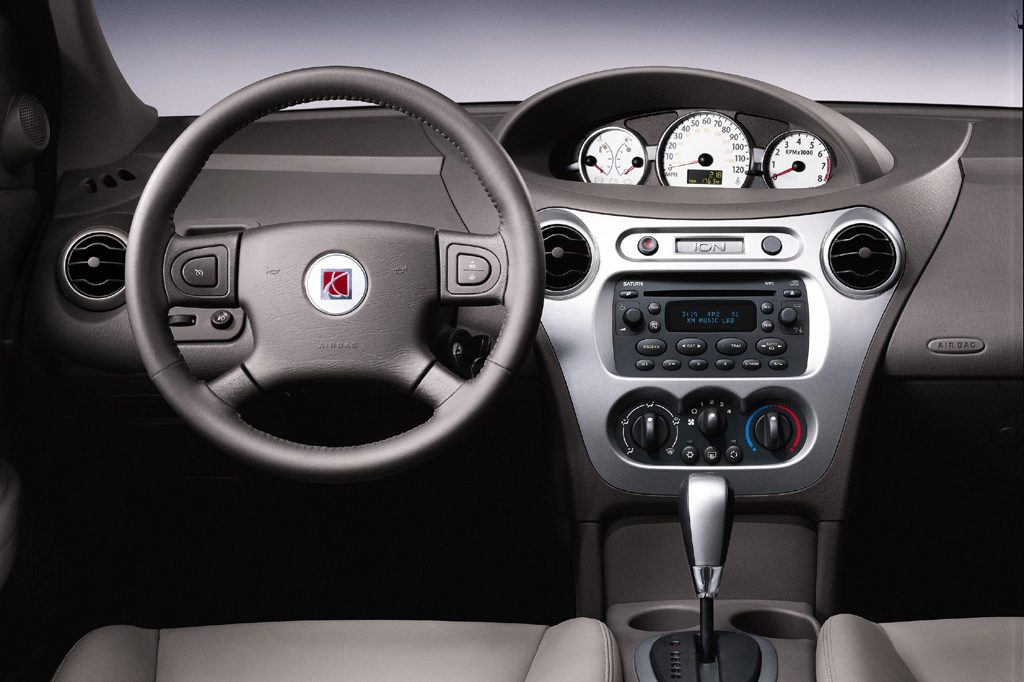
Cars with instruments in the center dashboard:
Mini Cooper: http://images.hgmsites.net/lrg/2010-mini-cooper-hardtop-2-do...
Toyota Yaris: https://cars.usnews.com/static/images/Auto/izmo/306771/2009_...
Saturn ION: http://consumerguide.com/wp-content/uploads/2014/07/05130061...
Citroen C4 Picasso: https://s-media-cache-ak0.pinimg.com/736x/fe/d6/5a/fed65a4f2...
etc...
Toyota Yaris: Not shown in that picture is the Head Up Display projected onto the windscreen, even closer to the driver's line of sight. I drove a Yaris for a few days a while back, and the HUD is good - not distracting there's and no need to turn your head, which would be dangerous.
Citroen C4: Another HUD http://www.citroen.co.uk/about-citroen/technology/head-up-di...
Saturn ION: Seems to be the only valid example. I don't know myself, can't remember ever being in a Saturn ION. Wikipedia tells me that GM does not make them anymore.
it still seems to me that for reasons of safety , you want some instrumentation to be very close to the driver's default line of sight. Not necessarily all of it, but a few key indicators such as speed.
who cares? I'm not looking at my speedo or tack in a turn, I'm watching the road. This feels like justifying poor design with an edge case.
http://i.auto-bild.de/ir_img/1/1/3/2/4/4/5/Renault-Twingo-72...
Not a good sign if the 3 is competing against the 3-series.
the main design flaw here is that the proximity makes it a completely different visual field than the road. while all your examples (I guess, havent clicked all, and only drove extensivly a twingo 1st gen, designed by stark studios) the distance makes your eye see the panel info while looking at the road. even more so than the behind the steering wheel models.
This screams made up problem to excuse a potential design flaw.
http://st.motortrend.com/uploads/sites/5/2017/07/Tesla-Model...
Presumably an exception is made because the car (mostly?) knows the speed limit and alerts if you exceed? I'm making s wild guess here.
Maybe it's actually less distracting than having instrumentation in front of you? I'd like to hire on for a few days when the opportunity arises.
This is the Google home page compared to Alta Vista. The absence of dials, switches, knobs, hidden buttons, things you have to twist in their own special way, it is all good.
Clearly there are some situations where the buttons have to exist, e.g. for seat adjustment, as you wouldn't want to be doing that whilst leaning for the screen. However, the minimal approach and a clear, easy to use console is way ahead of what other cars are doing for their interiors.
Without the clutter of an existing car interior I am sure that big flashing lights on the centre console about exceeding the speed limit will be perfectly visible to all occupants of the car.
This latter point is important, routinely my brother in law drives at speeds that are faster than what he tells my sister. She is sat next to him but can't see the speedometer, so if he says one speed then she has to believe him, even if it is just slightly fast rather than the true excessively fast figure. Having a centre console is a bit more fair to passengers wanting to know that information too. If it is the car rather than the driver that is driving I guess this is no different - everyone including the driver is a passenger.
In it's place are things you have to touch and slide without the tacticle feedback and consistency of controls.
> This latter point is important, routinely my brother in law drives at speeds that are faster than what he tells my sister. She is sat next to him but can't see the speedometer, so if he says one speed then she has to believe him, even if it is just slightly fast rather than the true excessively fast figure. Having a centre console is a bit more fair to passengers wanting to know that information too
SO this car is gonna be mentioned in divorce proceedings /s
Do you think a diagonal saccade is worse than a vertical one for some reason?
Yes, I do think it is worse, but that's just my gut feel, presumably Telsa designer's think otherwise. Not many other cars with the speed in the center console (older new-generation Minis come to mind though).
Yes, definitely. You don't?
Vertical movement is much easier, just try it. It's also easier to focus since one eye isn't farther away or blocked by your nose.
On autopilot the car will stick to the assigned speed (with adaptive cruise control slowing down or speeding up depending on the traffic in front of you). In fully autonomous driving mode the car will read the speed limit signs and adjust.
The Tesla Model S starts at $68,000. So the real-world price is down only 13% from the Model S.
$59,500 as shown, then you use that to compare to the base Model S at $68,000, referencing a "real-world" price difference of 13%.
How exactly is $59,500 defined as the official "real-world" price, such that it gets pegged as the key comparison point to use vs the base S? That's a wholly subjective premise you crafted.
I don't want this. But its a viable business model.
Right now there are not enough of them on the road nationwide to justify a secondary shops wanting to service them, however if they meet their goals with the Tesla 3 there will be
This will result in law suits against Tesla if they do not provide a way for 3rd parties to make parts and service the vehicles as there are multiple federal laws the prevent this type of locking down
Car manufacturers have tried this in the past, it always fails to work out of them.
Proprietary diagnostics is not surprising, not a lot of cars right now have that amount of electronics and software, it's probably reverse engineering to get a glimpse of the car brain on your own.
Especially budget markets like India and the 2 wheeler industry.
When you have plastics that age, seats that wear and parts that fail people are always going to want to buy a new car instead of adding new features to an old one.
I do agree that the mindset shift will also apply to cars. The difference is cars have a stronger resale market than tech.
I'm glad they keep pushing forward though, it's causing the infrastructure to advance to a point where I'm almost ready to go fully EV.
Where I am, a low-mileage (20-30k) 3-5 year old Nissan Leaf is the equivalent of around $12k with no road tax to pay. And it gets around 150mpg equivalent due to electricity prices.
Exciting times!
http://www.businessinsider.com/tesla-model-3-minimalistic-in...
I very much agree with you here with one exception. I wish there was the option of no center screen at all. I don't want maps and whatever multimedia features it offers. As for the stuff that you have to have that you now access only through the center console, they could still put it in the center, just in place of the screen rather than on the screen.
Yes, he tried a lot to unsell it earlier but he was trying to sell it while giving access to today's live stream :-)
I'm to the point where I only ever want to drive AWD vehicles in the winter. A safe and predictable commute is worth the slight markup.
See eg. this study: http://indexsmart.mirasmart.com/25esv/PDFfiles/25ESV-000260....
Seems like there is nothing to be maintained, given the all steel, aluminum, glass stuff everywhere.
Does it have any oil changes required, like in brakes or transmission?
Other than that, since there are much fewer moving parts, there is much less regular maintenance necessary. Brake pads and discs survive much longer thanks to regenerative braking.
* every 7,500mi: rotate tires
* every 22,500mi: change cabin air filter
* every 5 years: replace brake fluid
* every 150,000mi: replace battery cooling fluid
that's it. crazy!
"The main problem areas involved the drivetrain, power equipment, charging equipment, giant iPad-like center console, and body and sunroof squeaks, rattles, and leaks."
The most common problems involve replacement of the electric motors, warped brake rotors, door handles that fail to slide out as a driver approaches, and numerous squeaks and rattles, which may be more apparent given the very quiet nature of electric propulsion.
Other problem areas cited by Tesla owners are leaking cooling pumps for the battery pack, dead windshield wipers, persistent alignment issues with the wheels, and misaligned latches for the front trunklid and the rear liftgate.
Thus far, all such problems have been handled under Tesla's four-year/50,000-mile warranty (it's eight years and unlimited mileage on the powertrain)--and owners appear to be pleased with the level of attentiveness and customer service they have received. But Consumer Reports notes that once the car is out of warranty, such problems could become expensive for owners of older Teslas to fix.
http://www.greencarreports.com/news/1100561_tesla-model-s-to...
Coming from a state run engineering enterprise, where every motor is purchased from the lowest bidder, even the worst quality motors run for decades before even showing signs of any trouble, including mechanical.
For a car like the Tesla, it's hard to believe that the motor will give any sort of trouble.
Also, most electric motors, even those driven by variable frequency drives, are extremely simple in construction and are extremely resilient to shocks and prolonged use.
Almost all modern motors have efficiencies upwards of 97.5%, so you have very less heating losses and mechanical losses even in the most demanding conditions.
I personally like the idea because I hate carrying my keys with me and a credit card sized car would be much better for me. But I think Tesla should offer to sell normal key fobs for people who which to use those instead.
> associate road test editor Erick Ayapana had penciled me into a 2.0-liter Alfa Romeo Giulia to get here, and it feels like a wet sponge by comparison.
The interior that stood out to me was porsche 911 from around 1970. Not distracting, simple, robust, and lasts 30 years (when I saw it).
A larger display for excellent situational awareness (map, gps, dozen or so cameras, ultrasonic, and radar). What were you hoping for? A few dozen chrome knobs sprinkled around?
There's already two knobs on the right and left of the steering wheel, hopefully you can customize them for whatever you use the most. They didn't mention speech recognition. But if my phone can manage to be woken up and nav to wherever I need to go, seems like it shouldn't be too far behind for tesla. Two knobs, big screen, and voice prompts sounds good to me.
For tesla the matter is not ergonomics, but simply cost.
I understand how people can be excited about the driving experience and the fossile-fuel-vision of a Tesla. But interior wise they are not anything special.
I realize the waiting list is going to be really long of course, but the lease prices (assuming no opportunistic markup at the leasing company) should come in at a price point that actually makes this pretty cheap when fuel is taken into account.
Hopefully Tesla have the good sense to embrace this wholeheartedly, as I suspect that's where the critical mass could come from (and due to the short timeframes on car leases, extremely rapidly).
I understand why they did it -- Tesla's cars tend to be the most efficient EVs around, often by significant margins compared to competitors. But for someone who was hoping battery size competition would be the new megapixel race, this is quite disappointing to hear.
I suppose "range" could be used in the same way, but range is less "hard factual", as they can twist it however they want, unless they actually use the EPA and WLTP cycles.
The only thing worse than the Teslas are the Mercedes B250E and BYD e6.
This should be no surprise. Teslas are big, heavy, spacious cars, whereas other EVs tend to be small. Efficiency isn't a priority, and there's no reason to expect a 4,500lb Model S to be as efficient as a 3,300lb LEAF.
Tesla doesn't fudge range. They list EPA range in the US (and NEDC range in European countries). I think they may be required to.
Well, yes and no. Teslas have very low Cd, so are aerodynamically efficient for their size, but they use AC induction motors which are less efficient then the PM DC motors in most other EVs. Compared to the Bolt or the Hyundai Ioniq the Teslas are less efficient at lower speeds.
The large screen in the middle of the car is a non complete non-starter - lots of the stuff I carry in my car are going to poke nice holes in it: what a joke.
Tesla (or anyone else), please build a cheap, high-impact plastic, no-large-screen interior car with front and rear seats I can fold for lots of room and I'll buy them for the rest of my life.
What I want is a long-range electric 4x4 Renault Kangoo that is not a utility vehicle. I'm sure it can be built.
Not everyone shows off with fancy cars. Some people like to talk about their rugged athleticism and outdoor adventures.
Anyways - I'm just saying that I hope EV manufacturer move up (or down) the immaculate luxurious interiors trip sooner rather than later so that some of us can buy and start using EVs without having to constantly worry about ruining a design project we're probably not worthy of.
https://www.theverge.com/transportation/2017/7/27/16052118/b...
"THE B1 IS SO ANTI-TECH IT HAS AN ANALOG BATTERY LEVEL INDICATOR ON THE DASH"
LOL.
You have very specific needs that are already being met by existing solutions.
Why would you expect a niche car maker to address those needs with a single product?
This is a midsized sedan.