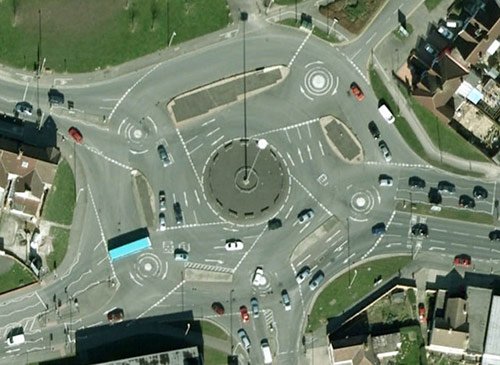
When it's busy traffic is literally coming at you from three directions, the geometry isn't obvious or intuitive, and none of the usual rules apply.
It always had glass from collisions on it.
Now compare that to regulated intersections, which come at a price of potentially longer delays of course, but in return have much lower mental tax on drivers.
Regular intersections with or without traffic lamps have a measurably higher number of incidents and rate of mortal incidents.
Roundabouts have fewer collision points and force drivers into trajectories that lead to less dramatic impacts.
https://en.wikipedia.org/wiki/Roundabout#Safety has a very illustrative diagram https://en.wikipedia.org/wiki/File:Roundabout_intersection_d... and some cited sources for that claim (claim that fits perfectly with my personal experience living near an urban intersection-turned-roundabout).
The biggest problem with light signals is that they don't force you to pay attention. Normal-sized roundabouts usually have a big feature in the middle that you'll hit if you don't pay any attention.
Traffic can only approach you from one direction and traffic on the roundabout has priority, to me it seems much simpler.
Compared to single roundabouts of a similar size, it's really not that bad. You just treat every little mini-roundabout separately and give way to the right.
It's much less confusing than large roundabouts where you need to anticipate lane markings (which are impossible to see in traffic) or you end up going round for another try.
(I can't find a reference after an admittedly lame search attempt, sorry!)
So, just like the rest of driving?
Freeway on-ramps, stop lights, pedestrian crossings, bike lanes, one way street... Lots of things are harder mentally until you learn to get used to them.
Roundabouts force you to slow down, however, which is why I think they get such a big backlash at first. But in reality, when built in the right areas, they improve overall traffic flow.
https://goo.gl/maps/aAq7pzA45eR2
It's actually 6 roundabouts forming a seventh (the Swindon one is only five forming a sixth) and it's also over a waterway.
As the taxi drove us through that madness, my boss turned to me and said "okay, you were right, it's best we didn't rent a car and try to drive to ourselves".
For reference, Colchester also has a "magic roundabout" with the same structure of Hemel's but Swindon's is easily the worst of the 3 because the whole thing operates as one junction due to how tightly packed the roundabouts are. Whereas Hemel and Colchester can be treated as 6 and 5 (respectively) separate junctions circling an island. That makes a huge difference when driving around these kinds of roundabouts.
It worked surprising well, if a little 'when all you've got is circles, everything looks like a roundabout' solution.
http://www.telegraph.co.uk/culture/tvandradio/8705932/Britai...
  -  The cathedral requirement was only to the 19th Century.

  -  Size does not matter. For example St Davids is a city with only 1,600 inhabitants

  -  A city in the UK is a place that has been granted city status by the monarch.

  -  You can loose city status for similar arbitrary reasons

  -  London is not even a fucking city in this system!
Sources:
  -  http://www.bbc.co.uk/news/magazine-13841482

- https://en.wikipedia.org/wiki/City_status_in_the_United_KingdomWell, there is the City of London aka the Square Mile, as well as the City of Westminster.
However, cities do /not/ need a Cathedral - just a Royal Charter. Look at e.g. Cambridge.
The Swindon one is notable because it was the first, and because it has the tightest geometry, which makes it harder to see how it works.
That's hardly a good fact to support the claim that roundabouts are safer that well-regulated conventional intersections... which they are actually, and more efficient in terms of the traffic flow. But the "1 fatality in 5 years" is an useless data point that proves absolutely nothing.
There has, however, been plenty of prangs.
My family use to live near Swindon - that roundabout is terrible for accidents when people get in the wrong lane and cut across. It's just that they tend to be slighter bumps due to the low speed.
A few things about the Magic Roundabout:
If you are a rail user then you will inevitably have rail replacement bus services that will inevitably give you a free tour of the Magic Roundabout. You can get on the top deck at the front and witness the awesomeness of the roundabout precariously but with a good view.
By bicycle the Magic Roundabout is a bit daunting but okay due to the low traffic speed and the expectation of other road users for you to be having no idea what you are doing.
What is not quite ever easy to come to terms with is that you are effectively driving on the right, not the left, as far as on-coming traffic is concerned. This is not normal for UK traffic situations, you always drive on the left in the UK and expect on-coming traffic to be to the right, not left.
Swindon is great, for a while I used to tell people I went there for my shopping because it was the largest town without a bookshop.
Fun fact: you can go the wrong way around the magic roundabout due to its lovecraftian geometry.
There's a group of cars on the very right simply driving through the roundabout instead of around the center dot; and the two red cars on the left side of the image also couldn't have ended up where they are without ignoring the roundabout right behind them.
Edit: Here's another photo that appears to be from the same event http://matrixdaily.com/wp-content/uploads/2016/07/MTX_MAGIC_...
And a photo of the roundabout in a more typical setting: http://www.boostinspiration.com/wp-content/uploads/2011/06/S...
(Actually - that gives me hope. If the shame gets too much, we as a nation might do the most British thing and quietly pretend it never happened)
>Mini-roundabouts were developed by the Road Research Laboratory in the early 1970s as an experiment into whether the success of the priority-to-the-right rule at larger roundabout junctions could be applied to locations where there wasn't enough space to install a full-size roundabout. By summer 1971, 33 were in use across Britain.
>[Frank] Blackmore pursued this discovery, noting that the design was also superior to signalised junctions, following a Peterborough experiment where an extra 1,000 vehicles could be handled every hour by a new small roundabout at a previously signalised T-junction. He started to wonder if several small roundabouts could be linked to improve more complex junctions.
>...Blackmore didn't give up, [...] and in 1972 gave Britain a new design of Ring Junction. It was supposed to be in Birmingham, but the Council there was unable to fund the scheme, and so the RRL was invited to try its new design at a congested roundabout near Swindon town centre. For the first time, traffic could flow both ways right around the central island, meaning that if one side was congested, the other side could take up the slack. After a few days of Police control, in which time RRL researchers logged events from a crane-mounted camera, the experiment was branded a success.
>[It] is one of the few places where the jams have never really returned despite forty years of traffic growth.
>...They also have an excellent safety record, probably because all traffic is moving too slowly to do any real damage in the event of a collision.
from http://www.cbrd.co.uk/articles/the-magic-roundabout/
see also an obituary tribute http://www.mini-roundabout.com/tribute.htm
Quite a colourful history for a roundabout guy - Born and brought up an expat in Algeria, studied engineering in Switzerland, RAF pilot in WW2 getting an Air Force Cross, became an Air Attaché in Beirut where duties included bugging the Russians next door with holes drilled through the wall. Then roundabouts.
That seems like more of a negative than a positive... You can improve the safety of any intersection by designing it in a way that forces people to go slow, but we don't because we like to get places quickly.