This bothers me so much. In my social circle (and I expect many of yours) simply understanding the other side is demonized. It's a sin to admit that, despite their conclusions being terrible, these human beings have some sense somewhere.
When you hear a view you disagree with, instead of disagreeing, first try to understand. These are intelligent human beings who will surprise you. Most often, it turns out the point they are making isn't quite the one you thought, or at least it has some nuance and the truth is somewhere in between you.
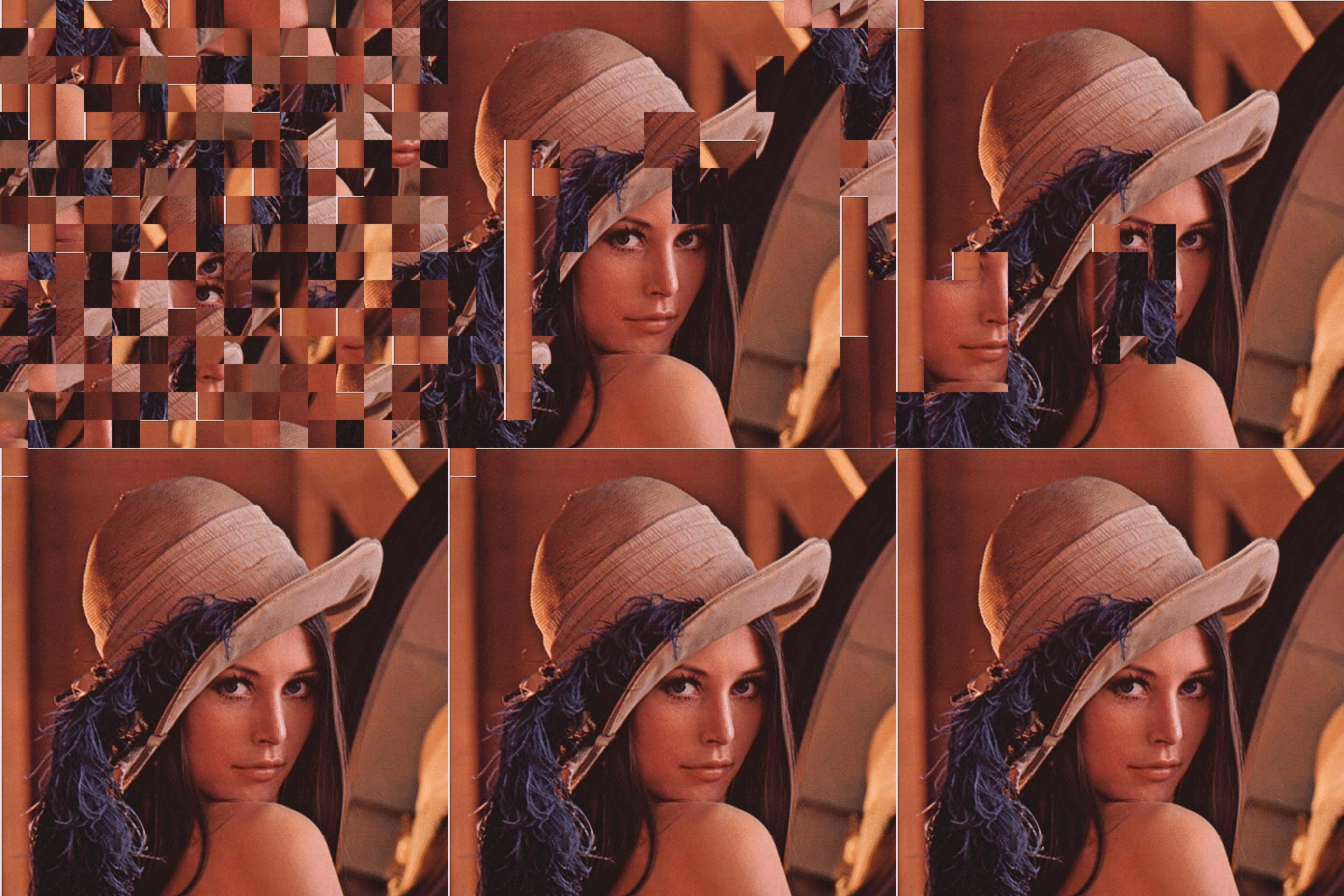
It's bad even here on HN. There was a post last week about using genetic algorithms to solve jigsaw puzzles. It looks like this: https://raw.githubusercontent.com/nemanja-m/gaps/master/imag... .
One commenter was disappointed at the test image used, because:
> At best, it's crass and tasteless. At worst, it's openly disrespectful and hostile to women.
Another commenter asked:
> Why is it crass and tasteless? And why is it openly hostile and disrespectful to women?
The response was:
> If I need to explain to you why using a nude image of a model (taken from a pornography magazine, no less) is hostile and disrespectful, then I suspect you are part of the problem.
As typical, treating your "opponent" as an intelligent moral person, trying to understand them first, applying the slightest bit of empathy, then even if you agree that the picture is crass/hostile/whatever, it's much more respectful and likely that the asker simply did not know the history of it, rather than the asker being immoral (from that POV).
Jumping straight to "you are part of the problem" is an extreme version of what happens in most of these disagreements. There's no respect or effort towards empathy and it makes me really sad.
applying the slightest bit of empathy, you'd immediately realize that the questioner simply didn't know the history of the test image (the original uncropped image was from playboy).
You are implicitly agreeing that with the idea that naked pictures of women are fundamentally crass, tasteless, openly hostile and disrespectful to women. I think this is not really a good thing to do, though I realize it is politically correct and the safe route.
I'm female and occasionally rant about how fashionable misandry (or the demonization of anything hetero male) has become, a la: http://micheleincalifornia.blogspot.com/2014/11/having-sad.h...
I have a lame hypothesis that if a woman makes such comments, maybe people will see the logic. Experience seems to not support that hypothesis. Haters keep on hating anyway. Sigh.
I'll try to clarify what I meant more concretely. The parent commenter in that thread seemed to think that any good person who knew the context would understand why it was bad. The next comment didn't see why it was bad, so the first person decided the next must not be a good person. Had they examined the other premise (context), they would have seen that lack of context is more likely. Of course there are other buried premises and assumptions, and all of those are more likely in some way imprecise or something rather than the next commenter simply being a bad person. Even in the most extreme cases, miscommunication happens all the damned time. Fixing those instead of deciding you're better/smarter/whatever is where I think those discussions should go.
The point is how the disagreement looked from the point of view of the person making those comments. I figured my own point of view isn't relevant to the meta-discussion.
Respectfully, I disagree. It's not a given that the comment implicitly agrees that naked pictures of women are disrespectful. The comment might implicitly agree that the economics of nude photos is disrespectful in this case, or in general, since this particular image is one that was sold. The comment might also be referring to the history of criticism of the Lena image: https://en.m.wikipedia.org/wiki/Lenna#Criticism
> He who knows only his own side of the case knows little of that. His reasons may be good, and no one may have been able to refute them. But if he is equally unable to refute the reasons on the opposite side, if he does not so much as know what they are, he has no ground for preferring either opinion... Nor is it enough that he should hear the opinions of adversaries from his own teachers, presented as they state them, and accompanied by what they offer as refutations. He must be able to hear them from persons who actually believe them...he must know them in their most plausible and persuasive form.
― John Stuart Mill, On Liberty
A few months back I read "The Righteous Mind: Why Good People Are Divided by Politics and Religion", by Jonathan Haidt. I'd highly suggest reading it for anyone seeking to improve their understanding of the ideological landscape in modern America. From the publisher's summary: In The Righteous Mind, social psychologist Jonathan Haidt explores the origins of our divisions and points the way forward to mutual understanding.
The biggest problem I'm seeing with many online communities is the unwillingness to engage with others. There's no discussions, they just tell you that you're wrong and evil, and then they ban or block you. That's no way to change people's mind; it just makes people more likely to dig in their heels. If you want to change people's views you need to engage them calmly and with respect. One of the greatest example of this that I can think of is Daryl Davis, a black man who converted ~200 people from the KKK just by befriending them.
To take an example less divisive than politics, I'll use religion (yeah–go figure).
Say you're an agnostic biologist. One Sunday, you meet your new neighbour, who happens to be an Eckists (https://en.wikipedia.org/wiki/Eckankar#Teachings). After a few weeks of infrequent small talk, he becomes dead set on helping you find you way to God's graces through a series of 25 two-hour rituals of singing the 'Hu'. He's also really excited by having someone to share his theory of the spiritual fluid "yam" that separates the living matter from the dead, and he considers "DNA" to be a hoax perpetrated by the Christadelphian Conspiracy.
You make what you believe is a very good case against any God existing, give an even better overview of the basics of molecular biology, and point out some of the most glaring inconsistencies in his theory of life.
But he comes back at you with the full force of someone spending about 500% as much time thinking and reading about religion and "yam" than you do. He always has an argument, and sometimes it takes a sleepless night to figure out where his argument actually breaks down.
Through no fault of yours, his internet connection starts developing the ugly habit of showing rather immoral photos of all genders where he would usually expect to see completely wholesome photos of the Eckankars' last Day of Celebrating Celibacy and Celery. He finally moves out.
You new neighbour is Frances. He is excited to tell you everything about his Christadelphian faith, and how the walnut is actually the most intelligent brain on the planet. He also has all the answers.
Now imagine there's an endless supply of these people, and they start showing up at work, starting to make legislation to cut your funding, and march across campus with their "Torches for the Glory of Walnut Yam". Do you actually belief your study of mitochondrial diseases will be improved by debating every single one of them? Remember: they don't operate by your standard of reasoning: whenever you find the missing link between hamster and opossum, they just see it as two new missing links in the chain of evolution.
Not every single opinion on the planet requires you to truly embrace the possibility that you may be wrong. But when enough people have that opinion, chances are that there is some other motivation for their belief beyond mass delusion.
The point is that you should try it out to see whether they're "reasonable". And if they are, then you're supposed to have an open, genuine discussion with them.
It is a really hard problem space to address well. But, I think a good place to start would be to acknowledge that with 7 billion people on the planet and the existence of the internet, humanity has an unprecedentedly challenging circumstance that makes it inherently harder than ever to find common ground with people with whom we disagree. Then challenge people to up their game.
This piece is guilty of the very sin it decries: Being not genuinely respectful and empathetic to the people it criticizes. I think acknowledging the unique and extreme challenges of modern life as a starting place is the only way out.
First, admit that agreeing to disagree is fundamentally harder than it has ever been before in human history because there is so much more opportunity to interact with people whose views and choices are utterly alien. Then, invite people to rise to the occasion.
Otherwise, you are merely pissing on people and provoking them in the exact way the article describes and decries as a bad practice. Most of this article merely slams parents, educational institutions, etc for their failures. There is zero acknowledgement that these failures might amount to crumpling under extreme stress.
And Tweeter. I never signed up, but from the posts and tweets I've seen, I can't imagine a worse platform for sharing ideas or views. I don't see a stream of 140 character insults or smartass comments ever resulting in someone saying "Hmm, that's a great point, maybe I'll rethink my position. I guess I am a dumbass just like you described. Thanks".
> Then we get to college, where the dominant mode of politics is identity politics, and in which the primary test of an argument isn’t the quality of the thinking but the cultural,
There is an element there were colleges have started to treat students (and parents who pay for the tuition) as customers. Don't offend anyone, build clubs for every need and hobby, luxury dorms. My university last I heard built a huge rec center with a pool and a lazy river going around it. Oh the irony. Tuition has risen dramatically and the idea is anyone who pays that much is not going to tolerate being inconvenienced, or challenged in any way. If they do, they'll "demand to talk to the manager" so to speak. Take their money and go some other place. And maybe mentality extends to ideas and what is taught and so on, not just rec centers and facilities.
> This is the baroque way Americans often speak these days. It is a way of replacing individual thought — with all the effort that actual thinking requires — with social identification
Another thing I noticed as an outsider, that maybe people from America haven't noticed because they are immersed in the culture, is that just as much as there are victims and oppressed groups, there is an equal and greater amount of those who want to gain an upper hand by either identifying as a victim in some way or claim to speak for some victims "My heart aches for the struggles of group X and I'll go on a Tweeter rampage to support them". And yet they've never interacted with that group in any meaningful way to understand them, and are simply doing this dance to brag and gain some kind of status. Can't tell how many times I've heard people trying to one up each other concerning how many minority group they know. "Oh you're friends with X and Y. Aha but I have a friend who is X, Y, and Z. And everyone gasps, oh wow, that's really cool you're such a good person". Once you see it a few times, it's hard to miss it.
I firmly believe in the idea that the tools that we shape shape us in turn as we use them. I don't think it's a coincidence that we're seeing an greater upsurge in rancor as social media becomes more entrenched in our day to day lives. If a system rewards people for doing something, you can bet that people will adapt their thought processes to maximize their gains. Nuance is going to be the first thing jettisoned in a short format that rewards instant emotional gratification.
Because there is no magical system that does this, and expecting it is slightly silly.
This, like many of today's rosy views of the golden past, is slightly misleading: while Socrates many have high-minded intellectual quarrels with Homer, one can't just ignore that he was murdered ("sentenced to death") by his fellow Athenians for supposedly corrupting the youth.
In comparison to drinking hemlock, the criticism today's divisive figures have to endure seems manageable.
Socrates quarrels with Homer. Aristotle quarrels with Plato. Locke quarrels with Hobbes and Rousseau quarrels with them both. Nietzsche quarrels with everyone. Wittgenstein quarrels with himself.
If only Newton and Boltzmann made the reading list.
However, there is one glaring issue. I completely agree that part of the increasing radicalism among younger Americans is coming from an increasing sensationalistic media that will say anything and do anything for clicks. [0] Unfortunately, there is a reason for that. Another absolutely phenomenal article that was written by a 50 year veteran of the news industry is "The Bad News About the News." [1] It describes more in detail precisely why the media has become what it has become. And the answer can be summed up in one word: money.
For many decades a small handful of media organizations had an effective monopoly on news, and access to information in general. That entailed a practically endless stream of money. Ethics and integrity cost nothing in a world where money is no concern. But then enter the internet. It, as a competitor to traditional news outlets, started very slow. And that slowness led traditional news media to fail to appreciate its potential. In short order the internet not only showed its potential but turned traditional media outlets borderline obsolete. They died from a fatal case of myopia. And we replaced them with social media which has shown that negative news, partisan news, emotionally charged news, and sensationalized news is what gets clicks. Even better when you combine them together.
And in the end, if you can't beat them join them. This has likely only been urged on by the ownership of the news media today. Time Warner owns CNN. Comcast owns NBC. Disney owns ABC. These are not exactly the first names you think of in altruism, which is what valuing an informed public over profitable quarters comes down to. The BBC is a peculiarity. They have ostensibly no profit motive, but I'm not familiar enough with their funding/directives/etc to even try to hypothesize why they've also jumped on the bandwagon. I can say something about ostensibly not for profit organizations in the US like NPR. NPR has been struggling. In the past 10 years alone they've had to buy out contracts and downsize multiple times. The only way they keep afloat is by donations, and mostly large donations. With them barely staying afloat if they publish anything that might cause a corporate donor to pull their support, it would be enough to put the company back in crisis. The company itself ends up beholden to special interests in a way that's even more insidious than Time Warner owning CNN. That's a direct and visible line. The line between donor interests and 'not for profit' organizations is less apparent to many.
I'm in no way defending what the news media has become. But like the article emphasizes, I think the first step before judging a group is to try your best to try to genuinely understand why they behave/think the way they do, in lieu of just attaching a label to them and calling them evil.
[0] - An image that sums up the state of the media today. https://i.imgur.com/PxU76c0h.jpg
[1] - http://csweb.brookings.edu/content/research/essays/2014/bad-...
I see maybe one or two people in that crowd that could be professional photographers or cameramen. It just shows how people in general may prefer whatever sin is implied.
And while TV probably gets more attention today, real journalism has always and still does happen mostly at newspapers. The WSJ/NYT/Economist/New Yorker of today are no worse than they ever were. In fact, it's not that long ago that almost all publishers were unabashed propagandists for some cause or party.
But it's true that changing economics have roughly halved the revenue journalism has available, and contrary to all the armchair publicists everywhere, we have yet to find a way to stop the profession from further deterioration. Those large organisations above may survive by virtue of their size, and the goodwill of people enamoured with what they represent. But at the local level, many communities will soon have to function without any good sources of news. And voting without information means all the incentives, and the mechanisms, of democracy will seize to function.
It's en vogue now to disparage all journalists as hacks of similar low caliber, differing only in the name that signs the cheques they get for pushing their benefactors' viewpoints. But that really doesn't help, because it removes all incentives to do good work. If some journo at The Economist gets "You're a lying puppet sucking Wall Street's dick" on twitter every morning, they'll soon run out of any remaining idealism.
So I'd wish people would be as appreciative of good work as they are critical of shoddy work. Highlight the excellent shows on NPR just as often as denouncing the drivel at MSNBC. Note how CNN fires staffers that approved a story they ultimately couldn't prove just as often as reminding everyone how wrong the NYT was about Iraqi WMD 16 years ago.
Consider their articles today. For instance the first non-opinion article I received when searching specifically for their site and Trump Russia was this [2]. The following 7 statements are the leads to 7 different paragraphs in that story.
- "The tactics reflect some of the hard-charging — and polarizing — personalities of Mr. Mueller’s team"
- "“They seem to be pursuing this more aggressively, taking a much harder line, than you’d expect to see in a typical white-collar case,”"
- "“They are setting a tone. It’s important early on to strike terror in the hearts of people in Washington, or else you will be rolled,”"
- "The moves against Mr. Manafort are just a glimpse of the aggressive tactics used by Mr. Mueller and his team of prosecutors "
- "The tactics reflect some of the hard-charging — and polarizing — personalities of Mr. Mueller’s team"
- "Admirers of Andrew Weissmann, one of the team’s senior prosecutors, describe him as relentless and uncompromising"
- "Some lawyers defending people who have been caught up in Mr. Mueller’s investigation privately complain that the special counsel’s team is unwilling to engage in the usual back-and-forth"
The piece reads like a trailer for a new low brow crime TV show. There's practically 0 valuable information, but it creates drama and starts building up characters to get readers ready for the next exciting entry. If you didn't get it - this prosecutor, he's a serious hardass - wow! Isn't that incredible!? In case you somehow missed it, they also added a picture of him looking like a hardass with the caption: "Robert S. Mueller III, a former F.B.I director, is known to dislike meandering investigations that languish for years." What a cowboy! The sheriff is in town boys!
It's sad that we now find this sort of journalism acceptable. And it's certainly not the reporters' doing it. That article carries no less than 3 names on the byline with 3 contributing reporters as well. It's like blaming developers for a shoddy piece of software. They create it no doubt, but the conditions and direction of which they are operating within are outside of their control so long as they continue to retain their employment there. That Watergate story was phenomenally interesting and informative, but it wouldn't hit the lowest common denominator. For that you need that emotional attachment - the characters, the story, the sensationalism. And so that is what the NYTimes today delivers.
I hope that the NYTimes new paywall push is a resounding success. So long as they are a slave to clicks, their quality will continue to deteriorate.
[1] - http://www.nytimes.com/1972/11/01/archives/the-watergate-mys...
[2] - https://www.nytimes.com/2017/09/18/us/politics/mueller-russi...
But seriously, thoughtful comments take time; and are often formed by trying to explain why the thoughtless comments are wrong.
Karl Marx's economic ideas are part of history. Isn't airtime at universities based on what has influenced people and shaped the world, whether good or bad? Learning what went wrong in history is a feature, not a bug. Hitler gets plenty of airtime too, and unlike Marx, he was actually and directly responsible for millions of deaths.
"The countries associated with some Marxist nations have led political opponents to blame Marx for millions of deaths,[259] but the fidelity of these varied revolutionaries, leaders and parties to Marx's work is highly contested and rejected by many Marxists.[260] It is now common to distinguish between the legacy and influence of Marx specifically and the legacy and influence of those who shaped his ideas for political purposes.[261]"
Kissinger was an active politician, and he's criticised not so much for his ideas as his actions. I seem to remember that quite a few people during the Charlottesville brouhaha were keen to insist that people should be judged by their actions.
There's also a difference between a study of Marx/Kissinger, and attending an event that has them as guests. A famous speaker's attendance is an honour for the host, but it also honours the speaker. I'm sure there are scores of left-leaning researchers and students who have read Kissinger's work or studied his actions while being highly critical of him.
The obvious example is that it's just as common to read Hitler's book and speeches as it is to read Marx when studying history.
Most of the hatred was focused on Dr. Murray, but when I took his right arm to shield him and to make sure we stayed together, the crowd turned on me. Someone pulled my hair, while others were shoving me. I feared for my life. Once we got into the car, protesters climbed on it, hitting the windows and rocking the vehicle whenever we stopped to avoid harming them. I am still wearing a neck brace, and spent a week in a dark room to recover from a concussion caused by the whiplash.
That's basically mob violence. Respectful protest and disagreement is to hear someone out, not intimidate and violently stop them from speaking. It's just an odd mindset. You're at college, so presumably you are there to be educated, to experience different points of view, to learn.
edit: Asked if modern media or some other factor was the biggest cause of this, saying this so the reply makes sense.
Tribalism. We seem to be hardwired for it, to seek it out. As the immediate bonds in family/religion/neighborhood/etc are being torn down by modern individualism, so new tribal bonds are formed.
In the age of the internet, as you said, you can find a voice that validates any belief. A community forms around the smallest nugget of common belief.
And so tribes are formed.
Mind you we also seem to be living in a society that increasingly believes that anything you think, you immediately believe to be true. That to hold opposing beliefs, or at least to inspect and consider thoughts that are “wrong”, immediately makes you ... I dunno. Almost like thinking something immediately makes it your sole belief.
So it becomes impossible, dangerous even, to allow opposing beliefs to even be expressed lest they take you over.
Thought police basically.
A capacity for, at a very minimum, civil debate, even where you disagree strongly with the other side, is a crucial foundation stone of the Enlightenment. There are edge cases for sure (I don't know how to have rational discourse with self-professed Nazis, for example), but actual debate (as opposed to fighting, spurning, hating and ostracising) needs to be a strongly-held default, or we are totally stuffed.
I'm not advocating no-platforming as a blanket policy for anybody I disagree with. I'm just saying if you have a death toll attached to your name, maybe you don't deserve the same respect afforded to somebody who simply has an unpopular opinion.
"It has always been the prerogative of children and half-wits to point out that the emperor has no clothes. But the half-wit remains a half-wit, and the emperor remains an emperor." -Neil Gaiman
It would be absolutely lovely, if it were solely that.
What this has to do with is with students preventing other students from engaging with certain speakers.
This is about insane protestors assaulting people, blocking entrances to venues, disrupting the actual events, and people trying to convince public universities to literally break the law by engaging in viewpoint discrimination.
The examples that the NYT used were situations where people were attacked, and literally sent to the hospital. IE, the 50 year old democrat teacher from middlebury who had to go to the hospital, because some protesters assaulted her for protecting a speaker as they were trying to escape a mob of people who surrounded them, and wouldn't let them leave.
Please, please, please lets all go back in time to when if you didn't like a speaker then you just didn't attend the speech.
You might imagine, then, that a university would begin to narrow the breadth of intellectual perspectives it allows, to align with the students’ wishes.
However, tuition is only part of the story. Universities are highly sticky - students aren’t going to leave Berkeley because Milo was invited to campus. However, the university risks both contributions from alumni, and branding against the echelon of students they want to attract.
Your perspective reflects only immediate concerns, which must be accounted for. But hopefully, I’ve shed a little light on these more complex decisions.
I once attended a lecture by Justice Scalia at my University, and I'm absolutely certain that the University can not legally pay a speaker anything close to the 6-digit sums that someone of his caliber would get on the commercial speakers' circuit. I once sat on a committee that organised such talks, and it took us a year of politics to get approval to invite the XKCD guy, who, unlike the usual academic visitors, charges a fee. Usually, speakers are afforded a stipend to cover their travel expenses only.