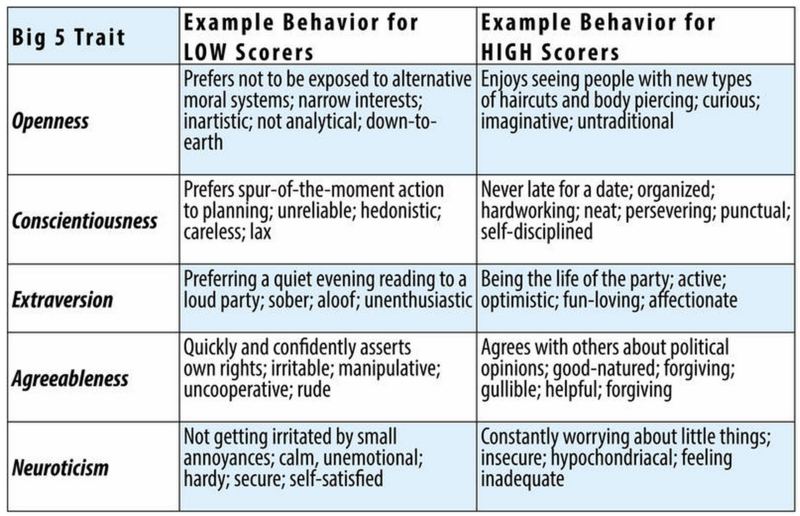
- Most people want to change their personality
- People with personalities that are considered "negative" by society (ex: introversion) wanted to become more extroverted
- People that wanted to change their personality, did change their personality slightly, and self reported daily behaviors that worked toward the goal (ex: “I smiled and laughed with others,” “I mixed well at a social function”)
- Personality at the start and the end were self reported, giving way to bias.
You can change your behaviors to differ from those you're predisposed to; but it takes more conscious effort to maintain those behaviors than it does to maintain the ones you are predisposed to.
And changing those behaviors doesn't count as changing your personality, though it may change some people's perception of your personality. Changing behaviors is something we all do at least situationally (even the most cheerful, boisterous person will generally manage to be reasonably subdued at a funeral). That doesn't mean we're changing our personalities every time we walk into a funeral home.
I still have the personality trait of being an introvert, but when I was specifically working to push myself, my tolerance for "things" was increased. So while my personality hasn't changed, specifically my preferences haven't changed, my tolerances and ability to enjoy things outside of my preferences has been flexible.
I wonder if that's what a lot of these self-reported people reported. "Before I couldn't go to a party and enjoy myself, now I can!" isn't exactly indication that their personality changed. Even if they enjoy the parties and want more, I'd argue that their personality could still be the same - it has been for me.
I also think ultimately my self-identified trait of introvert might not be correct - and likewise many subjects here I wonder if they might be incorrectly self-identified. For myself, what I think I really dislike is not the outside/etc - it's new encounters. I hate them. Really, I loathe them. Even things as simple as driving new places. The unknown area, the frenzied feeling of finding the correct street, parking in cities, etc. I don't like driving because of that, honestly. So am I really an introvert? I actually like going places, it's just that life brings a lot of unknowns, and those are ultimately what I dislike and I have to fight to keep a reasonable hold on.
I've changed my personality in the past, always for the better (I think). At school I was shy, couldn't talk to women, found it intimidating to socialise in new groups of people, wasn't entertaining, lacked confidence. All the usual stuff. I didn't like any of these traits and set about changing them. I had a bit of help along the way, but it was mostly my own doing.
These days I am confident, can easily entertain women with amusing conversation, do public speaking regularly, can mix in large groups of strangers without problems etc. It's a big change. Once or twice friends who have known me continuously since high school remark on it.
One issue I'm currently pondering is that of personality disorders. To what extent is such a "disorder" something the individual can fix with sufficient self reflection and willpower? My own experience tells me personality is quite plastic. So perhaps I find myself lacking in sympathy for such people. They can and should heal themselves.
One idea defines personality as an innate wiring of your cognitive processes given to you based on your genetics.
The other defines personality as the sum of all factors leading up to your current personality state (including your innate wiring).
Both of these ideas are true - there are some innate dispositional tendencies that are very observable, and there are also lots of things (structure, habits, practice, and improvement) that you can do to change yourself.
IMO, most of the arguments in the personality space come from the fact that the word "personality" is defined so loosely.
edit clarified based on comment
AFAIK, there isn't anything special about birth which would freeze brain development at that point. Baby brains are quite undeveloped - they don't experience the world like we do.
Your genetics do fix something at the time of conception, but otherwise it's a continual process based on experience.
I'm of the opinion that most views we think we hold 'philosophically' are, well, personality tendencies expressed formally.
It all gets a lot easier to conceive if one doesn't assume there is such a thing as a unified self, just a bunch of modules our self-describing narrative inhabits depending on what the environment asks for at the time. Specifically 'training your pre-frontal cortex' seems easier to me than 'becoming a more organised person'. Sorry if that seems a little rambly/obscure.
Given what I could glean about the culture of the place, I presume the 'Introverted' part of my personality was the issue. Though, you would think a company full of extroverts wouldn't have a problem telling a candidate why he was rejected :D
One of the often-unspoken realities here is that this growth and change will cause anxiety directly. It's observable in any living organism. (Now think about New Year's resolutions...they can be real anxiety spikers) If any really pleasing dopamine reward is to come of this process in humans, its full manifestation is often very time-delayed as the change process itself takes its course. So depending on the traits and their role in the trait-changer's own systems, models, and beliefs, it is helpful to identify pathways that can involve the trait-changer's strengths and yield some increased leverage. For example, "being open to _what_ is less stressful than being open to _that thing I can't typically stand being open to_?" There's this blended approach.
Beyond traits, I find that typologies and archetypes are very helpful in establishing a quick and dirty template for change. If you identify as a "type" that finds benefit from developing cleverness, even if you yourself aren't very clever _right now_, we may see some surprising success if we try some exercises to identify and harness a latent cleverness in service of your goals. If you are a natural idealist, an idealistic princess who befriends all the little forest creatures, that's actually a very helpful model to examine as well. The story has been shared across cultures for many centuries, and it's a matter of running down the list of type attributes and noting the deltas with regard to your current life. I call my own method Type / Trait Interleave and so far I've been happy with the outcomes for my clients.
With traits we quickly understand the contextual you and your contextually-variant patterns. With type we get at questions of your core self and begin to understand how your contextually-variant patterns could be sabotaging or benefiting some other system functioning in your life. Thanks op for the thought-provoking post, I didn't expect to see it here. :-)
I have found that when I speak, I rarely command attention and captivate as some others do. Probably something in my speech patterns. Perhaps they are slightly more apologetic / geeky / nice than others. People may interrupt me or turn away, even people who respect me.
When I do get rapt attention, such as teaching a class, I get an impostor syndrome because I'm not that used to it. I don't let it show - and I finish my thoughts. But I feel my speech is more rambling and unfocused than it should be. I have so many asides that I want to get to, and I like to speak using true sentences so I hedge what I say sometimes, and other times don't make overly ambitious claims.
Is there a way I can improve this? What do you see in your experience?
In your description you have just tipped us off to an analytical gift. I would suggest that you deepen your analyses of your speaking performances, develop and test theories, and refine what you described above into a model for improvement that ever more closely fits your problem like a tightening wrench.
Archetypally, I recommend that you watch films or read books like The King's Speech and note every thought pattern and technique that you can single out. "He talked to so-and-so about X. She encouraged him to try Y. In Y he found that..." (Now, who can I talk to? How will I approach their feedback?) Even if you have no speech impediment, these patterns will probably be broadly applicable to your needs. Good luck!
So taking your one sentence:
> I have found that when I speak, I rarely command attention and captivate as some others do. Probably something in my speech patterns. Perhaps they are slightly more apologetic / geeky / nice than others. People may interrupt me or turn away, even people who respect me.
You could rephrase (and speak) this as:
> When I speak, I rarely command attention and captivate as some others do. People interrupt me or turn away, even people who respect me.
People have a short attention span. I myself tend to mostly ignore this one colleague I have because pretty much half of what he says is filler, like, a ramp-up to his point ("so uhh, basically, like"), his main point (stuttering and lots of uhs), and end-filler ("you know?"). Mind you that he's not a stutterer as such, he just needs to make noises while he's trying to think of what to say next (like uhs). Not speaking in his native language is also a factor there.
TL;DR: Firm, short, unapologetic statements. "We should do this" instead of "Uh, guys, excuse me but, like, I think we should sorta lean towards this?"
Firstly, don't worry about impostor syndrome. Given you're trying to be someone you're currently not, it's entirely normal.
Secondly, and teaching a class is perfect for this, set up a situation where you can plan what you want to say. Not word for word, but the key points you wish to get across. Make sure you're clear, to yourself, what are the key points and what are asides. When you present, it's fine to use words like "generally" and "usually" while you explain key points but stop yourself from describing or explaining asides.
The first few times are uncomfortable but it should get easier. Over time it'll start to feel wrong when you're about to talk about an aside and you should find you need less planning to keep to the main line. You may also find that this will carry over into social conversations too.
BTW if it helps you for a class context, you can always caveat the lecture up front. Something like "although what I'm about to go over is generally true there are a few corner cases that I won't cover. If you have any questions please ask".
Something else that can work is asking people to give you honest feedback about your communication style. Ask them to be completely honest and don't lead them. The key to making this work is to accept what they say at face value i.e. don't argue it, question it or offer mitigations. Just use it as feedback.
However, for this to work you do need to be able to ask for feedback without leading and accept criticism. If you're not completely sure you can do that then it's best not to try.
Also for the impostor syndrome, do this once in a while and compare old videos with the new ones; you'll be surprised with the result ;)
Be careful with that assessment. You may captivate people like others do but you may not notice. I learned that in toastmasters. I thought that everybody had checked out of my speeches after the first minute but actually people listened and liked the speech.
Basically, try talking about something the people you are talking to want to hear.
You might (probably correctly) say I'm coming out of a depression through my own CBT interventions, though I'm pretty sure I was already on an initial upward trend because of positive environmental changes, so chicken/egg.
What you mentioned about anxiety triggered a lot of associations with Sapolsky's writing on stress (Why Zebras Don't Get Ulcers etc), and how bodily aspects interleave with personality tendencies... I do wonder sometimes if a very 'Cartesian' view of personality is problematic pragmatically and philosophically. I.e., 'I'm just an introvert' can be reached by a bad diet or untreated psychiatric symptoms or low social status or just plain old preferring fewer social contacts, and so it's difficult to really /do/ anything with that conception of onself.
This is taken from correlations with facebook likes. There's a lot of interesting observations here. For instance, introversion correlates very strongly with "nerd culture" stuff. Openness seems to strongly correlate with left or right politics. Emotionally stable people seem to like sports and outdoor activities (adding to a weird theory that lack of sunlight and exercise causes depression.)
Also lack of sunlight means less Vitamin D production. It's a big problem in northern countries where people have to take Vitamin D supplements.
What stood out to me was how Rap & hip-hop correlated most with Conservative and Relaxed types, I didn't expect that at all.
I think this is quite on the money. The problem is that many of us don't manage to think "you can". For one thing, many hold kind of fatalistic beliefs and feel powerless. Others suffer from over-confidence. That's not really thinking "you can" but delusion. I could imagine that this is a nature & nurture thing and that nurture would be enough for most people if only they could find them-selves in an environment that's right for them. The problem is, however, that we still kinda suck at bringing the right people together.
But functionally, almost everybody can learn to exhibit personality traits that benefit them personally and 'commercially'. You can be on for the interview, the meeting, the one-on-one. And you can conserve your energy when working at your desk or at home.
1) This is a tech-focused forum.
2) It was perfectly obvious that he was being clever.
3) The analogy was quite amusing.
4) The analogy does ring true... and even this research paper concedes the point that personal change is difficult and has proven elusive.
5) I imagine that if a wealth of actionable research results existed on this matter, that personal change and growth would have become more accessible already.
> A longitudinal study (or longitudinal survey, or panel study) is a research design that involves repeated observations of the same variables (e.g., people) over long periods of time, often many decades (i.e., uses longitudinal data).
This raises the follow up question: what is changing? Is there a fundamentally different reaction to the same situation, or is there instead a different interpretation of the situation which is what is leading to a different reaction?
Cognitive behavioral therapy, the "most widely used evidence-based practice for improving mental health," provides evidence that the latter is absolutely a possible answer. "CBT is a psychotherapy that is based on the cognitive model: the way that individuals perceive a situation is more closely connected to their reaction than the situation itself."
Based on this, it seems very possible at least one way people can "choose" to change their personality (as defined by their reactions (feelings, thoughts, and actions) to situations) is to seek to find ways to change the way they percieve the world.
Sources: https://www.livescience.com/16287-mushrooms-alter-personalit... https://en.wikipedia.org/wiki/Cognitive_behavioral_therapy https://beckinstitute.org/get-informed/what-is-cognitive-the...
Have you got a source for this? It sounds plausible but also difficult to prove.
There is a whole bunch of assumptions here. Why need? If you are ok with the way you are (you chose you are) why do you think people should pursue social status higher than their own choice and views? Also, social and popular traits are constantly changing, it requires enormous energy to keep up with trends. They also depend on society, culture, and a billion of other factors.
The way you should look at it is it gives you an idea that you can adapt your personality the way you want it. You want to be social - get some social traits. Want to be respected - another bunch of traits. Want to be a somebody else - do it accordingly.
>People refusing to do so will be considered selfish
People who want to judge and "consider" other people selfish just chose this trait, aren't they? So it's their own problem, not anybody else's.
>will be punished/excluded from society
Which one? There is a bunch of societies out there, you are probably excluded from many of them already today. Are you in a society of richest people? politicians? religious groups? street junkies? criminals? probably not, you are already excluded. This is how society works, you want to be among a certain group of people - get certain traits. As easy as that.
I'd also say that what you describe is just a more extreme version of how the world currently is - people with more popular personalities _tend_ to get further.
Why are some traits more likable than others? Which ones are real and which ones are faked or biased (actors, salespeople, etc)? This paper goes far deeper into those questions than I intended to do. My point was, that there are people out there (and also here) who will take this paper, read the abstract, assume that changing one's personality traits is as easy as drinking a beer and go tooting that misinterpretation of actual facts as alternate facts. It's not a yes or no choice. It's not as quantifiable as a beer. It's an expression of behavioral trends.
If you've ever known somebody who served in the military, you know that they often come back a changed person. I'm not talking about PTSD in combat vets, I'm just talking about simple personality traits like neatness.
On a more self-driven note, I became a less patient person in some specific ways after I lost a parent some years ago. (Because it become painfully obvious how limited our time is...)
There's nothing wrong with expecting someone to change their personality. Even if you want to claim that it's not a choice, it is a choice to at least attempt to change your personality, and that's the very least we should expect from anyone who has negative personality traits.
Who gets to decide the class of negative personality traits? Is there some objective measure of this "negativity"? It seems there are some gaping holes in your position which are probably impossible to fill.
Found this publication from them from five years ago. http://science.sciencemag.org/content/338/6103/79
From that, it's obvious that some personality traits can be changed (e.g. being punctual and neat) but others will be very hard (e.g. curious, imaginative, self-disciplined, feeling inadequate).
I like that movie, but it doesn't really add anything to the paper and even if it does I feel like this is the equivalent of saying "In Harry Potter a boy finds out he's special and goes on a magical adventure. Can we all find out we are special?"
It's more rhetoric than academic.
I believe that anybody who has put in any effort into bettering themselves knows for a fact one can completely change his/her own self-perception, and in-turn, their personality.
I'm not really sure I'd want to try to literally hack my brain this way. I have a lot of traits I don't like (hey, I'm posting this here while I should be working... Look! Shiny!) I understand they are what makes me the person my family loves (although some may say it's an acquired taste)
People can clearly change their personality, it's just so difficult that most people don't try or give up when they fail.
I also think personality is not unique - we have a whole range of "personalities" we employ depending on who we talk with and what the situation is. Thus, personality is a function of self-values and external situation - we have many masks, one for each occasion.
You can't listen to someone because his style and choice of decorations is different? At least you recognize that you're biased, but you should really try to fix that part of your personality.
You'll miss out on a lot in life if you immediately disregard things and people just because they're slightly different than what you're used to.
Sometimes just by being conscious and watching yourself as an external spectator of your own thought can do wonders.
Obviously these traits can change. Although for extraversion it is questionable (extraversion is not a merit, it's more like a gender kind of a "trait"), development of agreeableness, conscientiousness, stability and openness is what defines a character maturity of adult/adolescent person.
However, your characters can be trained.