UPS’s 50 seems very low for 2018 in comparison.
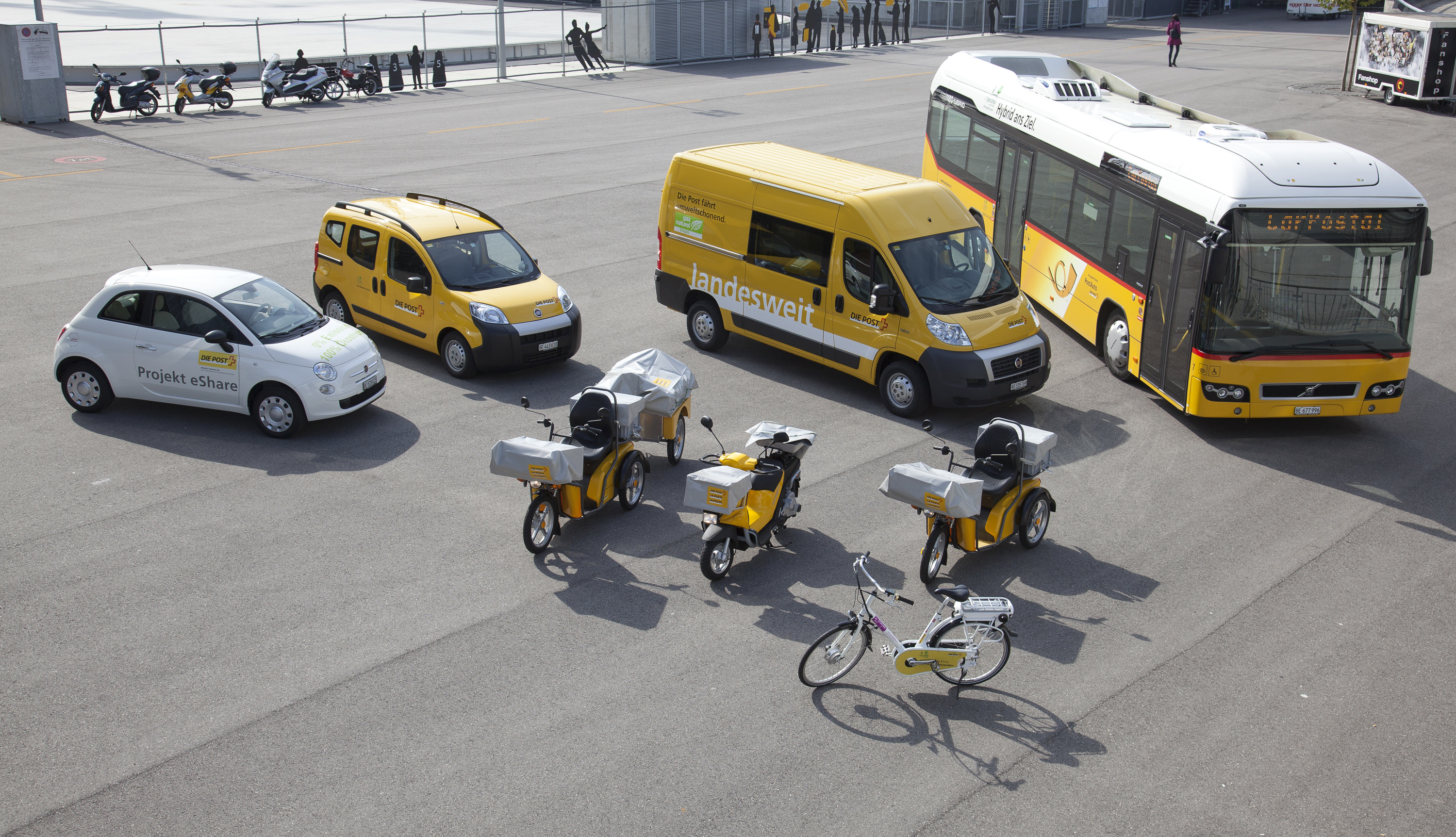
One article about them: https://www.bloomberg.com/news/articles/2017-03-24/even-germ... They are called StreetScooter https://en.wikipedia.org/wiki/StreetScooter
Incidentally this city is also in the process of adopting a fleet of battery-electric transit buses, but it's been a very rough process for the same sorts of reasons - very large vehicles that run very long routes in this relatively far-flung city. The buses failure in testing to deliver the promised 270 mile range has been a major issue with them, as the roughly 200 they're able to do isn't sufficient to complete their planned schedule.
I also suspect that the routes are shorter than you might think, because there are a lot of stops and they are not moving all that fast for most of the trip. I suspect most UPS trucks probably average well under 25 miles per hour for most of their travel which would put an 8 hour day around 200 miles. In denser areas like cities it could be significantly less than that. If a truck makes a 1-minute stop to toss a package on your porch then drives half a mile in another minute and repeats, it's still only covering 15 miles and 30 packages an hour.
I wouldn't be surprised if UPS trucks within cities tended to be below 50 miles/day most of the time, and since they control driving routes very tightly they can easily put these trucks only on appropriate routes.
Saying they should just use Streetscooters is like telling a family of 5 to use a motorcycle.
UPS’s 50 seems very low for 2018 in comparison.
If your company is constrained by (a), (b) or (c) current electric vans will make that limiting factor worse. Post offices are mostly constrained by (d) which makes it easier for them to deploy electric vehicles.
None of these problems are insurmountable, but current electric trucks aren't drop-in replacements for diesel trucks.
80 mile electric-only range is great, and it gets electric incentives (federal and more importantly for me, exempt from 40% import duty to Puerto Rico). The great thing as a pickup truck is it works as a stationary power source for tools, either from battery or generator. It's probably inferior to a Tacoma or something for offroad/etc. use, but is still adequate. Apparently their main market for these is the electric utility market, for outside plant maintenance/etc.
(But, in exchange via act 20+22: zero capital gains (LT/ST), zero tax on dividends, and consulting/services/export revenue are taxed at 0-4% -- all guaranteed through at least 2035. Seems to be becoming quite the hub for traders and cryptocurrency people, plus some saas/consultancy types, which becomes interesting to me for network effect reasons.)
I absolutely hate DHL as a recipient in NL, but this is pretty cool. They have other green vehicles too ( gas, electric ).
https://www.post.ch/-/media/post/ueber-uns/medienmitteilunge...
https://www.post.ch/de/ueber-uns/unternehmen/medien/medienmi...
Background: I work at Picnic, an online supermarket in the Netherlands, and we have a large fleet of small electric trucks for delivering in cities and neighborhoods.
You can barely call that biogas "burns extremely clean" with hydrogen sulfide in them, can you?
[1]: https://beerandbrewing.com/off-flavor-of-the-week-sulfur/
The alternative IC engine is typically diesel and spews lots of carcinogenic particles and compounds.
The numbers also get a lot worse once you consider the energy cost of shipping your food to you (as both your article and the person you were responding to noted).
I imagine how good that bike fleet would be today if they added electric assistance. Sure bicycles might not be great for the final mile delivery of someone's Amazon order of 50litres of mineral water but that is the point.
I never really understood why that made sense, when all the other courier companies use Sprinters or some other standard vehicle. They must see it as a competitive advantage.
I once saw a heavy wrecker flatbed in the late 00's hauling three ex-ups trucks with standard shift to the scrap yard. They were hastily painted white with a roller to hide the UPS color and logo but you could still see the logo through the shoddy paint job and brown patches along the edges.
Comment has some sound reasoning why they feel that way.
Curious though, why do you post/take that commen on a forum that was copied from an unnamed forum as fact?
I searched for the original publication and can't find it.
A lot of farm spouses used to do this gig. A moderately reliable car and a mechanically inclination is a key to success — cars need brakes every 3-6 weeks.
USPS in general started buying more low bidder commercial vehicles because their package volumes have increased and the bespoke, cheap mail trucks were too small.
It seems likely that stopgap vehicles are a reasonable answer. In my suburban area I'm seeing minivans where I used to see LLVs.
There is a nice exposition of LLVs and the electric replacement option here: https://www.greatbusinessschools.org/usps-long-life-vehicle/
I recently purchased an EV with a "100 mile range," and it so far hasn't achieved higher than a 70 mile range, given the cold weather, even with 100% charge, no climate control, and no real load. Turn on the heat, and suddenly you lose another 20 miles of range.
And it can take ages to charge, with current technology. I don't think this sounds too practical for deliveries, quite yet. But somehow, there are Lyft and Uber drivers who have these.
(This said I'm sure they'll have to have contingency plans for when the things run out of juice but that's probably the same plan they currently have for accidents or breakdowns)
Mind you, the real range is nearer 200 miles so I rarely need to worry about running out. On a 10 A, 230 V, single phase connection (Norway) it will add more than 80 miles overnight (say 18:00 to 06:00) so it is perfectly practical for everyday use.
At a Tesla Supercharger it takes an hour to go from 20% to 80%, that is adding over 100 miles.
I wouldn't recommend buying an EV that is not Tesla.
Driving carefully in my LEAF, I can get 4.2-4.5 miles per kWh. Driving like an ass, it's easy to get that figure down under 2.
I've been thinking of something purpose built to carry only small cargo and no passengers, i.e. 8 cu ft and 100lb total cargo capacity, with a limited range designed to make delivery runs and then return and charge (or maybe just swap power packs).
Nuro [1] is working on something in this vein. I think their vehicle is much too big personally, I would start with something that could carry maybe 30 lbs and 2 cu ft of cargo and scale up from there. While the walking-speed Starship [2] seems like it went too far in the other direction. But it seems like there is space for a cargo-only vehicle that could be extremely useful in the city, particularly if it's an on-demand model where businesses can hail them with an API call.
The question is whether a robot like this--which doesn't carry people but still has to operate on the roadways--does it make the AI problem materially easier to solve?
And in the spirit of fake-it-till-you-make-it, why not launch the service today by paying "operators" to remote control the vehicle over 4G links with just enough software to do collision avoidance and safely pull over if the operator disconnects?
[1] - https://nuro.ai/ [2] - https://www.starship.xyz/
Edit: Fixed typo.
[1] https://electrek.co/2017/08/23/royal-mail-new-electric-auton...