It's really frustrating that, in the first two visualizations, whose only difference is that one shows data for women, and the other shows data for men, they chose to use two different color scales. It makes it difficult to compare between the two.
For example, if you weren't paying close attention to the scales, you might easily get the impression that a greater proportion of women than men smoke in France and Chile.
For instance: Secondhand smoke deaths by age [0]
They show absolute numbers. You can see that for 70+ year olds, the quantity is increasing at 2016 compared to 2010 and 2005. But, how do we know that it is because the rate is increasing, or just because there are more 70+ year olds? If they had shown each age range divided by the total amount of people in the age range, it would have prevented this.
Every time I see absolute numbers in any kind of data visualization, immediately an alarm goes off I start to analyze whether that makes sense or they needed percentages, and many many times they messed up.
[0] https://ourworldindata.org/smoking#secondhand-smoke-deaths-b...
I used to smoke a pack a day and I'm glad I don't anymore.
I wonder (and if someone on HN knows how, please share) if you were to track use and abuse of pills, stimulants (including things like 5 hour energy), cannabis and other forms of what’s becoming not-so-recreational drug usage — what would we find?
https://www.newyorker.com/magazine/2018/05/14/the-promise-of...
https://en.wikipedia.org/wiki/JUUL
https://www.reddit.com/r/juul/comments/7xnhzm/juuling_in_sch...
My takeaway is American drug usage has been shaped by a lot of socio economic factors that do not have human or societal health ramifications. There needs to be a total, science-backed overhaul of drug policy for this reason.
Also, 5 hour energy is just caffeine and I highly doubt that caffeine usage in the US has changed significantly (from ubiquitous) over the past few decades.
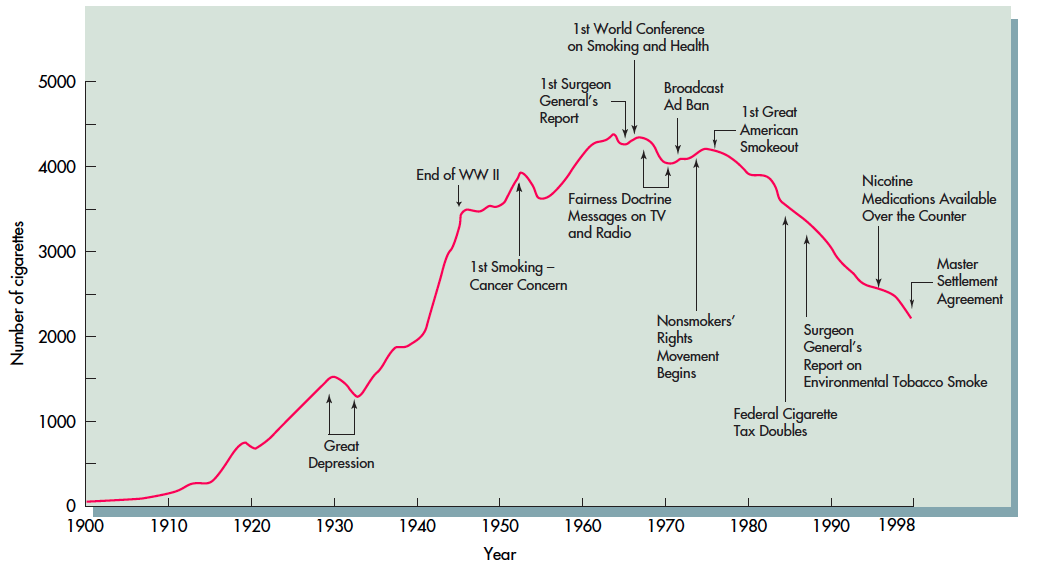
Looking at the consumption/events chart (https://ourworldindata.org/wp-content/uploads/2013/05/Annual...) it doesn't look like any of those efforts was particularly causal. Some like nicotine medication being available seem to have even slowed the decline.
To anyone reading this as a smoker. Quit the fucking thing. You won't miss it and there are ways to quit that aren't as harsh as cold turkey. Just seek medical advice and move on.
After a short recovery, it was like he was 10 years younger. Previously he would get winded just from tying his shoelaces, a combined effect of the smoking and constricted blood flow.
After recovering, it was like he got a new lease on life, he started getting into cooking healthier food, he started exercising and he even started playing the drums again. He's never been particularly open about his feelings, but I think it was a real eye opener for him, to face his own mortality and realizing that he'd been working way too much and not taking proper care of himself. His own dad died around the same age, also from a heart attack, which also made me realize that I have to watch my cholesterol and exercise more.
My dad turns 61 this October, and he's doing better than ever, fit as a fiddle, goes running and swimming every week. I'm glad he got a relatively mild warning and heeded it, otherwise he probably wouldn't be here today. And I'm glad medical technology had advanced to a point where they could save him, unlike his dad.
I quit smoking for love, but I miss it every time I think of it. Nonsmokers have no idea what they're missing. It's sheer bliss. The sooner we can figure out how to have noncarcinogenic smoke, the better.
They hardly drank(liquor) and it was their ownly vice, knowing it's still bad for them but could be doing worse.
New Zealand and Australia have made massive efforts to reduce their rates of smokers. They both have plain packaging, tobacco products aren't allowed to be visibly on sale (in New Zealand, they won't even tell you what they have, you have to guess and hope they have it in stock). They also have the most expensive tobacco in the world. A 25 pack of Marlboros will set you back AU$32 (US$23).
That doesn't seem right that the USA, which has in general put a lot less restrictions on tobacco and has much cheaper tobacco, has a lower incidence of smokers than Australia or New Zealand.
Anecdotally, most daily smokers I know aren't smoking 20 a day either.
This was based on WHO data published in 2016.
According to the same article, the rate had dropped to under 13% in Australia in 2016. The CDC put the US 2016 rate at 15.5% [2].
[1] https://en.m.wikipedia.org/wiki/Prevalence_of_tobacco_consum...
[2] https://www.cdc.gov/tobacco/data_statistics/fact_sheets/adul...
It only being men also suggests it isn't a suddent economic change like lifting tobacco taxes. Some cultural change suddenly made it cool for only men to smoke (again).
Is Mad Men running on every channel?
Every man I know smokes. That's not an exaggeration. It's ridiculously cheap, and with incredibly low income for most of the population, its the only vice that's allowed for most people.
A couple of guys on an island in the middle of nowhere once said it helps with the mosquito's (they also keep large fires lit for the same reason) but not sure if anyone else thinks that.
Do they all smoke kretek cigarettes?
Smoking is a big and growing business over there.
My state in Brazil banned cigarettes inside buildings when I was very young so going out and coming back smelling like a chimney was like going back in time.
Contrast that with the UK where tobacco is hidden behind shutters and only available from a separate kiosk area.
I wonder if having it openly displayed at checkouts removes the mystery (and hence its appeal) or just serves to make it an impulse purchase?
Needs to be severely reduced or banned altogether.
Seeing 15 year olds smoke is a huge societal failure.
In most EU countries, anti-smoking campaigns are frequent, packs must show huge labels with death warnings, advertising is illegal, as well as smoking in public enclosed spaces.
Still, the trend is downward in all countries.
I'm more worried about the non smoker countries which the tobacco companies are seeing as new territories to conquer.
John Oliver did a good segment about that two years ago https://youtu.be/6UsHHOCH4q8?t=239
> Seeing 15 year olds smoke is a huge societal failure. Yes and no. General trends suggest they are smoking less and drinking less alcohol compared to previous generations. It probably just stands out more relative to the general population. Alas, youth is lost on the young :-)
society is burdened in the 50% chance scenario that they develop lung cancer, alongside other medical problems which smoking exacerbates as well as being a contributory factor to others.
No risk or unknown risks? Last I looked into it there was no research on the health effects of smoking < 5 cigarettes a day either.
Also the “number of daily smokers” plot makes no sense in absolute terms, and really seems like it ought to be per capita.
Lots of questionable data viz here, plus some graphs clearly copied and pasted from elsewhere.
COPD: "Long-term exposure to lung irritants that damage the lungs and the airways usually is the cause of COPD." - nhlbi.nih.gov
I worry about the vaping trend I think there is going to be a massive amount of people diagnosed with COPD in 30 or 40 years.
It's always good to quit but as with genetics people are different. A few rare cases where a person smokes until their 90s and never seems to be affected. But I'd say most people who smoke are not so lucky. Sure maybe in the short term and yes it's great for the ex-smoker and the people around them but late in life illnesses pile up and COPD is a big risk.
My dad smoked but quit around age 30 now he has two lung diseases: COPD and IPF. It's possible one or both are related to his work as an oiler on a ship. He was always around fumes, dust, paint, exhaust but his smoking probably had a lasting effect too.
but I did not see the same think in Japan (I am not sure about other countries)
It would be instructive to do an image search for "Australian cigarette packaging" if you want to see exactly what they look like. I gather a lot of smokers like to use boxes to put their cigarette boxes in so they don't have to see them, but I don't know any smokers so that's just hearsay.
An interesting side effect of plain packaging is that it's made the prevalence of illegally imported cigarettes much more noticeable. There's a fair amount tobacco smuggled in from Indonesia and SE Asia, and you can notice it now because the smuggled packs of smokes still have branding on them.
A single pack can cost 11$ CAD to 15.50$ CAD, with cartons costing ~100$ or higher.
Where as in the US you can find 5-8$ pack, and cartons as low as $30$ USD.
The chart shows Canada and USA in the same price/color category.
Canada has been taxing more, and price keeps going up to curb smoking.
Currently trying to implement basic plain packaging.
I would say alot of teens are skipping cigs and straight to vaping. Where as many adults are quiting cigs or switching to vaping.
I also know of people who increased cannabis use to cut down/stop smoking cigs.
Someone else noted the effectiveness of nicotine... Which is misunderstood. I am someone who use to smoke a pack a day, to vaping for oral fixation.
My nicotine intake increased with vaping, but the satisfaction was not the same.
The satisfaction in cigs comes from mix in nicotine and increase in carbon monoxide in blood stream mainly.
If anyone is trying to quit, suggest reading: Alan Carr - easy way to quit smoking. Has helped many people including myself in understanding the sensations and what little control it has over you really.
Maybe smoking in public is more common in China/Asia?
There was also a lot of questions regarding nicotine being used to cope with other issues since nicotine is pretty effective.
The tobacco companies just charging more and blaming the tax... Turkey, France, Chile, Finland have tax contribution of over 80% !!
Shame because I otherwise loved my time there.
Portugal, ten years ago.
"Relativism" doesn't excuse their behavior. Smoking inside is disgusting and known to be mildly dangerous for fifty years.
Is this skewed data or do a lot of people die there for other reasons?