In other words, I highly recommend you try some generative art yourself and see that at its core, it is not that hard and YOU can do it too!
@inconvergent: https://twitter.com/inconvergent?s=09
It's easy to forget that art and creativity is an iterative / scientific process when you just see the finished products.
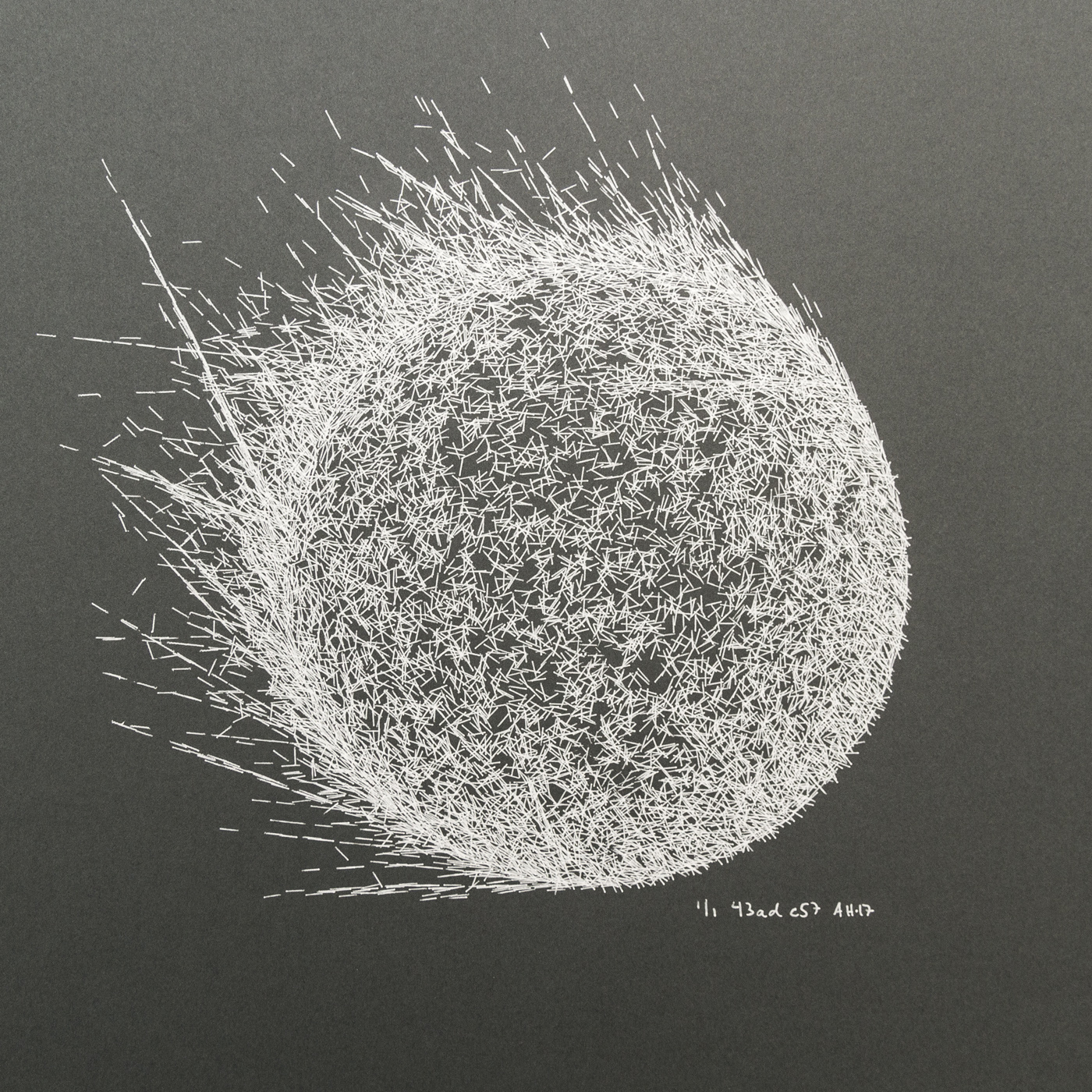
The first piece seems simple enough. Pick and random point on a sphere, and draw a few lines at random orientations a very small distance from that spot with no correction for persepective.
The second piece, the motion lines, seem to be a bit more complex. But they appear to be done by choosing a random spot on a circle's circumference, choosing an angle at random which is heavily biased towards the tangent line at that point on the circumference. Choosing a magnitude (length) for that motion line. And drawing some dashed lines along that path. Then repeating some new lines along that same path but shifted a random amount perpendicular to the motion line.
[I doubt I explained that second part very well, so don't try to re-read it if you didn't get it.]
Physically, I think he printed that one using an AxiDraw plotter.
Beyond the basics, it's also quite useful to pick out a piece of art or an effect you like and attempt to recreate it. You'll learn a lot of tricks very quickly that way.
Create random points, connect them in random ways, create random polygons.
Then start adding constraints like minimum distances, lengths or topological ones like overlap or touch.
This is a wonderful quote, which I'll probably steal. (Is it original to you?) Thank you!
https://www.doc.gold.ac.uk/~mas01whl/
(or John Conway, but that's another league)
https://en.wikipedia.org/wiki/Aristid_Lindenmayer
https://en.wikipedia.org/wiki/Przemys%C5%82aw_Prusinkiewicz
https://en.wikipedia.org/wiki/The_Algorithmic_Beauty_of_Plan...
Or possibly Lillian Schwartz's work at Bell Labs http://lillian.com/
IMO the Hyphae way is actually less cool than plain DLA. The algorithm had a lot of degrees of freedom that were selected randomly, while DLA has very few degrees of freedom and gives a cooler shape
I guess the point is that sometimes a simpler algorithm can give more interesting results for this kind of thing
In a lot of cases, if you're willing to throw a massive amount of computation at a morphogenetic problem, you can get a higher coolness-to-algorithmic-complexity ratio.
and those used for programming itself.
Formerly referred to as meta-programming
generative programming is the art of writing programs that help generate programs
sort of a way of extending the idea of the tool as in programming tool
beyond its current rather static avatar that consists merely of a rather lifeless IDE
Many of these techniques have practical applications in computer graphics; see for example https://www.youtube.com/user/keeroyz/videos
I've been a fan of his for years and have ported some of his stuff to my own robots...
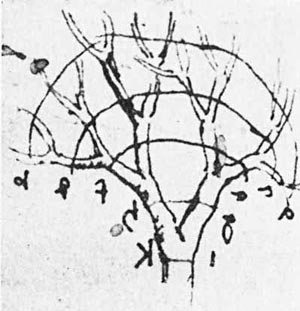
That is, if you face a tree and draw a circle with your arm, and add up all the thicknesses your fingers intersect, the total will always be the same.
https://www.insidescience.org/news/uncovering-da-vincis-rule...
> In other words, if a tree’s branches were folded upward and squeezed together, the tree would look like one big trunk with the same thickness from top to bottom.
Absolutely fascinating!
https://www.ncbi.nlm.nih.gov/pubmed/29370362
The modern understanding is that the pipe model holds only approximately.
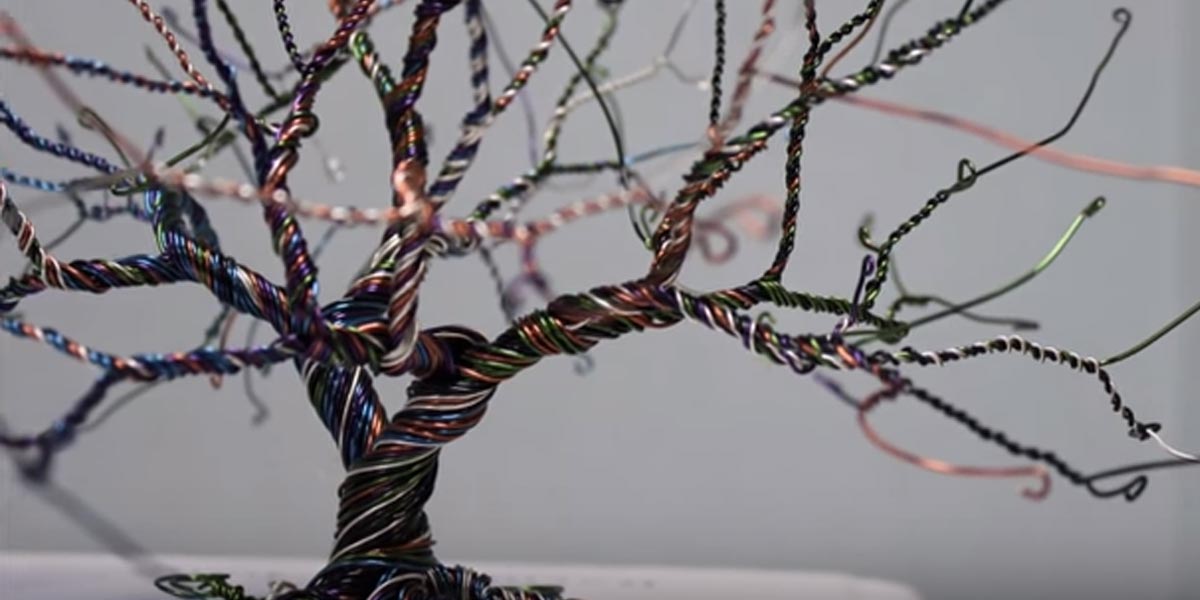
https://diyjoy.com/wp-content/uploads/2016/06/WireTree.jpg
https://www.thisiscolossal.com/2014/10/dense-wire-tree-sculp...
Some artists use them as another tool to process and transform their artwork https://thegradient.pub/playing-a-game-of-ganstruction/
I'm pretty sure that the invention of photography was also greeted with complaints that it lacked "real inspiration" because a photographer "just" had to choose what to take a picture of. But the real inspiration is always in what you choose your art to be, and not whether you create it by applying paint to a canvas.