As a Brit who left the UK a while ago, I recently had cause to request my "medical records" from my former GP. Of course such data can presumably be requested via the UK's Data Protection Act, but the lack of any kind of standard process or checks really shocked me, given the care they are treated with in places such as the US via specific legislation such as HIPPA and so forth.
My GP posted my entire history after one phone call to their receptionist via Skype, did no checks what so ever on my identity beyond confirming my name and DoB to look me up, I was left close to speechless following the call. I can't profess to be an expert on the topic of rights to medical data in the UK, but the above was true of my own experience and others I know, I've heard similar stories from a handful of GP friends and family. There is literally nothing stopping someone pulling your name and DoB from a Facebook account or similar and doing the same in many cases.
The number of GPs without electronic record keeping of any kind in the UK frankly amazes me as well, supposedly the NHS will be paperless by 2020...
Rest assured, it is a show, and most of your information is fed in real time to a half dozen different entities whom you have never heard of. The people who sell prescription data provide it to the pharma company before your insurer even gets the claim.
> As a Brit
I read your comment with no accent, but after I read that line my brain switched your "voice" to a British accented one :-)
I guess, in the US, we only started tracking patients recently. I had to call and have my old records faxed from my old GP in Texas to one in New Jersey, and then again from that GP to my NEWER one in New York. Earliest record was from when I was 7, since neither my mother or I remember who my pediatrician was before then.
You have everything from Psychology/Psychiatry notes to overdose records that many health staff can pull up from almost any computer.
EDIT: Remember many jobs disqualify you from the job if you have any past psychiatric treatment. Even if you are in your 40s Psych drugs at 13 are a disqualifier. "Paying cash" is what some doctors have resorted to. http://www.idealmedicalcare.org/75-med-students-antidepressa...
I am surrounded by doctor family members and friends (and nearly trained as a doctor) - diagnosis comes from incredibly vague datapoints and so context (and additional data points) are so valuable.
Patients are also often unreliable narrators. Having everything on record (but properly protected) is tantamount to being able to give the best care you can.
It’s not uncommon for teenagers to be misdiagnosed with mental illness or ADHD and either of those are disqualifiers for FAA medical certification, military pilot careers, and likely many other military, law enforcement, and intelligence careers. IIRC, a prolonged history of ADHD treatment is enough to disqualify military entrance for any MOS without waiver. Waivering prior ADHD diagnosis requires a costly and difficult process to undiagnose the patient and prove that he or she no longer has the condition and was incorrectly diagnosed in the first place, at least if you are trying to get FAA certified for a Class 1.
It's just surgeries posting paper notes to other surgeries. Very archaic and unreliable. They did try to digitise everything several years ago but somehow managed to waste £13bn and produced nothing. Completely incompetent.
Record keeping is one area of the NHS that is a total embarrassment.
Not true. A massive amount was wasted, but useful services were delivered as part of that £13bn, such as N3, PACS and the Spine.
Implementation of this goal though ..... not as successful. Mostly because those who make the electronic record systems don't understand the field well. See: https://news.ycombinator.com/item?id=18781264
You will be even more shocked down the road when you find out how these lies can hurt you.
True story, I had a major illness in my late 20s. And apparently I have a high tolerance for pain, so the nurses and doctors repeatedly underestimated how much pain I was in. I can be in incredible pain and still hold it together and answer questions in a calm and rational manner. This made one doctor suspicious that I was faking the whole thing. So then I tried to adjust my behavior. I started deliberately giving more outward signs of the pain I was in. And then the another doctor accused me of exaggerating or being a hypochondriac.
I was not able to find a level of external performance that kept all of my doctors happy. If I was too restrained, then they had trouble believing I was really feeling the pain that I described with my words. But if I tried to act the pain I felt, then I was accused of being a hypochondriac.
I should add that most of my doctors were great. In my whole life, I've only had 2 negative experiences with a doctor, the two that I just mentioned.
I know you said "apparently", but how can you know this for a fact?
How can anyone's pain tolerance be objectively measured? I've always wondered about this...
The physiological signs of pain occur mostly as a consequence of the way we consciously experience and process pain. (This is why "general anesthetic" works: central processing of pain is required before sensory input is actually registered as painful, and so, without the brain there to decide that a thing is painful, the physiological consequences don't happen. Pain that would give you a heart attack if you were awake doesn't cause the slightest physiological problem when you're unconscious from general anesthesia.)
If you are receiving a lot of "painful-stimulus describing" sensory input, and you're consciously experiencing those stimuli as painful qualia—but your body shows relatively little physiological response—then you have a high tolerance for pain.
This can be measured by using a standardized painful stimulus (e.g. a sub-cutaneous injection of a standardized dose of some insect's venom) together with an fMRI (or just self-reporting) to measure the intensity of the painful qualia, and various physiological monitors (EKG, etc.) to measure physiological response to the pain.
I believe this has been done before specifically in the case of certain sects of monks who like to demonstrate the depth of their meditative ability by tolerating large amounts of pain. They did the experiment to try to figure out whether the monks are tolerating an experienced pain, or merely are somehow not experiencing the painful stimulus as pain-qualia.
For example, I once declined to take a shot after the doctor explicitly told me that it would most likely not yield any benefit, given the response I had from other treatments.
The medical record simply shows that I declined the shot, but not that this was upon strong recommendation from the doctor.
This became an issue later when the provider went back to the records and stated "you were offered this shot and declined". It is technically true of course, but context would tell a slightly different story, and would definitely shift more responsibility towards the doctor.
The doctor was probably right to make this recommendation, but the fact that it is not captured in the records makes me uncomfortable.
The article has an example of the opposite, but equally important oddness of liability. If you don't mark down "XYZ thing is normal" then someone will come back to complain that you didn't find a problem with XYZ when examining them 27 years ago.
This sort of thing highlights the need for broad and bulletproof physician-patient privilege.
I don’t have a lot of faith in the quality of the records
I was asked this once after requesting mine. I flatly said "I don't", and waited. The person on the other end of the line was clearly thrown off by this, probably expecting something they could dish out a canned response to, hoping I'd give up. It was obvious from their voice they were scrambling for what to say to that.
A bit of rigmarole later, I had my medical records.
Whenever I've been asked, I just say "I want them for my files," and I've had no problems.
Sometimes questions like that could actually be an attempt to be helpful. For instance to send along only the needed records rather than a fat file full of extraneous info or save the patient the trouble of being a middleman between two doctors.
This is my thinking, annoying as it can be-I understand and can appreciate this position. It's possibly a matter of how that help is intended to be delivered.
"Why do you need the files?"
versus
"Is there something about your last visit you have questions about/do you have a follow up question for your doctor?"
etc.
I mention this because when I was on hard times financially and fell behind on a few bills I found it quite invasive and annoying when I called, on my own initiative to make a payment only to be asked "Why were you late on this payment?" in a rather abrupt manner. My response has always been "Is this question required for you to process the payment?" to which "No but we have payment options and plans to help individuals who may have fallen on hard times".
Okay, that's fair. I'd be more receptive if that olive branch was offered more delicately than "Why were you late?" which is frankly none of the debtor's damn business.
I'd like to do this myself, but I want to understand what I'm actually entitled to so I can be prepared if they push back.
It’s just way less work to send them directly. And since that’s what most patients are asking for...
However, the law allows the doctors to redact certain portions in your copy that they feel could be harmful to you.
In the past I worked at a medical company, so I was familiar with the joys of DICOM, etc. I paid €20 for a copy of my own brain-scan data on CD-ROM, posted to my house.
Pretty mind-blowing to have access to a scan of my own brain (well blood-vessels at least) on my home PC.
Like what?
I think those are regularly charged if records are being obtained for legal reasons (e.g. drug/equipment manufacturer lawsuits) but are generally not charged if records are being sent to a new provider. Copies for personal use/records are probably on a per-provider basis.
(Or so many years of experience with DRM says ;-)
I asked that it be removed.
No can do.
AFAIK I’ll go to the grave with a note from a random radiologist that I have hepatitis.
Or maybe it was hipatitis? ;-)
An example handout from Yale New Haven Hospital about it: https://projectepic.ynhh.org/Epic%20Newsletters%20and%20Fact...
You can also find out more about cross-vendor interchange at https://carequality.org/
I wish I had both CS/SE experience and Medical experience so that I could understand what keeps this field in the 1970s. I have suspicions.
Not to say things can't be improved, but there are a lot of factors that make it more difficult than a traditional B2B or B2C product.
Simply: those who choose the software are not those using it. So they go for recognizable names, certifications and how much money they'll get back for themselves.
Epic also has an app store. You can write your own SMART on FHIR apps, then deploy them inside the EHR with full access to patient data.
This is why heavy handed regulation is bad. The people on the end of the regulation have to deal with a ton of BS to the point where it becomes security theater. These systems need their own departments, experts, and even legal teams. The overhead is massive.You think a company is going to roll over and eat the costs without trying everything in their power to side step it? Loop holes to outright lies will be used. Anything to trim the fat.
Happened to a place I worked at. New regulations meant more overhead. During my tenure I watched the quality department grow from the side job of the head engineer to a department of three people (manager, assistant, engineer) and an outside contractor. I then watched the employee quality drop proportionately as they put more money into putting lipstick on a pig than actually fixing problems and improving quality. As long as you satisfy the auditor or customer you look like a well oiled machine. Just don't look under the rug.
I could go on at length about this but I'll try to keep it short. Basically, imagine that you're a startup and you want to compete with Epic in providing a comprehensive IT solution to health systems. You will _at least_ need to:
1. Write software for every major medical specialty that is comprehensive enough to satisfy the specialists' expectations of domain-specific tailoring
2. Also ensure that these modules are flexible to accommodate intra-specialty variation (for example, oncologists vary a lot in how they divide stages of cancer)
3. Ensure that your software will comply with and help your customers perform well financially with federal, state, local, and program-specific (Medicaid, Medicare...) regulations
4. Go into a room full of health executives who are deeply weary and suspicious of health IT people (for better and worse reasons) and convince them they're better off risking a multi-year, extremely expensive transition project on your startup, which might not be around in a few years, instead of going to an EMR vendor that's almost-not-even-mediocre but stable like Cerner or Epic. (The "nobody gets fired for buying IBM" effect here is real.)
Clearly all of this requires a lot of work, and would require millions of dollars in funding and the poaching of some top talent in healthcare IT who know the lay of the regulatory land. As a result, most HIT startups (that I know of, at least) target something less ambitious than an enterprise EMR. Some target only a specific specialty (like home health or care management), others target small family practices (which are becoming increasingly rare as they are bought out by major health systems).
This is in a way bad for everyone except the software vendors, though, because without a competitive threat, there is little incentive for companies like Epic to undertake the risky, major rewrites which are vital for the company's long-term technical health. Epic still uses a typeless, (almost) data structure-less language called MUMPS for its server and DB code, and on the client side, all of it is still either in VB6 (yes, 6, not .NET) or a quite spartan home-grown JavaScript framework. The result is that bad code never gets totally thrown out, and Epic's developers are not able to benefit from the productivity-multiply amenities of modern languages, which include type systems and abstractions more powerful than subroutines and goto statements. Development then takes an order of magnitude longer than it might have, and the feedback cycle continues.
There are other elements, like med/consult/lab/diagnostic imaging orders going to the relevant person/department instantly. With a handy interface for following them along, cancelling or re-scheduling them at any time.
A nurse doesn’t need to follow a provider around to find out what the new orders are, they show up automatically on their own task scheduler.
Providers can enter orders remotely.
Or allergies just getting verified instead of collected from scratch each visit.
Or billing/appointments happening electronically instead of manually completing forms.
https://www.newyorker.com/magazine/2018/11/12/why-doctors-ha...
A principal of a failed medical records startup described it to me as an incumbent coming to them and saying basically "You have a nice disruptive startup. But we don't want to be disrupted. We have some patents. Their details don't matter. Our <unit of time> legal budget is greater than your last round of funding. End of game."
Medical tech has the seemingly simple barriers voting has, but that once you incorporate it into a system they because heavily limiting and expensive.
You'd think I'd do something medical - I've been in the field 10 years, I should have been able to find a problem IT can address?
To be honest the thought of doing a health IT startup just fills me with dread.
He puts much of the blame on the generalization of computer systems, i.e. that the notes have to be readable by all sorts of staff and need to be systematized to accommodate that.
Even in the best case scenario though, it's a lot of clicking around to find clinical information that may be relevant to a patient (which means it can often go unnoticed).
This makes machine learning using the notes difficult since the content is so muddied up. It's far from impossible to do useful things with them but there is a lot of noise. Still, some things require us to look at the notes. For these things we would much rather have them than not.
While it's preferred to have the information entered in a structured way, doctors find that more of a hassle than entering in the data free-text and it's also no good for retrospective analysis where we didn't know several years ago we would be interested in something and so no structured field existed.
And since history is 90% of diagnosis, this isn’t some little quirk. It plays a huge role in helping patients. Huge.
As a type 1 diabetic, if I have high blood glucose and nausea, I'm going to say the letters "DKA" to the triage nurse. I'll never bring it up again -- because the first blood chemistry test answers that question one way or the other.
Regarding medical practice, why would a physician rely on what a high school graduate EMT obtains from a patient on the way to the hospital. Sure, it provides a starting point, but in no way would I find that comprehensive.
Similarly, an ER doc has a different perspective than a trauma surgeon, than a cardiologist. They all view things differently and ask different questions relative to their specialty.
One "simple" solution is to have departmental standardization of note format with thoughtful inclusion of what fields are typically pertinent. This doesn't solve the problem of care transitions but it might help standardize review in a hospital context.
The other thing that I've been pondering is something resembling a formalized data structure and language for note taking. For example, diagnosis X based on Y Z. Other probabilistic diagnosis A ruled out because not B not C yes D. Reduce free form notes to be as sparse as possible. Also there should be a reference system to point back to other notes / lab values / imaging which when clicked will bring up that data. Finally, a timeline which charts pertinent diagnoses, lab values, and changes over encounters. I'm not sure how viable it would be given the complexity of notes that my physician colleagues have showed me / what I've seen in research, but I'm curious.
I talked to some other physicians about this, and I learned that hospital departments use their standardized notes to include as much detail (i.e. bloat) as possible so that physicians can bill at higher tiers since billing is tied to the number of details included in the note.
[1] https://www.aafp.org/fpm/2003/0100/p29.html#fpm20030100p29-b...
And which acuity scale was this? Usually the higher the number, the less acute you are.
I’m using the CPT codes within the site I linked to. 99211–99215 are the codes that correlate to acuity, with 99215 being the most acute. I am aware of other systems like level 1 vs level 2 trauma centers. In that case, yes the level 1 is higher acuity. Maybe that’s what you were thinking of?
For care transitions the HL7 C-CDA 2.1 Continuity of Care Document (CCD) format works pretty well. Modern EHRs can export a summary of a patient's chart in that format. Some data may be lost in translation but usually it works fine. But there are often still technical obstacles to transporting a CCD from one provider to another.
There are existing formal code systems for notes: CPT, ICD-10-CM, RxNorm, CVX, SNOMED-CT, etc. Those are helpful for billing and analysis purposes, but they can't replace free form narrative text for most clinical use cases.
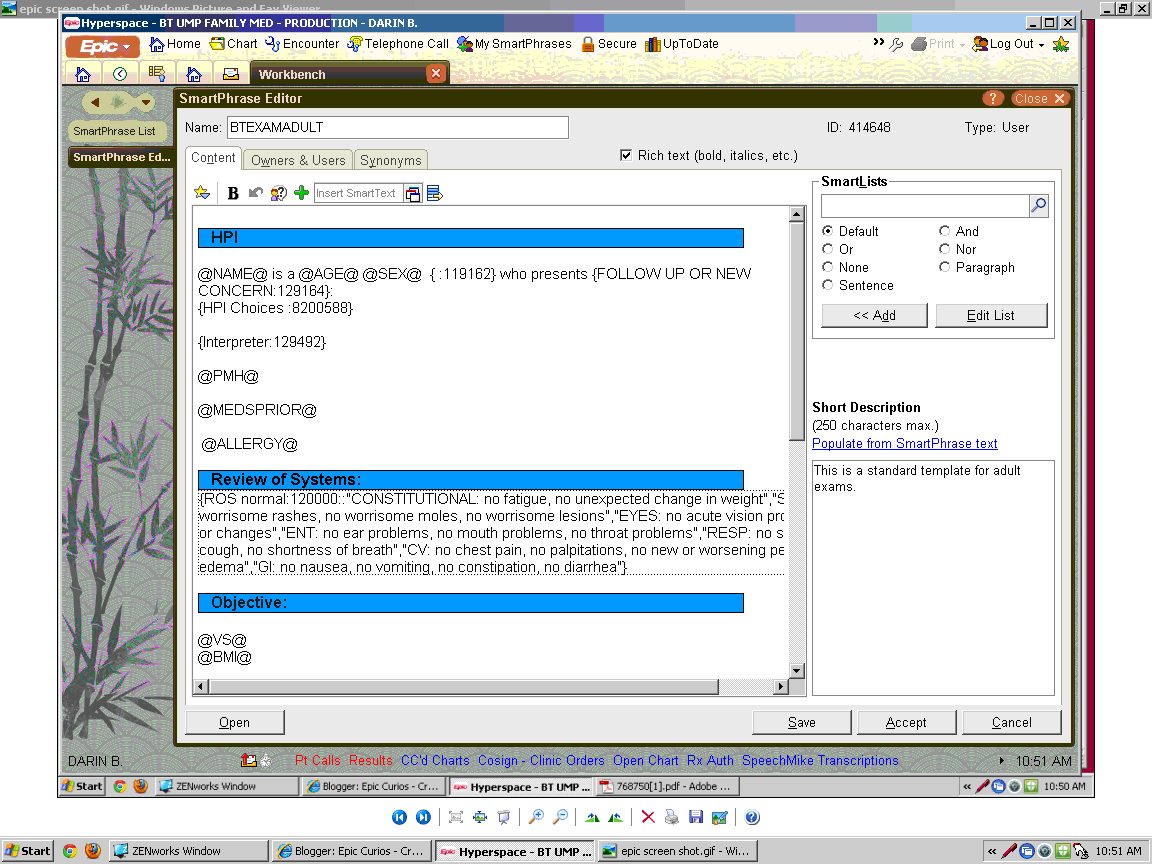
http://ist.jefferson.edu/content/dam/ist/epic/SmartList.PNG
http://3.bp.blogspot.com/-13TVMTrcPkA/UPWKAB_rTGI/AAAAAAAABD...
Some EHRs can streamline via templates and workflow. Others don't. I've literally had practice admins not implement new practices that would document properly and facilitate easy reporting because they would not be able to sell the change to the providers.
I'm not blaming providers for the data issues. They have a job to do and they do it. It just doesn't always get documented in a reportable manner. There needs to be an easier way to document, or some kind of Middleware that documents for them.
I see people a whole lot smarter than me trying to use ai to interpret notes. I personally think they are just facilitating the ongoing poor documentation problem. And things will slip through the natural language cracks, and it could be a potential health hazard.
I'm half-joking, of course. The guy is top-rated, elected head of the state association. He's widely-regarded as a combination of both brilliant with diagnostics and good with people. He just can't complete a sentence when we meet.
Why? Because he's got some pad he carries around that takes up all of his attention span. He comes into the room, sits down -- and there's this struggle for his attention that I watch play out. It usually involves a lot of verbal grunts.
"So we've got this .... er.. .. and it looks .. hmmmm. .... So this is...."
This could go on for a bit. Eventually we get to either a statement or a question.
Frankly I'd think the guy was having some sort of mental issues if it weren't for the facts that 1) he used to be fine before they all started carrying around pads, and 2) he's fine outside the clinic.
I really hope that the tech community has helped make healthcare better. It's certainly had an impact.
To me it's a little odd that hospitals are the ones who keep this information. I'd think that the records should belong to patients—it's about them after all. And that the patients would provide access to doctors or hospitals.
Right now I've got a personal medical journal that has things like:
* Sickness - Date Range and Notes
* Flu Shots - Date
* Injuries - Date and Notes
* Observations - Date and Notes
* Blood tests - Date and Photos of Tests
Before my yearly checkup (or if I have to visit a clinic) I review the last entries and open them on my phone incase my doctor wants to see any of them.
It works well enough for me, but seems like there could be a ton of opportunity for improvement. I'd love to have a system where my doctor could be notified and comment on new notes or events. Also the ability to bring in my scale, run tracker and other fitness data.
Here in the UK patients do have responsibility for some records - notably anticoagulation records and maternity / child health records.
I have seen literally one patient present with their anticoagulation record. I have lost count of the number of patients who come to appointments without their maternity notes or child health notes.
Even trying to get an accurate medication history from a patient is near impossible and we end up having to look at past hospital discharge letters, call their GP, or look on shared record systems to try and piece together what they are taking.
I'm all for patients "owning" their records but they must be held in a way that is accessible when needed regardless of human variabilities.
The bloat obscures critical information from other doctors. Patients are unable to read a meaningful account of their care, and are charged more for worse services.
This is absolutely the future, with the ubiquitous devices and cloud-like infrastructure. But we are decades away from with with entire segments of the population not even having an email account.
On paper, I could get a relatively uncomplicated chest pain case from the ER to the hospital unit with all the orders for workup ready in 45 minutes.
With the EHR, we had abominations like double medication reconciliation and poorly customized order sets that ballooned my average admit time to almost two hours. And I was among the fastest. (I should note I am told these issues have improved, but it took years.)
Given that there was so much other stuff to do now and that ordering had become a nightmare of lookups and checkboxes, physicians under time pressure are going to economize where they can. Where they do is in the documentation, which is not generally reviewed and won't by itself prevent the patient from getting where they're going.
Now move this to an outpatient office where patient loads have not lightened and it becomes magnified.
It's a point of pride that I don't copy-paste my notes, but I have the luxury of being mostly administrative these days and most of my patient contacts are in a hyperspecialized clinic where I can do things like prewrite most of the note even before I go in a room. But it's killing primary care and it's probably making things worse at the very point where it needs to be made better.
And what initial electronic order sets were implemented? Did the organization not just implement (as best as possible) the previously on-paper order sets?
It’s not a perfect approach (you can do things with an online form that you can’t do on paper and vice-versa), but it seems like a good approach to avoid (more) mass confusion on Day1.
I think that's when you need a second doctor to approve orders for another.
I fully support the use of EMRs as some ideal, but it should emerge as the best option not as something that was forced. The result was a lot of EMR systems that would have never been adopted if there wasn't added pressure from government regulations. I strongly believe that EMRs would look pretty different if they were adopted organically without regulation.
It's really astounding to me that the elephant in the room of healthcare regulation isn't discussed more in public discussions of cost. As a result we end up with EMRs where the tail wags the dog, lack of transparency, lack of competition, lack of choice, etc. etc. etc.
I keep hoping the weight of the edifice will cause the thing to implode as it becomes so obviously unsustainable, but it's as if more regulation just births more regulation.
Has the “standard” been to document X, Y and Z, but providers felt (rightly or wrongly) that documenting those things is unnecessary, so they didn’t, but now they have to and it’s easily auditable?
Is the problem the medium or the implementation?
The docs notes were, in many ways, even worse. The notes required manual typing, and many docs are not trained skilled touch typists. So the two-fingered part of the note was often very brief and succinct. The templated portions were huge - impressive reviews of systems where you could not really tell if the specific items had actually really been asked or if the template just vomited forth a page full of text for administrative review.
Make a doctor function as a data entry clerk and this is what happens.
Anyone that’s struggled with JIRA and just said forget this due to tool impedance will have a good idea of how painful this is. In hospitals I almost never see charts pulled up except on daily rounds. Sure nurses are great and smart people and usually remember everything, but they also work hard long hours and the cost of mistakes can be very high.
“In fact, across this same EHR, clinical notes in the United States are nearly 4 times longer on average than those in other countries”
It seems that the EHR isn’t the root cause of the problem.
I think there is also a general misunderstanding of "the note" in an EHR context. The progress note is really just one aspect of a provider's documentation of a visit. Things like medications and allergies are generally indicated as "reviewed" elsewhere in the chart and yet all of this information is many times also entered into the progress note unnecessarily adding to note bloat. In the days of the paper chart the progress note ended up being the only summary of the visit and even though it's now just one piece of the visit documentation, it's still written as though it will be the only source of truth.
Unhappy users are much louder than happy or neutral users.
As a result, when a non-US health provider wants to do some informal research on implementing EHRs, they mostly read a lot of angry complaints.
Also in terms of "numeric/digital" vs "paper" the point is ignorance: how many people outside IT world (and even inside) do actually know enough a desktop to take their own personal notes in an ordered, usable and useful thing?
IMVHO a so small percentage that we can probably know them all by name. Just take a look at a "common" mailbox: most of them are an utter pile of data, few with some incoherent taxonomies, few even with the sole inbox as an archival place. Than take a look a common "home directories": the very same mess. And if this is for personal and generic data do you think that those people are able to properly not only manage but share helpful information with digital systems?!
But yes, the current infrastructure is not good.
2. Legal liability (CYA)
3. We don't use outcome-based medicine
2. Sort of yes, but I've heard it more time from managers who use it more of an excuse for not wanting change rather than it being a legitimate argument (i.e. from people with little to no legal training).
3. This is changing slowly. The Affordable Care Act and it's little known cousin MACRA have started to shift the entire system (albeit slowly) towards more outcome based measures, primarily through Medicare. Major payers are following in their steps. Not happening overnight, but any major healthcare executive sees the writing on the wall and is taking these considerations into account for their investments.
[0]. https://www.healthaffairs.org/do/10.1377/hblog20180810.48196... [1]. https://www.healthaffairs.org/do/10.1377/hblog20180810.48196...
If you go in for a wonky heart, and you get some kind of imaging done on your chest, and then spot something in your lungs, they SHOULD ignore it. Outcome-Based Medicine says that's what they should do. They CAN'T ignore it.
Cardiologists actively want the lungs REMOVED from the images they order, because they don't want to accidentally notice any lung nodules. That's crazy!
And that's just one example.
We don't know how to properly ignore the things we should.
And if something IS there, and there COULD HAVE been action taken on it, then the people who looked at the images are potentially liable in court. Or at least in settlement.
The whole thing sucks.
There are some areas of healthcare where it is very cut and dry what defines good healthcare management. These are where we've developed good reporting outcomes that tie closely to clinical and resource utilization outcomes from the published literature. Think of your high volume routines cases such as diabetes (monitoring of A1C)[0] and knee replacements [1] that make of a large portion of health care cases. These are certainly not covering all healthcare episodes, but represent areas where significant fat can be trimmed.
With regard to your above clinical case, there are specific approaches for (what I assume is an incidental finding from a coronary CTA) reporting lung nodules and requesting follow up studies [2]. However, this represents an area where there is significant good faith professional disagreement of reporting.
I will agree that high-evidence clinical guidelines are not always followed, and payment reform has not been influenced all medical professions equally. The way healthcare is delivered is changing, and is being highly influenced by national policy level decisions.
[0]: https://www.healthaffairs.org/do/10.1377/hpb20121011.90233/f... [1]: http://files.kff.org/attachment/Evidence-Link-FAQs-Bundled-P... [2]: https://www.ncbi.nlm.nih.gov/pmc/articles/PMC5903561/
  - Doctor enters your visit (encounter), cross your fingers that his system has the most up-to-date medical codes (e.g. snomed, cpt, icd, etc)
  - Doctors notes for that encounter are potentially entered as a text area in one system (u/petermcneeley). Can be notes at the encounter level or for a specific diagnosis/lab result/etc.
  - The codes vs free text, is what we refer to as discreet and narrative/free text.
  - The current IHE spec. [2] (last updated in 2015?), allows for codes to be interpreted from narrative text if a valid code is not provided. I think there are a few startups that have popped up here that are trying to make sense of the narrative text.
  - That same spec would be great if everyone followed it but they have to get their system to bend a little bit or throw an integration engine in front of the problem to play nicely with others. (u/nradov)
  - Start sending those back and forth and you either end up losing those notes or butchering them up.


  - There are some orgs (e.g. DoD, VA, Sequoia, etc) that have everyone follow the basic requirements but then add their own flavor on top. [3]
  - FHIR [4] is here, but I think everyone is already scrambling or haven't had the need to make the cut over to it until its government mandated. I have to say this has been the easiest spec. to grok, but it is still way too flexible for these companies to mess up. A cut over to FHIR for everyone should ideally be that you have to use the Hapi FHIR models [5]. Maybe have a way for Hapi to sign the models on their way out?
[1] https://media1.tenor.com/images/af0c71048d5a130cefc335423c59...
[2] http://www.hl7.org/implement/standards/product_brief.cfm?pro...