>You know, sitting on the beach in Greece with friends I've heard people complaining that because we had a financial crisis they miss some of the comforts they used to have. I am like, "Come on! Enjoy your life and health. You are eating sardines and drinking Ouzo by the beach. We are free, we have good friends around and we laugh - this is what people are supposed to do."
>Don't concentrate only on work, stressful and bad things in your life. Concentrate instead on creating good moments and being around good people, because life is so beautiful.
It's really put things into perspective for me. There's no point in spending time and effort doing things we don't like, there's no point in staying in a job you hate, or spending time with people you don't like. I might get hit by a car and killed tomorrow and it would be fucking awful if my final thought was how I wasn't looking forward to going to work in the morning.
Obviously I understand that I'm privileged that I'm in this position. There's so many people out there who need to work shit jobs to feed themselves or their family. But most of us here on HN are in the same position as me. Why spend time working working some shit corporate job in the valley, paying a fucking fortune for rent, just so that you can get a job somewhere else earning more money? I earn enough money to be comfortable, I'd rather direct my efforts towards making meaningful human connections and enjoying life.
Work to live, don't live to work.
We live a completely minimal lifestyle. We own just enough to fit on the motorbike. In the last month, we've used a single plastic bottle (because we were on an island and wanted water and couldn't get it any other way) and created just a tiny bit of trash. We aren't religious about it. I'm only bringing it up because by focusing on making a minimal impact on this planet, it has allowed us to really let go of so much.
It isn't easy, but it is possible to do exactly what you're saying.
cheers,
https://imgur.com/a/8V6NUWm . (Kampot, Cambodia)
Near-death experiences: clinical implications http://www.scielo.br/scielo.php?pid=S0101-60832007000700015&...
> “Compared to non-experiencers, NDErs report greatly increased concern for others, decreased fear of death, and increased belief in an afterlife, increased religious interest and feeling, and lessened desire for material success and approval of others (Flynn, 1982).”
Even for those who did not have a NDE,
> “Compared to persons who had come close to death but not had NDEs, experiencers place significantly lower value on social status, professional and material success, and fame (Greyson, 1983a), and find death less threatening (Greyson, 1992).”
During that time, I didn't realize until later, different layers of my personality were stripping away and each layer was a new thought about my life.
Then the fireworks started...I didn't die. I rememer.I didn't really feel relief...just happiness and a new feeling that just existing and making the best od life was good enough.
Since then i've found my attitude towards a lot of things has changed. I used to worry about my health a lot, not quite hypochondriac but sometimes pretty close, i'd get overwhelmed with anxiety about dying from different things. In all the years since then I haven't worried about it any more.
I find little things that would frustrate me or i'd put a lot of energy into worrying about don't bother me any more. Generally my interactions with people.have improved. I find i expect less from them now while at the same time I find myself generally caring about people's lives and the things that happen to them more than I used to.
I also lost interest in watching graphically violent movies or just senseless violence on general.
I dunno...I know it's not the same as a real near death experience but reading your comment really made me think of that time.
Can recommend.
> The Wardak attack is turning into the single deadliest attack against the Afghan intelligence in the past 17 yrs. We are hearing now at least 40 dead more than 50 wounded. (some officials still insist not all are NDS officers - includes local upriser militias they were training) https://twitter.com/MujMash/status/1087338155072724992?s=19
This kind of attack and response is like mad contraption fueled by old human stupidity and borderline futuristic deadly powerful technology.
As a civilian you are supposed to keep very safe distance from such a powerful tech but someone, somewhere gets inevitably confronted with it mixed with a dash or a lot of human stupidity and most often dies.
Reading that, I can't imagine being stuck in such a situation without weapons. Yeah, a sidearm won't necessarily save one's life, particularly against several attackers, but all it would take is a few people to fight back to subdue the attackers. According to Wikipedia, there were only 'four or five gunmen' and about 200 people in the hotel (42 dead, over 160 rescued): if each person had been capable of resisting, then the attackers simply couldn't have won the day without a significantly larger team, which would have incurred increased cost, opsec risk & operational risk.
I can't imagine the terror of being stuck in a hotel room, waiting to die. A weapon might not save my life, but at least it'd give me something to focus on & feel better about.
> Don't concentrate only on work, stressful and bad things in your life. Concentrate instead on creating good moments and being around good people, because life is so beautiful.
Also, what's with "holding the bed with my toes and fists" ? I don't picture that really well.
The bed didn't have enough space for him to fit with its legs on the floor. I imagine he was lying face-up under the bed, with his arms outstretched, fists balled up supporting one end of the bed (under strut). At the other end, his heels would have been on the floor, with his toes bearing the weight of the bed
edit: uploaded my badly drawn interpretation https://imgur.com/a/Q3kBA1T
Hopefully the assailant only sat up on the bed after our guy tore it open and slid inside the frame. Still, he stayed hours at first, holding the bed 10 centimeters from the ground.
I wondered this as well. He did say he has had significant training, but honestly, I think this was just pure luck.
Just my hunch at least. Untidy bed is already ”broken”.
Terrorists in TV and movies are never like this. They're always super-serious evil, like Voldemort, like nobody ever is in real life. I wonder how much violence could be prevented if Hollywood didn't give us such a bullshit view of human nature.
It's also insane that Vasileiou went from being in immediate danger of burning alive to immediate danger of hypothermia. What a roller coaster. And his training was broad enough to cover the entire spectrum.
Somebody or training made the sniper question the action
[1] https://www.goodreads.com/book/show/2706211-the-unthinkable
It’s easy to assume that a given set of habits correlate with survival, and even easier to write a book effectively engaging in survivorship bias. It’s a lot harder to get lucky many times in a row, to have the opportunity to not die. So read the book, keep your back to a wall and an eye on exists, but recognize that none of that would have helped this guy. The two big tings that seemed to have saved this guy is temperament (look at his job for indication she that job followed temperament and and not the other way around) which allowed him to remain calm, and sheer dumb luck.
It is a correct assumption.
I survived this attack ... by not going to Afghanistan.
When it comes to hiding/camoflauge, the goal is not to mislead-- you don't want someone to look at you and see a random shrub or find fake evidence of an escape. That raises suspicion. The goal is to make someone looking directly at you have no idea you're even there, where you were or where you're going.
But still, the possible would exist that there's someone in the room who didn't dare climb down in the end.
This is taught in tradecraft courses, and this mention along with others in the article suggests to me that he's been through some tradecraft and/or SERE-type trainings -- probably oriented towards journalists.
But one detail seems to be wrong:
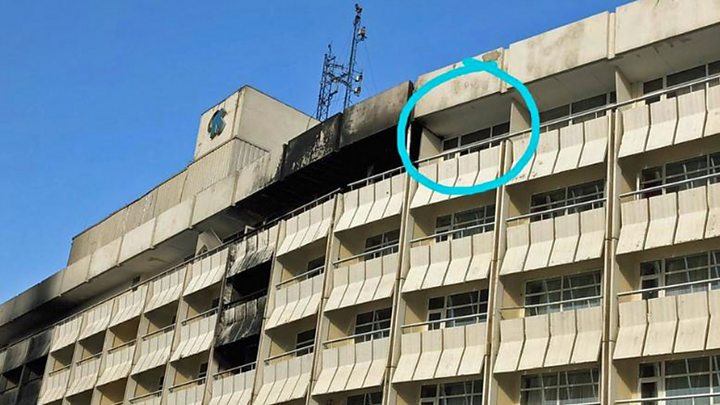
It says "I had to do something, so I went out on to the balcony. I could see the fire on __my left hand side__, it was heavy and I realised that if it reached my room I wasn't going to survive."
The provided image circles the balcony on the right hand side of the fire, so it would have been either his right hand side where he saw the fire, the image has been mirrored, or BBC just circled the wrong balcony: https://ichef.bbci.co.uk/images/ic/720x405/p06ynx4y.jpg
> early in the morning the international forces began to fire from a tank into the rooms. They concentrated on room 521, the one next door to me
The blackened rooms to his right aren't the fire he was talking about. There must have been another fire out of view of this picture.
Curious, what would be the logical explanation for that? I mean, for starters nobody would want to work there, and nobody would want to _stay_ there. Right?
I would apply the same line of thought here: I don't think this hotel is any more insecure that any other. In fact, I would expect it to have more security than the others from now on.
I understand the emotional point - it's pretty much the same point that Chris Rock made about renaming the new Twin Towers the "Never going in there tower". But I can totally see the hotel making a comeback - if Charlie Hebdo is still in business, I don't see why the hotel can't follow the same steps.
https://en.wikipedia.org/wiki/2011_Inter-Continental_Hotel_K...
The reason they still use the hotel, is that there are not a lot of hotels in the area. This is not NY city.
http://www.mbiconcepts.com/watson-sr-and-thoughtful-mistakes...
Fix all the damage, put up a plaque or other memorial to the victims, and then move forward.
This may seem harsh, but economic interests don't permanently go away when disasters happen.
Only problem is, they were bombed again in 2009, this time with the help of a staff insider...
If the Afghan people abandoned everywhere that had been the scene of an atrocity, there would be few places left to go.
[0] https://en.wikipedia.org/wiki/2011_Inter-Continental_Hotel_K...
If you need to travel to Kabul, as many people do, there are no truly safe options. Both hotels are beautiful and well guarded. They are also high-profile targets.
If your employer doesn't have access to a lower-profile private compound with private security then you are going to the Serena or the Intercontinental.
(IMO there is a small mistake. They write "I could see the fire on my left hand side" but the fire from the tagged window is on "the right" from inside...)
I feel this sentence could also save a lot of lives, in a slightly different way.
What's the excuse for the hotel not having any security?
https://ewn.co.za/2018/01/23/afghan-hotel-attack-stirs-fresh...
"KABUL - A bloody Taliban raid on a high-end hotel guarded by a private company in the Afghan capital ...
[...]
“There were 15 guards on duty at time of the attack and none of them engaged the attackers,”
Sure, in a normally-functioning country with available leadership and logistical resources. But that is not Afghanistan, at present.
That was my whole point.
To people from better off part of the world, luxury hotels in third-world countries are, almost as a rule, a magnet for trouble: petty crimes, robberies, encounters with mafia, and, as was in that case, an armed assault.
The odds of buglary, petty crimes and those vices you listed happening is close to zero. This is the reason why they are attractive to expats and high-end clients.
They have the best security and are usually located in prime areas making them less susceptible to some of those claims you made.
And they also have a brand to protect. Except they are very expensive relative to the cost of living of those countries but their target market is foreigners, short-stay expats and government delegations so they still get patronized.
Big hard property means you'll probably be safe from petty crime, but you might be collateral damage during a large terrorist attack. However, most places can repel the smaller attacks.
Smaller/anonymous property means you won't be collateral damage from anyone else, but it will be a whole lot easier for someone to learn "rich American/European is staying in this guesthouse" and then do a trivial attack. You have to be consistent with this, using local vehicles, probably not going out much, etc.
Depends on the situation which is better (the external situation as well as who you are as a target). A big factor is that K&R/institutional policies/etc. do not permit the low profile approach. If you're living in a low profile place but then taking a big armored truck to/from meetings with the government at hardened sites, you're probably going to have a bad time, too.
I'd personally feel weird being in Afghanistan or Iraq without a weapon (and possibly security detail) today, despite it being "safer" than when I was there, and having illegal weapons being itself an actual risk now. I solve this by just not going.
Most of the third world isn't actual-warzone and you're not as likely to face a huge terrorist attack on the biggest target. The Kenyan mall/etc. attacks are outliers. I'd generally go for the hardened strategy myself, as I don't want to have to go through the trouble of blending in, especially on a longer basis.
(In a high threat environment I'd probably go for my own secured compound somewhere, just so I wouldn't be collateral damage, but that requires you be able to hold/secure the compound, which puts a pretty high minimum scale to be economic. I lived in a villa in Baghdad with Kurdish security, and then in Afghanistan I stayed at a guest house with a 2:1 rifle to guest ratio, but yeah.)
I'll explain.
Luxury hotels in 3rd world countries are very different from normal hotels. They are "hotels" in name only.
Here, luxury hotels function pretty much like castles and keeps for local "feudal elites." What they do is not so much about providing lodging and comfort, but providing physical security and security from sights of common people to local rich and powerful.
You are totally right that such places are well secured, some even with security walls, barbed wire, and armed guards. But the very fact that such establishments tend to host "walking money bags," or people justly hated by local populace is the reason why troubles haunt them.
That infamous Ritz Carlton in Moscow near Kremlin certainly saw over 20 murders, and god knows how many other violent crimes. A Marriott nearby fared not much better.
> The odds of buglary, petty crimes and those vices you listed happening is close to zero. This is the reason why they are attractive to expats and high-end clients.
Such things happen near weekly, no matter how much security is posted on premises. This is really counterintuitive to a person from the West. How to say that... if hotel you are staying in is the only place in the city where burglars and pickpockets can steal anything of value, it will be targeted invariably of the amount of deterrent https://www.google.com/search?q=%22presidential+suite%22+bur...
I suppose the thinking goes that if one American is a potential target for an opportunistic violent extremist than a place that's frequently host to groups of Americans is perhaps more likely to be a target for a coordinated attack.
It might or might not be true but for the most part it wasn't particularly difficult to avoid my fellow Americans while traveling anyway. We tend to take business trips abroad but not many weeks-long exploratory vacations. Plus, you can't really get much of a feel for the country you're in from a Hilton now can you?
Edit: To add that I don't want to be fear-mongering. I think a lot of my friends and family thought I was taking a "risk" by traveling to some of the countries I went to and for the most part I felt just as safe in the Middle East as I did in New Orleans. I don't think fear should stop anyone from traveling but I also think it's wise to be mindful of some of the unfortunate realities of the world in which we live.
If they venture off the hotel area, and generally the safer city areas, it's on them.
I have no other way of discussing this further since that comment is too down the page for me to expect you to see replies to- but what would be a good "front-end framework" according to you? And if I may ask- what do you use?