Such a shame it turned out to be doomed due to being first and the now well known metal fatigue story.
The article, as with everything Comet related, ends with noting that lesson is why airliners now have very rounded windows. Yet none ever wonder or look at why cockpit windows remain decidedly rectangular. :)
If I remember rightly the refurbishment project hit the problem that, because the original planes were hand-built to 1950s tolerances, building new parts off the original plans simply wouldn't fit. The only viable approach was measure the specific plane you wanted to fit, and build a custom part for it.
Eventually one simply caught fire in the air: https://www.telegraph.co.uk/news/1528109/Fire-was-reported-o...
The destruction of the airframes was controversial: https://www.bbc.co.uk/news/uk-england-12292390 but I see it as a symbolic driving of a stake through the heart of a project that should have been honorably retired a couple of decades previously but instead took on a vampiric, undead, and ultimately fatal life.
Full details in the Haddon Cave report [0], the official investigation into the crash of Nimrod MR2 aircraft XV230 in Afghanistan in 2006. The 'simply' here (as in 'simply' caught fire) was in fact a catalogue of known problems and missed opportunities. The Nimrod variant involved was originally intended to perform long-duration maritime surveillance and was designed to allow the crew to intentionally switch off one of the engines when the plane arrived on station (to save fuel while loitering for hours). To restart the engine there was a pipe routed through the fuselage that carried hot gases from the running engine to kick start the cold one.
A separate modification of the complicated tanks and plumbing that supported in-air refuelling led to a (leaky) fuel pipe that was routed right past the (very hot) engine cross-coupling pipe. Very minor leaks somewhere in the system were routine.
In this case there was a fuel leak near the engine cross-coupling pipe. The unfortunate crew of 14 had six minutes from initial fire warning to the eventual and unavoidable explosion that killed them all.
[0] https://www.gov.uk/government/publications/the-nimrod-review
Don't listen to the "aerospace engineer" that answered you.
The reason why cockpit windows are so angular is of course for visibility. They are mounted in a heavy load-bearing frame. Structural efficiency is sacrificed for a better view.
I tried to find a nice picture for you, but the best I could find is this https://polybull.com/product/genuine-boeing-747-400-full-coc...
These in turn are mounted on another heavy frame that attaches to the main bulkheads. You can see the angles are quite sharp, certainly no more rounded than the Comet windows were. But, once stress concentration and metal fatigue was understood, appropriate allowances could be made.
Conversely, for passengers, the view is compromised for better structural efficiency.
Do you have a problem with any of the facts I presented?
There are many disciplines in "aerospace engineering", and if you say work on instrumentation, then saying "aerospace engineer here" in this context is about as misleading as saying "circles are just squares with large radius corners" (they are also "triangles with large radius corners").
What do you actually do in our job?
Aerospace engineer here. It's not the shape of the window but the radius of the corner. A circle is just a square with large-radius corners, really, and it's the sharp corner that causes stress concentrations.
If you look closely at modern jet liner cockpit windows you'll see they are in fact still rounded at the corners.
https://upload.wikimedia.org/wikipedia/commons/2/2e/Boeing_7...
http://www.c-and-e-museum.org/marville/photos/planes/comet-6...
Nowadays we have a very good understanding of how metals degrade/respond to repeated load cycles and can design around it. I have not personally worked on airliner window structures but there are a number of avenues that one could take to retain the general shape of the window and still avoid structural compromise due to cracking.
Comet windows did have rounded corners, as seen in the wreckage photo, similar to the 707's and others. The cause was stress at rivet holes and lack of strength in those areas. After strengthening it had oval windows. The popular view continues to believe the cause was windows with corners.
0. https://en.wikipedia.org/wiki/De_Havilland_Comet#Window_shap...
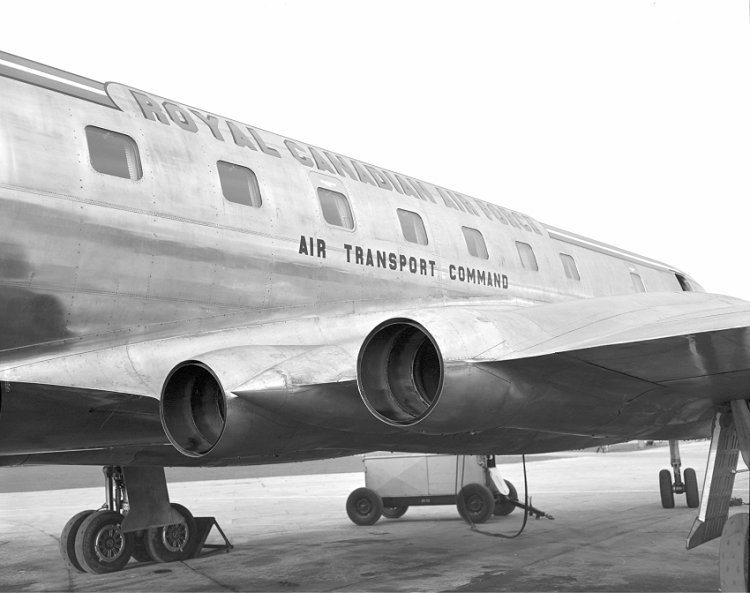
Quite a few early jetliners lacked normal nacelles.
EDIT: I found this wikipedia page [1] and clicked around, and the only jetliners I found without nacelles are the Tupolev ones -- the Tu-334, Tu-104, Tu-110, Tu-124 -- and the Tuplev supersonic Tu-144.
There were many military designs, such as the British V-bombers, with engines mounted in or directly on the wing, without pylons.
I can recommend "The Struggle for Europe" - he wasn't just writing about the history, he was actively taking part.
> The accident report's use of the word "window" when referring to the Automatic Direction Finding (ADF) aerial cutout panel[121] has led to a common belief that the Comet 1's accidents were the result of its having square passenger windows. In fact, Comet 1's cabin windows were very similar in shape, with similar corner radii, to those of the Boeing 377 and Douglas DC-7[122], both of which were pressurised aircraft. The windows in Northwest Airlines' B-377 were in fact larger and notably more rectangular[123] than those of the Comet 1. While stresses in the area of the passenger windows were significantly higher than de Havilland had calculated, nowhere in the accident report is it claimed that the fatigue failure of the Comet fuselage occurred was a result of the shape of the passenger windows, but instead from excessively high localised stress at bolt and rivet holes, for which insufficient reinforcing (and therefore structural load distribution) existed.
yoke: NOUN; Irish informal; A thing whose name one cannot recall, does not know, or does not wish to specify.
Comet 1—registration G-ALYP, dubbed “Yoke Peter,” from the phonetic alphabet then in use in Britain (George-Able- Love-Yoke-Peter)
Also an interesting aircraft.