And yet the total CO2 contribution of the world-wide aviation industry is 'only' 2%.
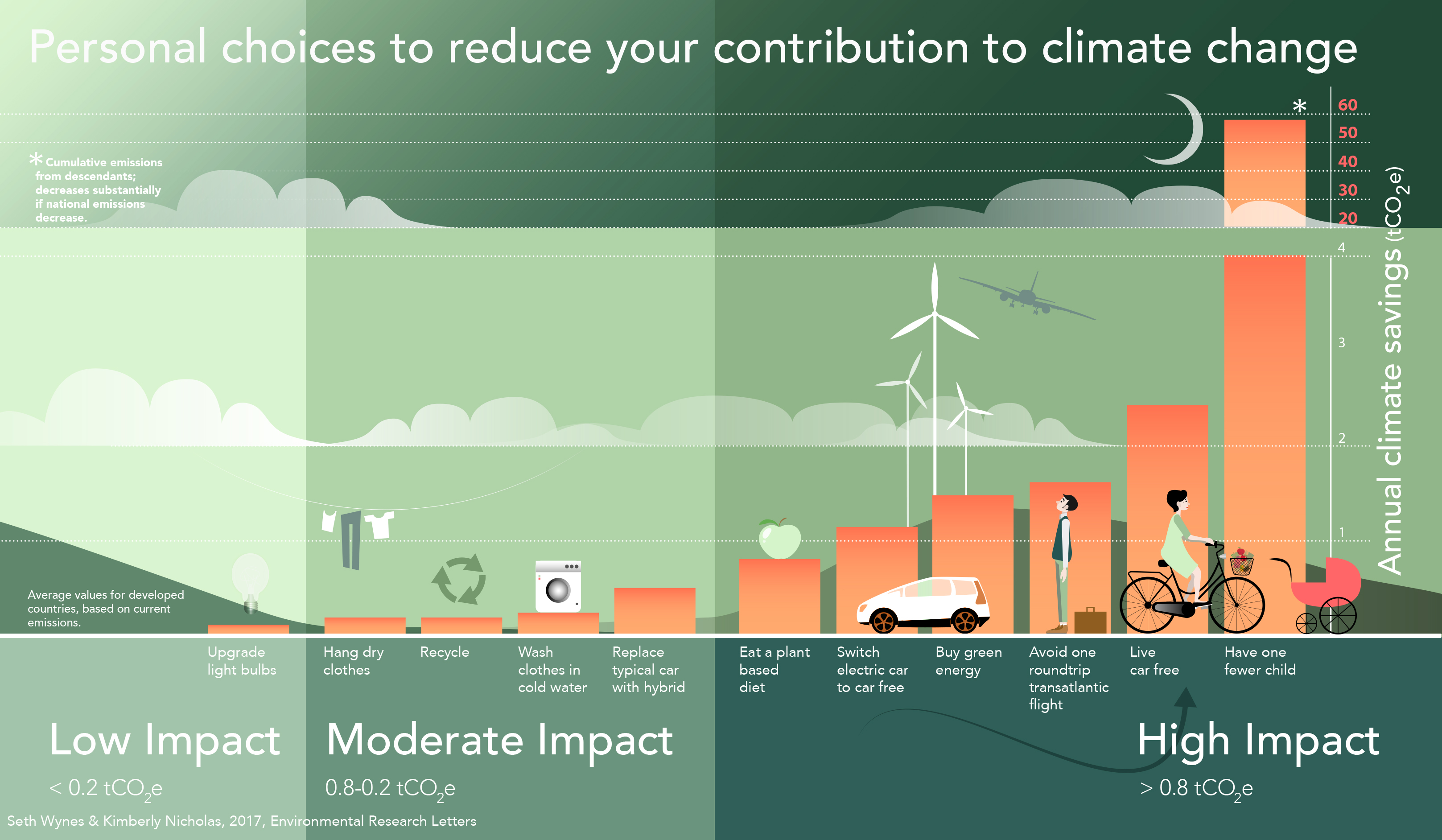
Based on that chart I would say having (more) children is by far the worst culprit. By now I'm really 100% convinced that the only way to save the earth is if everyone everywhere around the globe stops getting more than 2 children per couple, preferably not more than 1, so the world's population can shrink down back to somewhere around 1/10th of what it is now.
I'm 100% serious about this, and it makes me sad and angry nobody is actually really talking about this. Nothing we can do like eating less meat or skipping a holiday will help if the world's population doesn't shrink by a significant factor. It's a very unpopular opinion to have, because everyone likes children, they are the future, they are god's gift, it's a human right to make babies, bla bla, etc. But reduced to cold hard facts, there are simply way.too.many.people.
Yes I know this would absolutely kill our debt-based economies and probably significantly reduce the standard of living in many places, at least in the short-to-medium term, but that's a different topic. Completely destroying the earth will have much worse effect on the economy and standard of living anyway.
Well in some parts of the world people are already having less children. Even in Africa and Asia the birth rates are going down as people (women in particular) receive higher levels of education. So much so that in a few European nations the governments are actively encouraging couples to have more children. The most recent one I heard of is Hungary. I think the same is happening in some of the Scandinavian countries. In the far east (Korea if I'm not mistaken) there are even university courses on dating. In some of these places (Hungary in particular) the preferred approach is increase the birth rate as opposed to encouraging immigration to the country.
However, the contribution of children in the chart we are referring is dubious. The number is so high that I once googled and found what I think to be the original source. (A couple of swedish researches IIRC.)
They counted the children's and their descendants contributions and assigned them to parents for ongoing year.
There are many problems there. For example if the birth rate would be calculated as 2, the contribution would be infinite.
Also counting multiple generations is problematic, because if climate change is not mitigated within one generation we could be in for Mad Max * Water World.
https://en.wikipedia.org/wiki/Environmental_impact_of_aviati...
I also read somewhere that propeller based airplanes flying lower in the atmosphere would be better option for short haul flights.
This part of your statement desperately requires citation and supporting logic.
Among other things to consider - Compare moving a ~80kg person and a ~13kg bike at 18kph
vs
moving an 80 kg person in one-300th (ish) of a ~300,000 kg plane (call it 1000 kg of plane per person) at 960 kph. 777 GTOW is ~335,000 kg
Now considering that drag is roughly proportional to the cube of velocity, and compare 18kph on a bike to 960 kph on a plane. We'll call it ~50 times faster to keep the math simple. Drag is now 50^3 greater for the plane, or 125,000 times greater.
So you're moving about ten times as much weight and need to overcome 125,000 times as much air resistance while doing it. I think it's fair to say that you can got a lot more miles per burrito on bike than plane.
(https://www.quora.com/Why-is-air-resistance-roughly-proporti...)
This is a shame, because I love traveling to faraway places. But it comes at enormous cost. A low-frills slow cruise ship (think cargo ship with beds, not the Queen Mary 2) might manage all right, but even that's not fantastic. Better electrified rail to replace overland flights would be a good starting point
edit: But then again emissions at that altitude have a larger warming effect..
What about alcohol consumption?
Is confectionary, eg. chocolate, lollies, ice cream, considers food waste for environmental purpose, given they are highly processed and completely uncessary from a nutritional perspective?
So if you commute 10 miles to work every day, they are similar.
The effect over time or not using rentals/other people's cars maybe?