It’s debatable, however, how much that means. I suspect it serves more of a symbolic purpose, as a kernel of truth to a shared future fiction that the building is at least partially “original”.
In terms of costs, I suspect integrating those structures is likely to be more expensive than rebuilding from scratch. The loss is also greater than just the building, as it contained a multitude of art, some of it part of the structure like the famous stained glass windows, some not.
What takes time is often the financing: there are churches in Germany where, to this day they are collecting money and constructing piece-by-piece. I don’t know how this will play out here. For example: how much is the Catholic Church still involved? But I would assume the French state to be somewhat generous.
The other potentially delaying question is how to reconstruct. Going for an exact replica often feels anachronistic and sometimes tacky. The German Reichstag, for example, was reconstructed with a rather modern glass rotunda, and feels like a great example of combining old and new. The World Trade Centre was replaced by something entirely new. If they decide to go in such a direction, some time will be spent on architects’ competitions.
The reconstruction will be a restoration, to what degree, it remains to be seen, for example Reims Cathedral roof was rebuilt using concrete for the structure, but the general appearance will remain the same.
The symbolic is rather different that of the Reichtag, the Reichtag being the symbol of a new state in the XIXe century, destroyed during its darkest hour, and finally reconstructed after the rebirth of Germany and the Reunification with a mix of old and new, By itself the Reichtag summarizes German history.
Nowadays churches in France belong to the city, not the Church. Which has led to many tragedies recently, with town halls (usually Communist) intentionally neglecting churches until there was no choice but to destroy them. I don't have any faith in the French state these days to be consistent with monuments.
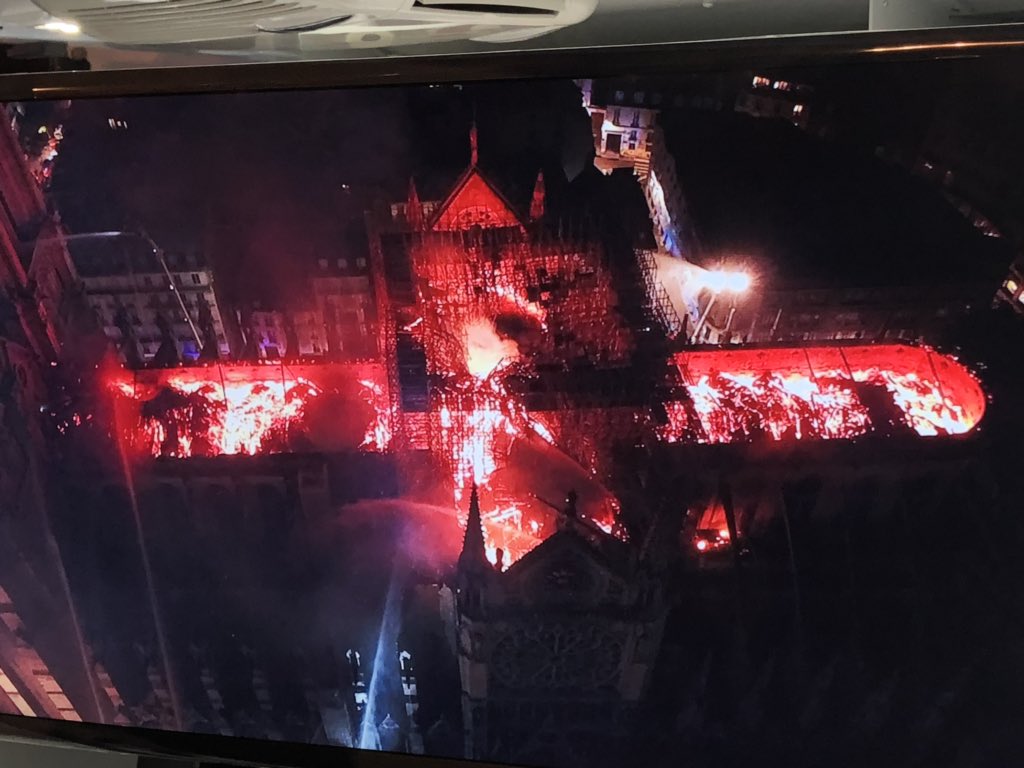
Looking at some aerial pictures (https://pbs.twimg.com/media/D4OFOKMWkAEEHsz.jpg), it looks like the vault is holding except maybe for the section above the transept area (where the spire collapsed), but it has probably suffered, if not from the collapse of the roof, the heat has probably weakened it.
But yes, one or two decades of restoration is a realistic estimation, it's roughly what it took for other cathedrals to be restored (Rouen, Reims) after the World Wars (hopefully Notre-Dame will be in a better state after the disaster)
Hopefully things will move faster with Notre-Dame de Paris, but it'll take at least decades.
But in this kind of restoration, the devil is in the details, repairing the structure and rebuilding the roof and the spire will probably take around 8 to 10 years, if the vault is not in too bad of a shape, more otherwise. But repairing the the sculptures and decoration, with all their minutes details will take generations.
For these, what was not destroyed by the fire is probably heavily damaged by the tons of waters poured to save the edifice.
Respectfully, you have no idea what you are talking about. Nobody in Europe would consider tearing down the remaining structures and rebuilding from scratch because it's cheaper.