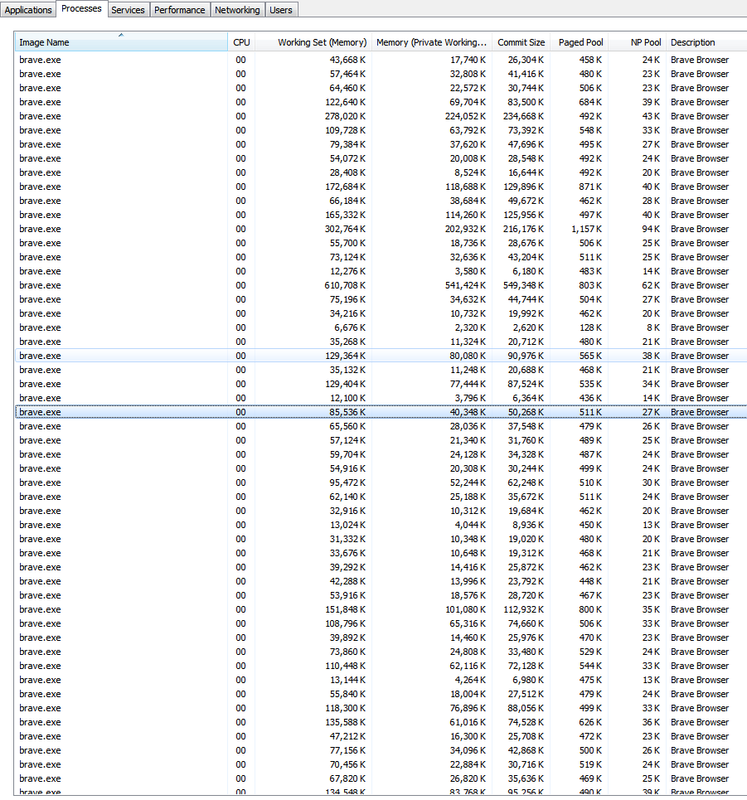
Installed it and then noticed in my firewall that it is
- trying to connect to a number of IPs owned by google, umm OK
- sending a multicast SSDP UDP request on port 1900 to 239.255.255.250
So googled that and got this page: https://community.brave.com/t/why-is-brave-issuing-upnp-disc...
Which basically tells you that the first thing Brave does is to try and detect what devices are in your local network.
... and that's where my Brave experiment ends.
edit:
Also note that uninstall is completely silent, no confirmation that it actually completed.
The uninstaller also leaves behind the updater utility AND the Windows Task scheduler tasks that run the updater.
The end
In evaluating Brave, you have to give it apples to apple comparison anyway. Brave vs. Chrome as its directly built on chromium. For compatibility, it shares the chrome app store too. I like to think of Brave as Chrome without most of Google but with all the benefits.
Anecdotally, I switched a colleague to Brave about 3 months ago. He decided to switch back to Chrome. Chrome was so much slower than Brave and added battery drain that he came back. I assume it was all the additional requests cut out (Google) or blocked by Brave (Adblocker).
Trust is something you have to earn. I do not install Chrome as I do not trust google. They have too much of my data already.
Brave claims at their main page:
"Brave is open source and built by a team of privacy focused, performance oriented pioneers of the web."
OK well they failed my 5 minute test.
Not having removed the SSDP parts is one thing.
Not uninstalling your updater after running uninstall is straight out sloppy.
There is controversy about how Brave does stuff, and I agree there is some sketchy stuff they are doing (replacing ads with their own). I'm glad they are giving us a choice, though, and exploring different options for sites being able to makes some money.
Blocking ads and trackers by default is pretty much essential in 2019.
The myth about ad replacement doesn't seem to want to die though!
There is no ad replacement, though the roadmap says at some time in the future publishers who opt-in will have the option to have their ad-slots filled by Brave's privacy-respecting approach.
For now I think the only ad trials running are pop-up notifications if users opt-in, and that's only in a few markets at this stage.
Not something I plan to opt-in to, but looking forward to the Github / Reddit / Twitter tipping and integrated crypto wallet.
That's all rolling through in the next few months.
How is it better than a choice of plug-ins to block them?
Just want to reinforce this from my experience. I've been using Brave since before they were based on Chromium. And a lot of comments were saying that Brave replaces adds with their own. But I never saw that.
Now they have a feature you can opt-in, to see adds and get BATs for that. I actually wanted to test this and opted in, but still never seen an add. I guess my location is not yet included.
So at least based on my experience from using Brave for a long time - it's hard to get adds even if you want to.
I would be more open to trying/using brave if someone respectable packaged it. As of writing, not a single distro packages it. It would lower my barrier to entry a lot if it were packaged by debian/fedora/f-droid. It doesn't imply anything serious, just that it can be built from source and that it passed the distro's basic diligence and guidelines. This seems like low-hanging fruit from brave's standpoint, and yet multiple issues on their github tracker about packaging downstream have remained open for a while.
> It doesn't imply anything serious, just that it can be built from source and that it passed the distro's basic diligence and guidelines.
For a modern web browser it probably doesn't achieve the latter. Both Chromium and Firefox are too complex for Debian's meager backporting resources. So they make an exception to their guidelines and ship the LTS release. I suppose the userbase just hopes that bad things don't if the browser LTS upgrade happens before the OS's LTS upgrade is ready.
I mean, what is the "worst" stuff it doesn't have? Account sign in?
It seems like there are plenty of other Chromium embedders to get that without the sketchy stuff.
That's years ago, I believe, and there are still ad blockers that don't seem to accept compromise.
Over here brave just dumps itself on c: in win64
Does it make money by showing you ads?
Chrome: Yes Brave: Yes Firefox: No
If yes, then they need to track your behavior in detail. I'm sure you don't deserve to be tracked.
Brave's stated goal is to establish an alternative ad-based business model that's long-term viable without the user being tracked. Will this be successful? Who knows, but at least they're trying to find a business model that respects your privacy while being long-term sustainable. Firefox's model doesn't, at least the way it works now.
Of course, development costs a lot. They will not need to rely on Google in the future if more people donate to them regularly. Consider donating to Firefox.
Does it render text in an ugly manner?
Chrome: No
Safari: No
Firefox: Yes
The unfortunate thing is that many Firefox users prefer the Firefox text rendering.
There’s no solution to fix this (I’ve researched a lot). It’s just a divide in the users based upon preferences.
Seems like an unnecessary optimization, though I'm sure it was fun. I wrote one a little while back in C++ also[0]. It's not documented the best, but uses a kind of custom tree to match.
0 - https://github.com/cretz/doogie/blob/master/src/blocker_rule...
This has already happened: https://www.theregister.co.uk/2019/04/03/googles_widevine_dr...
> Developer Samuel Maddock found this out to his cost. He's been working on an open source Electron-based (Chromium) browser called Metastream that allows users to stream videos in sync with one another. It's designed to be a way for friends to watch shows together even when they're apart.
> But Google's Widevine DRM business doesn't want to work with him. After four months of waiting, the firm responded to his request to license their proprietary DRM code, in conjunction with the castLabs API, with a denial.
(edited: formatting)
https://docs.rs/regex/1.1.7/regex/struct.RegexSet.html
http://intel.github.io/hyperscan/dev-reference/intro.html#co...
I'm not particularly impressed with their business. In fact I'm pretty disgusted with it.
https://brave.com/brave-ads-launch/
Users can then choose to contribute some or all of those funds back to the publishers/creators they visit that have signed up to Brave's platform. They try to do this all in as privacy-preserving a manner as possible.
In any case it's a great browser, at least better than Chrome when it comes to privacy, and I personally won't fall for the propaganda. Just like Tesla, there is a lot of "old" money that is threatened by the upstart so there is also a lot of negative sentiment.
"If a publisher has not verified ownership, then a user’s contributions will be held in reserve inside the browser for 90 days. The browser routinely updates an internal list of all verified publishers to determine whether a property can receive contributions. At the end of the 90 day period, any contributions marked for unverified publishers will be released back to the wallet. No funds leave the browser except to go to verified creators."
Previously:
"Previous versions ... would then hold contributed funds for those publishers in escrow until they’d verified. [And] Funds that were contributed from user-funded wallets will be held indefinitely, until the publisher verifies and transfers them to their own wallet."
That sounds like they had a suboptimal policy, realized it, and fixed it. If they _keep_ their 5% cut, or the interest on it, from contributions to unverified creators, I'll share your criticism.
But even if you're right, why is it unethical for me to install software on my own computer to render websites differently than the creator intended? For example, by removing ads? Or replacing ads with different ads? Or rendering all ads upside down?
Exploiting this grey area in the law will lead to a response from the courts and lawmakers. That response might well require that browsers display pages exactly as the publisher intends.
In other words, the end of ad blockers and other tools, thanks to Brave.
(Not at all unlikely given that Google seems to want that too.)
As for the hypothetical youtuber, they are always free to put product ads directly in their videos if they can/want to. However, if they can only make money via abusive 3rd party trackers, that's on them.
Does it make money by showing you ads?
Chrome: Yes Brave: Yes Firefox: No
If yes, then they need to track your behavior in detail. I'm sure your family deserves more.
Give them Firefox, turn on Webrender (it's awesome even today - biggest speedup you can get in FF).
It's little touches like how you can't re-order extension buttons with a basic mouse drag - no, you have to go into 'Customize...', and that's so clunky and 2004. They have some more work to do to really make it competitive with the mighty Chrome.
So after all that time, Brave is the first browser registering my interest due to these regular news stories. I still use Google services, but I don't like their current dominant position in shaping how the web works. That's too much power.
No clue about Safari but Firefox dies under these conditions, and I'm not interested in Chrome given not only Google but their 'vision' for the future of that browser including native anti-ad blocking. Opera was okay, but I enjoy the privacy features of Brave. Native ad-block, tracker blocking, etc that can all be customized per site in literally two clicks. Lion->Third Party Trackers for instance would allow me to enable third party trackers exclusively on Hacker News if, for some reason, I wanted to. Pretty cool stuff.
PS: using Brave browser, which is essentially a Chrome mod, also cements Google monopoly, indirectly.
Mozilla did a lot for so long, let's hope they can circle the issues and find resources to fix them.
I'm sure the more modern languages also help though, but I don't think that using a modern language is the major reason for the speedup.
It's a regular working process.. use a language that let you write ideas down and test them quick. Later reimplement them in assembly. I mean C.
Once they do, it'll be pretty amazing.
The pop up ads have been activated and I have been receiving the token for clicking, about $8 month worth of BAT. I am hoarding the tokens so that USD value might go up if the token moons together with bitcoin.
I would read that.
https://github.com/brave/brave-core/search?q=rust https://github.com/brave/adblock-rust-ffi https://github.com/brave/adblock-rust
Unfortunately Firefox is not a good match. I've tried the latest versions of Firefox and the developer edition, before using Brave and it still uses so much CPU in my macbook and the fan of the laptop sounds like an airplane is about to take off.
Edit: I have multiple Google accounts signed into. And also, it does not block all ads in GMail which uBlock on Chrome is able to.
Just out of curiosity, have you tried Firefox? I know it’s not perfect, but with minimal tweaking I think it’s very competitive.
I get around it with a too-big hammer and run Qubes. Brave in my personal Qube knows nothing about brave in my work Qube.
There's probably a better way.
In what situation would this "orders of magnitude slower" actually manifest itself as a perceptable delay?