*Netbooks were low-powered mobile devices (basically mini laptops) that launched in 2007 and basically disappeared (as a viable market category) after the iPad and its kind were launched in 2010.
EDIT added "form factor" for clarification
https://liliputing.com/2019/09/one-mix-3-pro-is-the-first-mi...
These aren't cheap (like the original netbooks), but they're pitched against the low end of the ultrabook market, for folks who need a better keyboard/typing experience than a Surface Go.
(Disclaimer: I own a One Mix 3S, predecessor to this new version and I rate it quite highly, except for support from the manufacturer which is patchy at best.)
Chromebooks are very much alive and well.
Chromebooks aren't a panacea.
Facebook is working on building out the tech via VR, but with an eye to AR and generally out in the open.
Apple is building out the underlying software support while working on some AR hardware in secret.
Microsoft has their enterprise hardware, but not sure what they're thinking about otherwise.
Using the phone as a computing device that powers a visual digital AR layer for the real world where you can interact with AR overlays either with thoughts (Neuralink?) or more likely basic gestures (like Oculus' camera tracking, or armbands) would be another revolutionary shift in platform UX and be the big shift away from phone screens.
I'm not sure how possible this hardware currently is or how soon this transition could happen, but people seem to be laying the ground work. Michael Abrash wrote an old blog posts about a couple of reasons why this is hard (primarily drawing black in AR), but he's been at Oculus a while now and I'd be curious how his thoughts have changed.
These foldable phones strike me as a dead end nobody wants.
Do you consider the hololens exclusively enterprise?
In general “we” don’t need a revolution of the current form factor. A sizeable portion of users have stopped upgrading and wait for their current phone to be dead, some are already clamoring for less, going back to iPhoneSE like phones.
I think the duo is not targeting the “we”, but way more specific user niches who have non generic goals and are not happy with even the bigger phones we have now. These people could be enough to float a product line, even if it doesn’t fish the other 90% of the users and their dogs.
I’d compare it to the Surface Studio, which was never expected to be a general public device as well.
I'm not happy with today's massive phones, but that doesn't mean I want a massive phone that can fold in half!
I just want a non-slippy phone that fits in my hand and pocket, and has a high-res screen. Truely, I don't understand the trend for slippy phones that keep getting bigger and bigger :/
Except these will be >$1000 netbooks.....
I think the future is conversational computing. I don't own an Alexa/HomePod/etc (yet... maybe some open source on prem thing at some point), but I think that's where the puck is moving. It's just that today their capabilities are somewhere around a rotary phone vs. an iPhone. Better than a telegraph (which I guess in this analogy is _typing_ your words into a document) but still very rudimentary. All it needs is time and effort.
Similar to HomePods, we have AirPods and their equivalents. The phone is just a conduit through which can pass the data necessary for the OS to talk with you, to do what you need.
For one, there is zero discoverability. I can ask Google today's weather. I can ask tomorrow's weather. I cannot ask yesterday's weather. Leaving aside why that would be (I would find it useful to know that it's X degrees hotter/cooler than yesterday) there's no way for me to know that without asking. It's the audio equivalent of fumbling around on a keyboard in a pitch black room. Just imagine placing a food order. It's going to have to read a menu to you and you're going to have to remember it all. No amount of tech improvement is going to change that fundamental fact.
Secondly, you can't multi-task. Or have more than one person using it simultaneously. Right now my wife and I might be looking at our phones at the same time, perhaps looking stuff up, maybe tapping out an e-mail. We'd have to go to separate rooms to do that.
But if I want to know today's weather or play a song, it works fine. As long as it recognises my voice correctly and there isn't too much background noise.
Let's be real, "conversational computing" may work in movies, but in reality you don't want people in the office or on the street hearing your interactions with your phone.
Also, talking to any of those assistants is literally the worst imaginable mode of interaction with a computer, period. Touchscreens in cars are in close second place.
I hate people who talk like this, as if there is something magical that people should be working on.
But I agree that innovation is often incremental efforts of exploration and convergence, like how we got to where we are in VR today. Magical phenomenal change like iPhone is rather exceptional.
I'm still waiting for a phone on which I can comfortably edit, build, and deploy code.
I don't think the reliability of a truly foldable display (e.g. Samsung's Galaxy Fold) will be very good until another couple versions of generational improvements.
The foldable display seems cool, but also seems to be, IMO, an expensive solution looking for something we don't know to be a problem yet. The problem is having no screen at the hinge. How big is this problem though? In theory it's nice but people don't even have foldable devices in these form factors yet. For all we know, most people might not mind the dual-screen approach, just like a lot of people have not minded the notch or other shortcomings of previous and current devices.
Otherwise it's just a thick phone that converts to 2 phones...
In case anyone hasn't seen Westworld: https://www.youtube.com/watch?v=q3dD7jOLaes
I find the ability to completely "close" my phone really appealing. It feels easier to ignore it, and the screens feel more protected to me.
I can also only describe the second benefit as "its like two monitors". I can watch TV on one and respond to messages/browse on another. I use a Note8+ already, so big screens for watching crap are already my preference though.
Every phone I've had with a case, grit collects betweeen the case and the back of the phone and scratches the phone up. I can imagine the same thing happening between the two screens if folded in my pocket.
I want to simply have a keyboard and screen that "looks like a laptop" but the brains is actually in the phone in my pocket!
And then when I have a proper dock, I just get a larger monitor(s) and larger desktop keyboard.
But the brains are still in the phone!
The key benefit (of the dumb laptop, especially) is I still want a laptop on the go, but..
1. Why manage data flow across two separate devices. My phone becomes truth, always.
2. My phone already has always-on data. Why worry about data for two devices. (To 4/5-g subscriptions, etc.) Searching for wi-fi.
3. Better power consumption for my "dumb laptop" device. (Less processing power in the laptop, hopefully space for a bigger battery)
I would buy this in a heartbeat!
There was speculation that this would enable Google to swap out the Linux Kernel for Fuschia when it becomes available.
The Windows NT Kernel has had a HAL and the ability to do this since it's inception in the 90s. Microsoft has been toying around with WSL on the desktop, what are the chances that they just beat Google to the punch and are running Android on the Windows Kernel?
How crazy would it be if WSL was just a cover for getting Android running ontop the Windows Kernel?
Announcing products like this should be reported on as an embarrassment for the companies that do it.
The best designed UI imo, and a great alternative to Ios and android.
When Windows Phone died and I switched to Android, the UI didn't feel as intuitive as the Windows one did. And of course it doesn't help that Google change the UI, in particular the settings, all.the.time.
The bigger question is "what do you need a folding display for?"...
What people need are actually two contradictory (until now) goals: compactness and large screen size. Folding is one solution to solve this contradiction.
They also released those Nokia branded Android devices.
It is not like MS has been doing consumer hardware releases for that long or anything!
It'll be interesting to see the support, IMHO one thing that keeps people (software devs and consumers) from buying into a new Android OEM that is selling an "Ecosystem" (e.g. Samsung Note) is the fear of a product line being dropped.
Personally I've replaced my last macbook with the surface and my iphone with an android phone, use mostly linux or windows with WSL these days and I see less and less apple products in particular among developers where the windows/linux combo seems to become more prevalent, at least anecdotally.
From UNIX point of view, not so much, given that they were one of the first licensees for PC hardware with Xenix.
Exec1: does it connect to Exchange?
Exec2: no.
Exec1: nixed!
Exec2 should have said: it will in the future!
https://youtu.be/dmaioTs0NH8?t=5111
The bigger dual screen device is the Surface Neo.
I doubt the average person can even tell the difference from a 660, to a 835, or an 855, given all the rest of the components (mainly storage) are the same.
2. Does anyone remember the name of a similar Microsoft notebook that was teased 5-10 years ago? It was a foldable notebook and notetaking device kind of like Remarkable. I wonder if this is the spiritual child of that.
2. You're probably thinking about the Courier. You'll see more about that in the thread about Surface Neo, which is the modern take on Courier.
However i'm very dubious of what the dual screen experience will be like bolted on top of Windows (NEO) and Android (DUO).
Somehow in my humble opinion Apple have been able to run rings around Google and Microsoft when it come's to pure UX in mobile tech and given the past history i fully expect that true in the future.
This is where i expect DUO will stumble, in the same way that Samsung fails with its extensions and bolt on's.
The catastrophe that is the Samsung folding phone didn’t send a strong enough message to the industry I guess.
IMO, Microsoft have done a fantastic job with the Surface Book. If they could replicate that high-end build quality while providing a solid feature set and a clean Android build, I can't see it not selling well. Throw a headphone jack in, and I'd wait in line for it!
The dual screen is interesting, but I don't see its use just yet.
It gives a better typing experience than a phone currently does & offers unique controls for apps on the 2nd screen.
Whereas with the laptop version I assume people will be missing their keyboard typing experience or complaining about having to carry around a bluetooth keyboard. I still hope they improve their concept of docking an Android phone & using it as a laptop replacement with a keyboard, mouse & monitor.
Hopefully it makes people watch videos in landscape again & quit recording in portrait mode. That alone would be a win!
- Edit - I just read a better article explaining their keyboard concept for the laptop version. That seems like a slightly better experience than I was imagining. Hopefully it's harder to lose than their pen.
The Surface range is good because it packs so much functionality into a nicely designed package. The same design principles, with a full feature set, would sell like wild-fire, and would put a lot of other phone manufacturers on notice.
These are all just wrappers around the latest qualcomm snapdragon with whatever twist the hardware manufacture wants to add. Basic functionality in all of them will be badly broken and there's more or less nothing you can do to fix it.
At least the iphone ships with an ssh client and scripting environment now. (not that I'm an iphone fan, it has it's own problems.)
I disagree.
The performance and battery life differences between different phones running the same chipset is insane.
Read through https://www.anandtech.com/show/14716/the-black-shark-2-revie...
For some benchmarks, the top phones are 50% faster! Storage benchmarks (not shown in that particular review) can be even more dramatic. Battery life differences can be huge (multiple hours) at the same capacity.
Each manufacturer customizes the heck out of the kernel, and also attached firmware. LTE speeds can vary dramatically with "the same antennas". Same for WiFi speeds.
The current Android phone I am using works great. It is surprisingly fluid and rather nice to use, though I'd argue Windows Phone 7 was still nicer (or at least more fun) to use, that ship has long since sailed.
I use the Termux app to SSH on my Android phone all the time.
Microsoft would've done better by making a x86 Surface Go running full-sized Windows that happened to make phone calls. There were a few models of Android tablets that could make phone calls, so it's not as if it were a outrageous idea.
IMO it was a mistake to give up on the Windows 10 mobile OS but it's also true that MS has made too many mistakes for it to ever take off at the point where Android and iOS have been developed for at least 7 years already.
https://play.google.com/store/apps/details?id=com.microsoft....
Apple designed the iPhone to be a pocketable one-handed companion device to a real computer.
People started using them as their only computer. The changed the design parameters enough that it made sense to offer a less pocketable device with a much larger screen.
The thesis is: maybe that market can be segmented even further, by adding an even less pocketable segment with even more screen space.
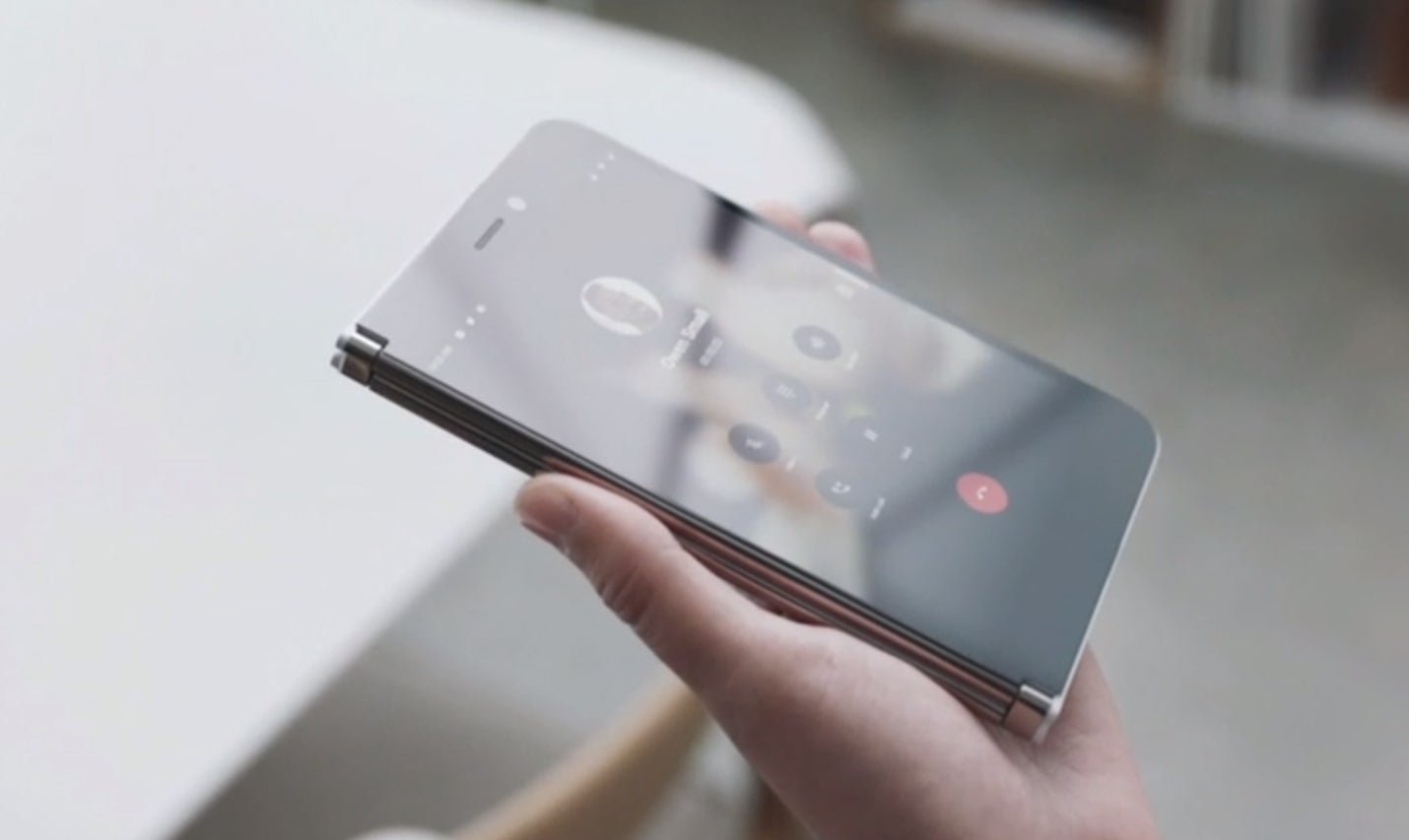
Unless I'm misunderstanding, it seems like you wouldn't ever need more than 270 degrees.
https://andro4all.com/files/2019/10/Microsoft-Surface-Duo.jp...
From this:
https://livecenterimages.azureedge.net/livecenter-images/lci...
(Disclaimer: work at Google, totally unrelated product, not the opinion of my employer, etc.)
I wouldn't really expect any difference. It's not like Apple's lower end products are buggier than their higher end ones.
but...how will I mount it in the car for GPS?
Just fold it?
https://andro4all.com/files/2019/10/Microsoft-Surface-Duo.jp...
I would get a bigger mount for the opened device though, maps are always nicer on bigger screens since you can see more.
Nice looking Surface lineup and hardware nevertheless, but after Microsoft removing that offline setting, I think that was a big turn off and a no deal from me for now, unless they reverse that atrocious decision to using online accounts only.