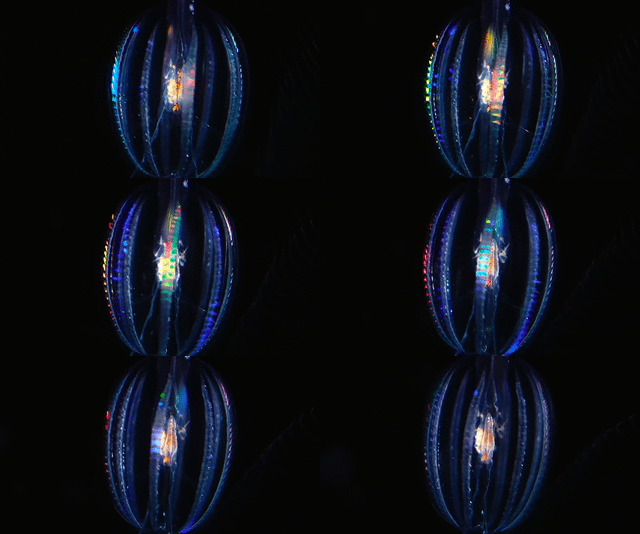
And blue keeps you awake.
The guys with their RGB computer gear where right after all...
https://upload.wikimedia.org/wikipedia/commons/4/42/LightRef...
https://media.giphy.com/media/sbxNFGQ59hWMg/giphy.gif
https://64.media.tumblr.com/afb8cb70c18bc8be2133410b46c3ca13...
There's a Jasper Fforde book[1] which treats green like an opiod (of course, the book is about a dalton style genetic dystopia - colour vision instead of race, but one with Ford in a Mao style "great leap forward").
The whole book treats colour as a powerful thing to manipulate bodies and minds.
[1] 125-66-53 in - http://www.jasperfforde.com/grey/chroma.html
I was about -5 and moved to -4.75
Red adds speed.
Blue adds cold.
That's why I use Redshift for Linux so the screen becomes more red.
Nice to know it's good for the eyes too
I'm lucky enough to live in a relatively green, sunny area.
I suspect it is just because I tend to spend too much time in dark rooms and in front of screens and being in the bright sun "fixes" that for a while.
Look up "pinhole camera" for a good explanation of this effect. These cameras don't even need a lens!
No, the aperture has no effect on the field of view. They are orthogonal features of how a lens works.
But the article ties this to light absorption by mitochondria, which it says absorb [1] 650-1000 mm light.
Two questions:
1. If you use a narrow band source of light, does it really need to be around 670 nm, or will anything in that 650-1000 range likely do?
2. Would it actually matter if there is also light outside this band?
If it doesn't actually have to be narrow and only contain 650-1000 nm, then it might actually work with some RGB devices. There seems to be significant variation among RGB devices, though.
jlokier linked to spectra for iPhone X [2] and iPad Pro 9.7/iPad Air 2 [3]. The iPhone X with Night Shift at maximum has a significant output about 650 nm. The iPads have very little above 650 nm.
This suggests that RGB devices might work for this, but there is no easy way of knowing for a given RGB device unless you can get its spectrogram.
From what I've been able to find, it looks like Philips Hue bulbs just miss, with their red falling off rapidly near 650 nm.
Candles look really good for this [4], and I'd guess similar for fires. I wonder if this means that ancient people tended to keep better eyesight in old age then us, because every significant light source they had (sunlight, moonlight, firelight) had a lot of its energy above 650 nm?
[1] OT, but why the heck does the "b" in "absorb" become a "p" in "absorption"?
[2] http://www.displaymate.com/Spectra_41a.html
[3] http://www.displaymate.com/Spectra_35.html
[4] http://dev.informationdisplay.org/IDArchive/2015/NovemberDec...
Your pupils will adjust to perceived intensity. So if the bulk of the light comes in at shorter wavelengths it'll contract and you'll get even less of the already small fraction in the range of interest.
On the other side in the infrared it's more a question of safety. You don't want to overload your retina.
So you want it visible but long wavelengths only, which boils down to a fairly narrow range.
That's assuming it actually works. Single studies and all that.
https://english.stackexchange.com/questions/59530/why-does-t...
If retina cells' energy absorbing properties are so selective, then how such treatment is different from daily exposure to ambient or dusktime sunlight? Or this 'recharging' stops in presence of 'wrong' wavelengths in the spectrum?
Now I'm wondering if 5 minutes without sunglasses could be good?
Any link to where you've read about this? Or search words?
I'm 30 now, I have been myopic since 6-7 years old. Every year from around 1998 to 2008 I went (well, was forced to go by my mother, she didn't like the idea of glasses) to clinic, where during 10-14 days I and other children did lots of exercises, which presumably had to improve my eyesight. Staring into a device, which emitted red light, was one of such exercises.
It usually happened one time a day, a doctor collected all children (10-15) into a group, we went into dark room, where the doctor pointed a light beam from that device (it was semi-portable) into child's eyes. There were 3-4 sessions, 1-2 minutes each. We were also encouraged to look into the sun in the evening, when it is close to the horizon and is red (for a few minutes each day).
The only problem with all those exercises is that they didn't really worked. I remember that during the first few years I at least was able to see some marginal improvements (like being able to see at the end of 2 week period 5-7 lines out of 10 instead of 4-5 on the standard chart).
However, all subsequent years I (and most children there) just imitated the progress due to the pressure from doctors ("Don't you see that line? You saw it yesterday. Have you watched TV again?") and parents ("Darling, look more carefully, you probably will see at least some letters there."). I still remember the first 7 lines (+ the last line) of that table by heart, more than 10 years since I saw/used it the last time.
Nothing worked: - neither exercises with lenses (you look though +lenses, then though -ones, than again though +ones and so on) - nor direct shots of vitamins and actovegin into your butt and under eyes (not as unpleasant experience as it sounds, they just enter a thin needle 1-2 cm below each of your eyes and administer a shot, it doesn't hurt all that much). - nor special eye treatment, where you hold small reservoirs with hot Riboflavin (vitamin B2) contacting your eyes for 30 minutes each day (there were electrodes there, with small current going through your eyes, probably to make the absorption better) - nor neck massage (What the hell neck massage has to do with eyesight? We were told, that it somehow improves blood circulation in the neck, and it is somehow better for blood circulation close to your eyes). The most pleasant exercise, by the way, you just seat for 5-7 minutes and a lady doctor does a massage.
Doing that as a child, without parents (I was dropped of in the morning and taken out closer to 16.00-17.00), waiting in queues for all those exercises (sometimes - 30-60 minutes for each). It was as close to hell as I got under my childhood.
The result - I got more or less the same -4 and -5 until I was 20 years old, just as other children, which just wore glasses. A few years after that I did laser correction, since that time I got 100% eyesight.
So, I don't believe in that "treatment". If it does something - the effect is marginal and quickly disappears a few weeks later. Get good/convenient glasses or contact lenses, if you have enough money - wait until 20-22 years and do laser surgery. It will change your life just as it changed mine.
Massages CAN improve circulation. It's just uncertain if it really helps with the issue at hand. For example, head massages increase hair width but don't cure baldness.
2. Ivano-Frankivsk regional hospital/clinic. Well, massages probably can do many things, they just don't cure/slow progressing myopia.
I honestly consider kazap/hohol to be too comical to be offensive, but apologies if I offended, not my intent.
Interesting, I would have never thought that we have cells that use light as energy.
Also, is this deep red light found in sunlight as well? As in, does this treatment only work with light that is restricted to this wavelength, or does it work with any light that contains ample amounts of this wavelength?
I know its been coming up here and there that we are just not getting enough sunlight in general with everyone studying indoors, working indoors, exercising indoors, etc. Just seeing if this is a broader issue of people not spending enough time in the great outdoors.
Light is ridiculously important for mitochondrial health, and that effect on mitochondria is one of the main reasons sunlight is so necessary for optimal health. Fun fact, 75% of potential ATP production only results from light exposure, with only 25% from food. We run on light more than we do food (necessary nutrients and minerals aside).
This is fascinating. Would you care to share literature that dives into this?
I finally have an excuse...
It trains the brain rather than affecting the eyes.
I have practiced looking at a pencil end / hair follicle / other small object as close to my eye as possible and then looking at a distant object for years now. I have also read about the Bates method, palming, etc and have tried them on and off over the years.
The close-far method seems to be the only reasonable "exercise" - though no one can tell me for sure whether there is muscles involved (or relaxing said muscles) in looking far away.
Anyway, nothing has helped. I also don't see strong research on the topic however. As an example, doing a one-arm chinup is possible for most people. It can take up to half a decade of structured, regular training.
Maybe fixing eyes is possible, but it requires 30+ mins a day, every day for years. Who knows.
Edit: Also, the strongest studies are the ones comparing Chinese kids in China and Austarlia, where the latter spend more time outdoors and have reliably better eyesight. Not really relevant to adults, but can help when raising your kids.
Your point about the outdoors is also made in the book. We are spending our time in near focus on screens and not using our far vision, as in nature. I now make sure to take time during the day to get outside and do distance gazing and expose my eyes to sunlight.
I recommend printing an eye chart and testing yourself w/ the same lighting and distance from the chart.
Also, keep me updated please (if you remember to, post here or something), genuinely interested.
I am tempted to buy a huge screen and place it across the room from me to have the focus point further away.
I think part of the problem might be that it's focused on one place, rather than close focus. But I guess it's better to be focused further away.
So I guess this is not new practice.
Anybody know how to make a 670nm deep red light?
Can an iPhone do it or would you want to buy an LED?
edit: I don't know any light source that peaks at that wavelength, so you would probably use a broad spectrum alternative and a filter to achieve what you want.
While it can be very bright in the open sun, your eyes will compensate for this. A light source which emits harmful amount of IR and little to no visible light will probably not elicit this reaction and damage your eyes without you realizing until it's too late.
Infrared lasers are particularly dangerous for this aspect.
In the "LED Indication - Discrete" category at Digi-Key, there are no 670 nm LEDs. (Digi-Key lets you filter on both peak and dominant wavelength. I assume peak is what we want here but it doesn't matter because there are no 670 nm dominant in those categories either).
In the category "LED Emitters" Mouser does list 670 nm in the filter, but checking out a few of those it seems they all actually specify peak wavelength is 650-670 nm.
I probably just missed it because I don't read German, but at led1.de I could not figure out how to filter on wavelength.
Assuming one is just looking for some through hole LEDs to whip something up on a breadboard, it looks like the closest readily available inexpensive LEDs are 660 nm peak and 638 nm dominant at around $0.40. Typical example [1] which is $0.41 for one, $2.95 for 10.
Since the article said 650-1000 nm, if we assume a peak of 700 nm works, then there are a lot of options, such as [2]. Dominant 635 nm. $0.29, 10 for $2.14.
[1] https://www.digikey.com/product-detail/en/lite-on-inc/LTL-42...
[2] https://www.digikey.com/product-detail/en/kingbright/WP3A8HD...
Still, if it doesn't help my eyes it'll be useful for my paranormal investigations ;)
Here are measured spectra for iPhone X and iPad Air 2 respectively:
    http://www.displaymate.com/Spectra_41a.html
    http://www.displaymate.com/Spectra_35.html
So you can't make a spectrum containing a single peak around 670nm.