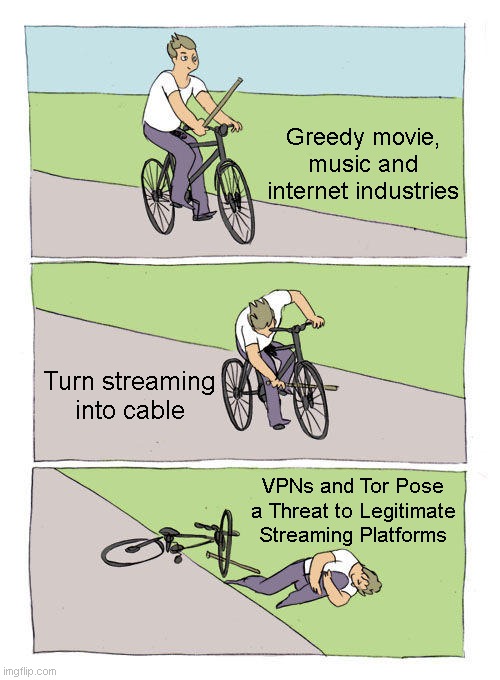
I had Netflix, Amazon, and Hulu subscriptions last year.
Today, I have none of those, except for one or two video purchases I made on Amazon.
Now I'm supposed to have Disney+, CBS All Access, HBO Max, Peacock, etc., and that list will probably grow. And we're at a low point in what we consider entertainment. It's bread and circuses up the wazoo. And now I'm apparently supposed to pay more(I heard the Netflix subscription increased again).
But people got unrealistic expectations of total price from the first few years of Netflix and Hulu prices + library. That stuff was always gonna get more expensive as the market moved to streaming.
I will admit that the request for a la carte assumed channel theming along the lines of cable, which isn't materializing in streaming. If I want just high quality sci-fi, which streaming service do I subscribe to? If I want feel good family movies? Etc.
But it was always going to be a dozen streaming services. Anybody who thought otherwise was either delusional or didn't understand how money worked.
I started just pirating the content I was subscribed to because it was easier. Then they made it harder with all the fragmentation so I stopped paying for it full stop.
Movie industry has to do the leg work to get my attention and that is very fragile. They choose not to so no cash from me.
I honestly don't see why anyone needs more than maybe two streaming services. Do you really need to see everything? Even during the pandemic, two seems to be plenty for most families.
Imagine arguing that movies are too expensive now because you have to see a movie every day. The obvious solution is to prioritize what you view and watch fewer movies.
For most people the current approach is better: spending $20 or $30 a month instead of $80 -- and with much better choices available, and often without any ads.
It's not about seeing everything, it's about seeing what's good, and how that's scattered across a dozen or more services where it's buried under mostly mediocre/bad content.
Sure, sometimes there's an option to just rent/buy digitally, but often that ends up being way more expensive than just buying a physical blu-ray version.
Case in point: If I wanted to stream Battlestar Galactica (2004) in Germany then the first option for that would be Amazon Prime Video. Even tho I pay for a prime membership, buying all 4 seasons digitally in HD quality, would cost me 92€, there is no option to just rent them.
While ordering the blu-ray set for the whole show, on Amazon with delivery tomorrow, would cost me 48€, nearly half as much and I get a physical version I can use as often and wherever I want, even if the unthinkable happens and Amazon goes out of business.
Why does the clearly inferior version of a product cost that much more?
> Look, I don't want to pay $120 for 900 channels I never watch. Just let me pay for them a la carte.
This reminds me of those plots where the devil grants wishes in sneaky terrible ways that are not at all what the asker intended.
Personally, I'd prefer to see every service have access to (pretty much) all content and then compete on quality/price/etc... kind of like how music tends to work nowadays.
Also movie industry: why are so many people watching our content without paying us for it?
If you don't want me to get smart on using VPN's, maybe it's time to evaluate your licensing system first..
Movie Industry: Those criminals are breaking the Law and paying us to watch our content in ways that we really do not want them to!
That's why US box office has always been the only metric that "Hollywood" cares about.
Much like the music industry, the need for the Hollywood-machine, which is effectively a bank that gives loans to make movies - just as record labels would give musicians a loan against future earnings to make an album.
The barrier to enter the world of video content creation has led to more independent films and the platform to restrict revenue from studio-funded productions are evaporating because they were so late and backwards in how they approached streaming.
Usually it's all about money, but what is such a strong incentive that makes it sensible to decline getting money from customers?
Laziness? Local laws? Some complicated scheme where it costs more money than it makes?
Publishers make deals with different distributors in different countries, and some (many) of these distribution deals are exclusive. For example, Universal signs a deal with a UK channel that includes the exclusive right to distribute in the UK. These exclusivity deals are mutually beneficial - Universal has less deal-signing overhead in dealing with fewer distributors overall, besides the additional exclusivity royalties paid to Universal, and the distributor benefits because exclusivity makes their platform more attractive to end-consumers, who are now forced to deal with that distributor in order to watch that film.
Meanwhile, a streaming distributor (i.e. Hulu) comes to Universal and shows interest in distributing the film as well. Universal tells Hulu, that it'll sign a distribution deal, but this deal must not violate any of the other dozens or hundreds of distribution deals that Universal already signed, so that Universal won't violate its preexisting agreements. Streaming distributors need to figure out exactly which films can be distributed exactly where; for many films from many distributors with non-standard agreements in many regions, this is a non-trivial problem to solve.
Many distributors - like Hulu - make the business decision not to solve it at all. Hence, region locking.
https://en.wikipedia.org/wiki/Price_discrimination
If you have a good whose marginal costs is very small, then once it has been created, the optimal method to sell it is to sell it to each person for the maximum amount they are able and willing to pay. Obviously, people in poorer countries aren't able to pay as much as people in richer countries, so by creating different versions for them, the seller can maximize revenue, but only if the people in richer countries aren't able to obtain it at the cheaper price.
In a way, this is good for poorer countries as they can obtain the goods at a cheaper price since the alternative might be that the seller simply abandons the market.
e: I do love that ThePirateBay is still sailing around the internet. The middle finger that could.
Heck let them set their own price, but any special deal should be considered a breach of the monopoly they have been granted - no more favoring one streaming service over another. No more region or geolock.
Since they are so happy about tell us that we have brought a CD, not its contents I should be allowed to get that content however I want and pay a standard fee in a standard way.
I'm ok coughing up the money required for the NHL subscription for the season, but I still can't watch my hometown team live without a blackout.
And you wonder why people VPN.
Still seems silly it's mentioned though, it's trivial to block Tor exits.
>For example, if Netflix is not available in country X, people could use a VPN to make it appear they come from country Y, where the service is legally available. This is a problem, MPA notes, particularly in the United Arab Emirates (UAE).
Hmmmmm....well maybe the idea of region locking and licensing content to specific regions in a world where everywhere is instantly connected to everywhere else is for lack of a better word...completely fucking idiotic.
A lot of the programming is really dated and mostly appealing to somewhat older folks, with tons of regional broadcasters having several versions of folks music festival shows.
There's some interesting online-content aimed at younger audiences like ZDFNeo, Tagesschau does some decent reporting but kills any comment section hours after release, if they open them at all. I enjoy content co-produced with ARTE like documentaries, but all of that has zero retention.
German public broadcasting laws do prohibit them from storing their content for an indefinite time, which the private media industry lobbied for as they feared public broadcasters would build massive libraries "distorting the market". This even applies to publicly funded news portals like Tagesschau [0] where articles will often be deleted after a year or ARTE documentaries that are only streamable for like 3 months, to then vanish in distribution/publisher limbo for sometimes years before they can be bought.
[0] https://www.tagesschau.de/inland/rundfunkaenderungsstaatsver...
In a pure capitalist world, you pay as you go, but in reality, people want common public goods funded by the public regardless of use.