> Testing conducted by Apple in October 2020 using preproduction 13-inch MacBook Pro systems with Apple M1 chip, as well as production 1.7GHz quad-core Intel Core i7-based 13-inch MacBook Pro systems, all configured with 16GB RAM and 2TB SSD. Open source project built with prerelease Xcode 12.2 with Apple Clang 12.0.0, Ninja 1.10.0.git, and CMake 3.16.5. Performance tests are conducted using specific computer systems and reflect the approximate performance of MacBook Pro.
I can't find any 2020 model of the Macbook Pro with a 1.7Ghz i7 chip so I'm wondering if they are comparing it with an even older model. Would definitely wait for these to get in the hands of viewers before taking Apple at their word.
Edit: Looks like they are comparing with the Intel 8th-gen i7 version of the A2289 model which was released in May this year. There was a small deal made at the time when they released new Macbooks with both 8th-gen and 10th-gen models. Apparently there is not much difference between the 8th-gen and the 10th-gen chips in terms of CPU performance but it's still a bit disingenuous of Apple not to compare with the best of their previous models.
https://www.howtogeek.com/671586/should-you-buy-the-13-inch-... https://www.youtube.com/watch?v=-hSOuK7qBgM
https://www.apple.com/newsroom/2020/11/apple-unleashes-m1/ Says: "“World’s fastest CPU core in low-power silicon”: Testing conducted by Apple in October 2020 using preproduction 13-inch MacBook Pro systems with Apple M1 chip and 16GB of RAM measuring peak single thread performance of workloads taken from select industry standard benchmarks, commercial applications, and open source applications. Comparison made against the highest-performing CPUs for notebooks, commercially available at the time of testing."
"highest-performing CPUs for notebooks, commercially available [in October 2020]" seems pretty good to me.
Still, this is pretty impressive, and I say this as someone who will never buy Apple hardware.
Keep in mind that the general performance of a given chip, and the performance of that chip in a thermally-constrained form-factor like a laptop, are very different things. Just because the i7-8557u is a decent CPU in a testbench, doesn't mean it didn't thermal-throttle itself under sustained load inside an MBP.
I'm using my 2016 MBP with 8 GB and have never had a problem except when trying to run multiple VM's.
So 8 GB doesn't seem unreasonable as a minimum. You can upgrade if you need the extra, but a large number of buyers don't need it and prefer a cheaper base price.
- 8 cores, 16 core neural engine.
- GPU, RAM, Secure enclave and CPU integrated.
- 5.x graphics performance.
- 10h more battery life.
- Thunderbolt/USB 4.
Available from today, starts shipping next week. Price starts at $1299, or $1199 for education.
Edit: 8GB RAM + 256GB SSD: $1299, 16GB RAM + 512GB SSD: 1499.
Sadly Internet connectivity isn't that good for everyone, even in developed cities.
If I'm missing it or if there's some other way to get that config, do tell, since that's the config I'm interested in!
+256GB SSD: $200
It's $1299 + $200 + $200 = $1699 for both upgrades.
It is big.LITTLE, so 4 fast + 4 slow cores.
Source: I had one up until last week.
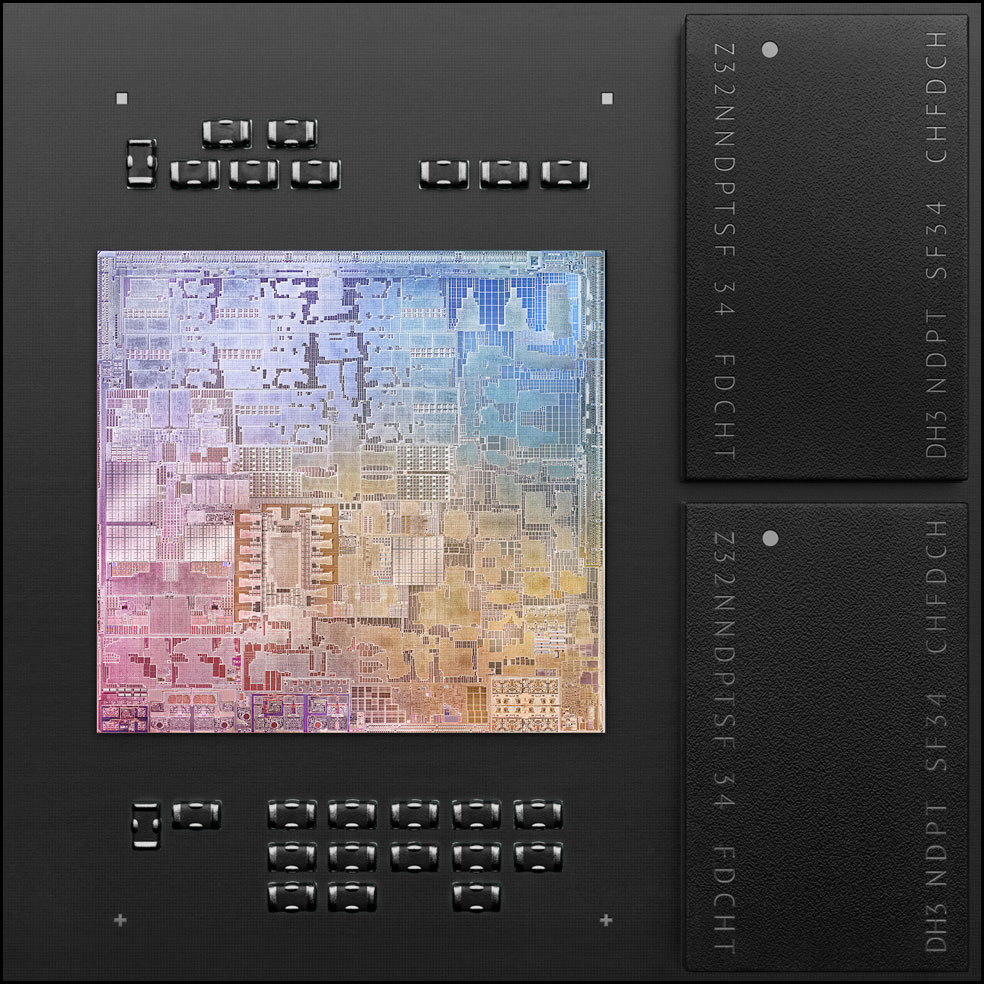
https://www.apple.com/v/mac/m1/a/images/overview/chip__fffqz...
Everything being on such a small package must leave room for a lot of battery cells.
Still waiting for it to deliver!
What to to? Cancel it and buy the new one with m1?
I'm betting the M1 can't actually work with discrete GPUs (though it remains to be seen what happens if you plug an M1 Mac into an eGPU. What do Thunderbolt-supporting ARM devices generally do with an eGPU?)
Instead, discrete GPU support (and off-package [hierarchically-managed?] DRAM support) is waiting for the M1X-or-whatever, the next chip. Along with that chip, they'll refresh all the discrete-GPU product lines: the higher-end MBPs, the iMacs, and the Mac Pro.
(Personally, I'm betting that Apple will take this opportunity to get rid of truly discrete GPUs in their products, and instead partner with a graphics company like AMD to license IP cores to put in their higher-end SoCs. So you could see e.g. AMD's next-gen Vega with their Smart Access Memory tech, wired to Apple's SoC-internal UMA bus.)
My expectations: - Single core: 1600-2000 range - Multi core: 7000-10000 range - Metal: 19000-23000 range
(I guess not yet, but still worth to ask here)