1. What is the dew point of the compressed air? Many applications using compressed air require very dry air so as to avoid corrosion issues (e.g., air tools) as well as problems related to heating of water vapor (e.g., tires). For small applications, the dew point is reduced using simple traps, silica gel beads, or molecular sieves, but for even-drier air or larger applications, refrigeration-based dehumidifiers are needed. If the use of water in the compression stage leaves the dew point significantly higher than what you get from reciprocating or Roots-type compressors, that added complexity could be a deterrent to adoption.
2. What's the energy efficiency of the process? Does the claimed "20% lower cost of ownership" account for the difference in efficiency (whatever it is)?
3. What sort of pressures can be achieved with a tabletop or shop-sized compressor? Presumably, this is related to the speed at which the drum is spun, but what are the practical limits?
I mean, I use a decent amount of very dry air at 300 bar (yeah...), and I'd love to replace the noisy beast of multi-stage compressor with something quieter and more efficient.
Indoor Scroll Compressors are around 47db (IE 100-1000 times quieter than the 70db mentioned here). They are completely oil-free and produce class 1/class 0 air. That is, you can use them to breathe from They are not as energy efficient as rotary screws, but it's only off by about 20%.
In practice, the flow of air into a tank produces way more noise than the compressor itself with these.
Even rotary screws are around 60-65db, and there are both oil and water cooled versions. They are very energy efficient, and due to the design, can be put on VFD's and modulate air-demand incredibly well.
Oil carryover is typically <3ppm, and you can use oils meant for incidental food contact/etc or filter it down further.
Both the above have 100% duty cycles. They can be on continuously (and in fact, oil-flooded rotary screws get unhappy if they are used too little).
Without more, or at least, based on what this article says, it's really hard to see what part of the market this thing will inhabit. They also don't talk at all about how to modulate them, what their duty cycle is, etc. Nor the dewpoint, etc.
I am no expert here so I am making the assumption that perhaps the innovative part here has to do with using fewer moving parts than existent solutions, and potentially naturally producing cool dry compressed air without any oil mixed in. The idea of fewer parts/nothing but the air filter, belt, fan, maybe drum bearing to ever replace I’d quite appealing to someone who only has access to a pancake compressor that’s loud as all hell.
It's similar to some of the ways you see here: https://cascousa.com/compressed-air-101/types-of-compressors...
As for fewer moving parts and less maintenance, probably not gonna win on that. The state you want already exists. If you get a rotary screw, you are basically just going to replace oil and filters every so often until the air end dies. For a hobbyist, maybe never.
You might never run it for the 8000 hours the oil lasts or the filters last. If you ran it 3 hours a day, it would take 7 years :)
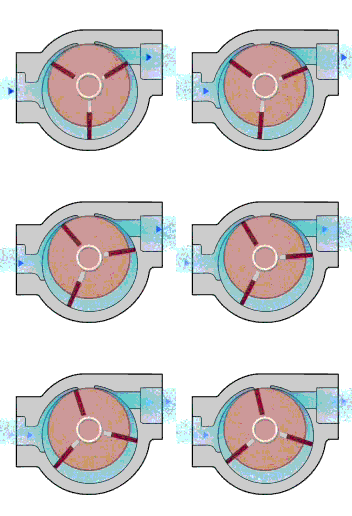
If you want simplicity and less moving parts, and the ability to fix them easily, you can get a rotary vane compressor.
They can't be modulated down as well using a VFD as you can a rotary screw (there is a minimal speed at which the vanes seal properly due to centrifugal force) , but they are ridiculously simple and have very few moving parts. They are also easily repairable.
Until it literally falls apart, you will just need to replace filters and oil every so often, and some carbon blades every so often (50k+ hours) or so of usage. The compressor itself will probably last 100k-200k hours, and so, again, for a hobbyist, may easily outlive you.
It's just a motor, connected to a slightly offset spinning circle with blades (so that as it rotates, the offset causes it to form progressively smaller chambers).
Looks like this: https://aircompressorworks.com/wp-content/uploads/2017/10/v-...
The wet air question is an interesting one. It seems like the compressed air would have more moisture in it than a piston-driven compressor, but at the same time having oil-contaminated air is problematic for moisture removal systems, especially dessicant-based ones. So you might need more thorough moisture removal, but with the dryer system having more life.
As far as efficiency goes, it's hard to tell because it's mostly a paper-company at this point and they don't have much in the way of product. Another press release mentions they can provide large volumes of air which usually translates to efficiency. The major source of work done in their system is to accelerate the water, so if you want more air, accelerate more water. It sounds pretty efficient to this armchair critic.
The other press release mentions they are targeting 10hp and 20hp systems, and 100hp systems are feasible. I'd imagine 10hp is where industrial compressors start.
[edit] Found a press release from 2014 where they claim better energy efficiency than conventional methods. This really does sound like a breakthrough.
I would assume that to get any kind of respectable efficiency the high pressure water needs to go through an energy recovery turbine before being cooled and reused.
But 7 bar is ~7 times as much air per cubic centimeter, so that's 14% as much space containing 33% as much water. The partial pressure doesn't drop at a 1:1 ratio.
As a former owner of many water management devices from pet fountains to humidifiers to dehumidifiers, I'm more concerned about the fact that air is full of particulates, and you're going to wash the particulates through a fluid that stays in the pump permanently, so how quickly is the funk going to make that compressor unpleasant to be around?
So what you lose is efficiency, because it will take compressing more intake air to get the same yield of compressed air at a certain pressure/dewpoint.
(this is why you often see a lot of wet storage tanks for air - leaving it in the tank lets a lot of the intake air water condense at the bottom)
Aftercoolers remove a ton of of the water, and so you often get an 20 degree approach temperature.
Removing more than that requires some form of air dryer.
Yeah, I was wondering about that too. But is the water going to be there permanently?
If the input air is quite dry, presumably (total guess) it would pick up some extra water. So you'd need to supply more. And probably not just tap water because of dissolved minerals and so forth - distilled seems like a better idea.
Conversely if the input air is humid, you might end up condensing water out of it, and need to bleed water from the system.
And then you're dissolving particulates in it either way...
All sounds like maintenance work, but maybe not a prohibitive amount of it.
Its also not just water that is collected at the bottom of the air tank, compressor oil also collects. Oil can also be deliberately added by either as a byproduct of compressor design or from separate equipment, into the airstream help lubricate and protect equipment from the moisture, reducing the need to remove the moisture through other means.
One of the devices stopped working between services and the bottom reciever tank half filled with water.
Edit: they're call bleed valves
Also: I’ve seen water vapor in the compressor ruin an otherwise nice paint job.
>Compressed air from a trompe is at the temperature of the water, and its partial pressure of water vapor is that of the dewpoint of the water's temperature. If the water is cool, the compressed air can be made very dry by passing it through pipes that are warmer than the water. Often, ordinary outside air can warm the pipes enough to produce dry, cool compressed air.
[https://en.wikipedia.org/wiki/Trompe]
So use a better heat exchanger to cool the water, and then heat up the air until it's dry enough, I guess?
Is it though? They don't really explain how it works or show any diagrams, and they said it was "inspired by" the trompe. So I'm a bit confused on that point.
It really looks more like a mashup of a centrifugal compressor and a diffusion pump. One where water instead of oil is used as the working fluid.
Similarly, using mercury as the rotating fluid might give you higher compression ratios, but then you'd have to deal with mercury vapor in the compressed air...
You can run a pump like this with kerosene instead of water, in order to reduce the amount of saturated vapor that comes out with the compressed air, but that can also cause certain flammability concerns. I once had one of my homemade vacuum pumps blow kerosene all over me when a gas bubble entrained a lot of fluid. This is one of those reasons I don't smoke - it can kill you.
But is it the theoretically most efficient way to compress air? Is there a (theoretical) way to compress the air adiabatic'ly (letting it heat up as you squeeze it), and do better overall?
So, if you just want to reach a certain pressure regardless of temperature, you will put in less energy with adiabatic compression, because all the energy you put into the gas stays there. However, in many gas compression applications, the gas is not going to stay hot, but will cool to something closer to the environmental temperature before being used. For these cases, then the hot gas is going to lose some of that energy to the environment. If you compress it isothermally instead of adiabatically, then it still loses heat energy to the environment, but it loses it as it is being compressed rather than after the compression is done. This requires less work.
So, in short, if you want hot compressed gas (like a diesel engine) go adiabatic, but if you want room-temperature compressed gas (like compressed air which sits in a container), go isothermal.
Would there be any special considerations in DIYing this that I'm overlooking? The only part that I can see being tricky is the centrifuge mechanism and sealing the bottom of that to a compressed air tube... not quite sure how to build that (presumably it'd have to withstand both high RPM and high pressure.)
Obviously a trompe is pretty easy to DIY if you have a steady stream of water and some serious elevation change, but the vast majority of places don't have that.
Your fridge at home likely has a cylinder air compressor in it, pumping gas up to 30 bar (400 psi) and it only makes a quiet humming.
The trick is that air compressor is attached to a big vibration damping weight, mounted on big springs, which are mounted into an oil filled heavy steel box, which is itself mounted onto rubber feet.
So easy... If it was that easy, it would have already been done, but...
1) compressor are maybe 100lb of solid cast steel
2) owners need to fix mechanical wear, not simply "replace the whole thing" - head gasket fails, gauges fails, hose leak (think thermal expansion / contraction), oil need to be changed, etc.
3) refrigerator system are sealed, air compressor need to pull air from the outside (ie. it can be DIRTY), which means lot of the noise actually come from the intake
Try to run a plasma cutter, or a 1" impact wrench out of a fridge compressor...
My home shop has a California air tools compressor in it that I chose specifically for its <70db volume. You can easily have a conversation when it’s running, and compared to my dust collector or other tools, it’s nearly silent.
some previous discussion: https://news.ycombinator.com/item?id=24760625
Do any commercial products do this?
It would seem to be better to have a closed loop water cooling system around the compressor head, but this is a very rare feature. So many home compressors treat cooling like "LOL 5% duty cycle for you", it's pretty annoying. Most of the time the cooling fans aren't even running unless the compressor is squeezing air, so the whole thing just soaks in its own heat once the tank is full.
For some industrial applications, electricity used to compress air is substantial, so there might be big cost savings to be had.
Even if you are pumping up bicycle tyres by hand there are benefits to cooling - by keeping the air cool, the same human muscle power can pump up twice as many tyres.