From:
https://en.m.wikipedia.org/wiki/Cirrus_Airframe_Parachute_Sy...
The Cirrus Airframe Parachute System (CAPS) is a whole-plane ballistic parachute recovery system designed specifically for Cirrus Aircraft's line of general aviation light aircraft including the SR20, SR22 and SF50. The design became the first of its kind to become certified with the FAA, achieving certification in October 1998, and as of 2014 was the only aircraft ballistic parachute used as standard equipment by an aviation company.
One downside of the systems is that they typically have a maximum lifespan of 10 years while airframes last 50+ years. So every 10 years there is a large maintenance cost to replace/renew the parachute system. Much less an issue for a $ 800k Cirrus SR22 (like the one in this incident) than for a $ 30k old Cessna.
> As of 1 May 2021, CAPS had been activated 122 times, 101 of which saw successful parachute deployment. In those successful deployments, there were 207 survivors and 1 fatality. No fatalities had occurred when the parachute was deployed within the certified speed and altitude parameters
This mostly clears it up.
I think it’s great that the system exists, it has undoubtedly saved lives, but unless Cirrus crashes are overwhelmingly fatal compared to other airplanes, it’s overstating “fatal accidents turned into non-fatal accidents” by likely a factor of ~3 and number of fatalities avoided by ~4.
This type of mishap is probably the best scenario for a chute, though. I have no illusions that following a mid-air that I am still a strong favorite to bring my non-chute airplane to earth without fatalities. (The stats say I’m about a 60:40 favorite to do so.)
CAPS saves lives. CAPS has not saved the lives of every person who survived a CAPS deployment, because most of those would have survived anyway. In most off-airport arrival scenarios, I’d be wishing to have a chute.
* - One of my instructors was in command for CAPS Event #46
These parachutes have been an absolute game-changer for small aircraft pilot survival. It's unlikely this kind of collision would have been survivable for the small-plane pilot 25 years ago.
"An aircraft is most vulnerable during take-off and landing because it is closer to the ground (its biggest obstacle), and is travelling at low speeds and therefore is harder to manoeuvre. According to statistics from Boeing, almost three-quarters of deaths from plane crashes between 2005 and 2014 occurred during these phases of flight. But this is the time when a detachable cabin would least likely be successful at saving lives. Being closer to the ground would give the pilot much less opportunity to jettison the cabin following an incident and if it were detached it could well land in a built-up area."
https://theconversation.com/why-a-detachable-cabin-probably-...
He sold his plane about 15 years ago (to a group of owners, one of which was a priest, I'm sure there's a joke in there). A few of winters later, he was called out to Romeo Airport; the pilot flying the plane that was formerly his had crashed the aircraft a few miles short of the runway in bad weather[1]. He was traveling with his daughter, a friend and, I think, his wife. He died, but his daughter was able to get free and make her way to a nearby farm to call for help. Looking at the plane, the fact that anyone survived at all let alone walked to a nearby house with minor injuries is pretty miraculous.
It's hard to impress upon folks who have never been in a small plane like that just how ... yeah ... how much it feels like you're hanging onto a kite. I have no idea the kinds of structural technologies are involved in the aircraft but I know his plane was made in the 70s and was light enough that he only had a pole which attached to the front landing gear to pull it out of the hangar. The weight is so critical that the 7-seat plane can realistically only seat 4-5 adults. I remember being shocked that they had to weigh the paint they applied when he had the plane re-painted.
[0] I'll spare the details as I have left many comments in the past about his experiences.
[1] https://aviation-safety.net/wikibase/43894 - "Pilot Error"; I recall my Dad saying "all plane crashes are pilot error"
I used to work in general aviation. If my eyes could fly a loop in my skull they would have.
Were the occupants required to use the bathroom before flying? That's how much weight you're potentially saving by weighing the paint on a small aircraft.
They make you weigh the paint because they want you to spray on a certain thickness so they say "X oz paint, Y oz thinner/hardener" (or something like that) in order to get your mixture into the right ballpark so it will work with whatever procedure they want you to spray it on with and get the thickness/finish/hardness the OEM wants you to get.
In aviation there's a ton of treating simple systems as black boxes and "do X and exactly X" type maintenance that happens in order to smoothly transfer liability. You paint a cowl the way the OEM says not because you couldn't get an equivalently performing cowl a different way but because you don't want the NTSB coming after you trying to determine if you did it different but right or different but wrong.
The specifications to which general aviation stuff is done isn't really any more exacting than stuff in automotive or heavy industry. The service literature is just more verbose and the service procedures are more tightly defined.
This makes perfect sense. I'm using a kitchen scale to measure the 2-part silicone mixture that I'm using for making toys, not because weight is critical but because it needs to be right for curing. I should do similar when mixing epoxy, but I always eyeball that for some reason. Maybe has to do with cost, it's $10-20 worth of silicone I'm mixing, and usually a quarter worth of epoxy, just due to quantities involved.
This reminds me of how often I quote weight limits on cars to people and their eyes go wide at how easy it is to exceed the OEM's recommended limits. I'm fairly sure I'm one of the few among my friend groups that has read through every owners manual for the cars/vans I've owned.
Painting a plane is one of those times that you often strip everything out anyway, so it's a convenient time to check the weight and balance against the logbook.
Edit: just looked it up. The plane was a Beechcraft Bonanza A36TC.
I think you overlooked an important factor there. The plane was indeed designed to realistically seat 7 adults.
The issue is that in the 50 years since the plane was originally designed, the average weight of adults (in the US) increased by about 18% [0] and the average adult woman today weighs as much as the average adult man in the 1960s.
[0] https://www.newsmax.com/US/average-weight-man-woman-obese/20...
My Dad almost always flew alone. So much so that when the plane was packed and we were making an approach into the Sandusky, OH airport, we had a sudden "dip" on the way down that everyone noticed (we were headed to Cedar Pointe, so it was preparation, I guess). My Dad explained that he wasn't used to landing with so much weight and hadn't adjusted the trim correctly[0].
[0] If it wasn't abundantly clear, all of my flying experience ended at about age 17, which was a while ago, and I was never a pilot, so to the extent that I get any of this wrong -- that's why :)
I think the "some adults, some kids" is more significant - similar to back seats in many small cars - you can put 3 passengers in there, but 3 adults won't be happy.
Years ago I was doing pilot training in a Cessna 152. A coworker of mine was a retired Navy captain and instructor at the TOPGUN program, with hundreds of carrier landings in an F-14. He looked at me like I was crazy. He said those little planes were deathtraps and he'd never go up in one again.
Not long after that I had a lesson that coincided with some turbulence from the nearby coast. The plane janked around by seemingly hundreds of feet in every direction. I was scared (almost literally) shitless, and that was my last lesson. I haven't been in a small plane since.
And he joked that every gauge/gadget on the dashboard that didn't come with the plane was there because "if I had it when X happened, X wouldn't have happened" (...or I wouldn't have left the ground knowing the condition existed, or it would have warned me with well enough time to get to safety before I have to be met by emergency vehicles on the tarmac).
Funny enough, he would get a little uncomfortable flying commercial. I'm not sure if he was putting on a show for us kids or if he was serious but he'd say he "didn't like someone else in charge of the plane". My Dad flew GA (alone) a few times a week most weeks, so he was unusually experienced for a small plane pilot.
[0] He had a breathing apparatus that allowed him to fly at higher altitudes in the unpressurized cabin, IIRC, but I'm not a pilot.
[1] Except, when he tells it, he was never in any danger. Doesn't matter if he's hanging an arm out the window trying to manually spin the prop, "it was always under control.". Uh huh.
By comparison, there are some horrific crashes today that drivers are walking away from. [1]
Went up in a four man single engine chopper once. It had all the reassuring solidity of a bicycle. Never again. I can’t even imagine what the truly tiny ones are like.
I was surprised at how similar the feel is. Your bicycle analogy made me laugh -- spot on. I used to love taking my macho friends up in my dad's plane. There's this moment after take-off where my Dad will comment on "how smooth the air is" ... it's either "perspective" or a pilot joke, I'm not sure, because said "smooth air" is about as bad as reasonable air-turbulence on a jet and the flight is usually marked occasionally by the kind of turbulence that would have the overhead bins tossing luggage onto passengers. I recall a humorous incident where my buddy Tim dropped an F-bomb over a hot mic on the headset when we got smacked sideways.
It was actually pretty fun but, of course, the weather is everything. I can't imagine how bad it would be in any wind more than about 5 knots but on the day I had my lesson, it was calm and clear.
I have a couple of friends that each crash landed at least twice in the past 10-15 years; one was in the hospital once, for the rest of the incidents they simply walked. In two cases it was engine failure, in one a stuck landing gear and the hospital one had an external factor.
The two "small" planes I've ridden in were a Cessna and an L-39. The Cessna felt like a toy, and the L-39 was a serious piece of hardware. Landings were also very different; the Cessna just got tossed around a lot more.
Looks like he tried to land in bad weather, descended before he could see the runway, and clipped some trees. Weather is an alarmingly common cause of accidents in general aviation.
A photo of the airborne metroliner with fuselage blown open: https://imgur.com/gallery/yKPOWR0
A tube is only strong when complete. Cut away half the tube and bending resistance probably goes down ~10x.
It's probably the opposite: that the fuselage was only strong enough to resist the air pressure differential, and that the real structural component was the cabin floor. And that, luckily, the control cables for the tail were routed through the cabin floor, instead of through the top of the cabin.
Many aviation enthusiasts / pilots first go to is to have a look at the flight data - usually available on FlightAware / FlightRadar24 and a few other websites, plus LiveATC usually can provide recordings of the flights communications to towers as well. We should refrain from using just those data points to draw conclusions to the cause; the NTSB (and other orgs) will perform an investigation and the report will be made public (both interim, and final ones), and changes are almost always made to processes / systems, and often to the virtual or physical items that led to this incident.
There are a few more photos and insights from various folks that were there at the time and captured a few moments on the reddit thread here:
https://www.reddit.com/r/flying/comments/nauck8/mid_air_just...
Note - it's incredibly rare for a midair not to result in fatalities so an incredible amount of luck all around.
https://iflyamerica.org/midairs.asp
This one was incredibly lucky, especially for the Key Lime aircraft.
Also, I like the headline including "all parties ok".
When you get your medical clearance, one of the things they look for is signs of psychological issues or instability. Not saying that's you, and I bet you'd do better than you think. Pilot training also IMHO makes you better at that stuff.
For such a serious accident this seems about the best possible outcome for the crew of both aircraft. I'm not an expert so I'm not going to comment on root cause or blame here, but simply glad to read that at least everybody survived.
Another lucky point is that it was at low altitude and at slow speed (preparing to land). Higher up it would have been much more likely to break up due to way higher speed and larger pressure difference between the cabin and outside.
The Metroliner (one with the fuselage ripped through) is commercial, [0] but apparently carrying cargo only in this case. [1]
Surely a mid-air collision even between two hobby Cessnas say is rare/interesting enough to make it?
[0] - https://www.keylimeair.com/
[1] - https://www.aopa.org/news-and-media/all-news/2021/may/12/col...
Remarkable that the Metroliner held together, despite that terrible damage, and they landed it safely
edit: interesting photo of the landing from the Reddit thread linked elsewhere https://imgur.com/gallery/yKPOWR0
One thing that makes it more likely is that US air traffic control makes heavy use of visual approaches, and then it's allowed to point two aircraft at collision courses on the same altitude because they can see each other. The European way to do this is to have them intercept at different altitudes so if one overshoots they pass over/under. But it results in lower capacity per runway than the US system.
Something else I'd like to point out is that it might seem easy to 'blame the Cirrus' pilot or them call out for inattention, but doing so by itself isn't helpful. Aviation is so safe partly because it has managed to turn a culture of blame into a culture of continuous improvement and shared learning: I'd be very surprised if the airport's procedures came out of this unmodified, for example.
This turn to final (with the unusual additional warning to “do not fly through final”) is a visual maneuver and I’d expect most every pilot to be hand-flying at that point. (My autopilot and navigator is capable to make that intercept, but it’s way more tedious and distracting to program it than to just fly it.)
The cirrus is the one that makes the mistake.
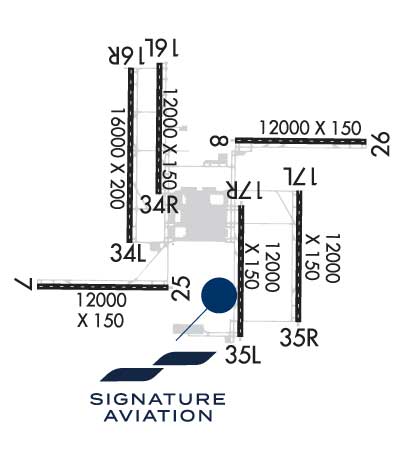
The 17 runways are quite close laterally (700’) , it may be either way a bad maneuver (overshooting) or chosing the wrong runway.
https://es.flightaware.com/resources/airport/APA/APD/AIRPORT...
The metro was not expecting another traffic in approach for his runway (I understand that they were in different frequencies with different controllers).
During the approach the upper-right side relative angle position in the window of the metro, makes the cirrus hard to spot. I guess he didn’t see the cirrus at all or just barely before the crash.
The cirrus is looking at the runway to his right and the other traffic probably the whole time, the metro is in front of him, so he doesn’t see the Metro till he is on top of him.
Usually with parallel runways, traffics are kept at different altitudes till they are aligned with their runways. This way if they make a mistake, they are separated by 1000’ vertically with the airplane flying parallel.
In this case the cirrus was cleared to visual approach and informed of the cessna he had to follow first. Once he says he has the cessna in sight, he is cleared to visual approach following the cessna. In the same comunication he is informed of the metro flying to the other runway and he replies traffic in sight again.
My guess is that he either has the metro in sight at the beginning and then he forgets about it during the maneuver, or he gives traffic in sight two times.
Thinking that the second part of the message is for the same aircraft (the cessna) he doesn’t even recognize what the controller is telling him about the metro. This is possible if he is too busy flying the maneuver and not paying proper attention to the radio, he hears “cleared for approach” and “traffic” but he mentally don’t really process the information the controller is giving him. A kind of sensory overload.
In airliners we have mandatory TCAS (traffic collision avoidance system) installed that shows you the near traffics in the screen and give you coordinated (between the traffics) automatic avoidance guidance and alarms( one traffic climbs and the other descends or keeps altitude).
In busy airports TCAS maneuver happen relatively often (a handfull of times a year) but nowadays is much harder to have a collision or a close call.
Also when two pilots are in the cockpit (like airliners) it’s easier that one is concentrated in flying and the other in the communications. It’s very common to correct and be corrected all the time during the flight.
It will be interesting to read the official report.
Edit: Kudos to the Metro pilot who was super calmed in the radio while declaring emergency and landing the plane. That is really difficult.
Edit 2: correcting the airport , KAPA (I talked about KDEN initially which has the same runways but with a bigger separation). This does make a difference regarding the mistake.
Thank you Denvercoder9 for the heads up.If that is so, then it seems from the recording that the Metroliner pilot was only informed about the Cessna ahead of him and on approach to 17R, not of the Cirrus.
The Cirrus pilot is told about the Metroliner in an exchange that goes thus:
TWR: "Cirrus 6DJ, traffic you're following just turned right base there ahead and to your right at 6600', Cessna."
6DJ: "I have traffic in sight, 6DJ."
TWR: "Cirrus 6DJ, follow them, runway 17R, cleared to land. Additional traffic north shore, it's a Metroliner for the parallel runway."
6DJ: "Traffic in sight, cleared to land 17R, 6DJ."
Now, does that second "traffic in sight" refer to both aircraft, or only to the Cessna he had just been cleared to follow? It would be unambiguous if he had replied "two in sight", but if, for whatever reason, the mention of the Metroliner (in the same call as the clearance was given) had not registered, the Cirrus pilot would not have been aware that more than one other aircraft needed his attention. And if the Metroliner communication was being conducted on a different frequency, neither pilot would have had any other opportunity to become aware of the other airplane, except by seeing it - and, in addition to the Metroliner pilot presumably being in the left seat, the Cirrus was banked right, turning final, and one might guess its pilot was probably looking at the runways and/or the Cessna ahead.
Putting this together, I suspect the Cirrus pilot never registered the presence of the Metroliner until the collision - and I doubt the Metroliner pilot saw the Cirrus even after the collision, given that he thought he had an engine failure (he might have seen it earlier, when it was heading north on downwind, and assumed it was behind him.)
This does not alter the fact that the Cirrus pilot overshot the 17R approach while turning onto final, and it is this which caused the collision. One other fact, pointed out by several commentators: the Cirrus was travelling at about 160 kts at the time, so any delay in turning final results in being out of position more quickly than in your average small, single-engined airplane.
> https://flttrack.fltplan.com/AirportDiagrams/KDENapt.jpg
This is the diagram for a different airport (Denver International, KDEN). The accident happened at Centennial Airport (KAPA), where the two runways are only separated by about 700 feet.
I really think that we should not have flying cars until we have true autopilot (hands off the wheel, meatbag!). The thought of the "Hey y'all! Lookit this!" knuckleheads that regularly open up, roaring past my house, in three dimensions, is chilling. They are bad enough with just two.
I'll bet that the advent of true driverless tech will also be the advent of illegal aftermarket "mod kits." I can see it now...the "Hold My Beer™" line of manual override modules...
I think the claim was qualified in some way like "collision between civilian flights that were both flying an ATC-assigned clearance at the time". (So some kinds of flights and some kinds of airspace don't require ATC clearance, and if one of them were involved in a collision, it wouldn't be ATC's responsibility, in some sense.)
My question at the moment is: is this claim plausible if you qualify or restrict it enough? Do you have to tack on additional conditions?
Is there any useful sense in which this collision was a first for U.S. aviation history?
It looks like the Cirrus wasn't flying to what the ATC cleared...
Glad to see no fatalities here; I'm an aerospace engineer in the field of airworthiness and technical risk management so my work sees a lot of accident reports and flight safety incidents. I can say with certainty these folks (esp. the metroliner crew) are very fortunate.
It's just an internal 16 channel GPS receiver with an external antenna and an altimeter that predicts the flight path and then transmits it - including a unique identifier - as low-power digital burst signals at one-second intervals. Other aircraft also equipped with FLARM receive that, compare it with their own flight path prediction, and also check for collision information with known data on obstacles, including electric power lines, radio masts and cable cars, etc. If a proximity warning is generated to one or more aircraft or obstacles, it bleeps like anything and generates bright LEDs that point in the direction of the threat. The display also gives indication of the threat level, plus the horizontal and vertical bearing to the threat -- and there are three warnings (iirc ~30s, ~15s, ~6s) -- it warns by time and not distance.
I remember the thing going off a few times; it's quite helpful and draws your attention to a region of sky immediately, including behind, above and below you. It's also dirt cheap† and is a battery-powered self-contained box with (I suspect) a microcontroller and glorified smartphone innards inside.
†(by aviation standards)
* https://www.cbc.ca/news/canada/british-columbia/pemberton-b-...
Whenever there is a collision involving light aircraft the question of anti-collision systems comes up. Unfortunately the powers that be have completely failed to come up with a workable standard for such aircraft. The glider people eventually just gave up on waiting and now use a proprietary system called FLARM which has fairly good adoption. There is more than one system of that type available for light powered aircraft with not very good adoption. Each system is entirely incompatible with each other, including the standardized ones used in heavy commercial aviation.
In other words, my hypothesis is that the fact that there are few mid-airs is owed to ATC, technology (TCAS, TAS) and “big sky”, rather than vigilant pilots.
From the picture, the plane at rest is pretty messed up, but all occupants are safe, and pending investigation, there doesn't seem to be a sign of mechanical error involved.
Flying in (or near) small planes has a lot of risk, but I don't see how this incident would change your impression of this one manufacturer's planes.
I'm sure the chances of a collision outside of the airport is absolutely basically zero, but these small planes fly really low over my house and the downtown area all the time. They get pretty low and close for touring over the big buildings for photos and stuff, see photos on reddit all the time..
Reminds me of the Aloha Flight 243. My mom's cousin was the pilot and hearing his first hand account was pretty crazy. Fun fact, he got to be an extra in the made for TV movie of the event.
https://www.thisdayinaviation.com/tag/robert-l-schornstheime...
And better GNSS based navigation equipment is now making it more likely than 20 years ago. The historical accuracy was such that planes where often a bit offset left or right off the route giving extra separation. Now the accuracy is so good that planes going opposite direction on the same route are passing exactly bang in the middle on top/below each other.
[0] https://en.wikipedia.org/wiki/Gol_Linhas_Aéreas_Flight_1907
[1] https://www.vanityfair.com/culture/2009/01/air_crash200901
We've improved GNSS significantly, but the technology to avoid collisions hasn't been widely deployed, even though it's orders of magnitude less complicated than high accuracy GNSS on the whole
So... a random dilution of precision generator could... save lives? ha.
The space can be constrained though. There are "airways" (jet routes) for flights, and not that much of a volume/size ratio when the volume concerns areas near airports -- where many planes approach, exit, are asked to circle in a holding pattern, etc.
So it's not like the whole sky is their domain...
https://en.wikipedia.org/wiki/Big_sky_theory
>In aviation, the Big Sky Theory is that two randomly flying bodies are very unlikely to collide, as the three-dimensional space is so large relative to the bodies. Some aviation safety rules involving altimetry and navigation standards are based on this concept. It does not apply when aircraft are flying along specific narrow routes, such as an airport traffic pattern or jet airway.
>The Big Sky Theory has been mathematically modeled, using a gas law approach. This implies that collisions of aircraft in free flight should be extremely rare in en-route airspace, whereas operational errors such as violations of formal separation standards should be relatively common. Three critical parameters are the number of flying objects per unit volume, their speed, and their size. Larger, faster objects, flying in a traffic-rich environment are more collision-prone.
http://code7700.com/big_sky_theory.htm
>It seems that there are a lot of pilots out there that believe in the "Big Sky Technique." They think the amount of airspace out there is so wide and vast, and that they are so small, that the chances of hitting another aircraft is too small to worry about. And yet history begs to differ.
The Big Sky - Kate Bush
https://www.youtube.com/watch?v=sV7w5TaYjRA&ab_channel=KateB...
    They look down
    At the ground
    Missing
    But I never go in now

    I'm looking at the big sky
    I'm looking at the big sky now
    I'm looking at the big sky
    You never understood me
    You never really tried
https://www.youtube.com/watch?v=Ug_Z-gu7u44&ab_channel=Naoyo...
    Big sky, big sky holding up the sun
    Big sky, big sky holding up the moon
    Big sky holding down the sea
    But it can't hold us down anymore

    Big sky holding up the stars
    Big sky holding Venus and Mars
    Big sky catch you in a jar
    But it can't hold us down anymore

    Big sky, big enormous place
    Big wind blow all over the place
    Big storm wrecking havoc and waste
But it can't hold us down anymoreAround takeoff and landing - there is effectively a 1D track for the approach and the climb-out. It's not quite that simple because different aircraft will have different descent profiles and different angles to the wind, but it's a much smaller 'search space' for collisions.
https://en.wikipedia.org/wiki/Aloha_Airlines_Flight_243
It's amazing that the hull can survive in the air for any time with that much torn away.
As an aviator my stress levels are only just coming down now from seeing this headline and clicking expecting there to be deaths.
Often for large airports the code is very similar to the IATA code for passengers, e.g. KJFK for JFK and KSFO for San Francisco. But not always, as in EGLL for London Heathrow which is LHR in passenger codes.