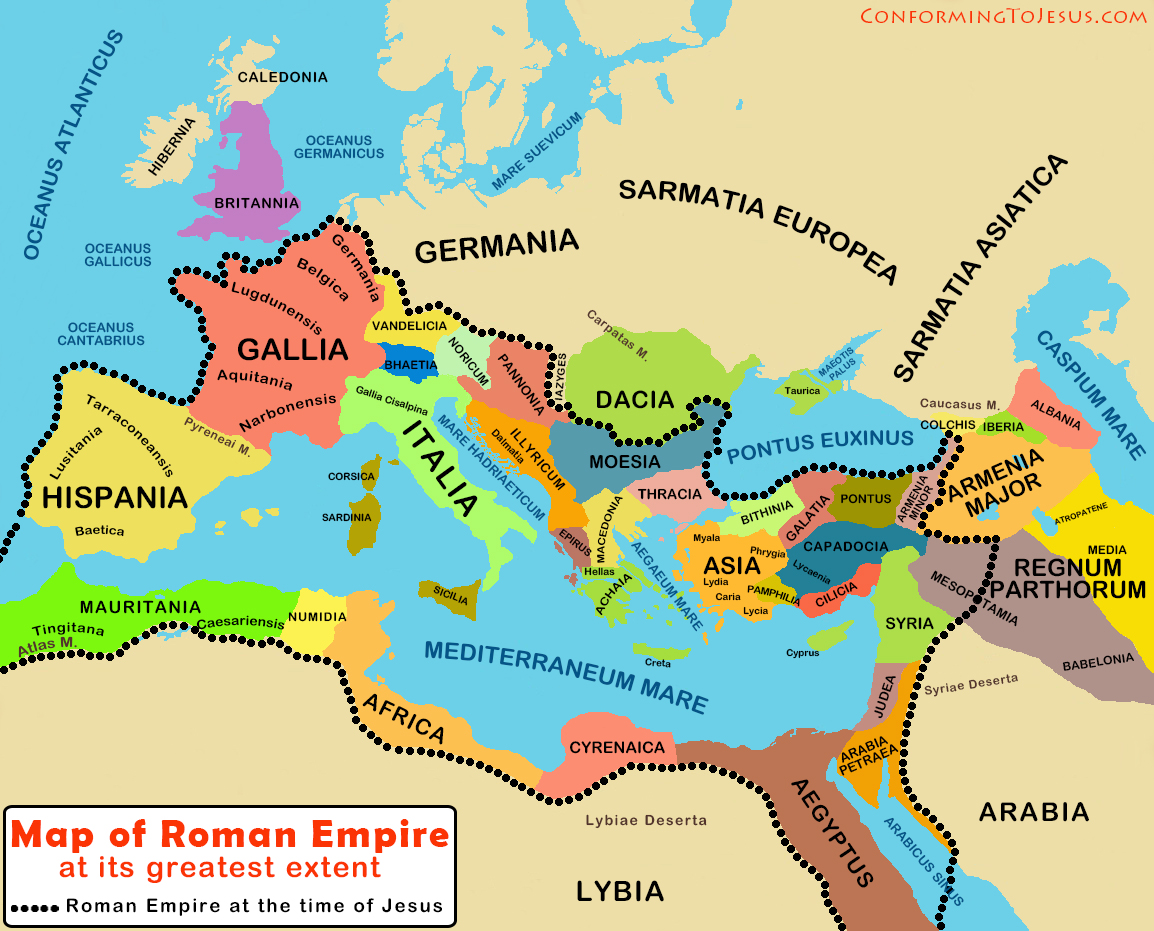
... but none of this upsets the fact that ethnicity is the 'primary weight' in the ultimate definition of borders, other than the borders which are artificial (i.e. political) which is why those tend to collapse.
i.e. " historical Europe or Rome you will rarely find borders defined by ethnicity" <- this is just not true.
Borders very clearly, 'mostly' ethnic, with huge caveats obviously, but those caveats don't change the underlying gravity of ethnicity.
Both a map of Europe today (though it's national) and even a map of the Roman Empire at any given time fairly strongly highlight this.
Roman borders don't help your point - they speak against it.
For a visual refresher here's a bunch of them [1].
Those are mostly ethnic divisions - some of which exist even today.
The fact that Greece has been 'occupied' for ~2200 years, by a whole variety of external powers, and still 'moslty' remains 'Greece' is evidence of this.
Despite your well meaning highlights of the Germanic invasion of Latin Gaul ... there is still a major delineating border between 'Gallia' and 'Germania' today [2].
Same for 'Hispania', 'Britannia', and 'Caledonia' (i.e. Scotland) and 'Hibernia' (i.e. Ireland).
It's an incredibly similar map 2000 years later.
Maybe one factor you could consider in your line of reasoning is the difference between political and ethnic boundaries.
When one group 'invades' another - that's a political change, not necessarily an ethnic one.
It becomes 'ethnic' when the invaders bring along with them considerable cultural power and especially 'bodies' i.e. if there's a lot of migration.
The official language of France in 2021 (and there are many) is French, which is Romantic, despite Frankish invasion.
Charlemagne was more or less a political phenomenon, less so cultural one.
[1] https://www.google.com/search?q=map+of+roman+empire&client=f...
[2] https://www.conformingtojesus.com/images/webpages/map_roman_...