For example:
- nollie fs 180 and fakie fs 180 (fs half cab) are two different directions: nollie fs 180 is in front of you and fakie fs 180 is behind you going blind
- nollie 5-0 and fakie 5-0 (fakie switch nosegrind) lean differently on the grind: nollie 5-0 you pop off your nose and land on your back truck, fakie 5-0 you pop off your tail and land on your front truck
- nollie noseslide and fakie noseslide are different motions to get into the slide: nollie nose you pop off nose and land on the nose in the ledge, fakie nose you pop off tail and land on the nose but you do a sort of half cab
The key distinction in the argument is that in fakie, your tail is always considered your "tail". Therefore you treat any derived tricks as being "backwards". In the 5-0 and noseslide examples, you're still popping off the front of your board, but you classify it as nose or tail based on if it's nollie or fakie.
There are caveats though such as "fakie crook" where if you kept the rule it should be "fakie suski", which no one says.
There's a million arbitrary and nonsensical rules in skateboarding which is part of the reason to love it, especially for something that "has no rules".
And remember, never carry your board by your truck :)
What most people would call a nose grind or 5-0 is inverted if you 180'd into it.
> And remember, never carry your board by your truck :)
I miss skateboarding :). My ankles don't though.
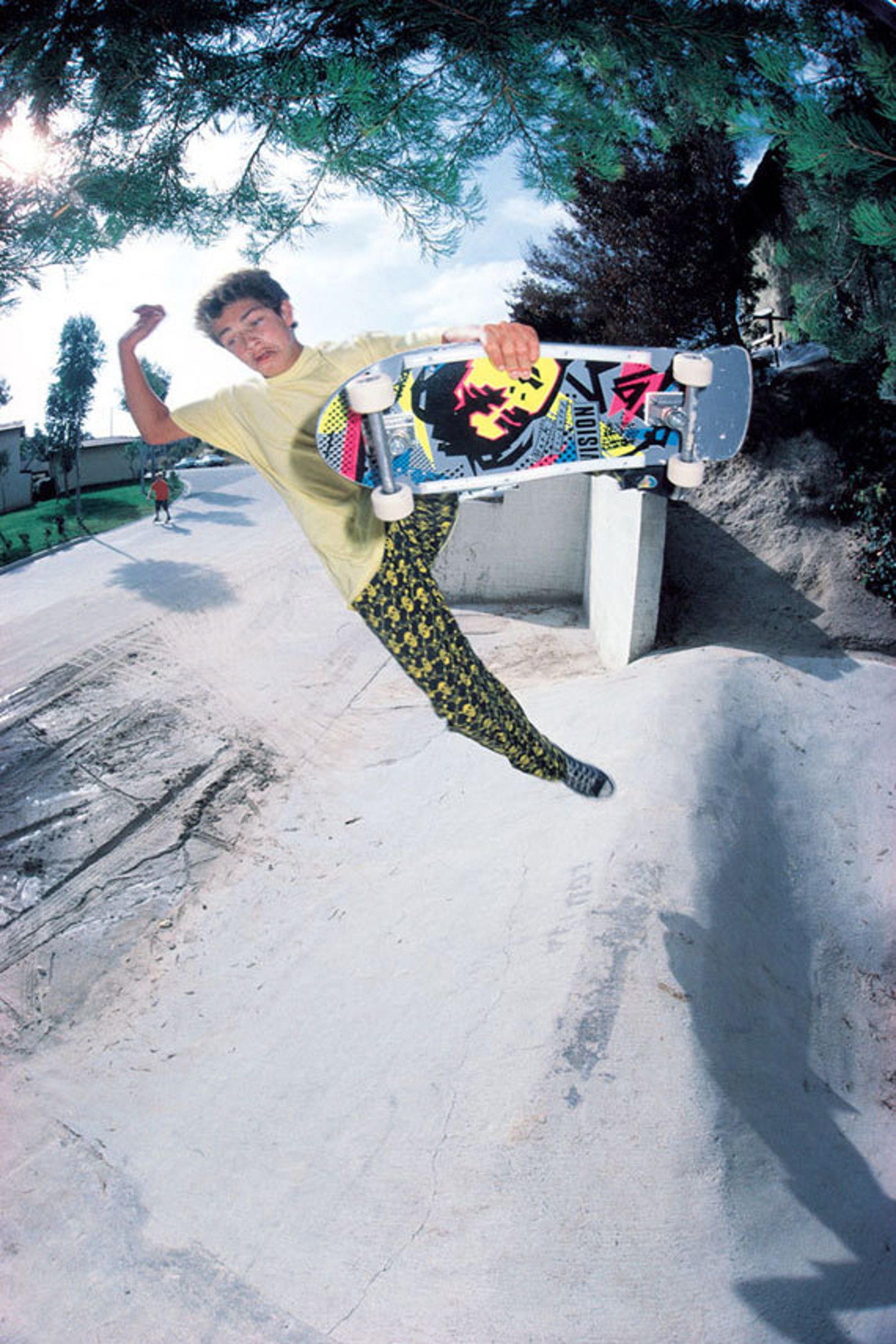
It made so much more sense when I learned a lot of these tricks were first invented in the 1980's, when most boards had an obvious nose versus tail difference. Like this one:
https://i.etsystatic.com/6865693/r/il/f51835/361296329/il_15...
So even though you we're grinding in a switch 5-0 looking position, you would be clearly grinding on the nose, hence "180 nosegrind".
One of my other favorites:
On circle rails there is "no such thing" as fs overcrook, just fs nosegrind, and there is no such thing as bs nosegrind, but there is bs overcrook.
At least that's how magazines seem to classify it.
That is till this day(12 years since I last set foot on a skateboard) the most illogical thing. Especially when combined with board slides which were also not apparent from the start(for years on I called front side board slide back side) and from a logical perspective the lip slide names made a lot more sense. That said, I never figured out how to classify nollie/fakie board and lip slides front or back. As far as experience I also never understood why were hard flips called hard(I learned how to do them in less than 15 minutes after I first decided to give them a go).
> I never figured out how to classify nollie/fakie board and lip slides front or back
Yep this one still trips me up to and is great argument over some beers. Especially when you introduce flip tricks into them as well :p
https://i0.heartyhosting.com/skateboarding.transworld.net/wp...
From this Transworld Article:
https://skateboarding.transworld.net/photos/tws-10-most-memo...
The specific tricks with their matrices are here: https://github.com/holomorpheus/topological-flips/blob/main/...
I always did hard flips as varial kickflips, but with fs-shuv instead of bs-shuv.
360 Pop Shove-it
360 Shove-it
360 Shuvit
A pop shuvit will be higher while a non-popped shuvit may barely leave the ground. Popping can actually make it easier to keep the axis of rotation closer to the center of the board.
“I know it when I see it” (maybe)
In which case I reject mathematics.
git clone --recursive
Is it? Isn't a hardflip just a mirror of the varial kickflip they describe, and rotation around their x-axis something else entirely?
The problem comes around that your front foot is very much in the way of the board if it is only doing an "inverse varial". The vertical (end over end) rotation comes out of necessity to get the front foot out of the way.
Plus it looks really cool.
Hardflip = 180 frontside shuvit + kickflip
The hardflip is unique in that it has two main variations. One is the end-over-end style that I think they're describing, where the board only does half a kickflip. The other is "flatter," and explicitly a 180 shuvit with a complete kickflip. In practice the end-over-end style is much more common, easier to perform, and nicer looking.
The fact that each skater can reverse their stance (aka switchstance), doesn't that double the possible number of flip tricks?
Note that a goofy skater could also do the moves described in the paper, but it would be a different trick because he's doing it switchstance.
(Source: the rules of SKATE per Battle of the Berrics, the skater has to declare his stance ahead of time for the purposes of normal vs switch tricks, aka the "Skategoat" (Leandre Sanders) rule)
It’s the same trick but you essentially have to relearn it with your other “hand”. Tricks are then flagged with the “switch” qualifier to indicate the rider wasn’t in their normal stance. Example: a regular (footed) skater skating right foot forward (switch) doing a kickflip is simply doing a switch kickflip (switch flip).
However for a goofy skater, the opposite is true.
  Kickflip ~ 360 shove it

  Ollie ~ 720 shove it ~ double kickflip
Kickflip, heelflip, flip + shove it in the "natural direction" (e.g. varial kickflip, 360 kickflip), and flip + shove it in the unnatural direction (e.g. hard flip)?
Your definition leaves out varial heels and inward heels.
Edit: On second thought I'm still not sure, I saw this in the paper, and I'm guessing they're classifying both direction shuvs as the same, and kick/heelflip as the same
Below we list these four tricks with their corresponding residue class in Z/4Z.
0 ↔ Ollie
1 ↔ 180 Shove-it
2 ↔ 360 Shove-it
3 ↔ 540 Shove-it
Another interesting choice of representatives is given by a combination of the shove-it and the kickflip.
0 ↔ Ollie
1 ↔ 180 Shove-it
2 ↔ Kickflip
3 ↔ Varial Kickflip
Ollie
Any Shove it/varial with no flip
Any Flip with no shove it
Any flip + shove it combo
?