What caused all the supply chain bottlenecks? - https://news.ycombinator.com/item?id=29029825
The previous stack:
Long Beach has temporarily suspended container stacking limitations - https://news.ycombinator.com/item?id=28971226 - Oct 2021 (483 comments)
Flexport CEO on how to fix the US supply chain crisis - https://news.ycombinator.com/item?id=28957379 - Oct 2021 (265 comments)
This is incorrect. There was a zoning rule which affected truck yards in Long Beach and Los Angeles. Truck yards. Not the port itself.
As stated in the linked tweets actually.
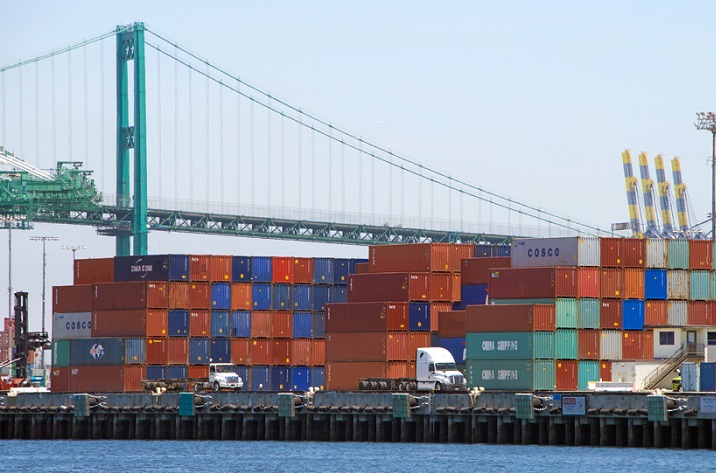
But if you don't believe that you can just google an image of the Port of Los Angeles from let's say 2019 and count how high the container piles go. Here is a randomly selected image from 2019 where 5 high piles can be clearly counted: https://www.joc.com/sites/default/files/field_feature_image/...
Accuracy is important. I'm not an expert on logistics, or zoning laws. But how could I trust the article's author when they clearly unable to parse their own sources?
> Normally one would settle this by changing prices, but for various reasons we won’t get into price mechanisms aren’t working properly to fix supply shortages.
It's nice that the article is not going into that. Instead it hammers on that politicians regulate where and how many containers can you plop down. That is not the real issue.
If you are moving containers into an area, and you are not moving an equal amount out then you are going to run out of space to store the containers. It is that simple. You can tweak rules to make a bit more space, for example by stacking them higher in the truck yards. But the real question is: why are the people who own these containers incentivised to move them back to where they want them to be filled? If you solve that the problem solves itself. If you can't solve that piles of containers will fill up what little more space you won by tweaking. So the very point the article decides to "not go into" is the only one worth going into.
Anecdote: I was driving into San Pedro in 2019, and I didn't have a smart phone at the time (so no map/gps). I took the wrong exit off of the 710 and ended up on Terminal Island. That was the most visually overwhelming place I have ever been... the scale of the ships, the height of the stacked containers (more than 2), the abundance of trains... the cranes... visually, overwhelming. And then there was all the road work, construction, detours, one-ways down wrong-way streets.... I was a hell of a morning as I tried to get to my presentation....
Sure, when your critical system goes down an RCA is hugely important and ultimately you have to apply a fix that addresses the core issue to avoid it happening again in the future.
But, at the time that the system is actually down it seems like the most important first step (once you understand the problem) is to get the system running again ASAP. This can give you the runway to fix the actual problem.
In that particular situation a temporary buffer that allows the flow to become unblocked is necessary.
The computer won't operate if you are unable to move data off the internal registers because there's nowhere to go. Including operations to delete the data in long term storage that is preventing the internal registers from being cleared.
As I understood it, by letting them stack empties higher, it freed up trailers to be used by trucks to go get containers out of the port. When that happens the port then wants empties to put back on the ship (or full if they are going somewhere) and then the ship can continue on.
So the "win" here was that more trailers would be available to take full containers from ships and that would move things along.
Most people who aren't familiar with trucking understand a tractor-trailer as a single vehicle, because that's what they usually see on the road.
When in reality it's exactly what the phrase describes: a tractor (or cab, or engine and steering and driver) + a trailer (or chassis + whatever it's hauling).
The entire idea of modern over-the-road trucking is built on the concept that one cab can pick up and haul any standard chassis (leaving aside hazmat and other complexities).
This is what allows for optimized freight movement, as you can limit the amount of time cabs are moving around without hauling anything, in addition to decoupling the load/unloading of a trailer (time consuming) from the driver turning around (want to minimize).
I.e. driver arrives at warehouse with container A on chassis B, parks it in a loading dock, and immediately hooks up to container T, already waiting on chassis U, and heads back out.
The bottleneck in this case was: (1) nowhere to legally put empty containers, causing (2) empty containers to stay on chassis, leading to (3) no available empty chassis to unload port cargo onto (containers must be loaded onto some sort of chassis to be removed from a port), leading to (4) a backup and full port yard, leading to (5) ports refusing to accept empties, to conserve their limited yard space, leading to GOTO 1.
Heh, I was noticing myself that it was kind of hard to follow because the domain ontology (what entities exist and how they relate) wasn't make explicit (like I just did with the previous parenthetical). Would have helped to know that a chassis and container-free trailer are the same thing.
And so I kind of balked when the author said the Flexport CEO:
>>Describes a clear physical problem that everyone can understand, in simple terms that everyone can understand but that don’t talk down to anyone.
I search Google news just about every day and all I can find is people patting themselves on the back for getting the rule changed, but nothing about whether the rule change has made a difference.
> 15. None of those people managed to do anything about the rule, or even get word out about the rule. No reporters wrote up news reports. No one was calling for a fix. The supply chain problems kept getting worse and mostly everyone agreed not to talk about it much and hope it would go away.
It's been my experience that nearly all of the times it's the low-, and maybe mid-, -level workers who see problems. And it's usually the upper end of the business or bureaucracy who end up ignoring the problem.
And then it's also been my experience that after the problem gets ignored for a while, the people who see the problem also don't report later problems because they know it won't be fixed and they're not empowered to fix it themselves.
This is a widespread problem in my eyes.
Of course the above is only able to fix local issues. It doesn't really leave any way for someone to say "we will have a bottleneck here if something else goes wrong"...
The author was using terminology introduced quite a while ago by Bruce F. Webster: https://brucefwebster.com/2008/04/15/the-wetware-crisis-the-...
The port of Prince Rupert has 5 (as in “can be counted on one hand”) berths and transfers 1.2M containers per year.
The port of Long Beach has 80 (yes, eight-zero!!!) berths and only transfers 8.1M containers per year.
Long Beach transfers 100k containers per berth per year. Prince Rupert transfers 240k containers per berth per year.
The port itself is protected by geography, and is one of the deepest natural harbours in the world.
It's a neat place!
Well, except for being one of the rainiest cities in Canada.
Edit: If you're interested in this kind of thing, here's a drone video I shot last year, of Prince Rupert's container port: https://www.youtube.com/watch?v=9DyG9wOWi0c
https://weatherspark.com/y/298/Average-Weather-in-Prince-Rup...
One reason I can think of is availability of labor, but how many people does it take to run a good-sized port? Not saying we build a new port out in the middle of nowhere, but a location where there is already a small- to mid-sized town nearby might be suitable. And also consider that the existing port locations have housing costs that are probably too high for many/most port workers anyway.
It seems like we need more ports in the US in places similar to Prince Rupert.
But, more importantly Prince Rupert is well connected to the CN rail network. A rail connection is key for efficient intermodal shipping. And there aren’t many deep water harbours on the west coast with railways. Building rail or road connections to new ports wouldn’t be trivial.
This is a little disingenuous. From what I understand, this was a rule put in place a long time ago, in a different context. The ramifications of such rule under unprecedented stress weren't understood or foreseen. Infinitely stacked containers would probably be an eyesore to be honest.
Great they removed the rule, but don't forget about Chesterton's fence.
In this case we do know the reason why: aesthetics. The side effects are just greater now, so out the rule goes.
So even if the rule shows up in some "city aesthetic code" where they wrote down "yep more than two is ugly", it may very well be satisfying some other desideratum that no one wrote down.
That's not to say this rule really does have other reasons, but you can't stop at "yup that's what our records show". And indeed, some of them mentioned possible safety issues that arise with greater depths.
Also, how high of a stack of containers do you feel safe working around in the next major SoCal earthquake?
No, that wasn't the case. It was a Fire Department ordinance for the city and not the port. It didn't apply to the Port of Long Beach itself. This is a photo from October 19th, before the emergency order on October 22.
https://www.usatoday.com/story/news/nation/2021/10/26/los-an...
Containers are stacked five high.
Often times the goal is to simply provide information to senior management that middle management isn't giving them.
Most of freight is run off spreadsheets and over the phone or by email. Flexport is built around digitization and optimization. Half of the appeal of their product is that it gives customers improved visibility!
It's therefore not surprising that a local city mayor didn't realize he had the power to unclog the US traffic jam. Referring to him diminutively as a bureaucrat is unfair. This guy almost certainly didn't even realize he could do anything to fix the problem and the fact that he resolved it in 8 hours (!) is something to be celebrated, not chided.
I've lost count of the number of times that I've been able to solve what was thought to be impossible by just talking to people.
I agree that the fact it was changed so quickly should be celebrated, but it also gives me pause to think about just how many things could instantly be improved if the people with the power sat up and paid attention.
HNers have pretty much no understanding or respect for what it means to realistically be in public service. They treat the realities as unfortunate errors ripe for optimization.
Yes, it is a deeply optimistic and progressive worldview. It's a real shame people don't respect the unimprovable world as it really is.
Nope - you don’t get to blame a new problem on a 20+ yr old regulation. Changing this will likely help in the short term, but it’s not the cause of the problem.
Reason 4 of the cause is what you should rail against: "This rule was created, and I am not making this up, because it was decided that higher stacks were not sufficiently aesthetically pleasing."
Isn't that alone an indictment of him or his organization (which, by extension, is an indictment of him)? Why did no one on his team tell him about the container backlog? If they did, why did they not suggest that he allow containers to be stacked higher? This isn't a new problem, it's been going on since at least March if not earlier.
Also consider for a minute how blindingly obvious it is, in retrospect, to know that containers can -- and should -- be stacked 3+ high vs. how hard it is to walk into a field of 2-stacks and know that they're being stacked inefficiently. Part of the challenge is informational: those that see the problem see it so obviously that they assume that there's a reason why the problem can't be fixed. Those that can't see the problem don't even realize there is a problem!
That's kind of the heart of the perennial frustration with bureaucracy: it's nobody's fault, so nothing gets done.
I don't think it will make matters worse but I won't be surprised if it doesn't actually solve the problem. It just seems like a cheap+fast attempt at a solution which is good.
There's a lot of narrative that's going into this discussion, an heroic visionary CEO, a bumbling politician. In fact, the mayor made the change as soon as it was brought up.
But I really like Petersen's thread:
What caused all the supply chain bottlenecks? Modern finance with its obsession with "Return on Equity."
As long as US has a net import of containers, whatever buffer created will be filled up soon.
If the port is full and the trucks are full, clearly we have more overall containers than before. Where did they come from? And is the place they come from now short on containers?
Those are of course separate problems. If we are accumulating empty containers, you could just dump them somewhere for the time being. Yes, the trucks would have to drive somewhere else than the port to dump them, but that's clearly better than economic standstill. And if it turns out that China is short on empty containers, then we might need to work on the incentives for ships to bring back the empties.
But unless this whole clogging was caused by a very temporary spike in container throughput, increasing buffer capacity will only alleviate the problem for so long.
And yes, the narrative of the story is definitely important, because it avoided all the rabble you see here that was getting in the way of a simple first step.
Pretend this were reported as "Long Beach allows containers to be stacked higher in order to deal with a glut of empty containers" rather than Randian Superhero Casually Solves Port Problem, and Miraculously the Parasitic Bureaucrats Are Forced to Listen to Him by the People of Twitter, and By the Way, Why Can't We Demolish Neighborhoods and Replace Them With SROs?
Wouldn't more cynicism be engendered by the second story than the first if the change turns out to be ineffective or even destructive?
I'm not sure if stacking 5-6 high is a long term solution. It works now, because it's only at 2 high and the buffer is available. But if they were at 5-6 high under normal circumstances when this tsunami wave hit we'd be talking about letting them go 8-9 high? Maybe limit them to 2 high but allow them to file a temporary permit to go to X high with justification... something along those lines, so it is a rather accessible flex up and down and it doesn't require extreme levels of non-local politics to accomplish.
The hyperlocalization of things like this in the US are the source of a lot of our problems IMO. We get stuck in local maxima that actually add up to terrible inefficiencies on the whole.
Something similar in concept, when evacuating a hurricane inbound lanes can be turned into outbound lanes and double the buffer. Of course the citizens of coastal cities don't want outbound lanes only at all times. This is for extreme situations (skimming but I think this is valid ref: https://en.wikipedia.org/wiki/Contraflow_lane_reversal)
2. What if it was stacked up to LIMIT and a wave of containers come again? The point is to reserve a buffer. I'm rather agnostic on the numbers use variables if you like; Normal limit X, buffer size Y, X+Y is what you can get a temporary permit for, Z is technical limit and this math is a test X+Y <= Z
A) the article is wrong, the limit was at truck yards, not the port B) Zoning is a thing, and as long as it is, residents (read voters) will want it used to keep their homes pretty and valuable whenever possible.
That's bad.
Also, now that I know I'm manipulated, I'm skeptical that the changes will have the outcome that they want. It could but it's not good that you've told me you've manipulated me.
That's also bad.
No, I think the news isn't being shared because it doesn't stoke fear, greed, or anger. The economics of the news causes people in those industries to (consciously or subconsciously) prioritize headlines which stoke fear, greed, or anger. "We solved a problem" doesn't stoke any of that.
Adding a secondary site for putting containers also seems like it's going to be a new challenge for the logistics company scheduling the rides (I have a friend who deals with train cargo scheduling). Truckers who are used to showing up at the port are now going to have to go to a completely different site altogether, and who knows how many IO issues the new site will also bring in.
Now's the chance for logistics companies to start hiring OpenTTD players.
It might be fun to release a Port of Los Angeles savegame that challenges folks to unhork the port.
That would be awesome!
I don’t know if that will happen, but this is an increased buffer size that is directly addressing a limiting factor. It might help.
Why wouldn't the buffer just fill again? I wonder if we've reached a point where manufacturing a new container is more economical than hauling an empty back across the ocean especially if you include opportunity cost to ship actual goods.
Increasing the buffer size is a temporary relief, but clearly the underlying problem is an ever-increasing number of containers (empty or full), or we wouldn't have gotten into this situation.
If we could dispose of the empty containers somewhere then this bottleneck would cease to exist - trucks could just haul away containers at max throughput. I gather that it's become harder to ship back empty containers though, and presumably just scrapping them is not a sound solution in the long run either.
This is not obvious to me. The same ships are going back to fetch more goods, so why would they want to go empty?
Surely the cost of manufacturing a new container is (or should be) less than the cost of putting it on an empty boat.
It would be better to require that the ships carry away as many empties as fit aboard.
Providing that storage space will allow the trucks to complete their circuit.
MMy understanding: many truck drivers are owner-operators, operating on extremely slim margins at the best of times (say 5 pickups per day).
With long waits and maybe one or two pickups per day, they go out of business.
I'm skeptical that this will fix the problem by itself, but it buys time to observe the system in action and adjust capacity on other bottlenecks to bring it back into balance.
All those warehouses, importers, all the network of knowledge and people and demand for imports, all the stuff that's real but maybe difficult to see, that's the magic that really makes a port have high value.
I'd like to think we still have those kinds of capabilities if they were needed, but I'm increasingly not sure that we actually do.
Maybe an off-shore port? With a floating causeway of rail? To do something quickly requires some out-of-the-box thinking.
Just suspend the rule of law and send in Bechtel behind a bunch of guns.
Is there a reason it does not get the traffic of L.A.? Or is a 3rd large port needed?
It sounds like anyone with a fancy use for empty shipping containers can probably get them for "free" right now if you just show up with a truck to haul them away.
My money is on the ports themselves being the problem. Having people waiting around for hours if not days is incredibly inefficient, and the Rotterdams, Singapores and Shenzhens of the world do not have this issue.
Let’s assume they unload every ship in a week or two all of those trucks have to push the stuff to the right place. Maybe some of them had to layoff and or furlough truckers. Those truckers then get better jobs . So you still fail.
Also I think the deadline is gonna be Christmas .
Maybe they should travel and see how ports are managed in the rest of the world.
This workflow rule that clogged the port seems to be the perfect platform for a former McKinsey consultant like Secretary of Transportation Pete Buttigieg to shine. Yet that thunder is stolen by the WSJ coverage and Flexport CEO tweetstorm.
-Unions are good for representing workers in negotiations with private companies. Taxpayers do not have anyone to represent them in negotiations with public unions. Disallow unions in government jobs. Government already has enough corruption and inefficiency.
-Dismantle the patent system. Ideas are worthless, execution is everything.
-Abolish the limited liability company. We saw in the mortgage crisis that allowing private companies to profit by putting risk on the public shoulders leads to disaster.
-Publish all tax records and make a constitutional amendment that all prices paid must be public. The free market makes the basic assumption that all prices paid and offered are public information.
On one hand, the fact that you need to go through this kind of song and dance to get anything done is probably yet another good indicator that America is deep into an irreversible decline. One the other hand, it's great to see this kind of well-document contemporaneous analysis of what good change making actually entails right now, something that's not only interesting and useful currently, and will surely be of interest to folks long into the future.
Like maybe being right was never enough to get things done at any point in history, but the amount of hoops you currently need to jump through in addition to being right seems deeply pathological.
Short-term optimisation.
> Then our hero enters, and decides to coordinate and plan a persuasion campaign to get the rule changed. Here’s how I think this went down.
First, negative feedback is good. The problem here was a case of positive feedback, which are always bad. This Ryan person might be helping in the one crisis, but he has just installed a thousand new timebombs.
Second, the reason NYT has nothing about this is that NYT editors tell its reporters to find stories that seem to illustrate what the editors want said. NYT is not really interested in what is actually happening; NYT has always been that way.
There are other ports. They're not economically viable. See e.g. my old comment about the history of Prince Rupert, BC:
LA and Long Beach don't seem big enough to cause a global problem.
The only thing this achieves is even more garbage in the ocean.
So that's the beauty of how it was communicated. No blame was placed on anyone, plausible deniability was given out to everyone, and he pre-empted being derided as a layman who doesn't know shit by pretending to accidentally discover the issue. In one fell swoop so many egos were placated and a plan was laid out on top of all that. No back and forth, just all boxes checked and all given license to proceed forward with enthusiasm and intent.
This is not correct.
Next though, CA DOT should do a one time waiver and extension of the 90-day BIT inspections on trailer chassis.
Or, we could pass strong right-to-repair legislation and mandate 3-5 year warranties on electronics so that my 55-inch Samsung curved LED TV can be fixed when it dies at 2 years and one month old.
Or, even more radical, we could stop squeezing out consumer babies and training them in our wasteful ways.
But no, let's keep feeding the bloated consumers of America. Let the planet burn!