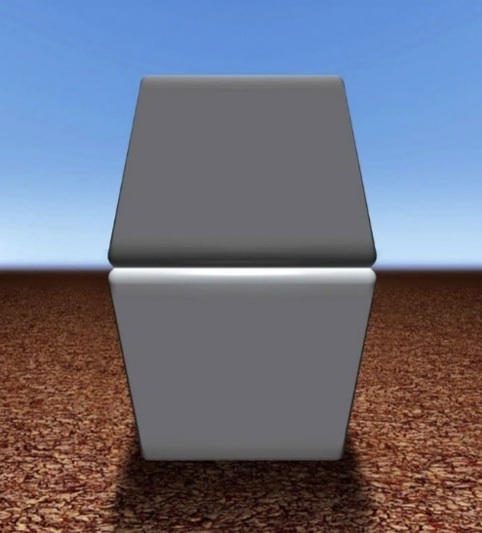
Expected Kokichi Sugihara to be represented as always, not disappointed. I will have to try and replicate this one as well.
quick edit: It doesn't always happen for me when I let the video continue to play, but if I pause it at 16s, then as soon as I hit the pause button, the image completely flips for me. Pretty wild. I think it's probably because I let my eyes drift away from the staircase for a brief moment, and when they return the image is sort of reinterpreted.
The wikipedia article mentions:
> There is evidence that by focusing on different parts of the figure, one can force a more stable perception of the cube.
Which is pretty interesting by itself, but I think it implies the need to physically move your eyes. What I'm curious about is the ability to alter your perception without moving your eyes physically. It seems like evidence for or against that could lead to some interesting conclusions.
The last illusion “Phantom Wiggle” is probably caused by time base differences of rods and cone photoreceptor systems.
The wiggle and movement of the strobed light is caused by ineffective calibrated of the bright and fast neural signals relative to the darker and slow (mesopic) signals of the large surrounding field of vision.
Timing differences between retinal subsystems (rods and cones mainly) are misinterpreted as movement.
Easy to see (expose) this temporal-spatial error effect between the slow rod photoreceptor system and the fast cone system.
Here is how: Just after dusk look at a bright light or even a star low on the horizon that ALSO happens to be near the trunk of a dark tree. Close one eye and then look at the bright light while gently rocking the corner of your open eye back and forth with your finger. The light and tree trunk will move relative to each other. In fact, the light may appear in the tree trunk. Time and space are also relative in the brain.
The brain has no clock or oscillator and has to create its own unifying timing system. The near-synchronization among brain subsystems is a key role of the thalmo-cortico-thalamuc feedback loop (imho).
Maybe I'm too used to see virtual 3D animations where objects can intersect and do whatever they want without any physics involved.
Am I crazy? Any else's thoughts?
The shoe is pink under normal lighting conditions, but the pixel values are green-gray in the photograph, where the lighting has been manipulated.
So, if you were to use a color-dropper tool on the photograph, you would get green-gray values for those pixels.
But some people are able to do color-correction in their minds and determine that the underlying color of the shoe (under normal lighting conditions) is pink. Indeed, the automatic color correction that occurs as they visually process the image is so strong that they find it hard to recognize that the actual pixel values are green-gray.
Yet when the color of the socks is changed to white, but nothing else about the photograph is altered, the visual cue that prompts them to do color-correction in their minds disappears, and they perceive the shoe color in the photograph to be green-gray, just as others do.
If they'd have said the answer is green-gray, then fine, this would be an illusion for those people who incorrectly thought the shoes are pink, but their answer is still wrong.
This is the one I find the simplest:
http://3.bp.blogspot.com/-FLbAdn2URJs/Toim-B864TI/AAAAAAAAOc...
And a video of a similar effect:
It's more of a magic trick, like when they cut a person in a box in two.