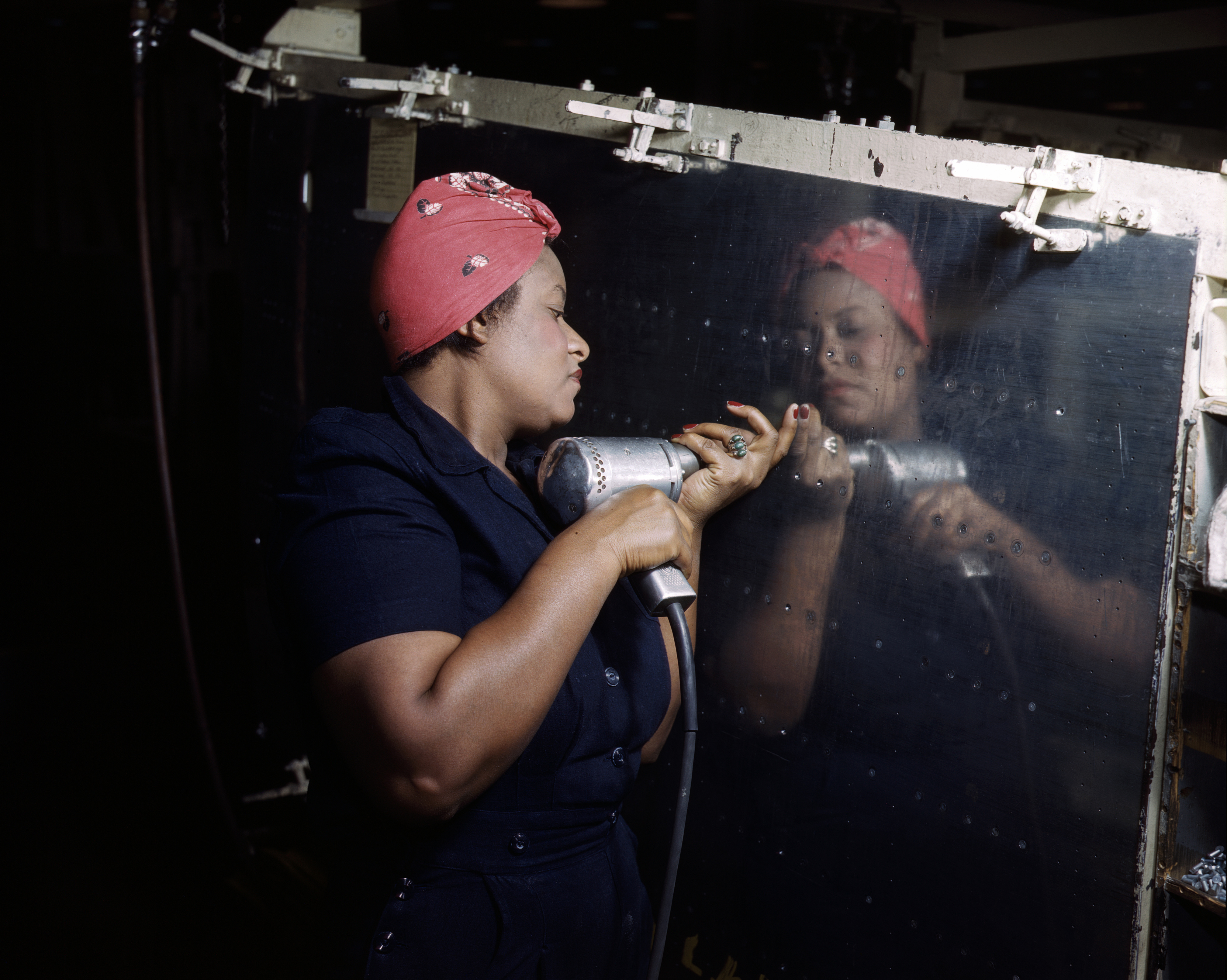
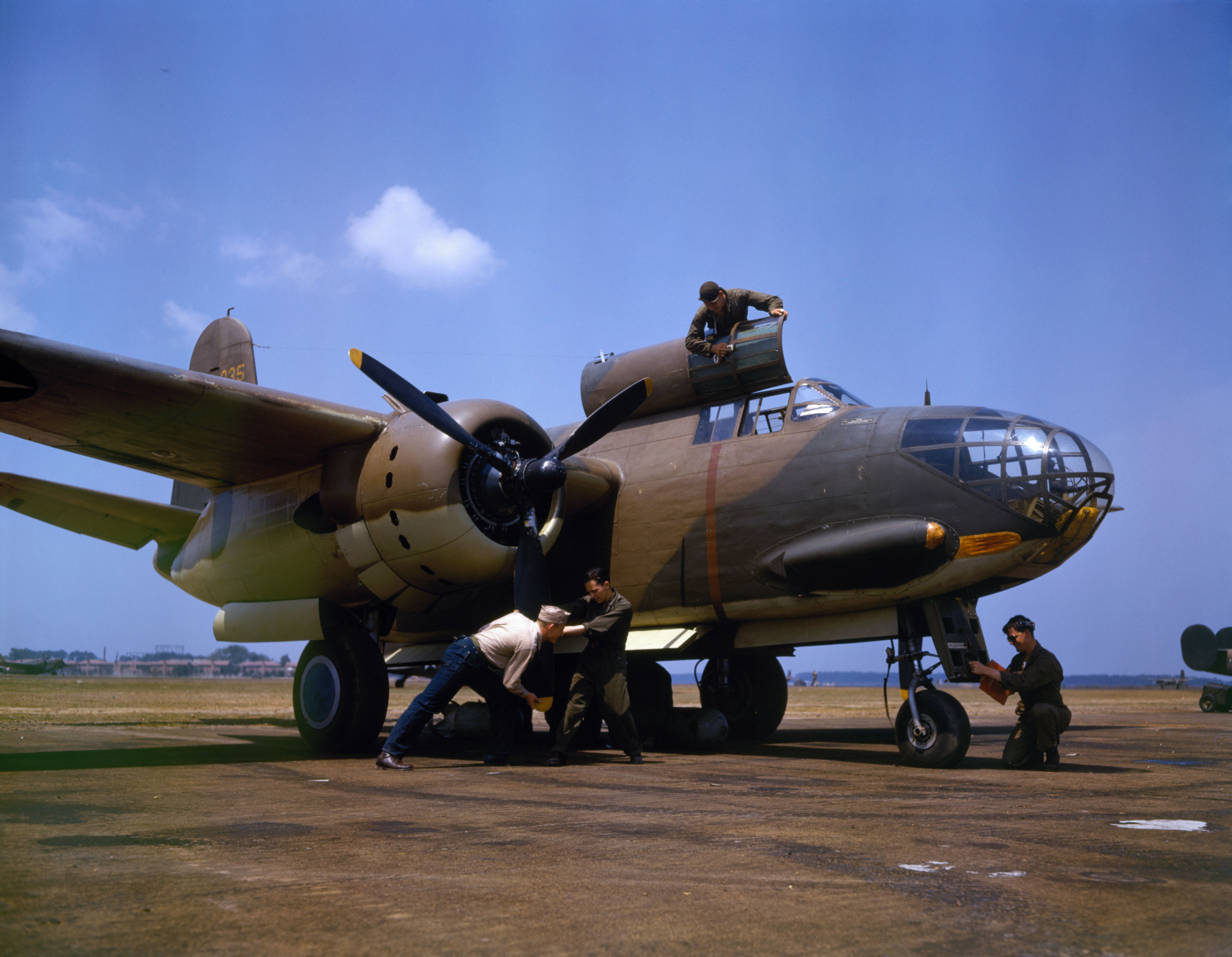
https://commons.wikimedia.org/wiki/Alfred_T._Palmer
Some favourites:
https://upload.wikimedia.org/wikipedia/commons/7/7b/Rosie_th...
https://upload.wikimedia.org/wikipedia/commons/c/c6/Carpente...
https://upload.wikimedia.org/wikipedia/commons/8/83/A-20_Hav...
https://anchoreditions.com/blog/dorothea-lange-censored-phot...
Her work was censored as part of the changed propaganda agenda from the we-are-all-citizens of Migrant Mother to ends-justify racism.
And the US jailed more than 120,000 Japanese Americans there.
For those who cannot visit, it's worth seeing how inhospitable the location is: https://goo.gl/maps/wz7NTbhMMYTid4b26
https://indiancountrytoday.com/news/haunted-by-world-war-ii-...
https://www.smithsonianmag.com/smart-news/us-forcibly-detain...
What all of the photographers had in common was a desire to show some kind of truth, and an inability to avoid restrictions from the authorities in the pursuit of that truth. What we are left with is a valuable resource to help us understand the camp experience. Although these artists were censored and manipulated, they provide for us today a concrete record of a time when American citizens were held behind barbed wire without due process of law. For that we are grateful.
https://www.nps.gov/manz/learn/photosmultimedia/photogallery...
The photos in the OP seem like a grab bag, they include some of those photos (like this one: https://commons.wikimedia.org/wiki/File:M-4_tank_crews_of_th...).
It's worth noting that the DOD collects all sorts of media and pictures from war and battle. What's sent out to the public is curated for a number of reasons.
The alignment of the spires in the original makes me think it's either taken from the north or south.
- Here's a current view from the north [2].
- Here's a view from the south [3].
My guess is that it's from the south and in approximately the same location as [3]. Without going too much further down the rabbit hole, I'm assuming:
- The Allies approached the city from the south.
- The original pic doesn't show the train station, which I don't think was destroyed during the war.
- The buildings in the original look ruined and the street view has all post-war buildings.
If anyone is a better lunchtime detective, happy to be corrected! And if you could help me figure out who is in the portrait in the foreground, that would be much appreciated!
1. https://1.bp.blogspot.com/-Fed2I0NB6x8/X3Tx_uhMp9I/AAAAAAAAa...
https://web.archive.org/web/20220128141631/https://rarehisto...
Death hangs like a cloud over these photos. I wonder how many of the subjects made it through the war alive.
Those D-Day soldiers, especially.
WWII photos are among most harrowing and iconic images in human history.
The technology is right on the line between old and modern. You can easily imagine yourself there with the tinny radios and the smell oil and grease. The planes and ships look scrappy, like they could easily be blown apart. Cranked out in volume to overpower the enemy, or at least have a few survive.
And then there's the suffering of people in the concentration camps, people who've had their cities bombed. Their faces tell you everything.
The sense of foreboding is palpable.
It was astonishing how quickly we reached a state of "bored adrenaline". By the second day, we were preparing our breakfast and not even looking outside when we heard (real) gunfire or airsoft pellets striking our shack. I remember sitting down, very tired and bored, thinking about nothing, but my hands still trembling from the adrenaline.
The ways that I naturally felt like moving (I think I'll lean on the wall of this shack for a while and watch the street, I think I'll lean against the wall and keep a hand on my gun) I eventually realized were the same poses I've seen civilians take in pictures of war zones.
That is, perhaps, the hedonic treadmill [1].
What a privilege to live in a stable part of the world!
Modern phones have tiny sensors. Pre 50s camera had massive sensors. Sensor size does a lot, the larger the sensor the less optical performance you need from the lenses. It also helps a lot with the "3D pop" due to depth of field, the larger the sensor the more depth of field you get.
4x5 cameras from the last century out-resolve modern 150mpx sensors.
35mm film, which has the same area as modern "full frame" cameras was called 'miniature format" until fairly recently.
Iphone vs full frame size: https://qph.fs.quoracdn.net/main-qimg-de59d641fcb2cb69218544...
full frame vs medium/large format size: https://www.quinnimages.com/wp-content/uploads/_mediavault/2...
A 150MP Bayer Matrix sensor would resolve about 7000 lines of vertical optical resolution.
I have some 35mm 50 ISO adox film here that can resolve about 600 lines per mm. That is about 21,000 lines of resolution. And there is better film which can do almost double that.
But ya, digital photos are usually blah.
Devices we have now that fit in our pockets can display a good photo almost instantly. Comparably sized modern cameras (digital medium format) given the same control of conditions (staging, access, models, lights, post-processing, etc) will certainly produce results comparable to, "better" than, or possibly indistinguishable from even the best of these older photos.
FoD is why SLR guys like me salivate over a 1.4 50 mm lens, not the added stop of light (especially not if you’re using digital - up the ISO)
My dad has images he shot going back to the 60s on a variety of films: Kodachrome, Ekatchrome, GAF, Agfachrome and Fujichrome. All stored the same. The Kodachromes look like new. Everything else deteriorated in one way or another.
https://en.wikipedia.org/wiki/Dwayne%27s_Photo
Kodak simplified the Kodachrome development process over the years, but it was never viable to do at home.
Honestly, anything but B&W and E6 was a PITA to do at home. Even the color negative process (C-41) was annoying at home due to the extra chemicals and temperatures required.
https://www.reframingphotography.com/content/processing-imag...
A lot of those sites have modern photos that have had "antique" filters, applied. I love seeing "Wild West" photos, with pictures of women in modern makeup.
I always laughed at the blow-dried 'dos on Little House on the Prairie.
Black Sheep Squadron had the 70's hairdos too, along with the very tightly tailored uniforms on the men. WW2 airmen never looked like that.
The weird ones, are the "mashup" movies and shows, like Streets of Fire, and Reprisal.
https://commons.wikimedia.org/wiki/Category:World_War_II_col...
https://en.wikipedia.org/wiki/Sergey_Prokudin-Gorsky#Gallery
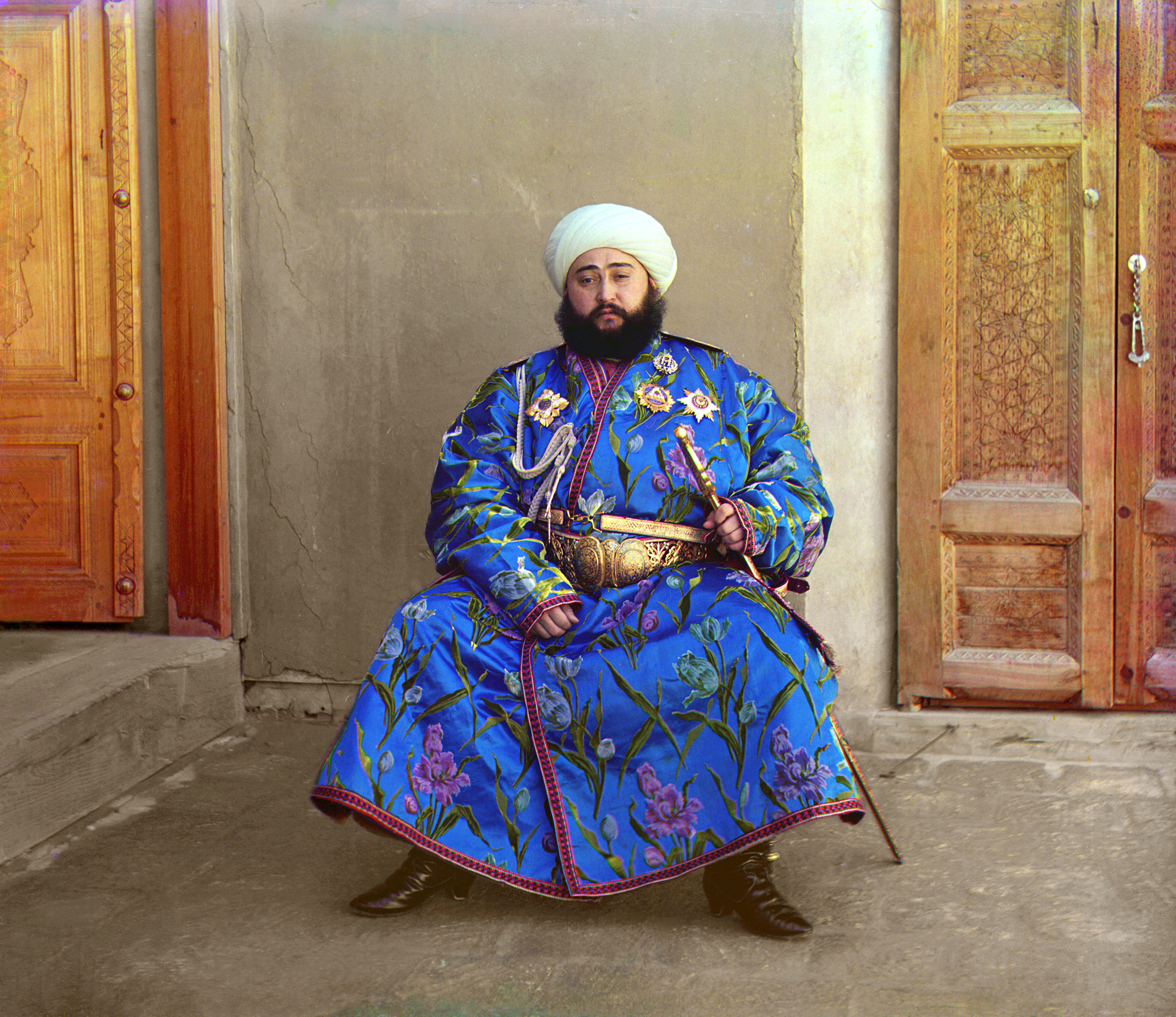
He took 3 photos with different colour filters in succession and captured them on large glass plates. Naive alignment possible before digital technology limited the quality of results, but as original separate negatives survived - it was possible to scan them at high quality and properly align digitally. So now we can see those photos in true colour and high quality.
As one of examples a very vivid photo of Emir of Bukhara taken in 1911:
https://upload.wikimedia.org/wikipedia/commons/3/33/Prokudin...
But, consider all the color films from before the war. There must have been a color method for there to be a movie!
Does anyone really think those women used lipstick like that while running a lathe? Makeup like that was saved tucked away in secret boxes for the day that the photographer came around.
https://www.flickr.com/photos/58451159@N00/albums/with/72157...
Another oddity. My family visited Berlin in 1969, and took several pictures of the Wall in its heyday. All with color slide film. Yet, if you look in the souvenir shops in Berlin today, all the photos of the Wall are black+white.
I look at that and wonder how they sourced all the CPUs and components... oh right, they probably had centralized domestic manufacturing and only imported raw materials.
Global Warming is going to trigger large scale wars, simply far too much disruption, including the likely displacement of a billion people or more.
Does anyone with knowledge of WW2 know if there was significant resistance to the victory in the months and years after "victory"?
It always strikes me as such a clear "victory" in a way I could not imagine in wars fought today. Is that just because the details of the end of the war have faded from general memory?
And no, despite that, it wasn't all that clean. Some German army divisions refused to surrender until early May 1945. There was sporadic resistance in the hills of Austria and in Yugoslavia until the end of May. In the East, Japanese holdouts, mostly in rural regions of the Philippines, Indonesia, etc., at the company level (dozens to hundreds of men) resisted in local pockets right into the 1950s, with the last guy not surrendering until 1974: https://en.wikipedia.org/wiki/Teruo_Nakamura
Psychologically speaking, both with Hitler's suicide and the Japanese emperor's announcement of surrender, people who lived through it often spoke of it like a spell being suddenly broken, all fervour evaporating in an instant, with intense tiredness and emptiness replacing it. They also spoke of relief. The leadership of the Axis had sworn that everyone would die to the last man if need be. And they had fought on long after the war was obviously lost. The surrender suddenly presented the possibility that people might just live. The fact that the Axis populations were starving and that the Americans started shipping in food, probably also helped convince people that it was better to not resist.
It's also hard to overstate the absolute scale of the purely military aspect of the victory and the occupation of the Axis territories. Nearly all infrastructure and military hardware had been destroyed. There were around 10 million Allied soldiers in Germany in April 1945 -- a ratio of about 1 occupying soldier to 7 German civilians. Meaningful and organized resistance seems impossible in the face of that. And the occupation troops did not leave until the Allies set up puppet governments that could and would crack down on any resistance to the new order.
Even colour photography by the British, like here, is relatively uncommon compared to the enormous output of American photographers. America was the only place during most of the war where you could just walk into a shop and buy some decent colour film.
I shot this on a 1955 leica m3 with the lens it came out of the factory with on a fairly low quality consumer film: https://i.imgur.com/3VKMtra.jpg
Plus, most of the lens recipes that dominated the middle 20th century (and certainly dominated in compact cameras until the 1990s) were established by the start of WWII. The main difference between then and, say, 1980, is coatings for colour photography and flare reduction.
it is striking that people have such a misapprehension of the resolution of 35mm film
My suspicion is that in the time before digital and everyone shot on film, most people were just really bad at taking photos ~ people used 35mm point-and-shoot, disposable cameras, 110 cameras, and similar. The general population weren't photographers and weren't using film to it's full potential - as a result, they got tons and tons of bad photos. Modern digital cameras (including those in phones) have great auto features for proper exposure, etc... and it's easy to delete bad photos (out of focus, too dark, etc...). I'm inclined to believe that most people's poor opinion of film is conflating the medium (film vs digital) with the camera experience (manual & confusing vs automagic).
There was recently a post here on HN about how the internet killed bad photos [1]. I made a similar comment at the time [2].
Originally, displaying them was only possible with a projector that super-imposed the three images. But computer processing allows the reconstruction of his photographs: https://upload.wikimedia.org/wikipedia/commons/e/e3/Rgb-comp... (That is Alim Khan, direct descendant of Genghis Khan, last of the Mongol rulers. Is your head spinning yet?)
Lilacs: https://upload.wikimedia.org/wikipedia/commons/6/6f/Gorskii_...
Electrical generators: https://upload.wikimedia.org/wikipedia/commons/7/74/Gorskii_...
Tea tax station: https://upload.wikimedia.org/wikipedia/commons/2/28/Gorskii_...
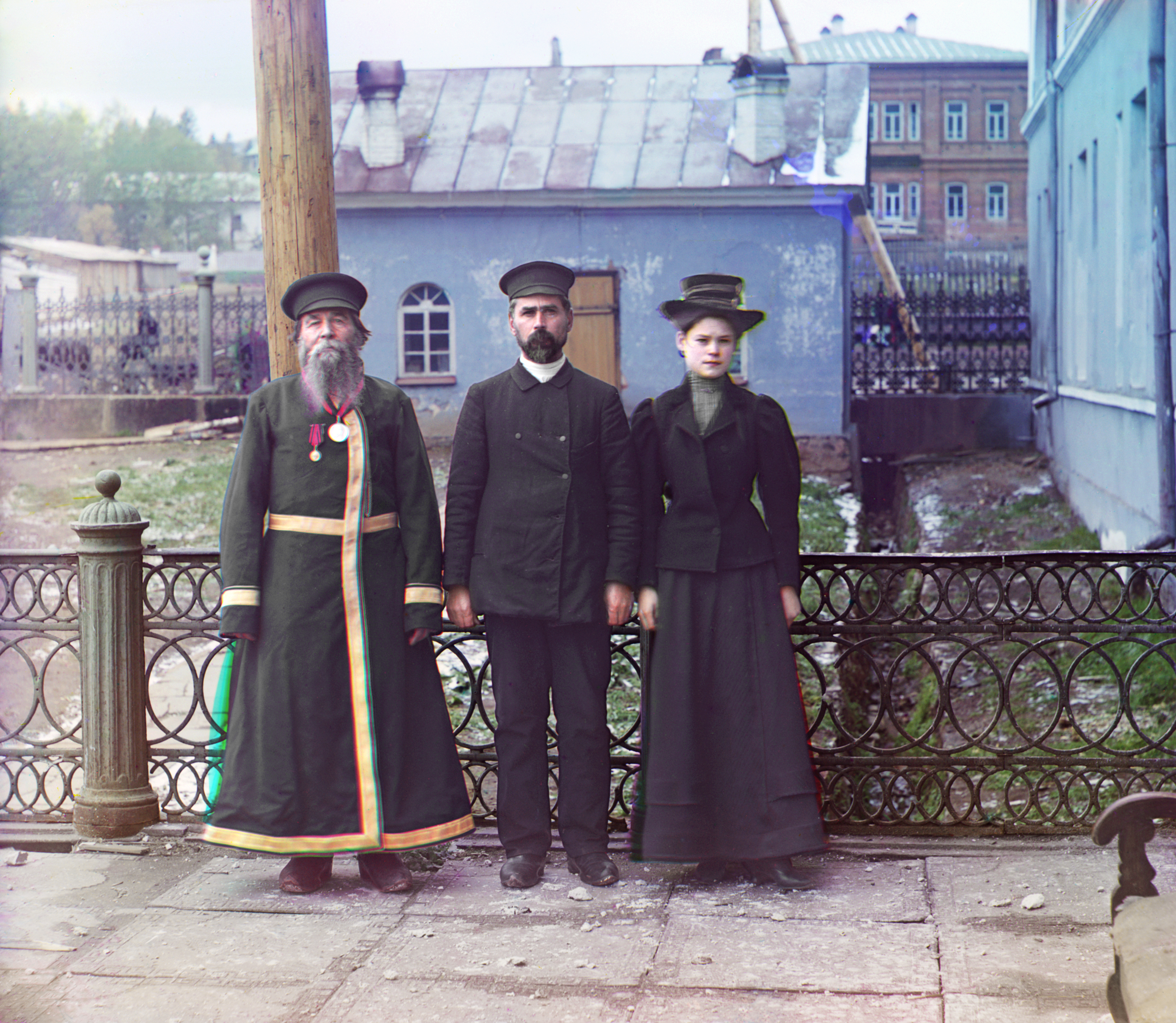
Three generations: https://upload.wikimedia.org/wikipedia/commons/8/8f/Prokudin... (you can see colour errors here on the fringes of the clothing, due to timing being off with the 3 shutters of his photographic process because the subject moved!)
I've never seen the early 20th century in the same light since I discovered him. His works are all in the public domain: https://commons.wikimedia.org/wiki/Sergey_Prokudin-Gorsky
Plus, many 35mm films were quite high-resolution even then; the downside was they were all very slow. This form of Kodachrome was ASA 10 or 12 or something like that.
Kodachrome. They give us those nice bright colors. They give us the greens of summers. Makes you think all the world's a sunny day. I got a Nikon camera. I love to take a photograph. Too bad mama took my Kodachrome away. ~ I'm sad that I'll never actually get to shoot on it.
Same for Hitler. A lot of people envision him as this screaming maniac but there are some recordings of him in casual conversation and he had a quite pleasant way of talking.