They are all GONE. No stock of anything (except the crappy ones, super-tiny packages, high Vgs(th) or high Rds(on) and other leftovers).
I've never seen anything like this, it's kind of frightening. Like walking into a grocery store and seeing the aisles all EMPTY except for a few scraps.
I don't even know where they all went. It's not like you need a TSMC slot to make a FET.
And whatever you look up, Chinese brokers have 10K-50K pieces of them for $25 each. Don't know what to think of that, either.
1. Our contract manufacturer calls in a panic no longer able to obtain/was shorted on a shipment of part XYZ. XYZ is increasingly becoming random "jellybean" parts like MOSFETS, oscillators, to slightly-more-complicated but not "fancy" stuff like serial transceivers, USB stuff, NOR flash, load switches. TI is the bane of my existence currently.
2. Search for a drop-in or near drop-in replacement. There are none, because that's what everyone's doing.
3. Search for alternative designs. Maybe the component is in distributor's stock (Digikey, Mouser, Newark, etc), maybe it's not.
4. Test the alternative design. By the time I receive parts, prototype, test, guess what? Can't get those parts anymore. Go back to step #2.
5. Fall behind on all of my other NPD responsibilities. Stress, burnout, acceptance. Lament not going into another engineering field. Feel bad about my midwest metro area compensation in comparison to a bunch of Silicon Valley SWEs on website.
6. GOTO #1
On new designs, I find a part in stock, we order ALL we need for the next year, and THEN I make a footprint and put it in the design. For EVERY SINGLE PART. Starting with the IC's. It actually works quite nicely once you get used to it. Obviously, there are some losses there too - just the cost of doing business in these crazy times.
I can't even get cables anymore. Or connectors. It's an insane situation, and the company I work for isn't built to manage this level of churn in our products. How do you support customers when equipment BOMs change every week? We just can't keep up.
7nm or whatever state-of-the art processes may be important for certain latest electronics, but I'm guessing there are many components that could use 10 year-old or more semiconductor fabrication processes.
If you're willing to share the original part number, I'm curious as to what FET could cause so much grief.
Same with USB-UART bridges; zip, nada, nothing. I found some Cypress parts a few weeks ago, and I should consider myself lucky.
I won't order PCB until I have all reels of parts on my desk.
If you wire up a solar cell like an LED, it glows dimly in infrared. QA uses this to diagnose dysfunctional wafers.
https://youtube.com/watch?v=BM7VDOoFIWI
The LED is the component on the left; there's a very dim flash (pretty much just the black die turning red) at around 11s, then every few seconds.
I can't remember exactly how it works... I think there's two capacitors charged up to the voltage of the LED in parallel through high-value resistors, and a circuit that shorts the +ve of one to the +ve of the other to put them in parallel.
It only just works at a very specific light level. IIRC some of the transistors are used as very low leakage diodes rather than transistors, as the regular diodes I had we're too leaky.
In the solar world they call it a blocking diode.
A gigawatt of solar cells represents about 5 square kilometers of silicon wafers at 20% light conversion efficiency. The world installed 183 gigawatts of solar PV in 2021, almost all of it based on silicon wafers:
https://www.pv-magazine.com/2022/02/01/bloombergnef-says-glo...
That's in the neighborhood of 915 square kilometers of wafers.
Silicon for solar has risen meteorically over the past 20 years.
https://www.pv-magazine.com/2021/10/26/whats-next-for-polysi...
Until the early 2000s, demand for polysilicon (often simply referred to as “poly”) was dominated by the semiconductor industry, which required a fairly steady 20,000 to 25,000 metric tons (MT) per year. But semiconductor demand for poly was quickly outpaced by PV as the solar industry began to grow rapidly, from a rounding error at the turn of the millennium to almost half of global polysilicon demand by the middle of the decade.
...
By the end of 2013, the manufacturing cost of polysilicon had tumbled to below $20/kg among industry leaders. Meanwhile, capacity had grown from less than 50,000 MT per year in 2007 to over 350,000 MT per year by 2013.
Polysilicon capacity at the end of 2021 was in the neighborhood of 700,000 metric tons, with more big expansions on the way. The extra 350,000 metric tons added since 2013 is almost entirely for solar.
MEMS. Micro-electromagnetic systems. The most common MEMS I can think of is the comb sensor, used for accelerometers in all of your cell phones.
https://www.memsjournal.com/2010/12/motion-sensing-in-the-ip...
The MEMS sensor for an accelerometer is quite simple. Take the nearest comb and smack it against a desk: you'll notice that the comb vibrates in one direction. Now hook up two combs and interleave their teeth together so that they're barely touching. When they touch, an electrical signal is sent through them to sense when they touch.
Add differently sized teeth, the larger the spacing the more acceleration is needed before they activate. (EDIT: Looks like the iPhone MEMS uses capacitance... similar concept though, the capacitance changes based off of how far away these teeth are from each other and you can measure that using college-level electronics)
Finally, have these teeth rotated in all directions, so that you can sense all the directions in one little device.
--------
MEMS are about using the physical properties of object, but just making these small physical objects really, really, really tiny thanks to the magic of photolithography.
You can see this literal comb structure by looking at any accelerometer under a microscope: https://memsjournal.typepad.com/.a/6a00d8345225f869e20148c70...
------
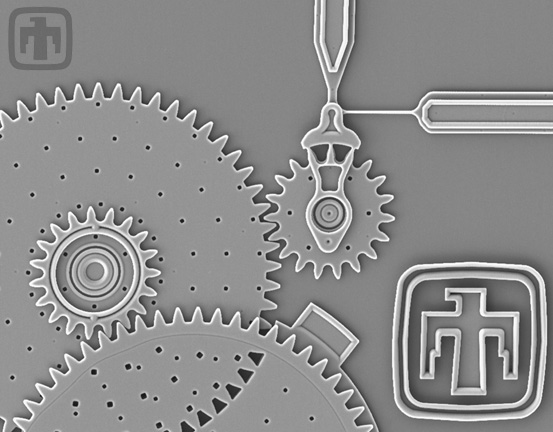
If the accelerometer is too difficult for you to understand, the "beginner MEMS" is gears.
https://www.sandia.gov/app/uploads/sites/145/2021/11/1-1.jpg
You can make any shape you want with modern chip-making tools. The "shape" most people want is a transistor (gate, drain, source). But in many ways, a teeny-tiny gear is simpler to think about.
The practical applications of micro-scale MEMS (gears, combs, springs, etc. etc. ) is somehow harder to think about than computers, so there aren't very many practical MEMS around. But still, practical MEMS help remind us that all of these chip-making tools exist in the real, physical world. Albeit at a very small scale.
- hard drive read/write heads (the platters are debatable)
- inkjet printer nozzles (this is why making a DIY inkjet printer is nontrivial)
- air pressure sensors (e.g., for car tires)
- precise frequency filters for smartphone wireless communication
- oscillators (https://news.ycombinator.com/item?id=18340693)
- very tiny microphones for smartphones (speakers are harder)
- Digital Micromirror Devices (DMDs): arrays of tiny mirrors used in most projectors
- microfluidics ("lab-on-a-chip" stuff for fast disease testing, DNA sequencing, cell manipulation, etc)
And a couple other semiconductor applications:
- LCD/LED screens (monitors, phones, laptops, etc) (these are made on a glass surface instead of a silicon wafer but use the same basic manufacturing techniques)
- laser diodes (laser pointers, CD / Blu-ray players)
- many quantum computers
E.g. EPROM (memory type chip) is typically deleted by shining a uv light on the actual silicon die, through a uv transparent quartz window in the final packaged chip.
edit: fixed EEPROM -> EPROM
Also, EPROMs are extremely vintage. They were replaced by EEPROMs - the first of which came out in 1977. That's an... extremely vintage example.
most recently: https://dyson-sphere-program.fandom.com/wiki/Microcrystallin...