The lack of fun, to me, is mostly because of how everything changed around it.
I can make a basic website now, no problem, everything is easier than it was aside from the fact we pretty much have to have HTTPS.
But, nobody will read it, because it will be lost in a sea of clickbait. I will have a hard time writing it, because I will be distracted by the sea of clickbait, and worst of all, I'll have a hard time finding things to write about.
And of course, the very fact it all does work so incredibly well, with a Sci-fi level of polish, means... it's no longer new. Most of it is being a cruise ship tourist, not an Arctic explorer.
Because the internet is dead without the offline stuff that gives it meaning.
It's like, binoculars and a field notes book with nobody to spy on, the perfect party where nobody shows up, or a spreadsheet showing all the customers someone doesn't have.
I think it's just like the idea of set and setting.
The internet/tech/coding/etc is the drug, and we lost all the cultural context, so now it's less "A beer at the bonfire with friends" and more "I had a bottle of wine alone because I don't know what else to do with myself".
Welcome to the 21st century! One of the 20th century's main themes was humans having to learn how to live in a world of infinite sugar, fat and salt.
Here in the 21st century, we have to learn how to live in a world of infinite information.
What will you do with your attention today? Will you consume the mental equivalent of broccoli or snickers bars?
My GFs blog is like in its 6th year now and every year its more visitors. Its not that much in internet terms (we are at ~700 visitors a day) but its serious content (dogs and science around dogs). No clickbaits, no cookies, no nothing.
That admission was the best part! Everyone here was not goody two shoes in their teens. Accepting this reality can release people from expectations of perfection. Perhaps ironically, kids' behavior can improve when they feel their imperfections are airable.
And yet, it still doesn't sit quite right with me. I suppose its because there doesn't seem to be the slightest hint in the writing that credit card fraud is wrong, or that it's even something you shouldn't do. I looked for it.
And to add to that, what he did wasn't 'a hack', it wasn't particularly clever. It was just theft of services and a lot of lying because he didn't have something he wanted.
I think if he would describe it as a youthful indiscretion or something similar it would go a long way.
That's called projection.
That's right -- modern age stuff isn't as _hackable_. Especially not at the hardware level. You get an Alexa or a mobile phone or a camera, it's all just a chip on a PCB in a plastic case, not intended to be fiddled with by anybody (not the owner, not some repair show, literally _nobody_) just to be thrown away after a year or two and replaced by a new one.
It's all very sad. There is still some software component to things that's hackable, but even that's harder to do. In the past you turned on your C64 and could start write away code, average Joe Teenager needs to install some IDE and pull in hundreds of NPM dependencies from shady places just to show a hello world. Unless daddy/mommy gave them a Linux box, then the story is different.
Or he could open a console in his web browser.
The kinds of hacking you can do today are different, but things are just as hackable if you want. If you don't want to hack, just get things done, then today things are much better, computers mostly just work for people who need to get things done.
It was simple and therefore easier to tamper and play with. Also, because it was so simple, more knowledge and understanding of the underlying mechanisms was required to use the technology. In the early years of the internet, simply operating a computer and exploring the web was an adventure in itself!
Now, things have gotten plenty complicated and that complexity brings bugs and makes the technology impenetrable to the common folk even with an educated mind - you need to be an expert now. If it's too complex, you can't play with it, and if you can't play with it, you don't learn and you don't have fun.
I feel that your conclusion, 'it just worked', is more a consequence of the increase in complexity rather than a root cause in itself.
Of course, I have to admit that my Bluetooth headset is pretty good, and a first-class gaming headset would be even better.
The Western Electric model 1500 [1], from 1963, is generally considered the best analog phone [1]. This was rented, not sold, so it is extremely reliable and rugged.
Best audio quality was with ISDN phones. Digital end to end, synchronized at the bit level, no noise, no dropouts.
I have no idea why modern mobile phones have no (or very low volume?) sidetone. It makes the UX orders of magnitude better.
The author:
1. Had more time than he knew what to do with.
2. Didn't have money
3. Had authority figures getting in the way of what he wanted to do.
A decade later, kids were 'hacking' their parents' wifi access points by logging in as admin/password to bypass "go to bed and stop using the internet" restrictions, but the author was not, because he likely had more money, less time, and most importantly, no authority to bypass :)
> part of the tragedy is that a lot of technology that worked well has been replaced by "better" technology that doesn't work well.
Yes I know that POTS landlines generally discard much not-in-human-vocal-range sounds that still affect how we perceive voice. But even with that limitation, I feel that the difference in sound quality as I remember it and as I now experience it cannot all be attributed to 30 years of rock concerts and rifle fire on these eardrums.
That's a very crude way of saying it and I 100% agree. The digital revolution promised to make analog world more precise, but we ended up having so much complexity as a result and the benefits gained by precision at low level is replaced by ever increasing chaos at high level. We seem to think having many things rendered simultaneously and faster are inherently so good not just for things like games that we built frameworks like React that run big parts of the web.
It's as if we decided increasing entropy isn't so bad after all.
Standing next to the phone talking to friends was strangely fun and nostalgic experience, despite the fact I had only used a payphone once in my life. I got a cellphone very quickly (perks of having a tech journalist in the family), so by the time I was old enough to be able to buy a phone card with my own money I no longer needed it. During the pandemic, all of the remaining phonebooths in the country were quietly shut down and dismantled.
I know it's completely irrational, but I'm still sad that I had to eventually return the one I worked on and that in the many years the system was still operational it never occurred to me to buy a card and call someone from a phone booth just for the fun of it.
P.S.: If anyone from Slovenia or other ex-Yu countries has any ideas how I could get my hands on one of those Iskra payphones, drop me an email (address in bio). I have so many ideas for projects involving them, but it seems that I'm a bit too late to stand behind the Telekom dumpster and snag a few before they're scrapped.
Some, near the end, could take a credit card or a telco card.
I presume you could buy the cards back in the day, anywhere and easily?
I'm using two of those 2€ sound cards from China to drive the handset and ringer speakers and both work quite well. I would probably need to add a small amplifier if I wanted the ringer to be heard from the street through the metal enclosure and plexiglass booth, but that wasn't a requirement for this project.
He installed a small switch between the payphone and the line before it went into the ground. He then exploited the lack of coordination between the phone and the exchange.
* First he would pick up the phone and start dialing 0800 (equivalent of 1-800), the phone would see this was a free number and ignore what was being entered next.
* Then he would briefly interrupt the line. The phone wouldn't notice but the exchange would think the call had ended.
* Then he would dial a new number. The exchange would think the payphone was making sure he paid, while the payphone would think he was still dialing a free number.
So to call 0900 123 456 for free he would dial 0800-click-0900123456
Obviously the phone company audits quickly turned up a problem but he got away with it for a little while.
In Japan, they would just accept DTMF tones from anything that would generate them. There was all these people using hacked cards that they installed countermeasures against which were hilarious because people using these hacked yakuza cards would keep one foot in the doorway in case the fabled alarm would go off, i knew a guy who did this thinking naaah it would never happen to me. NOPE happens to him, he had to squeeze himself out of that phone booth and run after a red light started flashing and the door slammed shut on his shoe... Literally just playing the DTMF tones into the handset would have gotten past that on every 'grey phone' out there (The ones that advertise ISDN connectivity). Wouldn't be surprised if that still works if they still have those phones anywhere.
The other way I did it in another country was a telephone company test line (toll free!) which would give you 30 seconds of silence then a dial tone (presumably 'remote'). From this dial tone you could call anywhere in the world. We got some list that phonelosers used to make and called places like the president of Kenya.
This guy mentions using a payphone which accepts incoming calls to get the internet as a kid in the 90s. Those which still rang on incoming were mostly gone by my time but a few were still configured to act like that. Was fun to sit down the road with a cellphone and watch people be scared to pick up the line after watching it ring for a few seconds.
This did not happen.
Almost no Japanese public telephones even in 2022 have a) doors which lock or b) motors/servos to operate the door. The exception on motors is a specialty item "automatic door (electric type)" which is sold primarily as an accessibility aid for people who cannot operate unpowered doors. The door, in all cases, is for caller privacy, not for preserving the integrity of telephone billing.
I feel _extremely_ confident in this, and confident that you would get an immediate on-the-record denial from NTT if you asked. One reason among many: if the phone booth was physically capable of locking people inside that would endanger human life in a natural disaster, and the first rule of engineering in Japan is that one's system must function during natural disasters.
On this I will see "I once talked to a Japanese woman" and raise you "I have written the acceptance testing protocols required by that 'rule' for a firm which produced publicly-deployable hardware artifacts." plus "I have two working eyeballs and can confirm the absence of a motor in almost all telephone deployments."
(Apologies for someone-is-wrong-on-the-Internet here but we were extremely serious about rule #1.)
Why didn't you install DTMF filters on the phones lol I was calling like new zealand and shit.
And I'm talking like, 20 years ago plus here... It could be bullshit for sure, I'm relating someone else's story.
How did this work? Did it literally lock you inside and how did you exit?
It's something that happened in the late 90s, some time after I was in Japan myself. I trust the source, his Japanese wife corroborated it somewhat embarrassed.
Wow, there's a name I haven't heard or thought about in years... I wonder if RBCP's writings are still floating around somewhere. Even the fictional ones (especially the fictional ones, I guess) are amazing.
This was like 5 years before my own time in Japan but pretty hilarious nonetheless
In my mind I thought that pay phones were fully automated, especially the count the money part.
Edit: oh yeah, and after that, you’d just call the operator and tell them the keys were sticky and to dial the number for you, then you’d “insert the coins” by playing the tones.
Well, or you just third party billed the call to someone you didn’t know. That worked too.
https://www.reddit.com/r/seinfeld/comments/4chcmp/seinfeld_e...
Billing automation came in the 1960s, but didn't involve computers yet. Special purpose hardware, paper tape, and punched cards were involved.
> My daughter is 5 - I don’t want her dialing 911.
Five year old girls calling 911 has saved a lot of lives. I just listened to a whole podcast series about that.
> Why yes, payphone.com, yes I have.
This had me rolling but it's also a great example of knowing your niche target audience.
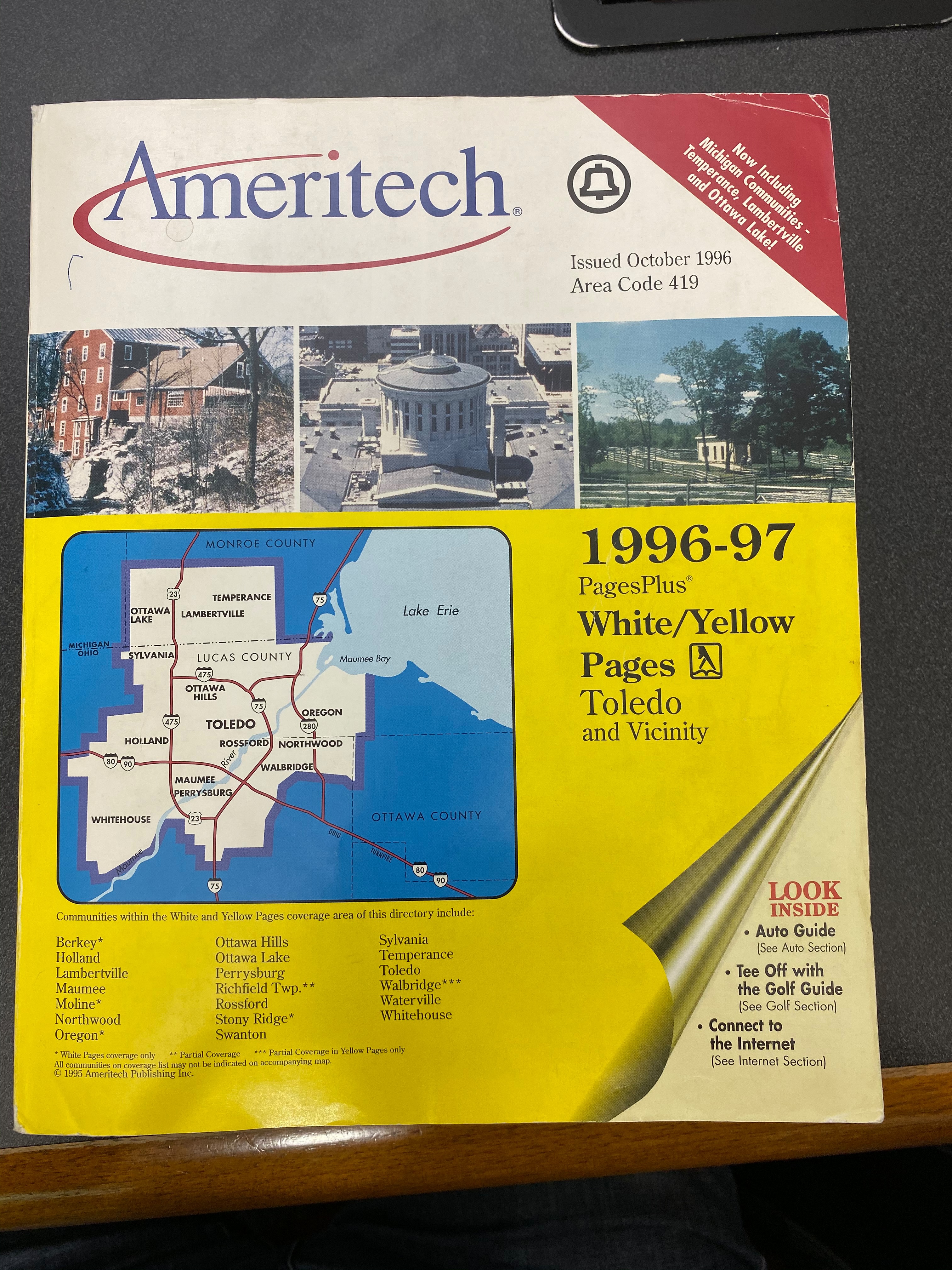
One of them did not validate the card number, so you could just type in 000000000000 or whatever and your free trial was enabled for a month or whatever and then be auto cancelled when they tried to bill for your first month after the trial. In the UK though local calls were not free and charged by the minute.
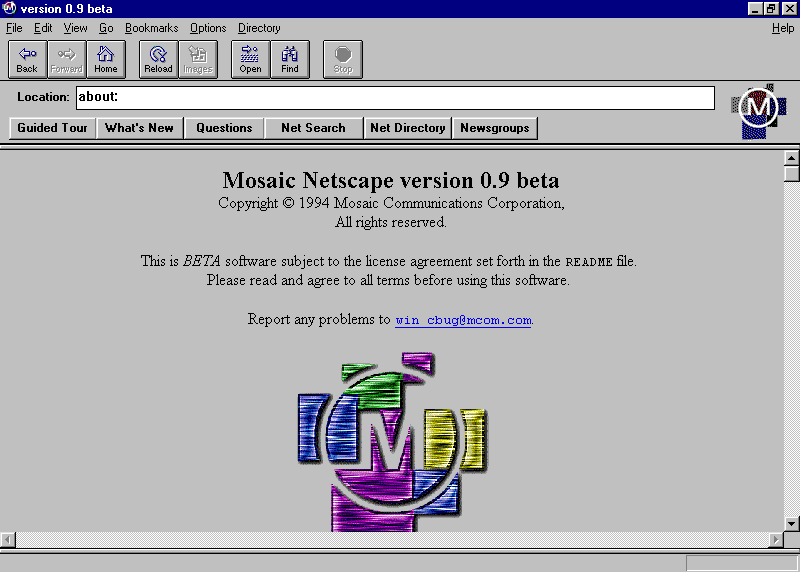
I think that ISP also bundled a <1.0 version of Netscape's Mozilla (0.8?) on their disk which was nice as otherwise I only had mosaic.
Good times.
Edit: I think the version of netscape/Mozilla was this one - I distinctly remember the "M" logo that would rotate as pages loaded slowly on a 14.4 modem: https://www.webdesignmuseum.org/uploaded/old-software/web-br....
Curious that it was called "mosaic netscape" - I don't remember that.
Presumably the activation of service happened locally in the device, or with minimal cross-checking with the backend billing service.
A few months later I tried it on another unit and the number no longer worked for activation :)
When I visited the US I was shocked that you could do all kind of business by just telling or typing in the number on the phone. I soon learned that cheaper businesses (e.g international calls at discount rates) did not accept my foreign card. However, more expensive businesses (like AT&T to stay at the same example) just accepted the number, no questions asked. CVV wasn't in use. A concept that exceeded my imagination, credit card numbers are not that secret, everone working at a checkout could collect them. When reading this I guess they would have also accepted phantasy numbers with a matching checksum.
My conclusion back then was: For those operating at comfortable margins some loss by fraud is just priced in. Those offering cheap prices don't have the luxury to do so, so they reject everything that is not easy to verify, like e.g. foreign cards.
Just need an old PC, a compatible dial-up modem with voice, and a card with a few FXO ports to go to the payphone and child's phone...
General rule of thumb is that any payphone that accepts credit cards is actually a COCOT, any payphone not branded by the ILEC is a COCOT, and a lot of the rest are COCOTs too depending on the telco. "Genuine" exchange-controlled payphones (that signal coin drops back to the exchange) have become rare.
I'm pretty surprised he went with the Viking box actually because it costs more than an inexpensive FXS ATA, and a lot more than getting an ATA used. It's simpler to set up, but on the other hand some ATAs have internal logic to connect their two lines that you can enable so they behave as standalone devices. I think this is typical on the older Ciscos.
Sure, culture has become more sensitive to these things overall and criminal prosecution of credit card fraud and computer crimes has become a lot more effective but there's a tangible difference between generating fake credit card numbers and masking your identity to defraud ISPs and hacking the Pentagon to access government secrets (namely, the latter fits into the hacker ethos of "liberating information" and rejecting authority whereas the former just provides personal gain). Changing your school records as a student is a childish version of the latter (as the intent is not to create false credentials for monetary gain but to defy the authority of teachers by subverting their means of "punishment").
The weird thing is we have had the CFAA hanging over us as some kind of Sword of Damocles for decades and we just collectively ignored it. Honestly everyone was even pretty cavalier about this stuff during and after the Mitnick prosecution...
In the 2000s when I talked to people who do urban exploration there was at least an understanding that you should not be taking photos in sensitive locations -- "please don't make a felony diary".
The 90s were cavalier. We're talking over 20 years ago, different time.
The big difference was that people were... for lack of a better designation, intensely naive back then. There just wasn't a lot of understanding around consequences.
I am pretty sure kids today are also doing some different mildly illegal stuff with technology, but we'll have to wait 20 years to find out about it.
to be fair that movie follows a group of teenagers showcasing illegal activities that finally culminate into their federal arrest.
yeah, they're later exonerated because 'Movie-FBI' has a heart and a sense of justice, but that's probably not the best movie to try to pull criminality psych from.
my guess : Eric Corley injected a lot of his own personal ethos into that movie. He was apparently an unpaid consultant.
Orherwise ISPs are the poster child of monopoly giants that had to be broken down kicking and screaming, but kept screwing the customer over and over because there is litteraly nothing that we can do about it (voting won't help). They can burn in hell I wouldn't care.
ISPs were also pretty liberal with free trials (AOL CDs galore) since it was mostly customer acquisition cost (it wasn't yet established that you had to have an Internet connection like you did a landline and Cable TV) and the marginal cost was low (ideally, the cost of peering -- the ISP basically had some routers and modem banks between an internet exchange and a phone exchange; and the user paid any applicable long distance charges to call the ISP). Whereas now you'd preauthorize the card at signup time to catch this sort of fraud beforehand.
There were a pretty good number of nationwide ISPs to choose from too, if you wanted something less fly by night. A whole heck of a lot of consolidation happened since then of course. But even the winners of dial-up pretty much lost to cable and baby bells. It was easy to setup a dial-up ISP, but it's darn hard to setup a broadband ISP, so we're stuck unless you can convince the FCC that the 1996 Telecom Act applies (might need some court work as well) and we can get mandatory line sharing back.
These days isn't it a lot easier to deal with that? You basically just get on the phone with equifax/transunion and upload some documents.
Guess that trial and error had to start somewhere.
Also I really wonder what the mathematical chances are that the card actually matched with someone back then. Like obviously a collision risk here but how large?
You have to remember how expensive this stuff was in the 80's and 90's, how low risk this type of fraud was, and how us teens didn't really think about it. ISPs billed by the hour, something a teen could not afford.
Check out any history of phreaking [0]
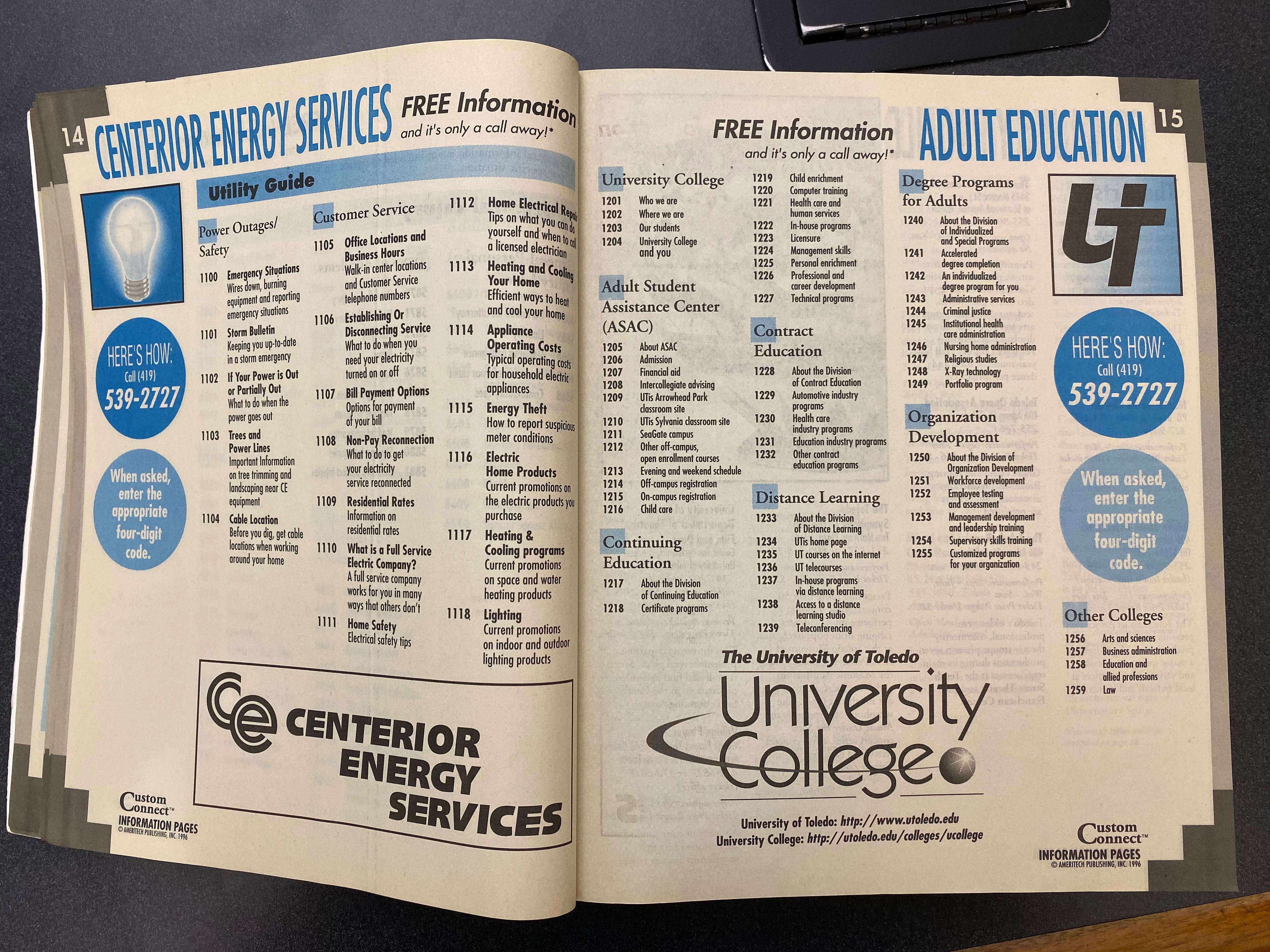
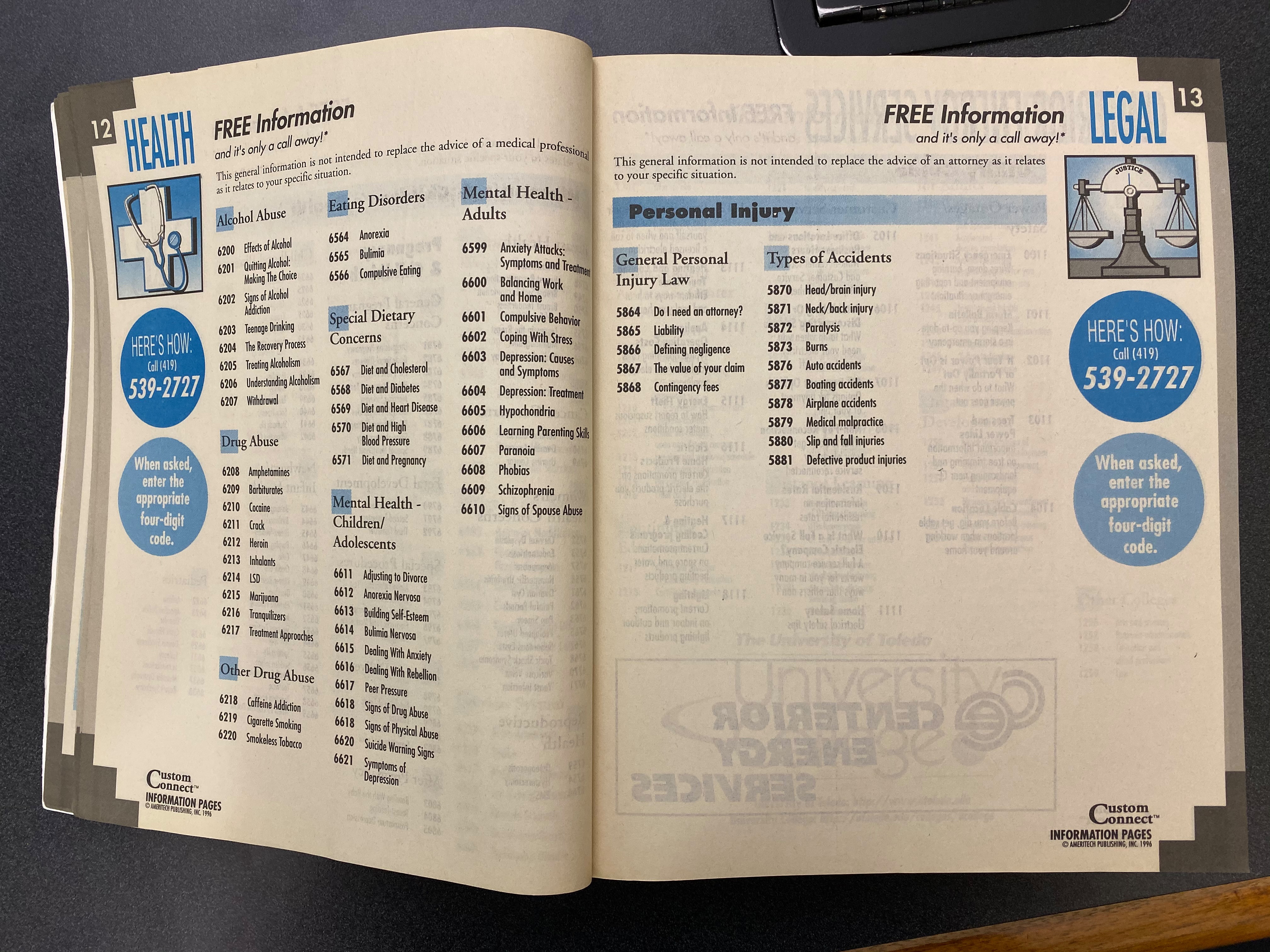
In my town in the 1990s, it had the unique feature of a free local number you could dial and use to play games, get movie showtimes, find out the time, and more. It was almost like audio-only webpages you pulled up with a four digit code after initially dialing a regular phone number. I would spend lots of time on there, typing in random codes to see if I could find an Easter egg. And I did.
I found a code - I think it may have been 9876 - that opened up a service where you could leave a short message that the next person could hear. Frequently it was nothing much, but sometimes it was … pretty strange, sometimes pretty entertaining.
Did anyone else stumble upon this strange corner of phone service, where you left a recording for strangers, and listened to what they left?
https://cdn.remarkedusercontent.com/file/remarked-prod/1/mar... https://cdn.remarkedusercontent.com/file/remarked-prod/1/mar... https://cdn.remarkedusercontent.com/file/remarked-prod/1/mar... https://cdn.remarkedusercontent.com/file/remarked-prod/1/mar... https://cdn.remarkedusercontent.com/file/remarked-prod/1/mar... https://cdn.remarkedusercontent.com/file/remarked-prod/1/mar...
I do remember our town had a local number, 8463, that we could call to get current time and temperature played back to us.
There was only one phone, so the rest of the kids were in a queue waiting to call theirs. You'll get an earful if you were the one to fill the coin storage (the phone company only comes once a month or so to collect the money) or jam a coin.
It all started when I discovered after buying our new house that most rooms were pre-wired with RJ11 outlets, with all the lines going to a central closet. So one day I bought a cheap 8-port PBX for $80 (https://www.amazon.com/dp/B015MIQ12A) and bought a classic rotary phone for my daughter's room, and a regular phone for our room. The PBX needed no configuration whatsoever, it comes with the ports assigned extensions 601, 602, etc, so right away my daughter was elated she could call us from her room by just dialing "601" or whatever. It's important to note we do not have a landline; the PBX's outgoing lines were left unconnected, so it was purely a private phone network. The PBX could also be configured so it auto-dials an extension as soon as the phone is picked up. But I wanted my daughter to learn how to use a rotary dial so I didn't use that feature. As a side note, the "phone line simulator" that the OP uses is basically a minimalist 2-port PBX with no outgoing line.
But I thought, how hard is it to replace the PBX with an Asterisk VOIP system? So I replaced the PBX with a $140 Analog Telphone Adapter (also 8 ports: https://www.amazon.com/dp/B07B6TL7N6), I configured the ATA to route calls via SIP to my Linux gateway, on which I installed Asterisk. I wrote a simple Asterisk config defining even shorter extensions so my daughter only has to dial "1" or "2" instead of "601" or "602". Then I set up some extensions that play recorded audio files, like songs, or sweet messages we recorded to each other.
Then, later I thought it might be practical for my daughter to be able to call my cellphone (in case of emergencies or whatnot). So I searched for VOIP providers, found https://voip.ms/ and signed up for an account. I configured Asterisk to place outgoing calls through this provider. And I defined new extensions: 3 rings my cellphone, and 4 rings my wife's cellphone, while the other extensions work just as before (eg. 1 still rings our bedroom.) But I specifically did NOT configure Asterisk to be able to place outgoing calls to arbitrary numbers. So the internal phones are only able to call my predefined extensions.
And again later I thought it might be practical to be able to call her bedroom phone from my cellphone. So I added a DID number (direct inward dialing) to my voip.ms account. Then I configured Asterisk to accept incoming calls from voip.ms, then prompt for an extension, and forward the call accordingly. So when I call the number, I hear "please dial an extension", then I can type 2, and my daughter's phone rings.
In order to avoid spam calls, I made Asterisk check the caller ID and accept calls coming ONLY from my cellphone or from my wife's cellphone. (I'm well aware that caller ID can be spoofed, in fact I have spoofed it myself a few times with my setup as a demonstration to family & friends.) In the 2 months since I bought the DID number I did not see a single call intercepted by my caller id filter. So it looks like I got a pretty "clean" number. I understand that I might not have been that lucky.
And that's basically where I'm at today. We have a mostly private in-home phone network, that can also call our cellphones, and our cellphones only are allowed to call into the house phone system.
Our daughter will call us in the morning when she wakes up to say what she wants for breakfast. When her cousins visit, they chat on the phone from room to room. It's fun!
As someone who knew nothing about Asterisk, I found the official documentation utterly mediocre. The process of configuring it consisted mostly of finding real-world examples, then trying to reverse engineer them by finding what they do from the documentation. But in the end I still got everything to work exactly the way I wanted it.
I had the pleasure of knowing a guy who knew a guy when I was in school. Basically there was a prefix 786 that you could (within the area code of course) dial the prefix for the callback 971 and the last 4 digits of the host (thankfully the number of the pay phone is right there on the pay phone) and then hang up twice the phone would ring until you picked the phone up.
Fast forward to another thing of the past, the mall! The mall had BANKS of pay-hones just sitting around. So a group of friends and I got to all of the banks and decided to make all the phones ring. We walked around the mall forever as people just looked at the ringing phones and carried on about their lives.
After doing it for about an hour security caught on and I got banned from the mall, I think for the fourth or fifth time.
It was a beautiful site to see. Two dozen or so payphones just ringing and people completely perplexed as to why.
Well… hmm. I taught my daughter how and when to do that by that age. You never know. That could end up saving a life. She knows not to do it frivolously. This does not seem too advanced a concept for a kindergartner.
That said, intercom-like internal system Bertrand built seems to be much cooler than having the real phone.
Yes, that was really weird to have as the very first item. As a parent I taught my child, when she was young, to know my phone number, to dial 911, and to recognize a police officer and other service people.
I’d try to make one myself if I wasn’t so good at killing hardware.
Okay, well, now I have something to do with the rotary phone I inherited from a previous job. Time to set up a phone line to my kid's room!
I wonder if something exists to connect any arbitrary number of phones together. Maybe even with distinct phone numbers?
edit: duh, of course it does, PBX. maybe that'll be my summer project.
One day I noticed the tones produced by putting a quarter in a pay phone to tell the backend switch a quarter had been inserted. It was, like, beep beep beep beep beep, really fast. Dimes and nickels made the same tones, but they were shorter, less beeps.
Something sounded familiar about these tones, and through trial and error, I realized these tones were made from the DTMF tones of either the asterisk key or the octothorpe key (I can't now remember which, and btw, it is not a hash symbol, it is an octothorpe). By putting enough presses of the right key into the memory of the Radio Shack dialer, I could fool payphones into thinking I had deposited quarters. I had turned my off the shelf Radio Shack DTMF dialer into a Red Box, without actually doing anything to the hardware or electronics. And it was a lot more svelte than the original Woz Red Boxes, about the size of a flip phone when closed.
At first, this worked at every payphone, always, any kind of call, local or long distance. I spent a lot of time at the airport and hotel pay phone banks calling a gf long distance. But eventually, my DTMF dialer stopped fooling the switch, so I could no longer make free local calls. But with long distance calls, I'd usually get an operator once the spoofed coin inserts failed, but they would always still fool the operator, who I think assumed line interference prevented (what I assume were) the new digital switches from recognizing coin insert tones. Then that stopped working; somehow the operators knew what I was doing and would accurately describe my spoof to me.
So it no longer worked with ordinary common pay phones. But I found a pay phone installation that was not ordinary, I believe it was called a "Smart Payphone," but it was not smart in the way we think of smart phones today; it just had some extra electronics and a small 3 line LCD panel which told you how long your call lasted. I could continue to make local and long distance calls from only these types of pay phones for a few more years until every place I knew there had been one had been uninstalled.
It only occurred to me later that I was not stealing from AT&T or some local Bell affiliate. I had been stealing from whomever owned the pay phone, who still had to pay for those long distance calls I made. I have carried the guilt and shame of my juvenile crimes ever since. Not kidding. That was all very, very wrong.
edit: not one of you asked "which one's the good one".. I rest my case.
Still sometimes I need to make an outgoing call to some customer support line or other such nonsense that only works over "the phone".
Back in the day before cellphones were an option I would sometimes use a payphone for these edge cases, but they basically no longer exist.
I had already canceled my cell phone subscriptions a couple years ago and ported my one remaining cell number to a VoIP provider. This lets me get SMS over email for dumb services I can't avoid like banks that insist on using SMS verification still.
Given that setup had worked well, I decided for rare life edge cases that still require classic phone system voice calls I could also get a VoiP ATA box and route calls to it. This let me setup some "dumb" landline phones at home, the first which logically had to be a payphone, which is now installed and working in my home office as of a few months ago, and I love it.
It is visible in most of my work video calls and people are often skeptical that it really works. Some call it to test are amazed it works fine. It amuses me.
After that, I switched to just getting a temporary SIM at the airport.
The unexpected screenshot of the LORD intro ascii art was a blast from the past.
I understand the anti-capitalist (or at least anti-corporate) and anti-authority attitudes of hacker culture but these stories are not told by anarchist cyberpunks "sticking it to the man" but almost invariably by sheltered (usually WASP) yuppies working for billion dollar companies or in this case, Slack.
These aren't so much stories about clever hacks and youthful rebellion but of a youth isolated from consequences for criminal offenses that would otherwise have been sufficient to give them a career-ending criminal record.
Nostalgia: Early 1960s near Liverpool UK. Being taken up the street to the phone booth to learn how to make a phone call (coins, dial number, press A button, talk, hang up, press B button to claim any leftover coins). Big thing when you are 6 years old.
https://www.google.com/maps/@55.9164681,-3.1675508,3a,15y,27...
Personally I’d go with a specialist/approved company such as x2connect.
As you might imagine, a lot of free outgoing calls were snuck in. Just pick it up when the clerk isn't looking. And no one wants to sit around all day guarding the phone, anyway. And so payphones. In those environments, you'd want them to be able to receive calls at a pre-arranged time, as well as place them. And it just kinda carried forward. But many regions in North America did start prohibiting incoming calls on payphones eventually. You couldn't do that in the 90s where I grew up in Canada.
Here's a list with physical addresses and phone numbers. Enjoy.
https://raw.githubusercontent.com/B15mu7h/Payphones/master/P...
Wow, didn't know about this at all. Will be experimenting with these for sure. Thanks!
Just worrying about the "seen some shit" thing: where I used to grow up, the only payphone was mostly used as a toilet by drunk people.
I would like to make use of an ancient analog phone.
It's important to note that other than call routing, the ATA has to do almost everything the phone company would do. The ATA provides any Caller ID, for example. It provides call-waiting, or 3-way conferencing. If you want to use a rotary phone, you'll need one that handles pulse dialing.
Your ATA will use SIP to connect to a VoIP provider. Some support using multiple SIP accounts (especially if the ATA has multiple FXS ports.
A VoIP analog telephone adapter (ATA) would be the most common form of this these days. Most will have two analog lines, though other configurations are available.
The Sipura SPA series and it's derivatives (Linksys PAP2(T), Cisco SPA122) are popular, as well as Obihai's lineup. I've used them all extensively and they're solid.
You can connect these to a SIP based VoIP provider or they can operate entirely standalone just calling port to port. With a bit of work you can even link up multiple devices on a private network IP to IP.
Seems like it will work just fine without doing that.
> I’m not quite ready to reap what I sow.
Thank you for rekindling some memories.
Naturally, I imagine he used the stud finder on himself a few times when his wife was in the room.