It basically always pays to ask a counter-question like "Will we want to change our action in some way based on the result of this test?"
Often the answer is no, so we can skip doing the test and get to remediation faster.
Once you notice this pattern (it's clearer in outage situations where moments matter), you frequently catch people (including yourself, if you're honest) seeking information that they don't even /plan/ to use as an input to some decision or action. In other words, there is no conceivable future where the answer to some proposed question would have an effect on their actions. If you find such a situation, you can at minimum remove answering that question from the critical path, and possibly just never bother finding the answer at all.
That doesn't mean that having such information is bad, just that we should think of the cost of gathering suit against its likelihood of mattering in terms of our actions. In fact, possibly one of the central purposes of IT broadly is to lower the cost of answering such questions, so that we can afford to ask more of them.
This is my absolute favorite question. I am continually amazed at how much crap it can cut through.
Sometimes there's a belabored debate between two choices and answering this question can reveal that the choices don't have to branch right now, that they have (or could have) a shared 'path prefix', enabling us to make the choice later when we have more information.
It's also relevant when people ask for ill-specified 'dashboards', or 'reports'.
Will what we do change substantially based on what we see on these dashboards? If not, why make them? And if so... can we just automate that behavior so we don't have to rely on someone noticing the dashboard?
For those purposes it is difficult to answer 'what will we change' and even harder to automate the process.
Unfortunately too many fails to appreciate complexity so "if something work" it must work anytime, at any scale, for any scenarios and so on. Teaching complexity IME generally fail.
I like to ask this too. This question is also very useful in a medical context. They often order tests where the outcome doesn’t really matter for the path forward.
Is this good enough for now and safe enough to try?
It makes sense, because at some level the success of a corporation is totally devoid of purpose outside the maximization of profit. I just think it is interesting how that bleeds into the habits of employees. How much of that do we take home?
I don't know what the answer is but I agree that market-worship is bad and makes all of us involved in market-driven work (i.e. basically everyone) a little less compassionate.
I've experienced this happening due to an influx of people into an organization who simply can't execute -- middle managers come in with impressive resumes but little understanding of the problems that need to be solved. When results aren't delivered, they default to extensive planning processes because it creates an appearance of work. There's lots of tangible outputs (market studies, reams of wiki pages and documentation that are written, fancy slide decks, plenty of presentations...) yet nothing that provides actual value to customers. They know execution is the hard part, they just can't do it, so they stay in planning mode endlessly in order to provide an illusion of productivity, and to keep their job.
To further elaborate on this point, sometimes that risk is internally created. If you get negative feedback for doing something everyone agrees is valuable, negative because it's not what your manager would have chosen as the highest priority, or because the architect would have planned the implementation slightly differently, etc., then the natural response to that negative feedback is "OK, next time, let's do some more planning so that you'll be happier with the work that's being done." What makes customers happy and what makes managers happy is not always the same thing.
Great organizations embrace risk. Not reckless risk, not the kind where you say "eh, this might result in two-day downtime for all our customers, YOLO", but the kind where you say "I prefer that my workers make imperfect decisions that we can fix later if we really need to so that the whole organization can move faster". 80% of the time, the decision does not need to be fixed. 80% of the remaining 20%, you don't have time to fix it, and usually, that actually works out OK, all things considered.
No plan survives contact with the enemy.
It's a military saying but I think it applies equally to business. I think that's the whole point of rubrics about how much you need to talk to customers.
When seconds count, the police are minutes away.
Said by pro gun people. I'm of mixed feelings about that but I still like the saying very much to encapsulate an idea about making hard decisions in critical situations when time is of the essence. It's similar to the military saying Sometimes, a 90 percent solution now is better than a 100 percent solution later.
Give me roundabouts any day.
I agree, roundabouts are better.
Not everybody follows the rule, and technically they're breaking traffic laws by doing so.
And you're right. I prefer roundabouts too, they're objectively safer. Massachusetts has a fair few roundabouts, but other parts of the country seem to abhor them.
These rules combine in such a way that it's genuinely unclear who should go in some situations - the above rules might contradict, or you might need information you don't have cause you got there after something broke "the order". But if you think it's your turn and start to go, people will let you, and ultimately no one gets stuck forever.
Still beats those four-way stop signs though! :-)
You'd be surprised how compact you can get a workable roundabout[0]. The brits have taken this to the extreme in some places,[1] Though I don't know effective a bit of paint is in actually making people treat it as a roundabout.
[0] https://media.istockphoto.com/photos/traffic-circle-roundabo... [1] https://media.istockphoto.com/photos/traffic-circle-roundabo...
eg around 90% reduction in injury crashes is mentioned.
One website:
https://iowadot.gov/traffic/roundabouts/BENEFITS-OF-GOING-IN...
I don't know how to put this into words, but I hate that "doing nothing" is equated by being worth less, or less urgent, or having less rights. Your emergency is not my urgency, or something along those lines. If I choose to live slow leisurely, I shouldn't loose any rights over it.
It'd also always give right of way to people who postpone doing things until the last minute (so that they're always in a hurry ... Hmm I feel a bit guilty).
Which isn't the best incentives to build society on
This design might have made sense in a world with voracious hiring of junior talent to do the execution. But hiring has slowed and had shifted towards more senior roles even before it slowed. So we are awash in grand plans and perpetually short of resources to execute them. Those who do get stuck executing plans are of lower than average skill, since the competent implementers are promoted to planning. So even if you can get resources for your grand plan, chances are it will be executed badly.
A very important part of my process is the “don’t try this at home, kids” part. It requires a great deal of architectural and implementation experience. Lots of scars and a pronounced limp.
If I describe this to folks, they tend to freak out, but it works on my machine…
[0] https://littlegreenviper.com/miscellany/forensic-design-docu...
“Doing” is not at all enough. (Well, it shouldn’t be.)
Peer into any random engineering org and you’ll inevitably find loads of engineers driving around in circles with the wind in their hair, smiling with a sense of how “fast” and productively they’re moving!
  It is the most common way of trying to cope with novelty: by means of metaphors
  and analogies we try to link the new to the old, the novel to the familiar.
  Under sufficiently slow and gradual change, it works reasonably well; in the case
  of a sharp discontinuity, however, the method breaks down: though we may glorify
  it with the name "common sense", our past experience is no longer relevant, the
  analogies become too shallow, and the metaphors become more misleading than illuminating.
  This is the situation that is characteristic for the "radical" novelty.
https://www.cs.utexas.edu/users/EWD/transcriptions/EWD10xx/E...
"I know that every large project has some things that are much less fun than others; so I can get through the tedium, the sweeping or whatever else needs to be done. I just do it and get it over with, instead of wasting time figuring out how not to do it. I learned that from my parents. My mother is amazing to watch because she doesn't do anything efficiently, really: She puts about three times as much energy as necessary into everything she does. But she never spends any time wondering what to do next or how to optimize anything; she just keeps working. Her strategy, slightly simplified, is, "See something that needs to be done and do it." All day long. And at the end of the day, she's accomplished a huge amount." - Donald Knuth
[1] https://shuvomoy.github.io/blogs/posts/Knuth-on-work-habits-....
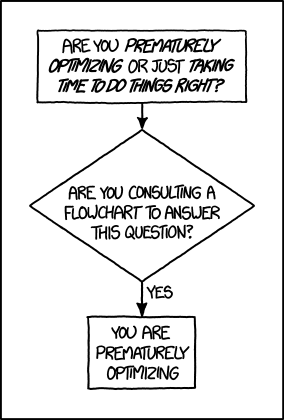
[2] https://www.explainxkcd.com/wiki/images/d/d5/optimization.pn...
(And as an aside, stopping at each intersection to discuss is not ideal, but at least no one is going to die.)
Anyway, I’m unconvinced. Most of the planning failures I’ve seen came about because people were bad at planning, not because they were talking too much. I’ve seen the opposite (not enough talking, not enough looking ahead) far more often.
I do like the slogan though. Planning is for doing.
The author is suggesting replacing it with the normal rules of the road, which are as close to not planning as possible (following basic heuristics like go on green). The example in the parable didn't have "unjust" stop signs or traffic lights for a reason.
In modern societies having equal rights is 'unjust'.
And that counts even if you assume everyone is honestly participating rather than selfishly manipulating the system. Once you take that into account the least unjust approach quickly becomes equality.
Only if you believe “need” should trump all other considerations. One can argue whether that is the way. I’d say it’s quite an assumption to build on.
a lot of time I feel like the diminishing return of a planning is pretty steep for many situations but it's hard to tell how much time we should spend for the planning beforehand. (this is a planning for planning and maybe this itself is over-planning lol).