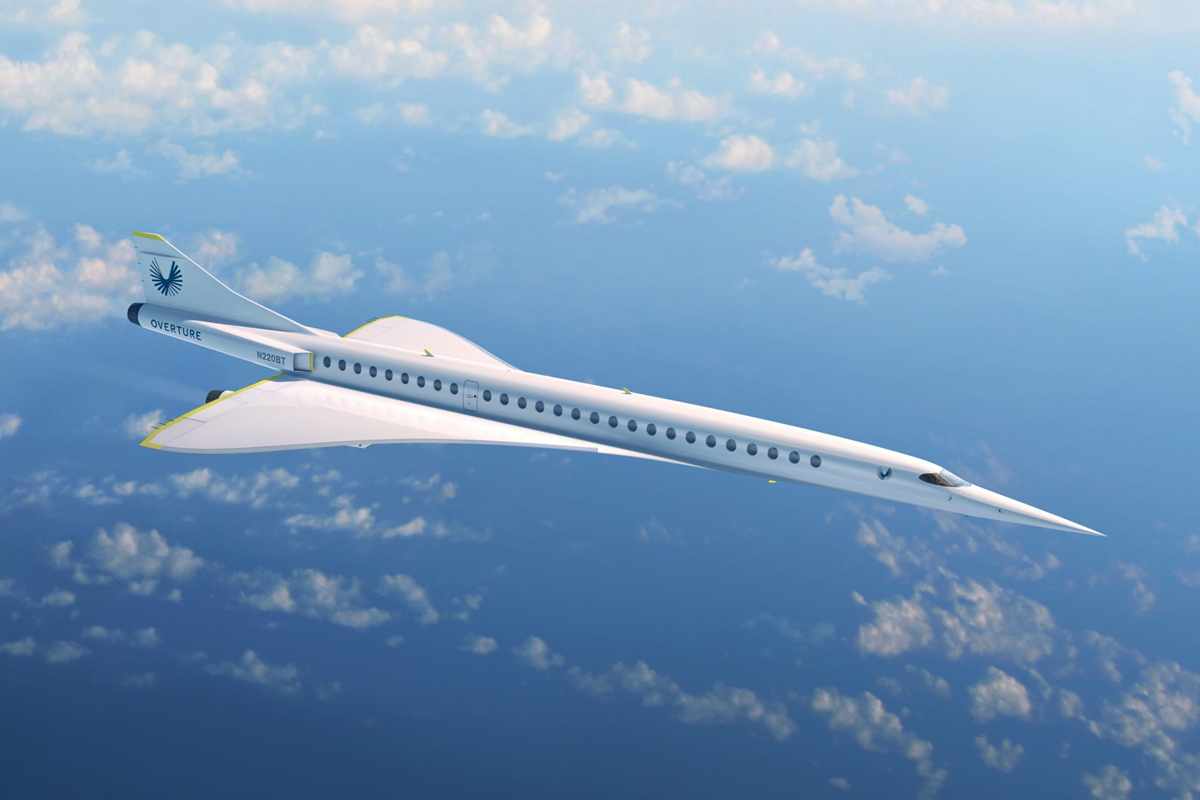
https://www.airway.com.br/wp-content/uploads/2020/10/Boom_Ov...
to a very scaled down Boeing 2707-300 configuration :
https://en.wikipedia.org/wiki/Boeing_2707
(that tiny fin tho...). While reducing cruise speed to 1.7 mach. I see no visible changes to deal with the sonic booms problem. So operation would be like Concorde I suppose, subsonic (or hi-subsonic) over land and Supersonic over ocean only. Unless the super-rich manage the regulation to change.
EDIT : ah yes :) "2x FASTER OVER WATER" and "20% FASTER OVER LAND"...
Also : Maybe good to remember that 18 airlines had once placed orders for Concorde, with only the 2 national carriers flying it in service eventually. And that The Boeing 2707 was ordered by 27 airlines before the program being canceled…
The small niche of customers willing to pay a significant premium in order to save some travel hours is not big enough to sustain an entire industry of specialized mechanics, parts suppliers, pilots, etc... Basically you need a critical mass of people riding these aircraft every year before the relatively high fixed costs eat you alive, and it's very hard to get a lot of people to buy into a high priced luxury service.
Going from the Concrods 3550nm range to 4250nm should help with that as it opens up several new routes and longer routes see a more significant drop in travel times.
Subsonic flight has become much more efficient, cheaper and when paying for higher class, more comfortable. This is one of the reasons often mentioned for the economic demise of the concorde. The audience willing to pay $6000 on a concorde ticket, could now spend $4000 on first class subsonic with a seat that fully reclines into a bed. They can fly a little longer at night but sleep the whole journey.
Wendover did a good economic analysis of the concorde: https://youtu.be/n1QEj09Pe6k
At least.
Even if you think price is a barrier, think about how many more millionaires and billionaires there are in America and Europe today than there were just 20 years ago.
Tack on our society's rediscovered fascination with conspicuous consumption ("influencers"), and I don't think filling seats will be the problem today that it once was.
Who in their right mind wants to spend top dollar to fly internationally on an American airline, worst of all AA, one of the two worst airlines on the planet?
Anyone with some money who wants a nice international flight is going to take one of the Asian or Middle Eastern airlines, not one of the shitty American-run airlines. The level of service is so far superior it's not even funny. AA is infamous for their horrible service in First Class.
I know I would pay a premium for this experience. Simply because it fits into my imagined jet set lifestyle phenomenally well. Maybe once every two years for a special occasion or treat ;)
I also think the economically limiting term is still the turbine blades. Lifetimes for commercial service turbines run 100k+ hours. Supersonic is maybe 1/10 that. And have higher rates of oxidation, cavitation, catastrophic fatigue, etc. We need a new Alphafold! For phase stability of alloys exhibiting high strain resistance at high temps and fast cycles...
But will the range be there? Concorde was severely range limited, which somewhat defeats the purpose of faster travel (if it only works on medium length routes).
Cutting a 14hr SYD-SFO flight down to 8.5hrs is just more impactful than cutting a 7h LHR-JFK flight down to 4.2 (when taking into consideration significant time at the airfields for taxi, boarding, security checks etc)
Concorde didn't have the range for long haul and once you need to land to refuel you lose all time savings.
Probably will be very expensive but it's exciting for future possibilities
Are you kidding me! I cant recall the last time I DIDN'T need to be in Honolulu in THREE HOURS!! This is a life changer for my Macadamia nut Addiction...
---
In all seriousness, the best commercial prospect for this is high-speed-cargo.
Need a part from GuangZhu like TODAY?
Need an organ transplant from Ohio to Munich, TODAY?
Need to fire 900 employees via ZOOM call whilst flying to your other mansions to feed your pet slaves, TODAY?
Possibilities are boundless!
> Need a part from GuangZhu
CAN-LAX is 6,284 nm.
> Ohio to Munich
OK that can work, CLE-MUC is 3,759 nm.
Just add a refueling stop at ANC, the same as most cargo flights today (and the same as most passenger flights in the past).
According to a Great Circle mapper, CAN-ANC-LAX is only about 250 km longer than CAN-LAX.
God, I fn Love you.
Might be related selecting an engine. The previous version of the design had a fantasy engine that didn't exist (I think the specs came from a military engine that they couldn't use due to export restrictions), but now they are working with Rolls-Royce, and appear to have actually selected an engine design. It must be smaller than what they originally wanted, because they moved from a 3 engine design to a 4 engine design.
edit: had to correlate sources to find that a bunch of popular aviation blogs got the original design wrong. was actually 3x turbofan -> 4x turbofan
Can these be 'stacked' - Can you have a turboFan in line with a turboProp such that the output of the wash of the Fan feeds into the Prop, but with a portion of the wash spinning to thrust on the outer ring of output.=, via a design in the cowlings which is hyper directed thrust vents (think the grid of straws used to funnel water into a cohesive column, which can be directed)
Imagine a small diameter turboprop behind a much larger turbofan
But eastbound makes a lot less sense, unless you're just trying to save time. Because flying at night eastbound won't make you gain much compared to a regular red eye and flying during the day, you'll land at night...
This will end up running LAX-JFK-LHR in my opinion.
And because the overall experience was so cool -- board directly from the lounge, the led display showing how fast you were going, seeing the curvature of the earth (sorry flat earthers), arriving before you left, etc. -- you never thought about the seat. I'm sure if you took it all the time you might care but most people it was awesome.
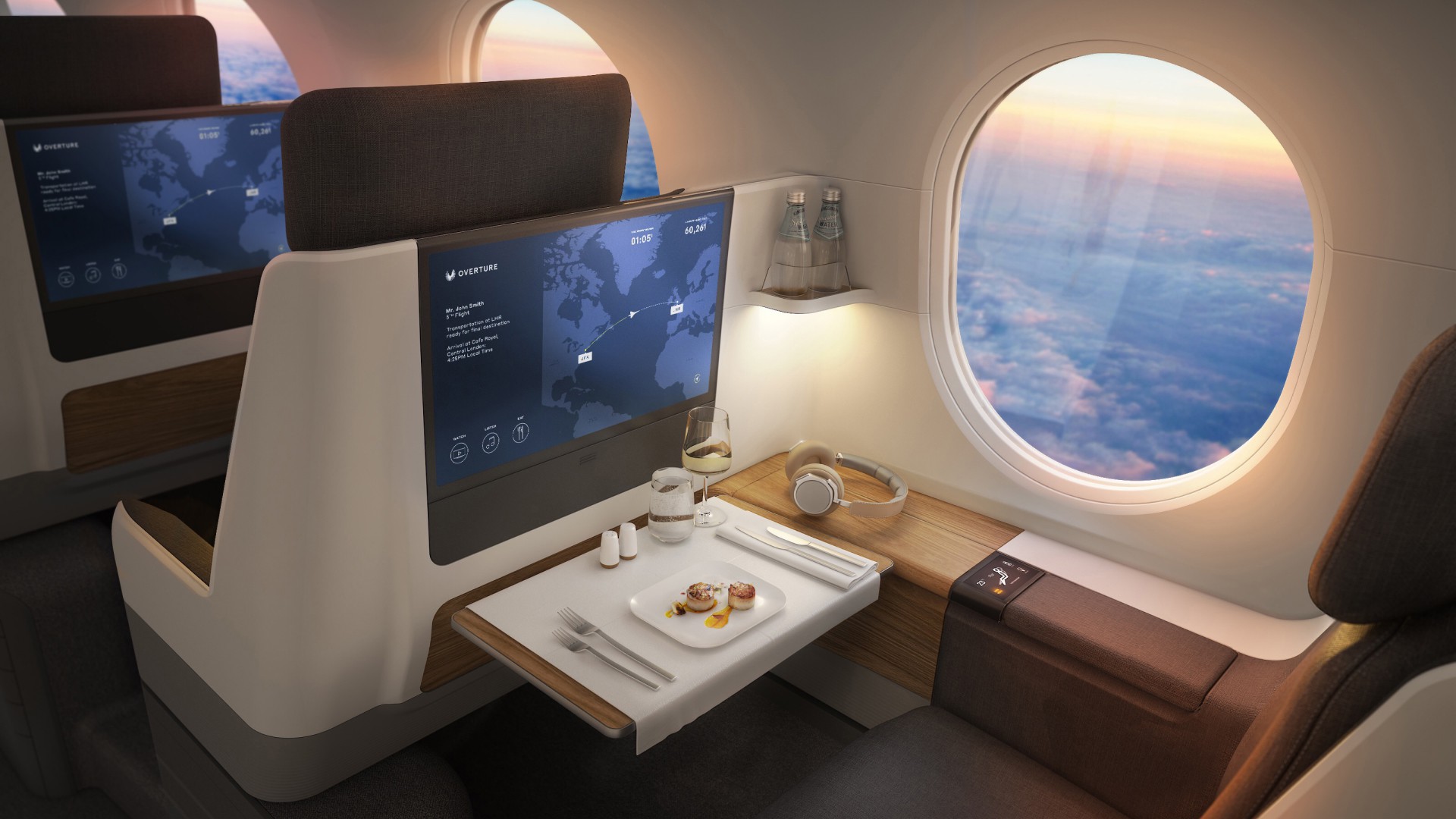
The seats do look very cramped and the windows are very small.
The museum of flight is amazing and much more interactive than most air museums.
https://www.intrepidmuseum.org/The-Intrepid-Experience/Exhib...
Has there been a render of the interior or something?
https://boomsupersonic.com/static/images/overture-experience...
All the imagined routes are over large bodies of water. Is it key to the functionality or intent of the aircraft in some way? Why not NYC to LAX in 3 hours?
People will tolerate a sonic boom once a quarter or so, but you've better have a really good reason, like national security.
That was Columbia, not Challenger. Challenger exploded on launch from Cape Canaveral.
A crosscountry scheduled supersonic flight will have to overfly populated areas twice a day - booming all the way.
(Something that causes a lot of confusion - people often think a sonic boom is an instantaneous thing that happens when the plane breaks the sound barrier - it is not, it’s a continuous shockwave that travels with the aircraft while it is flying above Mach 1; anyone on the ground who the shockwave passes over along the flight path hears a sonic boom)
If you’ve ever heard thunder from lightning 15 miles away compared to thunder directly overhead, that might give you some framework for figuring out the difference.
I think it was a mistake for the US to ban supersonic flight outright and especially at all altitudes. I can't imagine a sonic boom being a huge problem, if you are 10 miles up or higher.
A previous entrtant in this area seemed to suggest that efficiency dropped near mach 1, but then rose again to 95% at speeds around 1.4 so being able to stay at that speed may make it cheaper to run and maximize their USP of speed.
You'd need a much longer range for this to be a real win. If you double that range then you can do JFK-SIN or PTY-SYD and then you could do an LHR-PTY-SYD flight in ~12 hours which would be a massive win.
This is true for getting to JFK from Manhattan, which is 40 minutes with 0 traffic and then the airport is absolutely massive and has long lines, but Boston -> Logan or SF to SFO is minutes. I think my total time from my door to my gate is ~30-40 minutes when I fly SFO.
BA001 LHR 10:30AM -> JFK 09:25AM
BA002 JFK 08:30AM -> LHR 05:15PM
AF002 CDG 10:30AM -> JFK 08:15AM
AF001 JFK 08:00AM -> CDG 05:45PM
That's why flying westbound supersonic is less of an advantage. Because as you can see, flying west, your day is still wasted, even if you leave early.
Its prolly something like 5x-10x worse.
I wonder if designing for synthetic fuels gives them any benefits? They can be a little bit purer.
https://www.prometheusfuels.com/
(very cool website, not sure if thats a good or a bad thing)
Of course things didn’t work out that way with Concorde, which was not commercially successful and more of a spectacle than something founded in business fundamentals. But if Boom can make supersonic passenger travel economics work out it would certainly be hugely disruptive.
I think it's going to come down to exactly how fast or slow this is, the price, and what the hard-product (eg the seats) are like. A modern First Class is a very, very comfortable way to travel, and other than the novelty value, I'd certainly rather spend 8 hours in lie-flat that 5 hours in a recliner. That'll also depend on the time-of-day of the flight -- worth saving the time perhaps if you're traveling East-to-West, but for West-to-East might as well just overnight it?
Long story short, I think it'll have use-cases, but it's not like Concorde -- when Concorde launched, 1st Class over the Atlantic looked a lot like 1st Class inside the states now -- comfortable, but not somewhere you wanted to spend a lot of time
Knowing this, Boom is allegedly targeting an equivalent cost per mile to a standard business class seat.
Sometimes speed isn't better :).
I haven't looked into profitability yet but a quick look at the list of busiest routes shows that Asia dominates the list. https://en.wikipedia.org/wiki/List_of_busiest_passenger_air_...
I do agree though, LHR-JFK holds very little fascination for me. It's a relatively short flight with a lot of ground-side overhead time, so the benefits of Going Very Fast seem pretty minimal. The prospect of SFO-HND or LAX-ICN very fast though seems a lot more appealing.
At the time, Apple was booking 50 business-class seats a day just between San Francisco and Shanghai.
That's one company, on one route. Representing one segment of demand.
Certainly, things are likely to change with the effects of Covid, but I think there's a lot of substance to your perspective.
[1] https://9to5mac.com/2019/01/14/united-airlines-apple-biggest...
I don't see it doing so well for the middle eastern markets, ultra long hauls on average spend a lot of time flying over land (minus the Australian flights) - for example, see LAX-DXB whose only water crossing is the arctic ocean, where supersonic might not be allowed for ice preservation purposes https://flightaware.com/live/flight/UAE216/history/20220815/... , DXB-Tokyo which is almost entirely land: https://flightaware.com/live/flight/UAE318/history/20220815/... , or DXB-Cape Town, which again is mostly over land: https://flightaware.com/live/flight/UAE772/history/20220816/...
> Concorde earned £500 million for British Airways after tax profit, this was between a loss making 1982 and a highly profitable 2000 with just seven aircraft. The first profitable year was 1983 (£14 million) increasing to £54 million in 1987. BA had good and bad years, in 1992 they actually even made a small loss, but then quickly returned to profitability. Immediately before the crash the profit levels were running at nearly £60 million and could have returned had they kept flying. (Even the last 6 months of operation in 2003 netted £50 million profit).
And:
> With unprofitable routes mounting, Concorde was going through rough times in the early 1980s. At this point, British Airways made a move that potentially saved supersonic travel. In 1981, British Airways managing director Sir John King managed to purchase the Concorde fleet from the British Government outright for £16.5 million plus the first year’s profits. Following the purchase, British Airways increased fares, bringing Concorde routes closer to profitability. With the fleet now owned outright, British Airways added additional routes.
[0] https://www.heritageconcorde.com/concorde--british-airways
But keep in mind neither BA nor AF really paid for their fleet...
Have to be charging a great deal to the small number of passengers for it to be worth swapping in to a fully loaded 777 spot
No, but it’s the only airport in London that the big US legacy carriers - American, Delta, and United - fly to.
I hope any airline that gets these gets punished by all the other customers for the environmental irresponsibility of pushing this gass gussling technology.
Wow, you can blow through your whole annual carbon budget in only 4 hours!!
Who are the new “non-legacy” carriers in this setting?
I guess that's not nothing given how these sorts of contracts usually give the big name brand company lots of outs if the speculative company goes bust, but by bragging about it without specifying the amount, I'm guessing it's a low amount.
https://interestingengineering.com/culture/boom-xb1-superson...
https://www.denverpost.com/2017/06/20/centennial-boom-supers...
https://www.flightglobal.com/strategy/paris-boom-xb-1-schedu...
Overture is a production model for commercial operations.
It must be less efficient than a winged flyer - even a fast one like boom's, because it won't need so much energy to get out of the atmosphere like a starship has, right? I want starship to succeed but I'm guessing it will be so much more expensive and risky.
The main issue is that their production aircraft will need more powerful engines, and modern civilian airliner engines have large fans, high bypass ratios, and high compression ratios, all of which make them difficult to adapt to supersonic flight. It looks like their plan is to collaborate with Rolls-Royce to build a suitable engine using an existing engine core. I hope they can pull it off.
14 commercial aircraft were delivered of 20 total.
So why should I trust that their main airliner is anywhere even close to on-time.
I've learned to appreciate slow-travel using trains and have been a supporter of electric planes for reaching further places.
Rather than high speed rail to get the masses into cities for work, we are getting fast planes for the wealthy to work in NYC and spend the weekend in European villas.
Makes you scratch your head trying to justify this while climate change is encouraging people to eat bugs.
That wouldn't really work outside of some very specific cases. High speed rail (300km/h+) needs some distance to get to its cruising speed. Below that it's a waste of money. The shortest high-speed rail route i know of is Paris-Reims and it takes 40 minutes, which is decent for a commute, depending on home/work to train station distance.
https://www.pprune.org/tech-log/423988-concorde-question.htm...
At the beginning of the take off roll, each engine would be burning around 21 tonnes/hour.
Anyway, back to some figues; at Mach 2, 50,000', the typical fuel burn per engine would be around 5 tonnes/hour, falling to around 4.2 tonnes/hour at 60,000'
Better title - and still within HN limits - would have been:
"American Airlines to buy 20 Overture aircraft from Boom Supersonic"
Wouldnt be surprised if American put less than 1m down, which makes this nothing more than a slightly expensive PR campaign.
this is the worst possible time for launch and the name will be quite poetic
On a personal note, this company is based out of Centennial Airport (KAPA) which is in my neighborhood
At this point a new aircraft program is easily $15B+ of development. That kind of money is hard to come by for a new aviation company.
China, Russia, and Japan have all tried breaking into the market as well without much success.
There are already new companies doing short-distance electric passenger flight. These companies could well scale to longer distance flights.
You could also imagine a company like Tesla getting in that business as well.
And as far as automotive, or generally non-aerospace, companies are concerned, well, aerospace is hard. Really hard, it is with the potential exception of life science the most regulated industry on earth. None of the automotive experience (close to none, but you get the point) translate into an aerospace environment. And even if, we are still looking at billions of development cost for small aircraft to be used commercialy, in the range of ten billion plus for commercial airliners.
But Boeing and Airbus aren't invisible if you are offering a product they don't sell. See A220 with somewhere 220+ units sold. It did end up in hands of Airbus, but it was effort by Bombardier.
If supersonic travel was in demand post-pandemic and rising inflation, interest rates, Airbus would've been all over it.
Boeing has almost entirely ceded replacement of its own 757 and 767 to Airbus since it offers nothing in that midsize range today. Airbus fucked up thinking that the A380 was going to make money, and it took them a while to get the A350 right despite pressure from airlines to actually compete with the B787.
The costs of flying an airplane isn't proportional to its fuel usage. The faster an aircraft is, the more flights it can perform per day.
The carbon emissions impact of flying a gas-guzzling supersonic aircraft aren't evident either. Of course, more gas is used per trip but fewer planes need to be manufactured. Since there is no supersonic business jet, it could also make sense for some people who used to fly private for the speed and convenience to reconsider as they may get faster to their destination by flying supersonic.
It is indeed not proportional, but not in the way you are thinking. Drag (and ~fuel consumption) scales with velocity squared, so a plane flying twice at fast (and neglecting any time at the airport, which would make the argument even worse) would use four times as much fuel. I.e., even if twice the amount of passengers would be served, it would be done for four times the fuel consumption and four times the carbon emissions (or twice the fuel consumption per trip).
As cost of fuel is only a percentage of the price of the ticket, it's pretty obvious that there is a threshold as a percentage of total ticket cost under which spending 4x more in fuel to fly say 1.5x more passengers (because the airplane isn't flying 24/7) makes business sense.
That is obviously one of the reasons why they are starting with business class tickets because, fuel consists of a smaller percentage of ticket cost.
And there is zero logic behind your second obviousm, as your premise is already wrong. The reason they start with business class is because you can charge more per seat. Seems pretty obvious.
And the proposed aircraft are less than half the size of the aircraft they'd most likely replace, so actually sell fewer tickets on double the flight numbers
Not that this only applies if they fly at the same altitude. If you fly higher you can avoid that. That of course causes other problems but it is a relevant factor.
I'll guess that American's "non-refundable deposit" for the first 20 Boom aircraft was pretty small, and came out of American's marketing budget. Or was a negotiating tactic, to help American get a better price from some real aircraft manufacturer.
https://www.consumeraffairs.com/news/american-airlines-to-cu...
I live in a neighboring town not far from the boutique Triad Semiconductor, which designs digital/analog chips and components for many applications, including space.
That's just domestic. For international travel it has been a literal exponential decrease in hassle.
Of course, this all depends on whether or not the airport you use (and it is 100% dependent on the airport itself) has deployed all of the automated systems being used to lower terminal transit times.
My humble opinion is that it's aviation company without huge innovation or disruption of the industry. More like a fast horse rather than car.
This is slower and smaller than concorde, so we'll see if the market really values speed over convenience / luxury. Boeing made the opposite decision 20 years ago when they cancelled the sonic cruiser.
https://www.qantasnewsroom.com.au/media-releases/qantas-anno...
However you may also be stuck where the people who will pay for the faster time are the types who will NOT sit in cattle class, so your airplane will have to mainly be first-class/business style seating.
However, although I'm rooting for any company that's making a sincere (as opposed to fraudulent) attempt at bringing back supersonic travel, the hardest challenges may still be ahead for Boom. The biggest one is the need to find or build a new engine. They've recently redesigned the Overture to use four engines instead of two, which should ease required engine specs, but there's no engine that would meet the reliability, noise, fuel consumption, and dimension requirements for a supersonic passenger aircraft.
Related to the engines: money. It sounds impressive that boom raised at least $150 million, including $60 million from the US Air Force (which has the added advantage of creating a new customer segment in the military)... until you learn engine development alone would require in the ballpark of $6 BILLION of capital. Aviation history is rife with examples of amazing, innovative aircraft designs that failed because no suitable engine was available.
Also, Boom leadership has set some ambitious goals, which makes me a bit skeptical. They plan on using sustainable aviation fuel (SAF). Great! But now they not only need to create a new engine, they need to create a new engine that runs off of a new fuel. Additionally, they've set a goal price of $5,000 for a New York to London roundtrip whereas Concorde would've cost $20,000 for the same route. Heck, I once paid $8,000 for a Boston to Tokyo roundtrip business class flight. Nothing wrong with setting such a goal (and Boom isn't even the party that sets route prices) and it's OK for marketing claims to be a tad optimistic, but this tests the limits of credibility.
Lastly, there's the issue of possible routes, which is primarily limited by noise constraints. Unlike the Concorde, which needed afterburners to produce sufficient thrust for takeoff, Boom is going for a no-afterburner design. While this should expand the number of airports the Overture can use since afterburners won’t be blasting the neighborhood, you’re still not going to be able to fly over land. Boom suggest 500 routes are supersonically viable[1], which I’d assume means “pairs of international airports separated mostly by water”. We might be talking about something like 50 actual airports. only a fraction of those routes are not just supersonically viable, but economically viable. Of course, commercial aircraft are designed for particular types of routes. An Embraer ERJ-145 regional jet and the Boeing 787 long-range wide-body jet fly different routes. I’m not expert on this though; maybe 500 routes is plenty for a “total addressable market” in the aviation industry,
To bring it all together: my big issues with Boom are, one, engine development and, two, the choice of “hard problems” they decided to take on (specifically, SAF & cheap tickets). My hopes are that the engines are in development, using SAF instead of conventional fuel isn’t a big deal if you design for from the start, and the $5,000 thing is more about saying how low, hypothetically, an airline could price tickets while making money. I’d also like to know what the current status of the state-of-the-art is in quiet supersonic flight. NASA’s quiet supersonic demonstrator, the Lockheed Martin X-59 QuSST, combined with regulators’ desire to decide on supersonic overland travel in 2028, would open up new routes like JFK-LAX for planes meeting noise requirements, should regulators decide to allow it.
My hypothesis on Boom’s design choices? Quiet supersonic cruise is still technically challenging and has an uncertain regulatory future, and the political tide may be turning towards greater regulation on fossil fuels. So, by using SAF, Boom ensures that their plan will at least fly in an uncertain regulatory future, even if there’s no overland flight. And, using what they learned developing the Overture, they’ll be in a position to develop a quiet supersonic transport should regulators give the green light.
[1] I’d interpret routes to be something like airport-pairs, as in Laguardia-Heathrow would be one route. If you Boom could fly from three airports in the US to or from three airports in Europe, you’d have nine routes (3*3). This article talks a bit about the lack of clarity with Boom’s “route” number: <https://leehamnews.com/2021/06/04/hotr-500-destinations-for-...>
https://www.epa.gov/greenvehicles/fast-facts-transportation-...
Is this better or worse on that account? I have no idea. But it potentially could be substantially different either way.
7hrs London to NYC are more than acceptable, too bad it ends up being 10hrs
So, possibly zero. OK, thanks for the update.
https://www.cnbc.com/2022/03/28/irish-lessors-have-terminate...
"Aircraft Leasing Ireland (ALI), members of which include SMBC Aviation Capital, Avolon, Aircastle and AerCap Holdings, which is the world’s biggest aircraft leasing company, said that all of its members have complied fully with the sanctions."
Pretty glad I don't own American stock right now, because they're apparently led by madmen.
"American Airlines to buy 20 Overture aircraft from Boom Supersonic"
When reading the original title, I had the impression that the company was going to be acquired by AA.
Instead, it's "just" an order of 20 aircrafts.
Note that this is not a new move by Boom, they played this card when raising money when they pitched at YC demo day, and they're doing it again. The problem I have with this is the following:
> agreement to purchase up to 20 Overture aircraft, with an option for an additional 40. American has paid a non-refundable deposit on the initial 20 aircraft
It's "up to 20", and not "20", and there is a non-disclosed non-refundable deposit. If it's a, say, $10,000 per aircraft, total of $200,000 (ouch, should I say... up to $200,000?), it's a just a cheaper ad for AA, and ammo for the CEO when the board asks "where are you innovating?".
Good luck to Boom, but I am unconvinced this is a viable company and a viable business.
But, it's an interesting thought, and in line with a very interesting thread that kragen brought to my attention: https://news.ycombinator.com/item?id=32009925
FedEx likes to buy out Boeing facilities so that they're not "completely reliant" on Boeing for anything, see https://www.ch-aviation.com/portal/news/102874-fedex-to-take... "Air cargo carrier FedEx Express (FX, Memphis Int'l) is to take over the lease of Boeing's Dreamlifter Operations Centre at Paine Field, Everett, quashing any hopes of a return of the B787 Dreamliner production to Washington State."
I wonder why more airlines don't choose to do similar things.
Until the plane is actually flying in the air you should just treat any announcements as misleading (they announced that their test airframe was ready, what, 3-4 years ago?).
Same... at least they should put an S to aircraft... but then again maybe they hit the strict character limit...
But "Boom Supersonic is transforming air travel with Overture, the world’s fastest airliner, optimized for speed, safety, and sustainability. Serving both civil and government markets, Overture will fly at twice the speed of today’s airliners and is designed to run on 100% sustainable aviation fuel (SAF). Overture’s order book, including purchases and options from American Airlines, United Airlines, and Japan Airlines stands at 130 aircraft. Boom is working with Northrop Grumman for government and defense applications of Overture. Suppliers and partners collaborating with Boom on the Overture program include Collins Aerospace, Eaton, Safran Landing Systems, Rolls-Royce, the United States Air Force, American Express, Climeworks, and AWS."
This^ is significant support they already have. So they could operate for 10+ years, which seems like they will (even if they are just in R&D and burning cash). In a way, it is viable to the employees and suppliers, if they get paid for such a long time haha.
Same. I think their timelines are too aggressive. I want to be proved wrong though!
There is so much opportunity for innovation in areas of aviation where we desperately need to innovate: Getting rid leaded avgas, moving away from fossil fuels altogether which includes fields like energy storage and electric propulsion, developing an efficient trainer to replace the piston lead-gasoline burning C172 that is so ubiquitous and makes up much of the 1500 required hours for an ATP license. So many opportunities.
Aviation is ripe for innovation. This ain't it.
Incidentally, Boom is 5 minutes from my office here in Centennial, Colorado and where I fly out of KAPA. I'd like to see innovative US aerospace companies succeed, but I feel like these guys are chasing the wrong idea.
How is single-engine piston aircraft a critical area?
edit: I do note that according to 2019 report, North American companies had >60% global marketshare in both turboprops and business jets in terms of units shipped
Where do you think airline pilots come from? New pilots learn to fly in single-engine piston planes. And then again as flight instructors and commercial (non-ATP) pilots while building time to get their ATP rating and move onto the airlines. The continual slow death of GA is only going to worse an increasingly dire pilot shortage.
Neat. Love to watch traffic at KAPA - saw a Walton plane land there the other day an hour or so before Condi was named part owner of the Broncos.
Going from a 15h to 8h flight will be huge -- that's 30h to 15h round-trip.
I'm American and visited Australia once, and realized I probably never would again, it's just too far. An Australian friend of mine here in the US only went home to see his family every few years. It just takes sooo long, stuck in an economy-class seat.
Supersonic makes a lot of sense not as general-purpose, but for long-haul flights between hemispheres. At least until there's an economy-price "sleeper car" equivalent accomodation where you can actually sleep on flights.
This airliner is primarily targeted at shorter Atlantic routes; if they succeed in that market then they might build a larger successor model with the range for Pacific routes.
Without removing freedom of mobility, the only way we have to mitigate environmental costs is through price pressures which could be used to fund net neutral technologies.
Wait, it looks like I either misremembered that claim, or they have backed away from it:
> "Overture’s fleet will be able to run on 100% sustainable aviation fuels."
https://boomsupersonic.com/sustainability
Color me skeptical. Making existing aviation more climate-friendly would be a much more worthy goal than this ridiculous supersonic vanity project.
https://www.science.org/content/article/former-playwright-ai...
And there actually may be realistic optimization scenarios.
People don't want to have sympathy for 'world leaders' for example, but often physical presence is an important thing. And they waste so much time.
I don't like my own PM but I'd rather they spent a little more to cut his travel time down; his time is extremely expensive.
And this sounds ridiculous at first glance: but even if he could literally get reasonable sleep more often. His decisions are so impactful, the leverage so much, it matters. And I don't even like the guy at all.
That aside the secondary advantages from it might be positive, we need R&D that's ahead of the curve.
I'm fine with this as long as everyone isn't flying it all the time.
With the currently available conventional engine, it vastly outperforms the Cessnas and Cirruses, AFAICT.
So with the hybrid and pure electric options in development (these were planned from the start, so the plane is designed for them), it is still competitive.
https://www.pipistrel-aircraft.com/products/general-aviation...
(Not affiliated or associated in any way, just a fan of aviation innovation)
I was shocked to hear that leaded gasoline is still around, so I did a quick search. Turns out most (all?) piston-engine driven airplanes still run on leaded gas. Jet airliners don't, so I'm not sure if the overall impact is significant, but nonetheless shocking to hear that we're still spraying lead into the air we breathe.
> Turns out most (all?) piston-engine driven airplanes still run on leaded gas
Not technically all. There is unleaded avgas although it's not yet common and some piston planes are diesel.
The pandemic was terrible for the most part, but it did give us an opportunity to rethink how we live and work, including how to lessen future pandemics and enviromental degradation with our choices on transportation.
The problem is that the greenhouse gas impact will be higher for a supersonic trip compared to a subsonic one. This is on top of the issue that we don't really have a good low carbon alternative for longer range air travel (batteries don't have anywhere near enough specific energy). The best option we have is synthetic jet fuel produced from green electricity. Producing jet fuel that way is many times more expensive than fossil fuel jet fuel.
What does “less people” mean? You mean Boom is targeting only the ultra-rich? That’s not their aim. They aim to make supersonic flight both possible and affordable.
I see no evidence that this is at all realistic, and a lot of evidence to the contrary.
Do they even have a story explaining how their new supersonic jet could possibly reduce costs?
But basic physics dictates that supersonic flight requires a lot of power, as well as low bypass turbofans. So competitive with modern "normal" airliners in terms of cost or emissions per seat-km, nope, not gonna happen.
Synthetic jet fuel is a good idea that deserves R&D money (if we're gonna keep flying long distance in a carbon constrained world I think something like that is going to be necessary), but is orthogonal to a supersonic airliner. Unsure why they think that bundling synthetic jet fuel (itself a high-risk R&D project) with their supersonic jet (another high risk R&D project) will do anything but increase the risk of failure of the entire project. Well, the uncharitable explanation why they're doing it is of course greenwashing.
But 50 years have passed since the Concorde was designed. Both computational fluid dynamics algorithms and computing power have made tremendous progress. It's quite likely Ouverture will have a much better fuel economy than Concorde, if only for the fact that it will use turbofan rather than turbojet.
Isn't that more chemical engineering? Boom sounds mostly mechanical.
> moving away from fossil fuels altogether which includes fields like energy storage and electric propulsion
Isn't this mostly battery tech? Seems like a stretch for these experts to be working on that.
> developing an efficient trainer to replace the piston lead-gasoline burning C172 that is so ubiquitous and makes up much of the 1500 required hours for an ATP license.
At least this sounds like something in their wheelhouse, but needless to say, there's no money in that.
Boom is developing a plane that has demand. Simple as that. Not everyone needs to try to save the world.