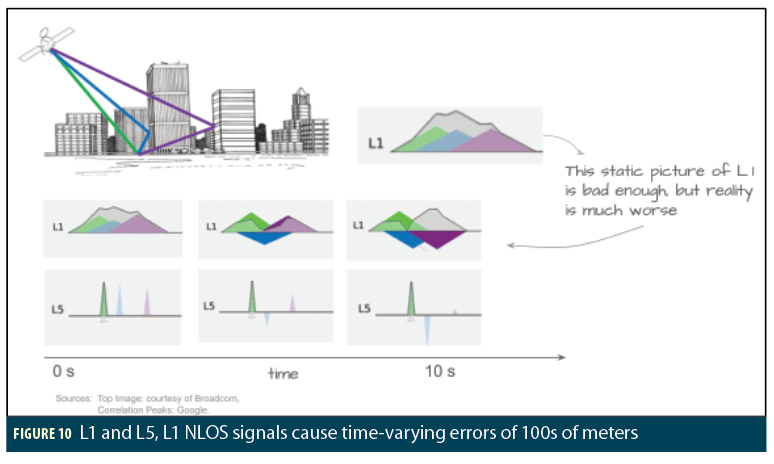
That's not how it works at all. L5 at 1176 MHz has a different ionospheric delay than L1 at 1575 MHz. Since the timing data is identical, you can calculate and remove the ionospheric delay if you can receive both signals at once.
Correlation peak width is an SNR property (and to a lesser extent dependent on receiver LO phase noise), not something that really corresponds to the RF band in use. Whichever signal is stronger (taking antenna gain into account) is the one that will yield better-quality baseband data.