https://www.glassdoor.com/Reviews/Chetu-Reviews-E231082.htm
>> Review: “You'll discover during training week that the the company will watch over you all day, even long tenured employees are watched via their WebCam.”
>> “Glassdoor Alert: Attempt to Inflate Reviews — We have evidence that someone has taken steps to artificially inflate the rating for this employer with positive reviews posted in violation of our Community Guidelines. We have removed these reviews. Please exercise your best judgment when evaluating this employer. Learn more about Glassdoor Alerts:
https://help.glassdoor.com/s/article/Glassdoor-Alerts-Badge-...
_________________
From related company’s homepage:
>> “We are proud to employ over 2,800 in-house developers with a variety of software development experience in an array of industries.”
In the Netherlands court, the legal fees were sub 1k, and the decision happened less than 2 months from the filing.
"Less than a week after the plaintiff was fired, the Rijswijk branch of Chetu Inc. was deregistered from the Chamber of Commerce and shut down on 2 September, records show."
Seems fishy, but could an innocent explanation be that he was their only Dutch employee?
This is the sort of name given to processes uses when an employee is already performing below expectations. (Where I work it’s a more euphemistic Performance Improvement). If that’s the case here then his firing was a bit less sudden than it appears. Though the entire monitoring process seems draconian regardless.
Stigma around being on a corrective performance plan should be removed?
I can imagine being in the middle of a critical project, on a tight deadline, and getting the "You've been randomly selected to attend the performance program again." email.
I have seen companies that lack this process and witnessed employees getting very positive feedback from managers even in performance reviews, only to be shell shocked with a termination for poor performance.
Given the option to have a PiP process or not I would rather have one.
I have seen employees go on a PIP and then improve their way out of it. I have seen them be used as a tool to justify termination, and in one case the PIP ended up revealing fraud.
I think the point is, if a company is going to abuse employee, that will happen with or with out a PIP, but even with abusive management having that process IMO is better than not
We implemented a coaching system for our support team about a year ago with the explicit purpose that individual coaching does not directly affect KPI, and that as much coaching can and should be done freely without worry of impacting the support team. The system tracks both the person being coached and their team lead who does the coaching. The coaching is directed to be as instructive as possible, that it's not about punishment, but better ways of handling specific technical situations or adherence to the support policy.
Long term reviews consider not just the person being coached, but also the leader as well, as a high number of coaching options across multiple persons on the same team would suggest an issue with the leadership as the root cause, and more qualitative reviews focus on that element as well. The entire point is to ensure that Performance Improvement Plans don't have to be a thing, and that there is constructive feedback flowing into the system.
Adoption was slow, but with strict adherence to what a coaching instruction must include, we've seen exceptionally high improvement and much calmer conversations when mistakes are made since the support persons realize "this isn't a KPI penalty or a PIP; it's just trying to prevent that." Having the system "open", i.e., the support persons can see every entry they have at any time with a few clicks of a button means no secrets.
It's a lot of documenting, but so far we're seeing a ton of success with it and positive feedback to having this process for constructive criticism, and the focus on also considering "this might be a leadership issue" also helps add some comfort.
I get the logic, but as an American I was surprised… I was never PiPed but I too would have assumed it was better than the alternative. Not always!
I have had very close interactions (details below) with managers who completely fabricated “poor performance” in order to PIP the target out of a job.
In both cases, I had the PIP target secretly work in tandem with a star employee to produce work that was considered top notch work up and down the management chain.
In both cases, the manager took a cursory look at the work and completely dressed down the PIP target verbally and in writing with little or no constructive feedback.
One manager was fired, and the other manager was out to pasture to work on meaningless solo projects (necessary due to organizational reasons).
I am not sure how common this is, but managers who are slightly more intelligent about it can fairly easily set up a PIP target to fail while technically providing constructive feedback.
One of the cultural problems in this org was that pretty much 100% of the managers were bad/inexperienced/untrained, so the unwritten rule was to not monitor the administrative actions of other managers. I was brought in basically to protect them from potential lawsuits that would have had merit — they were incapable of doing this internally.
> I think the point is, if a company is going to abuse employee, that will happen with or with out a PIP
Agreed.
> but even with abusive management having that process IMO is better than not
Sort of, imho. What I always tell people is that they should consider their PIP period as a type of severance and look for another job aggressively while they are on it.
In the handful of orgs that do PIPs well, the folks will usually know that the process is not punitive. I will add that I am fairly certain they every relatively large org I’ve known that does PIPs well also gives folks an opportunity to transfer if the job is not a good fit (assuming the target is not a bad apple, which is a selection problem).
Anyway, I agree that PIPs could and should be an effective tool for remediation. That said, I am not sure it’s any better than undocumented managerial capriciousness and malfeasance since usually all it really does in these situations is slow down the bad behavior slightly.
If anyone gets randomly fired by a bad manager in an org with no PIP, they are probably better off just being out of the org in general rather than suffering for a few months in a sham.
Oddly enough, after we 'mutually agreed to terminate my employment' there, I got a call from the director of another department offering me a job in his department and, most surprisingly, a really glowing recommendation on LinkedIn from the very manager that fired me.
I don't claim to understand it. But I do understand why the company had such high turnover, and why the guy I had been hired to replace had gone on mental health leave and just never came back.
I started making plans to resign pretty soon after being put on the PIP.
The dismissal process for underperformance here (UK) requires the employer to give warnings: one verbal, and two written, I think. The employer is also expected to help the employee meet the performance target. The PIP sounds like a checklist version of that help - it's not meant to help the employee, it's meant to hustle along the dismissal process. I'd take a job flipping burgers, rather than work for a boss that put me on a PIP.
> The telemarketing worker replied back two days later, “I don't feel comfortable being monitored for 9 hours a day by a camera. This is an invasion of my privacy and makes me feel really uncomfortable. that's the reason why my camera isn't on. You can already monitor all activities on my laptop and I am sharing my screen.”
The article also mentioned "commission" as part of his compensation which may be related to a sales function.
- 3 Weeks paid vacation (we get 5 by law)
- Health insurance (you know the drill)
- 3 weeks parental leave (we get 1 year for 80% pay, first 6 months full pay, then 5 years protection against dismissal)
- 5 days paid care leave for when your kid is sick (we get 12)
So their benefits which makes them think make them attactive are all below basic EU law that even store clerks get
- 4 weeks paid holiday
- 4 months unpaid parental leave, 14 weeks paid for the mother
https://en.wikipedia.org/wiki/European_labour_law is the best overview I can find.
Tbh, it’s just a cost of doing business in the Netherlands.
That is just crazy.... I would hate to be a chidless person in your country, I can not image the extra amount of work that get places on people that do not have children...
As someone that will never have a child I like the fact that the US does not force this kind of parental leave on employers, I know that will be very unpopular hot take
A company (an employer) rents the time and skills of employees for a particular task. It's not a pool of work that employees must struggle to achieve regardless of circumstances - it's the employer's responsibility to hire enough staff.
For example, my paternity leave (20 days or 40 half days) would not impact my colleagues. Some of them can opt into overtime, but the same labor laws also define how overtime works - as an employer, you can't order someone to work extra hours unless described in their contract (and limited to the maximum specified by law, with mandatory regular breaks). Overtime is also paid at 150% or 200% of your regular pay, depending on the day of the week and hour of the day (e.g., weekends and nights obviously cost more than daytime rates). Very few jobs are even allowed to work on Sundays.
As a person without kids I do sometimes wish childfree people got benefits in ways that have more _immediate_ applications for us as well. But that doesn't mean parents shouldn't keep getting generous leave allowances to care for their children.
> I can not image the extra amount of work that get places on people that do not have children...
What you're forgetting is the amount of work required to raise children. That's an externality that is only covered through a social contract, where everyone contributes to a next generation. Why should parents put in the extra work to raise children that, god forbid, would ever do something you benefit from?
What you want is someone else doing the work so that you can just reap the benefits. You're a freeloader, plain and simple (other, less favorable words come to mind).
Unless, of course, you will never in your life use the services or inventions of anyone younger than you. But, somehow, I doubt that - am I right? You just expect those cohorts to just appear out od thin air to your benefit.
It's called society.
Rising tides and boats comes to mind.
There are better solutions (teaching individuals to be more financially responsible and kicking overly rich capitalists to the curb, for one) but that's preaching to the choir.
Being in a union pays off in labor court: Unions usually offer sending their legal staff instead of a lawyer that you‘d need to personally retain. This substantially reduces the costs of a court case for the employee.
See https://www.klugo.de/ratgeber/arbeitsgericht-kosten
(1) or shared, on partial wins.
https://en.wikipedia.org/wiki/American_rule_(attorney%27s_fe...
For work related cases, if you are in a union, they will foot the bill in most cases.
There’s so many fun things. Mandatory rest periods, on-call on weekends in some countries requiring additional work, having to actually pay people, needing to provide them with the equipment to be on-call (phone and subscription) and on it goes.
This is the first time I've heard of any US company requiring an employee to keep a camera on themselves 9 hours per day. Obviously, that's not some standard US company practice.
I wouldn't be surprised if these same practices would fail in a US court.
One big difference is the variability of the outcome in the U.S. You might get a result where such a firing is upheld, or you might get several million $ in punitive damages. Most companies don't care to roll the dice.
Last employer did this without the status led turned on. They also recorded, keystrokes, push notifications attached to volume changes and media players, used sslstrip/mitm on web traffic, among other things.
Sadly, wouldn't be surprised if the same has carried over to remote.
I wish Europeans were a bit more business savy and corporate, and not see businesses as just bad things that are part of life, but of course when I’m in US I see the other extreme where businesses want to extract all value from me all the time, and it gets tiring.
Personally I value my "work". That is not to say I value my efforts for my employer which makes this hard to explain.
I do not find value is laying around, vacationing, sports, or any other traditional "leisure" activity. I like to work
So even when I am not "working" for pay for my employer, I am still working. I am going a personal coding project, or working on my home, or working on my car, or working in some other way.
I work... weather it is for pay, for my own personal pleasure.
The Russia is an actual threat for EU countries. Which is why the biggest hawks in that conflict are EU countries.
...
There can be no bigger enemy than the country that blew up European pipelines to sink European industry.
https://www.bloomberg.com/news/articles/2022-03-09/european-...
This is not a proxy war between the US and Russia. Ukraine nor Russia started this conflict at the behest or instigation of the US. The US (and NATO, the entire western world really) are supportive of Ukraine but it's important to note that Ukraine is not a puppet of the US and that Putin started this conflict.
Swap the US and Russia and replace "Ukraine" with "North Vietnam" and you have a historical conflict which everyone agrees was a proxy war. How is this different?
Seeing how well that worked for the US, no thanks.
The only reason European GDP is going down is because of 10-year-long trade war that was started circa 2005 by the US. It started with tariffs back then, moved onto trying to push NAFTA-like 'trade deals' via TTIP etc, and when all failed, they just blew the pipeline.
Judging from what was done to Japan with 'Plaza Accords', there is no guilt or responsibility of the targeted country and their people in this. Japanese were and still are the most sacrificing, hardworking workers. And yet, after accepting the terms that the US forced on them with those accords, Japanese economy is still in ruins.
Of course, that's an old picture of the country; ~10 years ago when everyone though of Tokyo as a place where kids hung out on the street in cool fashion all day, that's because those kids were unemployed because they weren't willing to become salarymen. And there has been real reform towards productivity since then.
Also, Japan’s Phillips Curve looks like Japan.
I’ve already seen it happen, after legal claims using “lines of code” to assert ownership of the code base.
I've been let go earlier this year in spite of good performance reviews because they thought I'd probably do fine, but weren't 100% sure and they didn't want to take the financial risk of being "stuck" with me.
Coming from the ‘land of the free’ that’s basically anything.
They make 50% less. And they don't have to pay $1000 per head for private insurance, more for other insurance, $3000/month for being able to be a roommate in a 30 m2 apartment. Also they have disability, reasonable retirement, paid vacations and everything that are pretty much nonexistent for American employees.
For a software engineer, I’m not sure if the Netherlands makes sense. For everyone else, I’m almost certain it does.
https://twitter.com/CPopeHC/status/1466794872648650752
https://substackcdn.com/image/fetch/f_auto,q_auto:best,fl_pr...
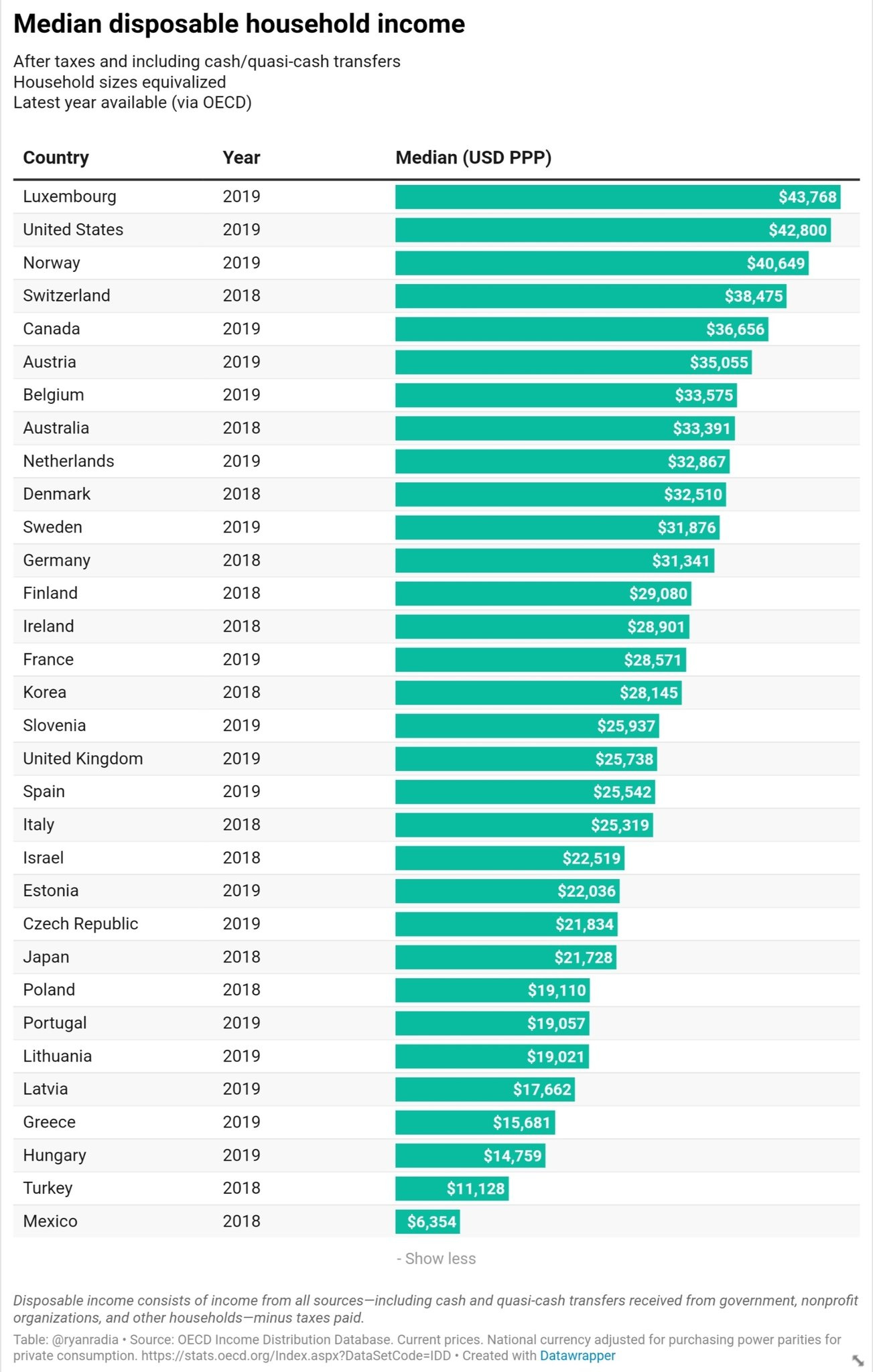
https://en.wikipedia.org/wiki/OECD_Better_Life_Index#2020
I think a more interesting point is that people in the UK and Japan specifically are poorer than you'd think they are. And they don't have working clothes dryers either.
So, it's a fair assumption that no organisation in the Netherlands is going to pay out as a result of this.
What are the chances of the employee being able to enforce this judgment in a Florida court?
See: https://e-justice.europa.eu/379/EN/european_account_preserva...
It takes time and usually isn't worth for small amounts... But for 75k someone will take time.
It operates similarly to the European Account Preservation Order, and under the right circumstances it is possible to apply for a freezing order on a _without notice_ basis meaning that the employer would not be aware of the order until it is issued.
wtf, was this a job or a prison camp?
Their (bad) legal argument was. He refused to follow work instructions, hence he did not perform his work as required, hence we can fire him "op staande voet" which is an on the spot firing that does not require a long process of attempting to improve employee performance. They needed a 'op staande voet' firing because the long process takes months. The justifications for this are limited to things like "theft or fraud", "Threatening or causing Grievous insult", "repeated innebriation" (called out specifically in law), or "refusing a task".
That final cause "Refusing a task" ,or in dutch, quoting from the law: "wanneer de werknemer hardnekkig weigert te voldoen aan redelijke bevelen of opdrachten, hem door of namens de werkgever verstrekt", can be translated to insubordination. A full translation of the dutch phrasing would be: "when the employee persistently refuses to comply with reasonable orders or instructions issued to him by or on behalf of the employer". Hence the company argued that "turn on your webcam all working day" was a "reasonable order or instruction issued by the employer".
Note that the story mentions this was during a "Corrective Action Program". That sounds like they were already in the firing process. Which starts with a process of notifying an employee their performance is not good enough, and requires they are offered a chance to improve. This 'offering a chance to improve' is usually done by putting employees on a 'performance improvement plan'. I believe many US states have similar procedures.
Most US companies follow similar procedures because they are a sensible thing to do. But 49 out of 50 US states have "at will" employment which means that employers can fire any employee at any time for no reason at all.
I will say that it’s typically used in the context of raising children for example, but it’s definitely acceptable to use this word in Dutch in this context.
From what I've read, this employee was indeed insubordinate; but they were entitled to be insubordinate, because the instruction they were given wasn't proper. It would be wrong to court-martial a soldier, for example, if they refused an order to murder PoWs, even though prima facie that would be insubordination.
"Insubordination is the act of willfully disobeying a lawful order of one's superior."
Your boss is your superior, so disobeying what he asks of you is insubordination.
That's why it is not insubordination, the order must be lawful. Your boss is your superior but there are plenty of possible scenarios where disobeying their orders is not insubordination. Besides that, your boss is not in a position to give you orders. It is a work place not a prison or a platoon.
In modern times insubordination is almost always related to military contexts.
Outside of acknowledged overt heirarchy like the military where the strict heirarchy has a defensible purpose (there is always some sort of heirarchy, but only in something like a military is a pathological form of it justified) you are theoretically always equal to anyone else, and your order-taking is merely a very limited commercial transaction. You are not actually subordinate to your boss or anyone else.
There is just this very narrow scope where you have voluntarily agreed to accept some specific kinds of directions in a specific context in return for pay.
Swap subordinate for subservient and I would not consider "insubservience" or "failure to be a servant" a very damning charge and I would look more at anyone who thought it was.
If the court ruled in their favour it would have been insubordination.
Thankfully, in Europe, unions have harshly fought for somewhat fair employment laws and this relationship only applies to actual work and not the whimsies of your boss.
https://www.merriam-webster.com/dictionary/superior
Boss is by definition superior to your position, not in a sense better, but higher.
If I tell you to go buy 10 apples, refusing would be insubordination because it's legal to buy apples.
If I tell you to go steal 10 apples, refusing would not be insubordination because it's legal to buy apples.
Until the court ruled against them, the view of the firm would have been it was legal to require someone to have their camera on. Hence they viewed it as insubordination to refuse.
They are wrong, it's not insubordination, but it's not unfair of them to think it was.
How would you know? That said, I suspect I have not as the first one was out of school and the few other jobs I've had were all from people I knew.
But when comparing overall US & EU working conditions, it's a very lopsided contest. US employees seem to be abused by European standards: at-will employment, no maternity leave, workplace surveillance, unpaid overtime for salaried employees are illegal pretty much everywhere - even Romania.
No. The reason is compensation.
Sometimes I feel like it might be good to meet in the middle (i.e. some amount of punishment awarded to the plaintiff, also as compensation for having had to take a corporation to court and presumably spending months in stress), but then I'm not sure where the line should be. Or perhaps a criminal case should be joined onto this, where the same judge (already familiar with all the details) also decides on a punitive amount going to the state.
Also historically there have been ways to unlock stolen phones so they can be resold "cleanly" later. I don't know what current iPhones are like, but I wouldn't be surprised if it was possible with Android phones.
We couldn't trust them to do anything.
And Chetu doesn't trust its employees. Heh
If I had a company, I'd much rather that my employees generate value, rather than "looking busy" and "working hard"
My last manager was this type and was a big advocate for everyone returning to office, likely for playing this game.
Is this a company where a manager is literally watching over employees for the whole day? I don't think that's normal outside of things like production lines and other blue-collar type environments.
Damn sweet. I wish we had such great employee protection laws in Austria, where the company/employer can terminate your employment relationship without any reason at all.
>Less than a week after the plaintiff was fired, the Rijswijk branch of Chetu Inc. was deregistered from the Chamber of Commerce and shut down on 2 September, records show
So the company knew they were in the wrong for firing him and immediately shut down their Dutch operations to avoid the lawsuit.
See this: https://www.usp.gv.at/mitarbeiter/beendigung-arbeitsverhaelt...
On the flip side, if one day you go in and you’ve just had enough of the hourly retail job and think you can get a better one, you can up and walk out then and there. Usually we flash the double V for Victory sign and say “Peace out!” when that’s the case. It’s fun.
I remember working as a waiter once and the Manager started assigning employees cleaning duties like getting on ladders for ceiling vents. Waiters get paid by tips, salary was $2.13 an hour at the time. When he asked me I told him I wouldn’t do it and would call the Workforce Commission if he wanted to push the issue. Needless to say I was the only front of house person not cleaning shit like a chump that day.
https://en.m.wikipedia.org/wiki/Right-to-work_law
All the states are At Will, but a number of them have exceptions that provide certain protections (ex. Not being fired for following the law):
Wtf?
No, "right to work" is not the opposite of "at will," they have almost nothing to do with each other. Furthermore, Texas IS a "right to work" state.
"Right-to-work" laws are laws that make joining a union not a requirement for employment.
All states in the US are "at will" employment.
Sounds like a good way to burn bridges. If I'd show up to work one day and tell them to suck it up for the next few months of planned projects, I do know what kind of reference my boss would provide to future employers.
It's not about loyalty or something, but so long as there isn't anything egregious, it does seem reasonable to me that both sides can expect a notice periods.
Not true at all what you claim about Austria. There are zero protections in place for workers here unless you're over 50 or work at a place with a union (worker's council) that will fight for you. If you work for a small tech company you have no protections against unfair dismissal. Basically your boss can tell you at any time "in 30 days you won't work here anymore, goodbye" without any reason. Unlike other EU countries where you need to provide a specific legal reason why you're letting an employee go or you can get sued for unfair dismissal like the man in the article did to his former employer.
I spoke to Arbeite Kammer after being dismissed for no reason by a douchebag boss and they told me "your employer doesn't need a reason to dismiss you according to Austrian labor law".
My jaw dropped when I realized that Austria is basically, similar to US in this regard, where you get no protection against unfair dismissal except that here you get about 30-60 day notice period to find another job while you continue to work for your current employer. Austrian employers are even allowed to dismiss you while you're on sick leave. Crazy stuff.
Very backwards employment laws for an EU county.
in this particular example, the legal date for termination in austria would have been december 31st (because by default it is 6 weeks notice after august 26, to the nearest quarter) in germany it would have been september 30th.
and for termination without notice
https://www.arbeitnehmer.at/kuendigung/entlassung/
pretty clearly spells out the reasons when someone can be fired, which contradicts your claim that people can be fired for no reason.
It was a constrast of Denmark, Germany and the US. In Germany it was hard to fire somebody, so employers were reluctant to hire. Denmark & the US had no such troubles, but the difference between Denmark and the US was that a fired employee in the US loses health care, et cetera. OTOH the fired Danish employee falls into the generous Danish social security. The anecdote was that the Danish rules were the best of both worlds.
It's hearsay, but I found it convincing. Austrian social security isn't as good as Denmark's, IIRC, but it's much better than the US's, so perhaps Austria is close to the optimum of the guy telling me that anecdote?
Or he was their only Dutch employee so there was no point in keeping their Dutch entity open.
//edit: apparently that’s incorrect for the Netherlands. Must have mixed that up.
In my contract, it says there is a few months' notice period, both when I want to stop working there as well as when they want me to stop working there. When reviewing the contract, it sounded reasonable and I just assumed that when I get the notice, that's how it is.
Later, I learned of these "there must be a valid reason" type of protections.
Does that make this whole clause void? Or even working in my favor, that is: even if there is a valid reason, our contract adds those months of notice period?
One more site to add to the memory hole.
Every company I worked for with foreign employees, hired (or more often acquired) knew the lay of the land.
An employer should be free to use webcam monitoring (no different than if the employee was in person with a supervisor nearby).
That seems unfortunate; the employee's best chance for collecting is if the employer continues to have business operations in the Netherlands.
And yet there are people who prefer working on site and “being observed by management”.
Or that there are jobs where you don't have the choice of WFH so you have to show up to the office whether you like it or not if you want to afford food and rent.
Or lack of silence, space, amenities at home, or the multiple other reasons why some people to go to the office.
Why be judgemental about it? Let people do what they want and you do what you want.
But to say that in tech, which thrives due to remote customers, people must work on site is misguided. People cant afford the “luxuries” you mentioned because they need to be in the proximity of their office. Some are so traumatised by the experience that they cant fathom the notion that it is possible to own a place of your own, moreover, a place that can provide quietness and space. Such people need reminding that yes it is possible. If a company demand remote customers then employees can demand remote work.
Those that despite having the space and the option of working form home yet chose onsite are welcome to do so. But i will remind folks that that is unnatural for human beings. Farming cattle is bad enough let alone people.
So, people not wanting to bring their work inside their homes where they eat, sleep, watch movies, play games, meet friends, have sex and play with their kids is unnatural? Are you gonna tell me next that same sex couples are also unnatural?
I'll tell you what's unnatural: You trying to be the authority on what's unnatural.
Stop trying to enforce your world views on everyone.