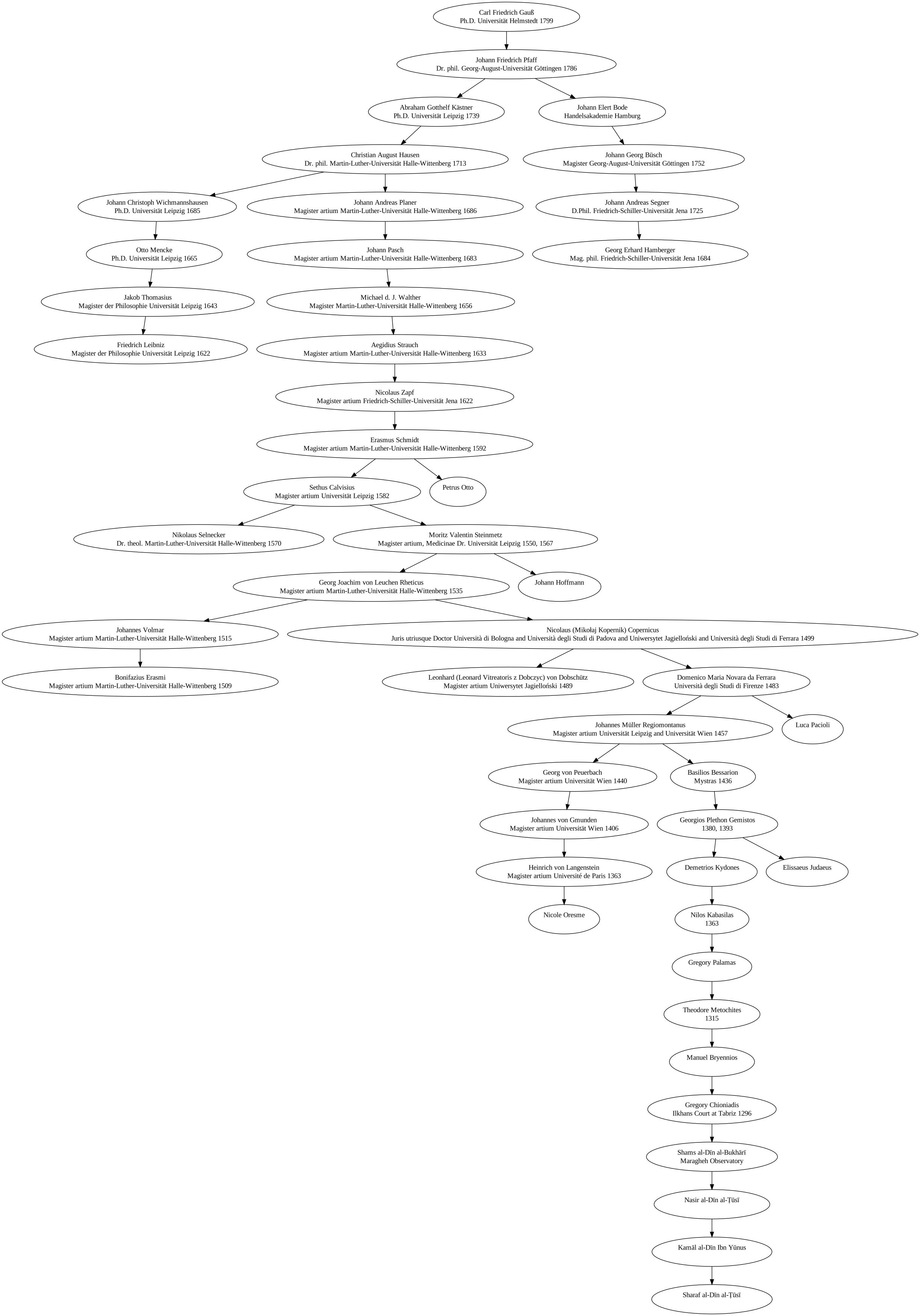
Thrun's page seems to have an error about Leibniz: "Gottfried Wilhelm Leibniz 1966, 1967, 1976"
It would be nice to be able to trace figures like al-Tusi back to Plato and Imhotep, to know if there really was an unbroken line of personal mentorship the way there is in the Buddhist lineages, or if at some point the oral line was severed. Perhaps during the Roman rampages through Greece, the line of transmission of philosophy only survived in Alexandria, or less plausibly, somewhere in India, only to resurface in Arabia while Europe was sunken into its Dark Ages. Or perhaps it had to be recovered from the few manuscripts the Christians hadn't yet recycled into hymnals, like the Archimedes Palimpsest.
We know that somewhere between Eudoxus and Galileo the idea of freely postulated axiom systems was lost, and it was not really fully rediscovered until the 19th century.
[0] https://en.wikipedia.org/wiki/Descent_from_antiquity [1] https://en.wikipedia.org/wiki/Guillaume_d%27Estouteville
But it does seem very unlikely that we could trace it, given how little written material survives from that period in India.
Our (Episcopal) parish used to have a small framed "genealogy" that purported to trace our diocesan bishop's consecration lineage back to St. Peter. I was always a bit skeptical.
Tangent: Some Roman Catholics would flatly deny the validity of any Anglican ordinations post-Henry VIII ....
The likelihood of a text surviving tends towards zero given enough time
Before antiquity we often only have quoted fragments to look at
The early episodes of the History of Philosophy Without Any Gaps is a pretty good introduction to how little we know about pre-socratic thinkers especially
Surviving corpora can often be only hundreds of characters long
One thing to note is that there seems to be a compounding difficulty of preserving records. Eg we don’t have much science or mathematics from anything like late antiquity but somehow the Hagia Sophia was built in 537. If you look at the evidence that people were still capable of the kind of analysis required to build that structure it seems plausible that much mathematics or science was still happening (in the eastern Roman Empire) but not being recorded. Perhaps if you are copying books you’re more likely to be copying the important ancient foundational texts rather than more advanced narrower more recent things. There’s like 7-800 years between Apollonius and the construction of that church. I do wonder what mathematics was done in that time but not recorded. But it also may be that the culture around mathematics was somehow limited with no (evidence of anything like) algebra or calculus or coordinate systems which are pretty important to the developments in the last few hundred years of mathematics.
Early western Christianity was pretty bad for preserving ancient texts (a silly and likely exaggerated way to phrase the attitude is something like ‘if it’s compatible with the bible it is unnecessary and if it disagrees with the bible it’s heresy and should be destroyed’ though it also seems the New Testament is somewhat Aristotelian) but the eastern empire kept many of them going (in their original Greek), and the Muslims ended up with Arabic translations and Western Europe then got copies or contemporary Arabic works through what is now Spain and translated them into Latin (this could be somewhat tricky for mathematics but worse for anything more philosophical which would have likely been changed first to be compatible with Islam and second to be compatible with Roman Catholicism).[1] Eventually scholars in the west also got access to the Greek texts from the Byzantine empire and the attitudes towards censorship had changed (I guess it was less necessary for things that were not in the vernacular) and it was perhaps lucky that this happened before the fall of Constantinople.
[1] apart from destruction there are also things that are lost due to there being a lot of texts and not that many people looking at them. Eg I think there’s a big library associated with the bishop of toledo (maybe a cathedral or seminary library; maybe in a bishops palace) which is full of Arabic texts from before the rechristianization of Spain. There may be texts there which are unknown to modern scholars.
I assume the 19th century rediscovery you refer to was Boole, Hamilton et al and their work in logic and the beginnings of abstract algebra.
Thank you for preparing for the Y10K problem.
here is one for neuroscience: https://neurotree.org/neurotree/
Maybe one student having more than one advisor? If that's the case, usually it's just a thesis committee or reviewer or something, and not really multiple _main_ advisors
Having a junior and a senior advisor is fairly common. Sometimes the work is done in multiple institutions, with a separate advisor in each. In some systems, most people who supervise students are not formally qualified to do so, creating a need for a separate formal supervisor. Sometimes there are two equal advisors, and sometimes the advisor changes for various reasons. Sometimes the student is an independent scholar and the advisors are only loosely involved in the work. If you only have written records, it can be impossible to tell which of these was the case for a particular student.
To give you an example, about half of my group at University X did a Bachelor's in statistics at University X, then a Mater's in statistics at University X, then a PhD in statistics at University X, and some are even doing a PostDoc (in statistics at University X)!
https://www.genealogy.math.ndsu.nodak.edu/id.php?id=38586
Bernoulli -> Euler -> Lagrange -> Poisson and Fourier
I suppose this was done by hand. Having such an overview while doing the research would be really beneficial for discovering novel ideas and connections. I haven't come across such a tool as of yet.
Think about his amour de soi. Did it existed previously anywhere else? Who talked about something similar earlier?
I'd die for something like that.
Rousseau: https://pov.is/e/93f9822c-1ed8-4bc9-aec9-064e7bb6807c Amour de soi: https://pov.is/e/82e9f674-ebbf-4c36-b225-ec1653ce3367
You can go backwards and forwards in time using by-year view (though missing data in Wikidata makes this a bit difficult): https://pov.is/e/93f9822c-1ed8-4bc9-aec9-064e7bb6807c?i=Q5&o...
[1] https://mitpress.mit.edu/9780262045308/ideas-that-created-th... [2] https://www.genealogy.math.ndsu.nodak.edu/
|
|
|
|
I was never aware of this connection. Is there some reasons or story behind how all of these geniuses clustered together?
See Castelvecchi, D. "Majority of mathematicians hail from just 24 scientific ‘families’". Nature 537, 20–21 (2016). https://doi.org/10.1038/nature.2016.20491
https://web.archive.org/web/20121112081753/http://www.telegr...
I came up with this game after realizing I had an Erdős–Bacon number. He credits me, but spun the article to make this sound like a "thing" other people cared about.
I was written out of that Wikipedia page long ago. Very little of what survives on that page stands up to close scrutiny.
Combining these numbers is an obscure amusement, but people take the separate numbers seriously. For Erdős numbers, should one count posthumous papers? My "2" via Persi Diaconis goes to "3" if one doesn't.
The original intent of the Bacon number game was to count actors in fictional speaking roles. My "2" here is from a speaking role in "A Beautiful Mind". The "Oracle of Bacon" replaced this intent with whatever their database could easily report. Appearing as oneself in a documentary on Erdős had the obvious hilarious effect.
One understand these links better by studying IMBD credits. Daniel Kleitman's "2" depends on a "Thanks" credit from "Good Will Hunting", and few of the other low Bacon numbers on the Erdős–Bacon Wikipedia page can be confirmed at all.
Perhaps some of these people are available:
https://en.wikipedia.org/wiki/List_of_people_by_Erdős_number