Most that seek to change the constitution want to take away rights or add new ones. It is good it is hard to change, especially when many of the change seekers can’t even get the popular support to get a law passed or a veto overridden.
I used to admire the US constitution. I've grown up now.
Who could possibly be opposed to human rights - i.e. human beings having rights? And indeed, the US constitution does appear to be largely about rights.
Over the years I've increasingly leaned to the view that these rights are mostly a legal fiction, and that the things that are supposedly rights are highly subjective political footballs. Nowadays I think of a constitution as a largely non-political set of rules for how government works; i.e. it's a description of a mechanism, not a description of an outcome.
From that point of view, the US Constitution is an awful constitution.
Ultimately all constitutions are just ink on paper (or parchment depending on age) and are only as good as the people who govern.
> things that are supposedly rights are highly subjective political footballs.
The fabric of society is a pitch where political football is played. The US Constitution is a product of the times when it was created, and so our pitch was created to balance the power of populous states vs. rural states with proportional representation (House) and fixed representation (Senate) and the electoral college. It took great pains to prevent rule by fiat of the executive because of the lesson from English rule. It's surprising it has held up, but a lot of the pressures that existed when it was created are still present (red state/blue state is really urban/rural) in the US today.
> From that point of view, the US Constitution is an awful constitution.
If a slow, plodding government that is largely effective only when faced with unifying crisis or there is a very high level of consensus is what you want, then the US Constitution works.
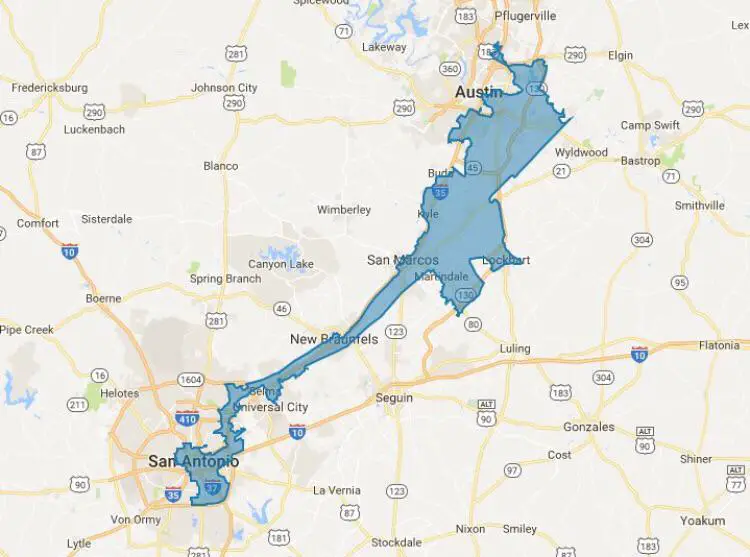
How Texas draws congressional districts is up to the people of the Great State of Texas.
The US has thrived, meaning its definition of rights is reasonably on the mark.
Anyway, my point was that I don't think these rights exist, and that framing things in terms of rights is arse-over-tit. I'm not interested in arguing whether the US chose the right set of rights; I'm saying I have no idea what a "right" is, other than a privilege granted by law.
Americans love to wallow in "oh, woe is us!" whereas if one reads history books, the US is in a golden age.
Yep, and Constitutions define these privileges and make them supreme, above other laws.
What do you mean? US citizens have pretty much the most rights of any people in the world.
Can you list the countries that guarantee freedom of speech, freedom to bear arms, freedom from unreasonable searches and freedom to stay silent (not incriminate yourself)?
(Of course, the implementation of these rights is ... imperfect.)
In practice the US performs rather badly when scores on civil liberties.
Here is one methodology https://knoema.com/atlas/ranks/Civil-liberties-index?mode=am... but you can find similar results across many others.
Just take our prison population per capita if you want a glaring metric on how poorly we do at freedom.
Which IMO is mostly a reflection of a country in which a large subset of the electorate do not really believe in human rights beyond the extent of a useful legal fiction to be followed in the default case and quietly ignored in the pursuit of specific outcomes.
If the people had a hardline stance on human rights and civil liberties the government would reflect that.
Nothing says "human rights" like criminalising protests, confiscating money, and prohibiting unvaccinated people from leaving the country.
We're 'free' in an Orwellian sense. Freedom to be educated, have health care regardless of one's employment|wealth, welfare with dignity for those in need — none of these concepts come into consideration into what 'freedom' actually means in practice.
My political leanings started libertarian. Over the years, I have traveled and read, and came to see the US for the farce it is, and encounter the deluded population convinced America is 'the greatest nation ever'. It has potential for sure, but when will we unlock it and truly taste real freedom?
None of the Bill of Rights is guaranteeing free stuff.
My contention is simply that these rights are legal fictions and political footballs, and should not be in-scope for a constitution. They shouldn't be baked-in; they should be simple legislation.
I mainly don't believe in these "rights". I think people should be treated fairly and equitably; and I think that should be a matter of law. But constitution is about meta-law - how laws are made, not what their effect is.
They're inherent to being a human being - those "inalienable" rights mentioned in the Declaration of Independence.
The US Constitution did not create those rights, it recognized them.
How many times have you seen people on HN advocating, to much popular support, for infringing upon the 4th amendment for people who are involved in specific types of business or the infringing upon 5th amendment protections for people engaged in certain activities?
It’s a delineation of governmental responsibilities between the various federal branches and the states. It wasn’t until the Bill of Rights was later ratified that it has anything to say about individual rights other than to deny them.
The (lack of a) Bill of Rights was a major concern when the Constitution was drafted. It was passed with the promise that amending it with a Bill of Rights would be the first priority.
The Constitution was only passed without it so the convention wouldn't keep dragging on.