[1]: https://www.ncsc.gov.uk/static-assets/images/blog-post/instr...
[1] https://arstechnica.com/tech-policy/2021/02/citibank-just-go...
[2] https://www.reuters.com/markets/us/citigroup-wins-appeal-ove...
https://www.popularmechanics.com/technology/infrastructure/a...
Can you guess which music video that’s from?
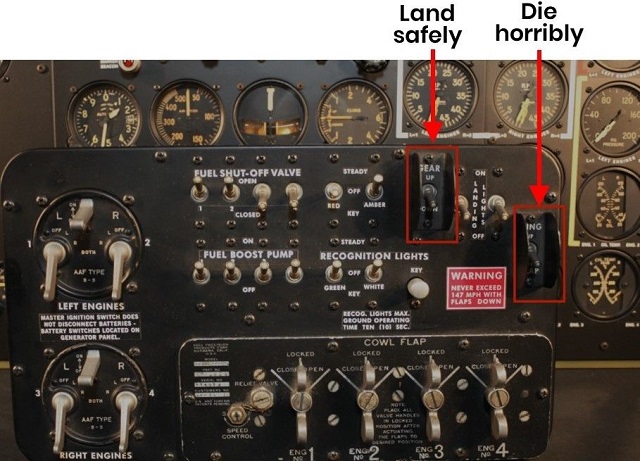
But to be fair It's not that bad when you realize using flaps and gear is time correlated - you slow down, enable flaps, get near the airport, then put the gear down.
There is no "I want to put the gear down in situation when enabling flaps would fuck stuff up too much"
Unless, maybe, you just limped your plane in because it’s missing a big chunk of a wing.
One thing the military does is try to make it hard to make a simple mistake and kill a bunch of your own troops.
During the last Iraq invasion I was running around with a fuel tanker which had a pony motor to offload the fuel. It was pretty complicated with a bunch of levers and valves you had to set to get the fuel flowing the right way (and not on the ground) but had a data plate to tell you what to do, easy peasy. One day we were at a bag farm dumping fuel and this staff sergeant wandered up and says I’m doing it wrong. “Data plate” I say and point at the data plate but she started to get all huffy so, whatever, do what she says which was all fine and good until the tanker starts filling up because it is set up backwards. She made some lame excuse for not following the law of the one true god, the data plate, and wandered off to bother someone else.
Am I missing something here? What's the headline supposed to mean? Is it a tongue-in-cheek gesture, since GCHQ routinely hoover up personal data and spy on both their citizenry and foreign countries?
He thinks that the UK is going to implode?
Probably correct even if it is mostly harmless.
"GCHQ routinely hoover up personal data and spy on both their citizenry and foreign countries?"
It's hard to say which it really is.
Its Ian ingratiating himself to the geek readership so they think he's one of them and not, well, a fucking ex government spook ;)
> one problem (in my opinion) is that it’s too easy to set up free hosting for your cybercrime site. There’s no friction and no risk to dissuade would-be-crims.
Sounds like an Inbound TCP License is next on the UK’s to-do list?
Make sure you have a license for those bits.
You'd want both the gear and flaps down on landing, so both switches would be in the down position. If the switches weren't in sync, e.g. you need one switch up and the other down for landing, that would be a problem.
In the reverse hitting flaps up before gear up is likely to cause problems.
I am intrigued by the memory safety section. It’s a hot topic these days, right? So here’s an interesting thought experiment.
What if all these areas where we use memory-unsafe technologies were replaced by memory managed technologies like C#, Python, Go, etc. Sure, lots of things would run slower (raw TLS in Python, yay), BUT would there suddenly just be less exploits? Or is this area more of “Law of Conservation of Ugly”?
Not sure whether this is still a problem now that computers are way faster but my own experience is that despite the resources available, our apps are slower than ever, even ones that do largely what they did 20 years ago like Word and Visual Studio!
Yes. We'd see at least a 30% reduction in exploits, and in the overwhelming majority of use cases the slowdown wouldn't be relevant. Software in those areas would also get written a lot quicker.
The trouble is that there's no incentive to do this, at any level. Software would probably crash more (because one of the biggest ways memory-safe languages avoid security issues is by turning silent corruption into visible crashes). No-one cares if you deliver the project in 50% less time than it would otherwise take (you're still missing the schedule), but everyone cares if it's 50% slower on a meaningless microbenchmark. And C bros no longer get to slap each other on the back about what l33t h4x0rs they are. (I suspect, cynically, that one of the reasons Rust is the language that's finally getting to replace C, is that it's that rarest of memory-safe languages that puts an equal amounts of (mostly) pointless difficulty on the programmer).
When you stall, you start falling at the speed gravity pulls you minus any drag your airframe presents. And if you’re already close to the airfield, you might be only a few hundred feet up, so you’re out of room to put the nose down and throttle up to regain speed necessary to regain lift.
Putting gear down adds a little drag (and a lot of noise), so a minor speed in reduction; going full flaps slows you a lot. You usually pitch the nose down a little more to increase your rate of descent as you go full flaps, so that you keep the speed up to keep the lift up which keeps your plane up. If it’s dark, you’re tired, flying close to stall speed already, go full flap without realizing you just did and don’t keep your eyes glued to the air speed indicator, you’ll stall out and fall from the sky. Trying to recover would catch a lot of disoriented pilots unawares.
A large reduction in lift (raising flaps) will cause a aircraft to dive. A large increase in lift (lowering flaps) will cause a aircraft to stall -- and fall.
Either of these changes would be recoverable if there were more thrust or more altitude, both of which are intentionally minimized during a landing.
A bit of searching seems to have revealed that the actual problem was inadvertent gear retraction. Pilots were retracting the gear, either while adjusting flaps on final approach or after landing when they tried to raise the flaps again.
Airplanes don't fall out of the sky because transport safety boards do the analysis and the manufacturers follow their advice - the idea is only one planet crashes per type of mistake.
Well it's hard to get a group of open source developers to follow cleanroom techniques for free. I am guessing that the thinking is to fund the identified OSS groups.
Which is nice...
Obligatory XKCD: https://xkcd.com/2347/
The only issue is who funds them all? UK? US? China? UN? Some body similar to WHO but for cyber?
Yes, absolutely!
For example we build all kinds of crazy things into our CPUs but don't make them safe because this would break compatibility with software design form the 1960s. That's pure insanity given the gigantic costs caused by the to this day unsafe computer architectures. We're talking here about hundreds of billions of dollars, every year. Still nobody wants to change anything.
But than the text goes on:
> For example, one problem (in my opinion) is that it’s too easy to set up free hosting for your cybercrime site. There’s no friction and no risk to dissuade would-be-crims.
Pure nonsense and propaganda!
First of all, there is no "free hosting" for cybercrime. If it would be free the whole following argument about economical initiatives for the hosting providers falls apart.
Also it seems someone wants to change the fundamental nature of the internet: A key principle of the internet is that everybody with access can provide services. So even if hosting providers would be strongly regulated the cybercrime gangs can still host their shit themself. (And because of initiatives some "illegal" unregulated hosting providers would pop up quickly anyway, as it actually the case already).
Fighting the root cause would in this case mean to restructure the internet to a fully state controlled entity. What this guy (indirectly) proposes it pervert! But of course nicely in line with everything the British government stands for…
It has reasons why our governments across the globe pushing for "everything online", payed with "digital currency" (this includes "plastic" and online banking and such, in the future "digital Dollars / Euros / Pounds" etc), and in the last step digital IDs bound to the vital internet access. The result of this is full control—a new age of slavery. (But at least there wouldn't be much cybercrime than; isn't that great? /s)
A much more favorable solution would be safe free hard- and software, so cybercrime would be infeasible by pure technological means (of course nothing can protect people from their own stupidity, but that's a different story, and not unique to the cyberspace). Such a resolution to the root causes means of course less power to the central governments and all power to the people making and using digital things. But I understand that governments aren't in favor of this and dream instead of the full control approach.
The article contains actually much more of the typical intelligence propaganda (or "narrative" how they themself call this kind of propaganda), as others pointed out here already. I would not consider this text anyhow honest.
Man getting paid to spy on people complains about not being able to spy on people and uses the tried and tested "think of the children!" angle. Classic.
Good
> but also potentially reduces the resilience of mobile networks because it messes with the caching strategies in place today and makes diagnosing problems harder.
This is a lie because the vast majority of internet traffic is already encrypted and hence un-cachable. Even if it is true, I don't care, we can trade caching for privacy, we did it with HTTP and the sky didn't fall.
> It also makes it impossible for those networks not to charge for certain data traffic because they can’t see which sites a phone is trying to visit.
Again, good.
Seriously. Fuck this guy and everything he stands for.
> it messes with the caching strategies in place today and makes diagnosing problems harder.
ISPs will do the most boneheaded things to your traffic if it is not encrypted. There was a time when Comcast liked injecting random HTML into pages. I'm sure this guy has never had to "diagnose problems" resulting from an ISP rewriting HTML on the fly. Nowadays with TLS, ISPs are mostly out of the picture and the surface area for problems is dramatically smaller.
Just more of the same tired refrain from people using motivated reasoning who don't have any care for user privacy or the rights of individuals online.
precedes that.