The review tools on github already go too far toward this by removing far too much context.
If you look at only the PR, even with a few lines of context, you still don't see much.
I actually like the diff view window provided by JetBrains editors through the alreedy bundled "Github plugin". I get to see the whole file, before and after (left/right), with highlights for changes, lines added, lins removed. That way I see the entire context.
If you only see the usual change+3 lines of context you often don't even see what function is impacted, and it's also rare to have the context of the entire module being changed in ones head already.
For evaluating PRs, I use the PR review feature in IDEA editors and go through the list of files changed, opening a new window with the entirety of that file available to me, changes highlighted. F7 jumps to the next change, but mostly I just scroll.
You can add review comments right in the diff view.
https://youtu.be/MoXxF3aWW8k ("IntelliJ IDEA. GitHub Pull Requests") -- Diff viewer shown at 2:40; In that video the diff view is shown inside the editor, but I much prefer - and fortunately that is configurable - to open the Diff View in a new window, maximized.
https://www.jetbrains.com/help/idea/comparing-files-and-fold...
The example works only for PRs on GitHub and IDEA editors, but I wanted to present the concept, and show that IMO very nice diff view and how it makes it easy to review changes with the context of the entire file.
Thanks for the links.
I don't work at Meta and I still don't have any idea which of you is right.
A commit would satisfy the description above.
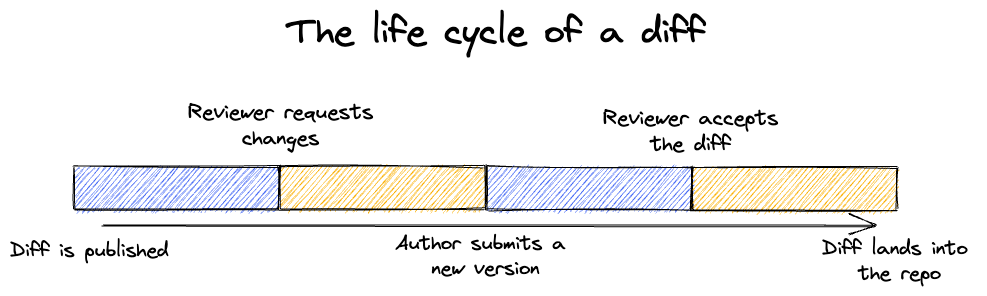
As would a pull/merge request, which the image in the article perhaps fits better: https://engineering.fb.com/wp-content/uploads/2022/11/Code-R...
Of course, it's possible to review each individual commit as well, but who does that?
I know that some folks love to mess around as much as they need in their local branches, commit often and then do an interactive rebase, to maybe end up with one or just a few commits that can then be the basis for a pull/merge request, then the difference matter a little bit less.
Imagine a feature that would heavily degrade performances as a whole, but as it’s being introduced in small bits and pieces no one sees the big picture and are left to wonder why perfs are slowly degrading, boiling frog style.