An example of clojure performance issues covered here: https://tech.redplanetlabs.com/2020/09/02/clojure-faster/
All that stuff above should be fixed at the language/stdlib level.
But what is your take on what needs fixing ? What would have been your solution for the N data-structures/ M algo problem you mentioned above ?
> real structs
I'm not even sure if value types are conducive towards immutable, persistent data structures. I'm certainly excited for project Valhalla but I'm not sure if Clojure, nor any Clojure-like JVM language, written in an idiomatic fashion, would really benefit from it.
> light-weight concurrency like Go
Project loom is already in preview mode. Lightweight concurrency is nearly here for any JVM language, and once it's fully released I will likely have zero reason to use core.async.
> type support
Static typing is A Thing you can choose to do, but I doubt you would get many daily Clojure users agreeing that it is "better". I think it's different and better in some circumstances but not necessarily others. It definitely feels trendy these days, sorta like how dynamic typing felt trendy 15 years ago.
There is a reason why all dynamically typed languages today are scrambling to add some form of static typing to their language, but never the other way around.
Static typing does everything dynamic typing does, but better, faster, allow automatic refactoring, faster programs, better navigation, better documentation, better maintenance.
"All your life's work for naught, Pepaw. If only you had been on the right side of history".
I do have a substantive disagreement with this statement: "There is a reason why all dynamically typed languages today are scrambling to add some form of static typing to their language, but never the other way around".
Languages like C#, Java, Scala, and Typescript have all adopted some degree of type inference. Their users wanted it for a long time. To begin with, none of these languages are anywhere near as strictly-typed as a language like Haskell. Clearly even developers on "the right side of history" don't want to maximize static type checking in all cases, so the issue is not as cut and dry as you make it sound.
However, to be fair, Clojure's response to types is `org.clojure/spec.alpha`, and if you give it a really good chance, you'll see that it brings a lot to the table.
It doesn't change that I believe strong typing (a Haskell or Idris/Agda-like flavour of it) to be the future, but what it did change was how I thought about type systems and how to write and test programs.
I appreciate that it's a bit frustrating to have someone vaguely identify an area of concern and clarification and actionable suggestions are much more valuable.
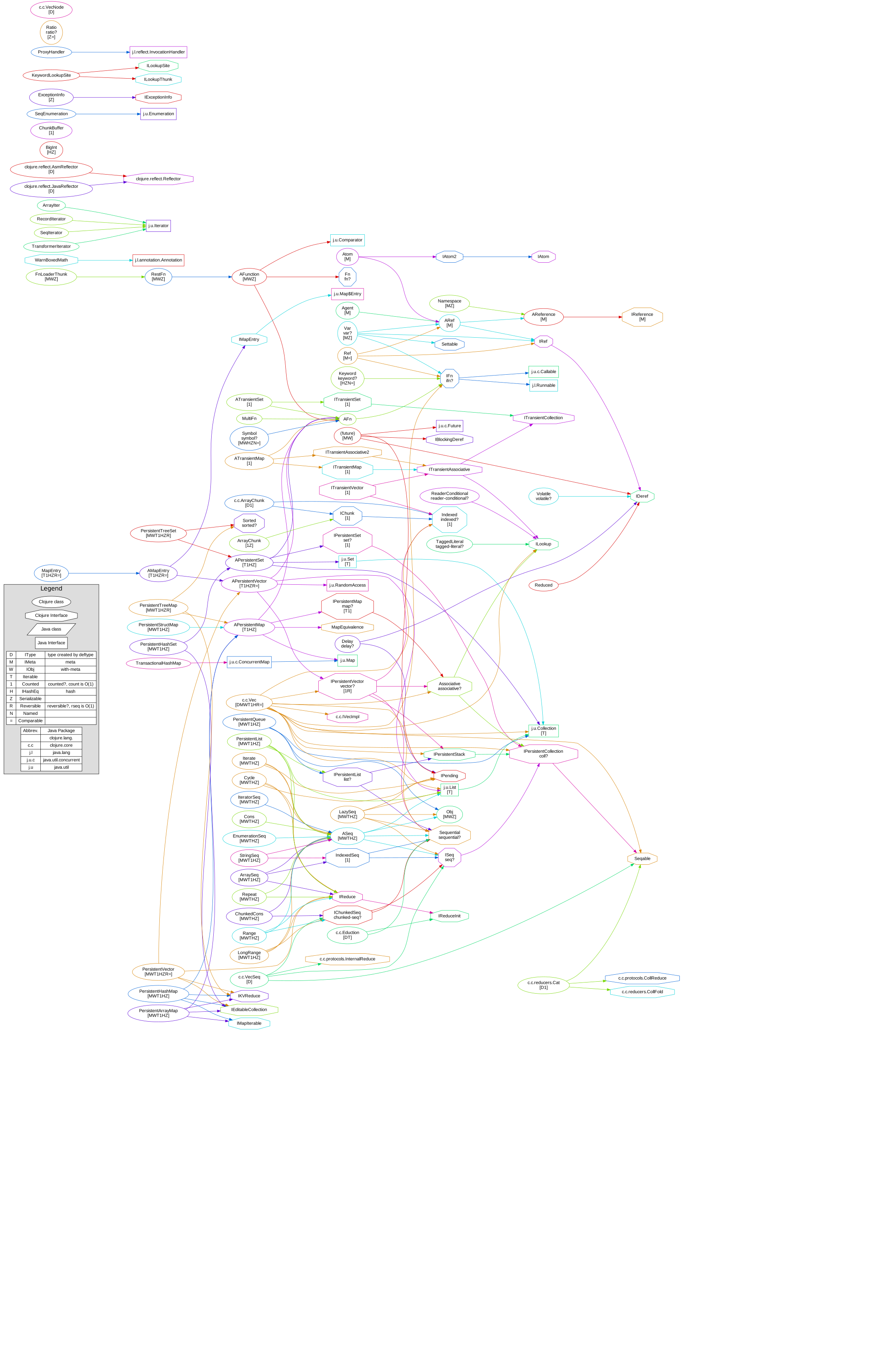
There's two things. One is that the data structure ontology[1] is difficult to internalize because of its complexity. When I write Clojure code, I consider the capabilities of the data structures being passed to the function. I think we have some implicit understanding of this early on. You expect the type of such and such to support seq-ing or deref-ing or something else. You're thinking in terms of capabilities and that's good. But if you want to be exacting, at some point you'll have to be able to point to an interface or several in the diagram and say, "yes, I really do expect something that conforms to IPersistentVector or IMeta or something else. In order to preserve backwards compatibility, this is more confusing than it needs to be. Moreover, at that point, you're not in Clojure-land anymore.
My second point is that at this step in the narrative, you're reading Java code and the illusion of 100 functions is broken. I ask myself, "Why, aren't Clojure data structures implemented in terms of protocols?" There's a perfectly good way of abstracting functionality that seems good enough for users, but not good enough for standard library implementers? It feels like the answer is, "We don't want to break Clojure1.x and we don't want to deal with the Python3 problem." Which is fair, admirable even, but it still leaves me left wanting. I think there's a simpler, more consistent Clojure hiding in there, waiting to be let out.
Apologies for the awkward way this reads; I simply wanted to get it out before lunch time.
1. https://raw.githubusercontent.com/jafingerhut/clojure-classe...