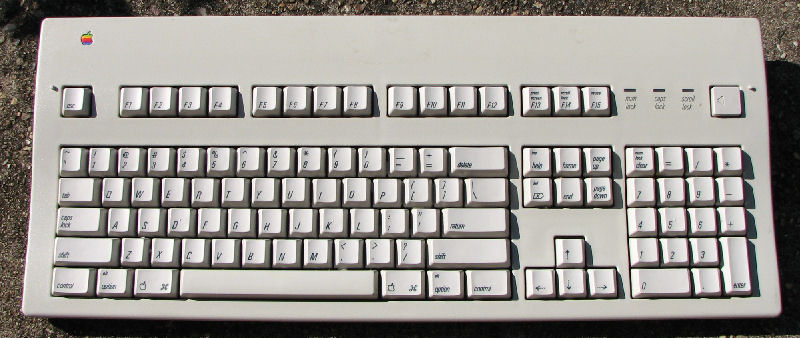
It requires a rather hefty ADB to USB adapter, which ran me about fifty bucks (http://www.amazon.com/Griffin-2001-ADB-iMate-Universal-adapt...) but to me, it was worth it.
Modern Apple keyboards look beautiful sitting in a pristine environment, but the lack of key travel, too-flat form factor, and decent spacing makes typing unpleasant.
My old Extended Keyboard takes up more space on my desk than my laptop does. It's noisy as hell. It's about as pretty as a Soviet gas station. And I can type all day long on it without my hands ever tiring.
Very similar layout, with a smaller form factor, non mechanical but to me it feels just as good, and it features an USB hub. My preferred keyboard at home and at work, along with some ControllerMate magic to turn the Help key into something more useful.
PS: it also has a delete (Ctrl-D) key to the right of backspace (Ctrl-H), in the usual PC position.
One feature of this keyboard that I unfortunately discovered by accident is that the Command+Control+Power keystroke does a hard reboot on modern Macs, just as it did on the old Mac SE and Apple IIgs.
2) The Das Keyboard is nice but still not as good as Model M / Unicomp SpaceSaver: http://jseliger.com/2009/11/01/product-review-das-keyboard/ . I used the review copy with an iMac.
3) Virtually any mechanical keyboard is a HUGE improvement on the default keyboards that most manufacturers ship.
(Yes, I know that key activation pressure is measured in newtons, not grams, but since we're all on Earth here, we can deal :)
If you're a mechanical nut, you still have the Matias Tactile Pro (http://matias.ca/tactilepro3/index.php) which has the added bonus of not just the proper keycaps, but the indicators for the additional characters possible with option and shift.
- 3 points (#2, #3 and #8) related to USB functionality
- 3 essentially identical points (#5, #6 and #7) about what type of keys they have
- Only points #1 and #4 are something that could be considered as real differentiator by a layman
- Gold-plated contacts are mentioned 4(!) times on the first page - I wonder if they provide any advantage over silver or metal ones
- They also mention Darth Vader(!) somewhere on their front page
- They also have a chart that should communicate some additional value that the keyboard provides (and it probably does)
Overall, my impression is that they overdid their marketing. Thoughts?
Update: They also mention (in a system requirements sections that nobody reads) that to use the hub functionality, you would need to occupy two ports of your mac, not one, which somewhat lessens the value proposition
As far as technology: there are basically three major varieties. One has a plastic membrane that separates two conductive surfaces; physical pressure forces the two surfaces in contact and actuates the key. These are usually fairly large contact surfaces and also are relatively sealed, but you can get situations where you need to press harder on the key to get it to actuate, and if little bits of crap get between the surfaces then the key is pretty well dead. There are a variety of ways of forcing that actuation; simple physical pressure (your microwave pad), a plunger (less prone to troublesome false actuations), the scissor switches you see in laptops or the modern Apple keyboards, but they're all basically similar as far as electrical conductivity and tend to fail in relatively similar ways.
The Model M is actually a membrane like this under the surface, but the membrane is almost totally sealed off and is operated by extremely reliable and powerful (well, for a keyboard) actuator--the buckling spring operates a small lever in the guts of the keyboard, pressing the devices in contact. As a result they get excellent lifetime and a very consistent and desirable action. The size of the lever and the distance between the key and the actuation (and also the sheer size of a Model M) mean that the contact surfaces can be relatively large. Earlier IBM keyboards used a capacitive action which is very rare today; the only one I know of is the Happy Hacking Keyboard.
The Cherry MX switches the Das uses have a mechanical switch that makes and breaks contact on every keystroke. They are mechanically more compact than the buckling spring type with similarly desirable key action, but the switch means they need to be made in a very durable way. Cherry says the MXs are good for 50 million operations; I don't know how many operations IBM guaranteed theirs for but I'm sitting next to one made in 1989 so I presume it is "a lot".
Which is a lot of words to say that "gold might make a difference and anyway Cherry doesn't sell good switches without the gold plating and they're the only people of any repute making those type of keys any more".
Edit: one other further irritation for people who type fast; N-key rollover is a term you may have heard of. On a PS/2 keyboard, you can literally activate every key on the keyboard at once and the computer can track them all. This is because the PS/2 tracks key up and key down events but doesn't try to keep state so much. USB does and because of this true N-key rollover is impossible without custom software on both ends; the best we can do is I think six, so in this case the Das is state of the art, such as it is. Supposedly the v4 Sidewinder got around this, probably through a custom driver mode.
But this keyboard, even if it supposedly designed for the mac, won't get my money: - weird FN keys where the right control stands, instead of the leftmost part like on most laptops (including macbooks) - eject key way too close to backspace. (really, what could go wrong especially where the delete key is - and while the mac can use a proper delete key?) - no KP_Equal key
Basically, they took the PC version, didn't change the molds (expansive!!) and just printed some mac-like labels on the key.
A cheap hack, not worth $133.
I'll keep my non mechanical (non gold platted, not approved by Darth Vader) Apple USB keyboard - http://www.amazon.com/Apple-109-Key-Version-Keyboard-1003199...
And they do also come with a USB hub and work fine even of the newest OSX such as Lion
http://elitekeyboards.com/products.php?sub=pfu_keyboards,hhk...
Reusable Earplugs: "Multi-use, comfortable earplugs for co-workers or significant others of Das Keyboard Professional or Das Keyboard Ultimate users."
The now discontinued HP mini keyboard [1] was exactly as I thought all the keyboards would had been past 2005. Exactly the full size layout, just without the unnecessary numerical pad whose only use it to keep the mouse far away from my right hand.
[1] http://www.amazon.com/HP-AS601AA-ABA-Mini-Keyboard/dp/B0025Z...
[1]: http://store.daskeyboard.com/Linux-Key-Caps-2-keys/dp/B004JP...
The one pictured is hideously ugly, though.
I switched from a Model M to the default iMac keyboard (the wired one with the number pad) back in August when I switched to from linux to an iMac and it's taken me until just recently, to get used to it. I still don't like the feel of the keyboard quite as much and have been tempted to buy the Unicomp keyboard many times. That said, I do find it more comfortable than most other non-mechanical keyboards out there.
I've had several offers from people wanting to buy the Model M, but I refuse to part with it, even if I'm not using it at this very moment. I found it years ago, in the back of a storage shed, covered in about a decade of dust, grease, and cob webs, cleaned it up, and it looks practically new and works perfectly. I do so love that keyboard.
You can order a customized version. I have a custom Unicomp EnduraPro with blank keycaps (like a Das Ultimate) and they also reprogrammed it (i.e.: I wanted to swap CapsLock with left Ctrl and Tilde/Backtick with Esc).
I can't recommend them highly enough.
Anyone used both and can convince me not to order one of the Das'?
I since then switched to a customized keyboard made by Unicomp and couldn't look back. The buckling springs may feel a little bit too hard at first, but over time I found them to soften.
I've successfully bought a Das Keyboard from GetDigital: http://www.getdigital.de/products/Das_Keyboard_Model_S
It even let me brush up on my German :)