https://www.seaspiracy.org/facts
"Species like thresher, bull and hammerhead sharks have lost up to 80-99% of their populations in the last two decades.
Seabird populations have declined by 70% since the 1950's.
Studies estimate that up to 40% of all marine life caught is thrown overboard as bycatch.
Six out of seven species of sea turtles are either threatened or endangered due to fishing.
Over 300,000 whales, dolphins and porpoises are killed as bycatch every year.
2.7 trillion fish are caught every year, or up to 5 million caught every minute.
Fish populations are in decline to near extinction.
For history, here's the criminal, senseless moron, shame on him, shame on them all: https://www.youtube.com/watch?v=NtfGFt1c5H8
https://www.pulsefishing.eu/what-is-pulse-fishing/techniques
If it doesn't destroy the plants too, it probably ~is better for the ecosystem than what it's replacing, but if aliens come and start dragging electrocution nets over human cities to electrocute us all, we won't be able to say we didn't have it coming.
This is a fairly important part. It’s one thing to fish and eat. It’s another thing to fish and destroy. Trawling is the strip mining of the sea.
The regulation nominally exists to disincentivize bycatch but anecdotally it seems to just ensure that bycatch becomes waste.
NOAA states:
>Fishermen sometimes catch and discard animals they do not want, cannot sell, or are not allowed to keep.
There’s a huge difference in not allowed to keep and we would keep for ourselves. If you’re netting a bunch of undersized fish you have to release them, I catch lots of undersized fish I’d love to eat but I’m not legally allowed to.
https://www.fisheries.noaa.gov/insight/understanding-bycatch
Not exactly. Bycatch becomes energy diverted towards the scavengers part of the trophic chain. They are feeding other animals with it.
https://www.independent.co.uk/climate-change/news/revealed-t...
https://web.colby.edu/st297-global18/2019/01/21/atlantic-blu...
What a dark future: "Bluefun tuna is extinct in the wild but you can still eat it from Mitsubishi"
And then: "Today the last bluefin tuna in the history of the world was sold for $20M to a billionaire."
Something like that...
It sounded very intelligent and convincing to me at 18, and sounds downright idiotic to me now.
Read up on the Simon/Ehrlich wager. Nobody knows the future, but your professor was demonstrating a solid economic principle.
And if we found alternatives to Tuna, it doesn’t mean that other species like sharks and Orca can.
Economically, mining is exploitation of any resource on a basis which fails to account for the full ecological formation costs of that resource.
In the case of petroleum, we can look at one ecological cost: time.
Petroleum formed over a period of hundreds of millions of years. It's been extracted by humans for a couple of hundred years. Even on napkin math, the time cost is being discounted by on the order of one million fold.
If the resource were so vast that it could not be meaningfully exhausted, this wouldn't be an issue. But we've hit peak conventional oil within numerous major producer countries, and quite probably the world, which corresponds to roughly half the total exploitable resource having been exhausted.
The economic theory most often mentioned for pricing of nonrenewable resources is Hotelling's Rule, formulated in 1932. I've read that paper numerous times, and the fact that strikes me most about it is that although it cites earlier economic works and numerous references of the author himself, it cites absolutely no scientific, geological, or petrochemical references. It's utterly devoid of any real-world grounding.
And we have pricing data to invalidate it, one of the most comprehensive being crude oil prices dating to 1870 or so. That's published as part of BP's Annual Statistical Review of Energy, showing both nominal and inflation-adjusted prices.
What's clear is that price does not follow the trend predicted by Hotelling, but rather reflects, at various times, unrestrained extraction (when the price collapses), various catellisations and embargos (when it peaks), and several periods of long-term managed output, during which it remains quite nearly constant. The longest and most stable such period was from the early 1930s to the early 1970s, following the establishment of regulated extraction in the United States (at the time the world's peak, and surplus-capacity, provider of oil).
Immediately prior to this period, following major discoveries and unregulated extraction in East Texas, the price fell from a target $1/bbl to $0.13/bbl, and finally as low as $0.02/bbl. The rational for pricing wasn't Hotelling's model, but the bare minimum price required to meet marginal costs of extraction.
More recently, in the 2000s and 2010s, what's emerged has been the flip side of demand destruction, where prices of oil can rise to the point that economic activity can't support them, and demand collapses, with it ultimately price (as more expensive marginal wells are withdrawn from production). Price has see-sawed between highs as the global economy surged, and lows, as it collapsed. Sometimes exogenously as with the 2020 global COVID pandemic, which saw US spot futures prices fall negative briefly at contracts expired and delivery had to be made --- there was no available storage and traders paid to have their oil offloaded.
The upshot is that extractive commodity prices don't behave as one might expect during periods of exhaustion. Rather than rising monotonically, they'll jump around on thin trading, surges in supply and demand, and external influences.
If you want less of something, don't subsidize it.
> Tax the caught fish
How would you tax the bycatch?
How would you price the dead whales, dolphins and turtles?
How would you price the sharks dying because the populations of fish are collapsing?
Bycatch aside, this number absolutely floors me. There is no way this number can sound remotely sustainable to anyone, right?
I love seafood, but I know the issues with overfishing so I don't eat it often and when I do, I do my best to only eat sustainably caught or farmed fish...but I feel absolutely hopeless seeing numbers like this.
Poke around and look up how big wild schools of anchovy can be, or how many krill it takes to feed a whale. And each of those numbers you find are just teensy little blips. The ocean is really big and its teeming with life.
As earlier responses have noted, this is an exceedingly common misperception. It further fails to acknowledge harms done.
Estimates are that upwards of 90% of all marine animal life has been destroyed largely by human activity.
Vast fisheries have utterly collapsed, notably Grand Banks cod off Newfoundland, sardines off California, orange roughy, and more. Surviving fisheries are hugely impacted, often with both far fewer and far smaller individuals than in historical records.
Records and understand themselves are exceptionally limited, as major scientific study of the oceans dates only to the mid-20th century, after which much of the harm had already been done.
A fascinating trivium is that there is more oil floating in tankers over the oceans than there are fish swimming in it.
And, as myshpa noted, the deep oceans tend not to have much biological activity. Fish (and plankton) aggregate near continental boundaries where upwelling provides essential nutrients. Sunshine and water alone are vastly insufficient.
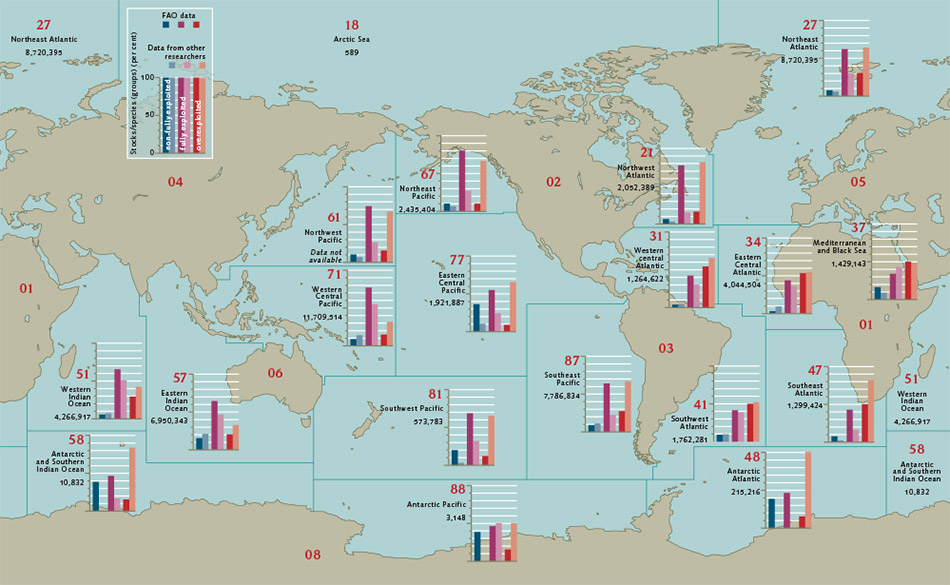
Map of global fisheries / fish stocks: <https://www.theglobaleducationproject.org/earth/fisheries-an...>
State of fisheries: <https://worldoceanreview.com/en/wor-2/fisheries/state-of-fis...>
Notably this map showing sustainable- / over-exploitation status: <https://worldoceanreview.com/en/files/2013/04/wor2_c3a_s52_3...>
In general, you tend to find much more biomass and biodiversity closer to the coasts. But you can get hotspots of productivity in other places such as upwelling regions and also near seamounts (shameless plug of my paper on this)."
"People assume, well oceans are massive so fish stocks are massive as well. But if you went hunting for game as a protein source you wouldn't assume it lives at the top of every mountain and bottom of every valley. You know it has a range that confines its distribution and therefore its abundance. You dont go hunting across the vast, empty desert.
Commercial fisheries know this and are squeezing the last bits they can out of the pelagic fish we all expect on the dinner table (tuna, mahi, etc), but as you aptly point out, the majority of fisheries biomass is near the coast. Fish we eat do not come from habitat that covers 70% of the planet, its much closer to < 10 %."
https://www.reddit.com/r/askscience/comments/imu81a/if_you_p...
https://www.sciencealert.com/there-s-a-desert-in-the-middle-...
The ocean is really big and was teeming with life.
There, fixed it for you
The sheer number of animals that are slaughtered to produce meat for human consumption is absolutely mind-boggling. In addition to the fish, humans killed 72 billion chickens, 3.3 billion ducks, 1.3 billion pigs, over a half-billion geese, turkeys, rabbits, sheep, and goats (each!), over 300 million cattle, and over 70 million rodents for food in 2019 alone [1].
Animal agriculture overall generates more CO2 emissions than every automobile, ship, and airplane on Earth - more carbon than the entire transportation sector. An overwhelming majority of arable land on this planet is used to feed those animals, fated to death from birth, rather than humans - in many developing countries, humans starve while livestock are plumped for slaughter and export. [2]. 75% of historic deforestation in the Amazon, 55% of erosion, 60% of nitrogen pollution, and 44% of anthropogenic methane and nitrous oxide emissions (each) are a direct result of animal agriculture [3].
If you live in the US, like I do, it's not just the animals and the environment that suffer under animal agriculture. It's an open secret that undocumented children are exploited to work in slaughterhouses in this country [4] while politicians are actively rolling back protections for those exploited children [5] to ensure that boneless skinless chicken breasts stay cheap at WalMart.
There is no such thing as sustainable animal agriculture - it is a lie used to greenwash products, to make us feel righteous when we pay for corpses at the grocery store or restaurant. The only sane and ethical response to this devastation is to completely reject the economic exploitation of animals - to adopt a fully vegan philosophy. Of course, this does cause some difficulties in the modern context (especially in the US), but the trouble of learning to cook vegetables and seitan is nothing compared to the harm that animal agriculture causes to billions of humans and non-humans every year. (It also cured my high blood pressure and pre-diabetes in three months, but everyone knows vegetables are good for you :)
[1] https://www.fao.org/faostat/en/#data/QCL (https://web.archive.org/web/20211208184438/https://www.fao.o...) [2] https://www.colorado.edu/ecenter/2022/03/15/it-may-be-uncomf.... [3] https://climatenexus.org/climate-issues/food/animal-agricult... [4] https://www.nbcnews.com/news/us-news/feds-find-100-children-... [5] https://www.axios.com/local/nw-arkansas/2023/03/13/arkansas-...
Yeah I absolutely don't agree. I don't believe it can be done at scale - but it can be done. Watch a channel like Harry's Farm on youtube - guy basically has cattle on moors where nothing else could possibly grow - they just stay there all year, eat grass, then one day they get slaughtered. There is nothing about farming them this way that's unsustainable.
>>The only sane and ethical response to this devastation is to completely reject the economic exploitation of animals - to adopt a fully vegan philosophy.
I think you might be getting too much of that "greenwashed" propaganda yourself friend.
We should be fighting against factory farming with all our might, and especially the US is a sad place when it comes to animal rights. But going out and saying it can't be done sustainably is a lie peddled by people who either literally can't imagine how it can be done, or who don't want to see it. I believe meat can be sustainably produced, but it should be reflected in its cost - people shouldn't be eating meat 3x times a day because it's so cheap.
I eat a lot of eggs. 100% of my eggs and the occasional chicken come from my parents, who, with twelve chickens, produce an insane surplus of eggs, letting them eat whatever bugs they find and feeding them scraps.
People will argue this isn't scalable, and maybe it isn't. But the price of my beef suggests it is underutilized at this time. Certainly more rural and semirural people could keep chickens. I would favor this alternative anyway, since industrial-scale food production isn't just inhumane, it produces inferior products that are subject to enormous risks and shocks as producers race to centralize and become more and more efficient. You don't want hyperefficiency in your food supply. Hyperefficiency means fragility.
Massive industrialized agriculture is its own ecological disaster. The farming of corn for ethanol (!!!) and the massive, endless fields of soybeans and canola in the US midwest (foods eaten by almost no American a few decades ago) are permanently destroying the ecology of nearly half the US. It's annihilating topsoil at alarming rates, eradicated huge swaths of natural wildlife, and filled watersheds with massive amounts of fertilizer and pesticides which are then contributing to killing all the fish. You see how we've come full circle.
Do you know what would be great and sustainable for the midwest? Fill the plains with cows. For thousands of years, they were filled with ruminants. The cows must be kept in tightly packed herds to emulate their behavior when predators are present. This will regenerate the topsoil, as that's what formed much of it in the first place, and end the flow of poison into the waterways. I'm not opposed to returning the buffalo instead, if you prefer.
You talk about greenwashing - that's a big part of the push behind veganism. Obviously there's sincere people like you, but there's a lot of money in producing highly processed foods and (soon) artificial meat. Highly processed foods (besides being a health disaster) can be easily produced via "food science" from relatively stable, controllable inputs, which animals are not. They are much easier to scale, which is where the real money comes from when you're selling commodities. Frequently, even when one input does become a problem, it can be replaced with no obvious impact to the consumer.
It's not about taking a holistic look what what we need to do ecologically and environmentally, which would include meat. It's about cash.
> fated to death from birth
Everything born into this world will die. That's nothing special about livestock.
Why not? How many fish are born every minute?
Establish ownable fishing rights per ocean areas, and regular greed will solve this problem.
Privatization didn't help ... small owners rent their land to the big ag, wildlife is still being decimated, land degradation accelerated, and now there are new deserts in central Europe (last week there was a sand storm in Hungary and Slovakia).
What really works for ocean policy is putting informed experts in charge of global regulations and everyone adhering to the rules under strict observation and penalties. It’s just really hard to get those institutions setup.
There’s an opportunity to use the existing UNCLOS framework to establish rules around commercial fishing operations, but they’ve been stalled for years. Likely because China is the worst offender and currently disputes a lot of the rules around sea/ocean territory given their interests in their immediate maritime spaces.
Wildlife isn't owned by anybody. Contrast this with cows. Cows are in no danger of extinction, despite mass slaughter of them.
Also, it's not like fish are going to respect lot borders. Overfishing in the lot next to mine will damage my lot's value. The only correct way for me to respond is by overfishing my lot.
[1] And leave my neighbours to deal with the long-term fallout.
You may be disappointed to learn that lucrative radioactive sludge cover opportunities are quite hard to find in today's market.
You're right the fishing right zones need to account for fish migration paths etc.
It used to be for every pound of wild caught shrimp caught, more than 4.5-5 pounds of other fish species were caught as bycatch and discarded dead. But now thanks to by catch reduction devices that is down up to 30%, so an optimistic 3.15-3.5 pound of bycatch.
https://i.redd.it/bonkanv0xiba1.jpg
If that photo doesn't cause people to wake up to what's being done, ostensibly on our behalf, I don't know what will.
2) I paid more than I’d like so the US could buy the biggest guns.
I still think the idea should be discussed and maybe g20 nations come up with some agreements.
Hopefully things like lab grown fish improve and maybe we can move people away from the real thing.
I keep telling my kids they are lucky anytime we get the treat of having some fish as in their future it may not be something available to the common person.
So, we may as well save the fish.
It was so easy to stop eating animal "products". The whole thing started to seem obscene, like a nightmare - ads on TV trying to tempt people to eat slaughtered baby sheep etc. I thought I'd miss the taste of meat but never have. (I feel so weird writing that sentence now.)
I encourage everyone reading this not to be a part of the problem, to stop contributing to this desecration. If no-one ate meat, this genocide of sea life would just stop. For every person that stops, we get closer to that. I realize in some cultures, it's not so simple, but in many, it is.
I respect your noble pursuit of not eating meat, and I have encountered arguments similar to yours enough times now that I feel compelled to respond in genuine kindness as someone who does like to eat meat (within "reason").
Animals are benignly cruel to each other beyond your imagination or the production of what nature documentaries will show you. Nature is a fight of survival. No animal wants pain or to be eaten, yet that is the reality that every wild animal faces. The conversation of humanizing animals is very interesting, but in the process we disregard the reality of their natural existence. Their lifespans are short, and often brutal. I weigh the reality of wilderness to the reality of industrial farming and ask myself if there isn't some kind of middle ground. I think there is. You can raise animals in pastures where they free range outside. They have a relatively peaceful, predation, free life after which you consume them (by killing them quickly and painlessly).
I deplore the reality of industrial farming and "agricultural waste". Chickens being raised for one singular body part and then thrown away. We do not treat any of our food with respect, living or otherwise. We are not efficient. We do not care about quality. We don't even try consuming the whole thing. That's where I find this industry disgusting. Meat should not be this disposably cheap.
https://yourveganfallacyis.com/en/animals-eat-animals
> They have a relatively peaceful, predation, free life after which you consume them
From the article
> "It's devastating," he said. "This is more than just an income issue for me. It's an inability to do what I love. So, on a financial level and on a personal level, it's devastating."
I'm glad it's a financial loss. Nobody should be a commodity. And it's wrong that it's what somebody loves to do.
We eventually saved the mother, but that donkey was truly scarred. For about two years, I would of said that donkey was clinically depressed. It really changed my perspective on just how intelligent animals actually are, and I’m sure they feel complex emotions just like us.
That distress has to get into the milk; this is one of the pathways of epigenetic regulation -- meaning the distress is heritable, and may impact cross-species.
And it is a completely unneccessary practice. See https://ec.europa.eu/eip/agriculture/en/find-connect/project...
On this farm, calves are kept with cows for 5 months after birth.
However I understand that people do need to eat something, and thus I would encourage people to consider their diet based on the more complex plane than vegetarian vs meat. Most food, especially cheap food, do have negative consequences on the environment. If you can, look into the background of food you buy, alternative raise and farm your own food (chickens are excellent pets and one of the best way to keep grass down without using machinery, and they eat practically everything that would go into a compost). It doesn't scale but it do reduce the problem. Those that want to take a even bigger step can try the few environment friendly choices like say seaweed and shellfish. There is zero risk of mussel genocide, through one has to be aware of the farming method.
80% of the population will starve to death if we do this. Is that what you want?
People will instead say nonsense like, “corporations are the problem.”
I think it’s great that you’re taking steps to reduce your impact on the world (I’ve made many myself: no meat, no kids, no driving, no flying, small dense housing), but honestly don’t get your hopes up for anyone else following suit.
The heavily-processed vegetable-based "product" aggressively marketed to you has been shipped halfway round the world, having been farmed using just about the least sustainable farming practices imaginable.
Which one is harming the environment?
Very little food is air-freighted; it accounts for only 0.16% of food miles.
Many of the foods people assume to come by air are actually transported by boat – avocados and almonds are prime examples. Shipping one kilogram of avocados from Mexico to the United Kingdom would generate ... only around 8% of avocados’ total footprint. Even when shipped at great distances, its emissions are much less than locally-produced animal products.
If I didn’t raise these animals they just wouldn’t have existed to begin with. So I do feel bad they have to die but I also gave them a great life.
The idea that continuing to live is a personal decision is tempting as a part of a moral code (Ayn Rand takes this idea to absurd conclusions, for example.), but depression/suffering must be ~extremely severe for people to get over their self-preservation instinct. You are ~not, in any meaningful way, making a conscious decision to continue living for the rest of your natural life. You never gave consent to be in the situation you're in as a human being, and the animals you're raising ~certainly didn't.
https://www.scientificamerican.com/article/phytoplankton-pop... [2008]
I'm really bummed we won't have a season, but having more fish in the future is worth the short term cost.
I suspect we'll see additional cessation of fishing in other areas as it further unravels that we've been chronically overfishing for decades.
Britain after WW2 overharvested mackerel from their seas for so long that they had to put permanent fishing quotas and even today the mackerel have not fully recovered from overfishing over half a century ago. Anglers have an enormous impact on fish and wildlife stocks.
It’s not a great example of an effective policy response.
https://en.wikipedia.org/wiki/Cod_fishing_in_Newfoundland
Cod stocks collapsed in the early 1990s, with a moratorium on fishing enacted in 1993. It took until 2011 for signs to show that the ecosystem was recovering.
The Atlantic cod industry waves hi.
Or, it would, if there was still an Atlantic cod industry.
https://www.researchgate.net/figure/Historical-Atlantic-cod-...
Anglers have an enormous impact on fish and wildlife stocks.
https://www.science.org/content/article/common-tire-chemical...
Allowable non-treaty ocean harvest (thousands of fish)
  Coho:    C  R
  0–300    25 75
  >300     60 40
  Chinook:
  0–100    50 50
  >100–150 60 40
  >150     70 30
There's a lot of different fly fishing experiences in California from traditional trout to really unique stuff. Please do try some out!
Sometimes I hear Millennials and Gen-Z say they don't want to have kids because the world sucks and think they're doomers but they have a point.
Withering syndrome also started impacting abalone populations around the same time as the sea otters. It's still a problem.
https://wildlife.ca.gov/Conservation/Laboratories/Shellfish-...
More recently, sea star wasting syndrome has killed off the predators that kept sea urchins in check. Sunflower sea stars are now locally extinct. Those urchins eat the same kelp as abalone and have out competed them along most of the California coast.
https://marine.ucsc.edu/data-products/sea-star-wasting/index...
The otters are actually not a real problem for abalone. Yes, otters are a natural predator, but the current sea otter population is not recovering to levels that would seriously impact abalone recovery. To my knowledge, the Otter population is still plateaued at around 3-4k globally (used to be hundreds of thousands) In addition, many otters are found south of San Francisco, and while their range does historically include waters well north off GG bridge (where the red abalone are) it’s not a significant amount. I live within 10 miles of the Sonoma coast and frequently visit, I’ve seen maybe 5 otters in the past 10 years, even while kayaking/diving.
The biggest challenge for abalone right now is the lack of kelp beds (food) to recover a huge population die off in 2014/15 during a red tide event. The red tide devastated populations, literally thousands of shells washing ashore. In the wake of the die off, and unfortunately in conjunction with the timing of the sunflower star wasting disease killing off the urchins main predator, this left a huge vacancy for urchins to move in and create “urchin barrens” which are just rocks and ecosystems covered in urchins, nothing else. Urchins compete with abalone for food, and bull kelp for space to grow. So now the abalone, and their food source, don’t have the physical space to re-establish.
There was a sighting of the sunflower star in Sonoma this year so there are hopes that they will make a ferocious come back. In additions, the massive population boom of urchins has led to wasting and disease within that population, which is now slightly declining (good).
Abalone take 6-7 years to reach harvesting size and I think a few years before they can reproduce, so their recovery will always take a while. But it looks like we may have turned a slight corner this year.
Although you are totally right that they may never RE-open the fishery, I still hold hope they will someday as it’s an incredibly fun hobby and I love eating abalone. But at the end of the day, I just want to see healthy/balanced ecosystems. The waters used to be a lot more interesting when there was more abs, kelp, and other critters instead of the depressing urchin barrens of the last so many years. Thanks for reading.
It's one thing if you are out line fishing and throw back the live fish who are caught on your line you don't want. But net fishing and just destroying a huge percentage of whats in your net because it's not what you wanted is absolutely outrageous.
This is the core issue. With droughts tending to increase rather than decrease, CA probably needs to reevaluate its commitment to supporting its (very large) agribusinesses.
Literally nothing needs to change except stop growing a low value crop. Charging for water would have the same effect.
70% decline
If your business depends on this fishing season, what do you do? Go bartend?
Every business has dependencies outside of its control, and yeah, sometimes you may have to go bartend for a bit. It sucks, but business never comes with total guarantees. Planning for this stuff can help.
Just don't call it a union.
Of course not. The more accurate word is "cartel" (note: I see management of a shared resource as a perfectly legitimate justification for cartel behavior).
https://www.abc10.com/article/news/local/reeling-in-the-doug...
Outside of New Orleans, the only other useful preparation of catfish is pet food.
> If your business depends on this fishing season
It seems that there's more people than fish. Draughts, overfishing, pollution ... not much perspective in that.
If I may ... plant based has a future, fishing ... not so sure.
Is there similar issues in California?
Apparently they saw the first salmon coming back after 50 years: https://www.spiegel.de/international/zeitgeist/fish-story-fi...
As a child I heard that story about bringing the salmons back. That it took 50 years and not yet a success is somehow very disappointing and I wonder if other countries will afford such ling-term restoration projects.
Here's another about the problem with Columbia River (Washington) dams. https://www.theguardian.com/environment/2021/jun/09/salmon-f...
[1] https://www.thisamericanlife.org/773/transcript [2] https://www.youtube.com/watch?v=l9qA8c-E_oA
Exclusive large critical non-human zones should be immediately established if we are actually serious about conservation.
I don't know the right answer, but hypothetically if 50% of fishing is waste, then reducing demand/consumption by 5% won't be as impactful as reducing waste by 20%.
And unlike the massive amount of consumers who all have to make different individual choices to achieve that, efficiencies in industries is likely to be centralized in a few big players.
Sorry.