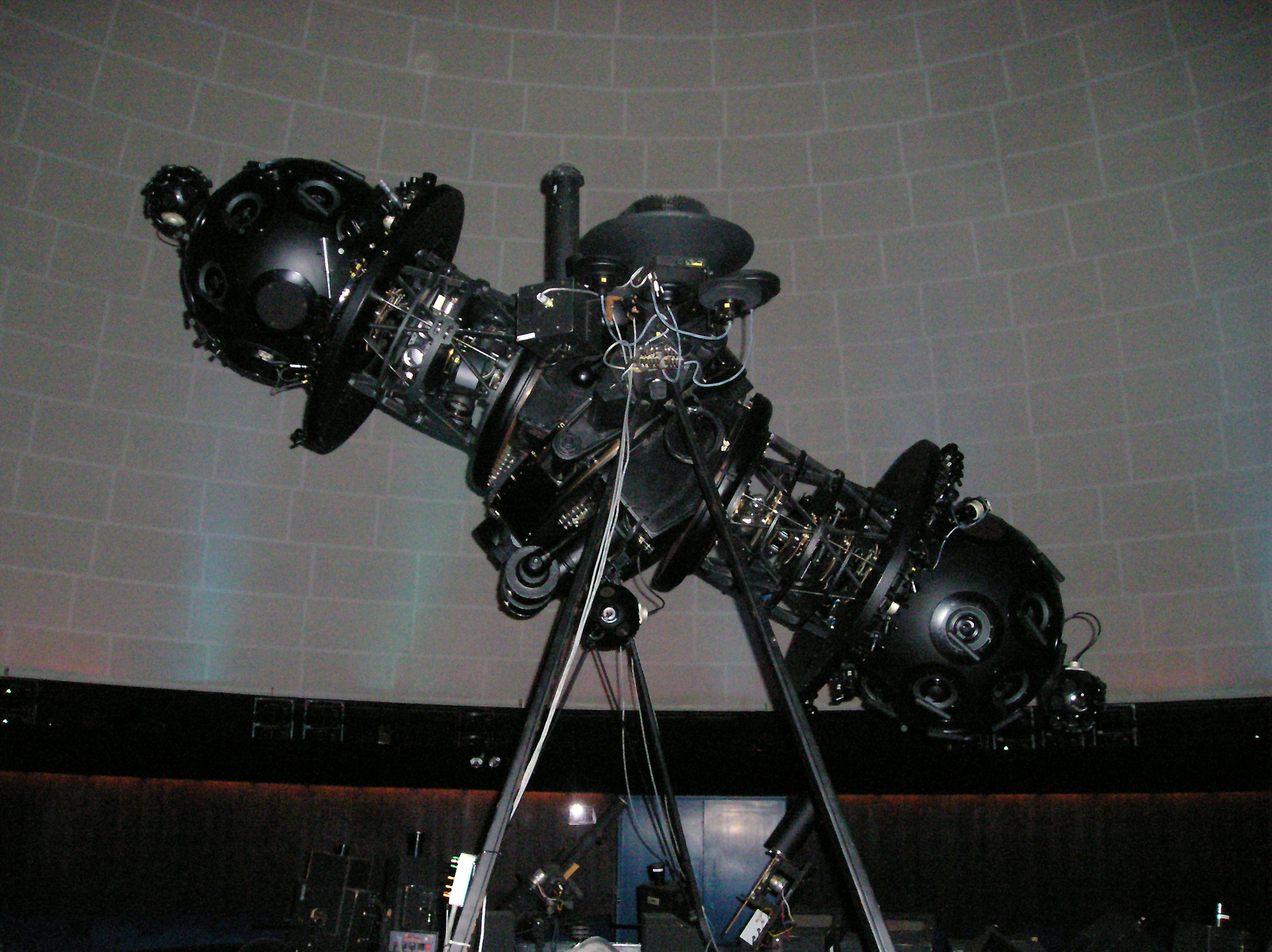
It's actually quite interesting how many design and technical problems we had to solve to make the planetarium a "breathtaking" experience. Some interesting ones.
* Projection optics for a curved surface are a whole other ball game to a flat cinema screen. Pixel sizes change radically across the surface, and you have to use a combination of optics, clever encoding and film making to keep the perceived quality uniform across the entire surface.
* The gold standard for planetariums is that when each person looks at the "center" of the screen, no part of their visual field extends past the edge of the screen. That ensures the complete immersive experience. I ended up diving into biology and medicine literature to understand the size of the human visual field across age. At the same time, spent far too much time playing with the geometry of the planetarium.
* Air change. I found out that commercial spaces (concert halls or airplanes etc) change the entire air several times an hour. I then went about trying to min-max the number of air changes while keeping the exhaust fan noise levels imperceptible in this very small planetarium.
And many more. I also found interesting ideas. One publication claimed that if you played a loud sound, along with some sudden air flow changes just before starting your show, the audience would relax more. I wasn't able to implement or experimentally test this.
Special shoutout to the European Space Agency, who released many high quality full length planetarium shows under open licenses.
With good reason - spaces that don't are terribly uncomfortable within ten minutes.
This is the minimum standard for any new construction commercial/institutional building according to recent building codes in Ontario, and probably many other jurisdictions.
Maybe it's unusual for these building code standards to actually be enforced without special exemptions where the writer lives?
Our company had ethics enough to try and enforce such reasonable standards without any external pressure.
My first visit was a mind-blowing experience that felt akin to an acid trip. It wasn't just the night sky being projected but also a documentary that leveraged the projection medium. If you haven't been to one, I'd certainly recommend it.
It probably was one like this: https://upload.wikimedia.org/wikipedia/commons/b/bb/ZeissPla...
https://www.bhphotovideo.com/explora/photography/features/pl...?
But there's still the problem of finding shows where they are actually used...
0: https://en.wikipedia.org/wiki/Zeiss_projector#List_of_planet...
I heard about it from previous generations, I’m not that old! Says me ;)