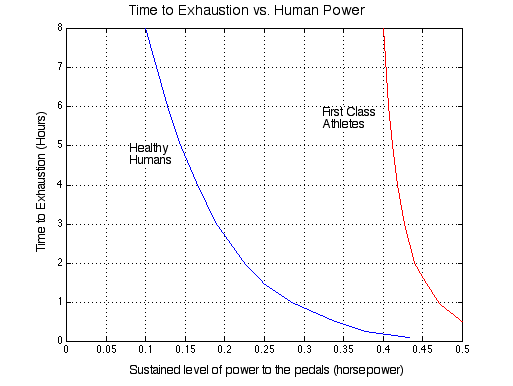
The second thing was this graph by Doug Malewicki:
If I'm on your site's main blog page : https://www.pedalpc.com/blog/ : and I click on an article, it will correctly display with the following URL : https://www.pedalpc.com/blog/how-much-electricity-can-human-...
If I click the same article via the generated RSS I get a 404 because the URL is : https://www.pedalpc.com/PedalPC News/how-much-electricity-can-human-generate-per-day/
Note: /blog/ ..VS.. /PedalPC News/
For me personally I would miss the desk space - I really like to have ample space to put keyboard, paper notes, electronics etc on. How would one use this with a regular desk? Have you tried it?
The PedalPC is a computer desk with a built-in, pedal-powered generator. It helps keep you fit by making useful, moderate physical activity an integral part of your workday. It also provides you with a clean, reliable, and dependable off-grid source of electricity that you can set up anywhere.
I built it because I wanted some way to get exercise while I worked, but didn't want the energy I expended go to waste. I didn't see anything on the market, so I built my own. I've redesigned and rebuilt it several times over the years to arrive at what's shown here.
I've been working on this as a side project since 2010. I'd appreciate some feedback on it before developing it further.
The amount of electricity you can generate depends on your age, physical health, and how much you pedal each day. I'm 58 and produce around 220-240 Whr a day pedaling 3-4 hours per day. The PedalPC's maximum designed power output is 100 W. I typically generate about 60 W.
That may not sound like much, but it's enough to power my computer, monitor, printer, desk lamp, and a cooling fan. It also recharges our phones and battery-powered LED lights we use around our home for nighttime illumination. It also powers our router and fiber network terminator to give us 24/7 broadband internet and wifi.
The desk uses an e-bike direct-drive mini hub motor as the generator. It's driven by a toothed belt to minimize noise. The generator charges a 12 V LiFePO4 battery to smooth out the generator's variable output and store any excess energy generated for use when you're not pedaling.
The desk has four 12 V DC power sockets and four pairs of USB power sockets. You can view the power consumption of each power socket and turn each one on or off from a dashboard in your web browser. Each 12 V socket also has PWM control, for varying things like cooling fan speed or beverage cup heater wattage.
The dashboard is served from a small web server built into the desk. You can use it to host any other content you want, like a blog, wiki, small Fediverse instance, etc. (I use mine to host this project's web site.) You can also use it for a DNS server (e.g. pihole instance), file backup server, etc. Of course, you'll need to pedal enough each day to keep the server running! My dream would be to develop a network of desks like this, with each user hosting and powering their own content.
I have built similar machines for two software developers in our town. One was mostly identical to the one shown here, with a built-in desktop. He uses it with his laptop. The other was built without a desktop, so he could use it with his existing standing desk. He uses his to charge batteries, power banks, and phones while he works. Both seem quite happy with them.
Future plans are for a version made specifically for standing desks, better documentation, and an API to make it easier to integrate with things like Home Assistant, NextCloud, fitness loggers, or your own personal dashboard.
Would you like a desk like this? (If so, please sign up for the newsletter in the footer on my site :) ). If not, what would you like to see instead? Any advice you may have is welcome. Thanks.
I'm curious about the effect this has had on your fitness. 60 W output on a bike is pretty low intensity exercise for most people, but 15-20 hours a week is a lot of volume.
Did you have to work up to that? Where did you start and what did the journey to where you are now look like?
Do you have a sense of how this has affected your capacity for higher intensity exercise? (If it helps to have a more concrete idea of what I mean by this, were I designing an experiment I would probably track max power output and power output at VT1 and VT2. But any kind of fitness metric would be interesting, as would be what you think the effect has been, even if it's not based on hard data.)
Keep in mind 60 W of electrical output is ~100 W of human power output, due to generator and rectifier efficiencies. I would call it a moderate workout. I can engage in a normal conversation or video conference call without a problem, but would find it a bit difficult to sing.
This is a bit of an aside but I'm curious as to why you chose your specific internet traffic routing method for your website vs something like Tailscale, or ngrok, or similar tunnelling solutions.
I think for me it would be especially interesting to have a combination of the generator, battery, control board, power sockets and the single-board computer (everything but the desk frame, essentially) in the form factor of an under-desk bike
I never thought a human could generate useful energy after a science museum exhibit from my childhood made you try to power a 60W filament light bulb with a bike and it was hard to keep it lit.
Or a Youtube video where an olympic bicyclist can barely power a toaster enough to gently singe some toast.
Makes more sense if the human isn’t solely responsible for providing all the energy on demand.
Unless I decide to live truly off grid, I guess I would not use this 8h/day, maybe 2h on average and otherwise continue to use a regular on-grid setup (which itself is already a variation of sitting, standing, and treadmill).
Do you imagine the "switching" between setups to be made simpler?
The simplest solution would be to plug your equipment into USB and AC power strips, then switch the power strip cords whenever you want to change setups.
The problem with doing this is:
1) You lose the ability to individually monitor the power consumption of each device, and
2) You'd have to use an AC inverter to power your non-USB-powered (e.g. your laptop or monitor). Using an inverter wastes a lot of energy, because you're converting from DC to AC back to DC. The more energy you waste, the less you have available to power your equipment.