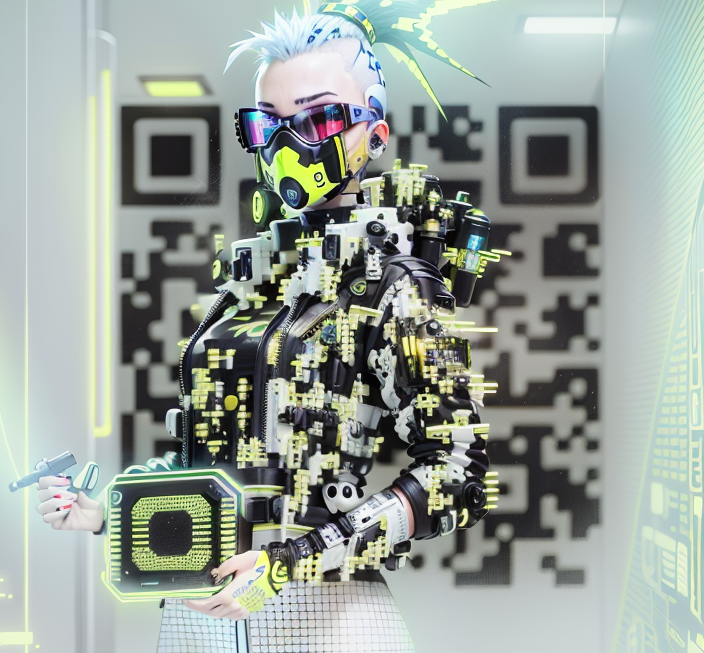
I feel like this is closer to how human artists create, artists have a set of constraints, and a lot of limitations, and forcing NN to output valid QR codes puts the same constraints on the process itself.
Next step, include the QR reader in the training loop, and make it differentiable to increase the valid output from 1/4 to 100%
The cherry-on-top to refine things we cannot do, adding an artificial flare to the organic substance, yada, yada, yada.
I'm sure somebody will get to this soon.
If you scan it, you realize it's putting lots of "junk" at the end of the URL that doesn't change its meaning, but is used to tweak how the QR code looks.
The URL is on the form videolan.org/#234234234523453455...
Or even better just wire up a QR decoder to the loop and automatically reject images that don't decode correctly, and let the model sort out how far it can go.
[A-Z0-9] encodes a lot more efficiently than [a-zA-Z0-9] so there are other considerations when altering a url.
It’s like scratching a design onto the bottom of an audio CD, playing it, and if it works on your CD player, shipping it. “Works for me”
Make the cool QR code first, then get it to work everywhere when you actually made something cool.
I get what you mean, it's a misuse of the underlying technology and a crude hack in some ways, but if it's stupid and it works it's not stupid.
This may be great for steganography — like these US POWs in Vietnam blinking Morse code for "torture" while being filmed, when their captors don't realize that and pass the video, and the morbid message is later extracted.
What is the quality metric?
Does it need to work in an emergency?
Does it need to look cool more than it needs to work instantly? (like an ad)
Also, I imagine most people use like 3 QR code readers, snapchat, the camera app for ios/android. Seems pretty trivial to test for 80% of the population.
This makes me think of your stereotypical pirate map to buried treasure
I'm wondering if I could make one of those, turn it into an interesting piece of art, then frame it and put it up in my living room. When guests ask for WiFi, I would just say "take a photo of that picture".
https://learn.thinkdiffusion.com/creating-qr-codes-with-cont...
I was speaking to him when he created it!
A regular QR code, regardless of the fact they are an eyesore, people know what to do when they see one on a menu.
Artistic ones don’t really look like QR. Def don’t want to have to add an arrow and “scan this!”
I suspect this will come on more handy incorporating QR into larger murals that people might photograph anyway.
iOS camera “sees” QR codes w a url preview. This surprise embedded mega might make for an interesting beat in the march to ubiquitous AR.
I tried with built-in camera app of my Samsung m21.
If anyone wants to use this, they should do a lot of testing first.
Edit: I also noticed that angle matters when scanning from certain monitors, the first qr code didn't work at first, but I noticed the top of the picture was too dark then I tried to hold the phone in the same angle as the screen and it worked.
https://mp.weixin.qq.com/s/i4WR5ULH1ZZYl8Watf3EPw
They talk about a custom QR codes ControlNet.
QR codes with logo's typically contain bit errors and rely on the forward error correction code to correct those errors. The logo comes at the cost of some noise margin.
I'd guess that that the same applies here? All good if decoration is your priority, but if reliability is also a priority you have to be aware of the tradeoff.
i wonder if all qr code scanners follow a standard way to read the code, while accounting for the redundant data and checking for errors.
might explain why my phone struggles to scan some of them.
I wonder if this would work better or worse with different types of 2D barcodes like Aztec, Data Matrix, or PDF-417
It has very bad UX because it muddles the "affordance" of a QR. A QR should explicitly and clearly look like a QR for people to understand they should use it as such.
It isn't effective because it degrades the bandwidth of QR codes. It reduces the amount of information you can place on QR codes.
This is just a gimmick, a funny trick that implements bad functionality.
As in Jurassic Park: just because you can do it doesn't mean you should do it.
And second, if it does become very popular, users will become familiar with it and will likely instinctively grok that some of the ‘art’ they are looking at can be scanned as a QR code. Phase one will be artsy QR codes with a written caption: “Hey, this is actually a QR code! Scan it!” Phase two, is removing the caption because people are so accustomed to them.
currently using a1111 off of https://colab.research.google.com/github/TheLastBen/fast-sta...
and hoping to go from there
And some content in between