Making any type of chemical energy carrier comes with substantial losses, so whenever you can, using electricity directly is better.
If you absolutely need a chemical energy carrier, the first one you will look at is hydrogen, because it's the simplest and you avoid all the direct air capture or other CO2 sourcing issue.
If H2 does not work due to its low volumetric energy density, the next one to consider is ammonia. It has a higher energy density, but it also has some downsides. It's very toxic, it does not burn very well, and burning it causes nasty side products like NOx and N2O.
Then there's methanol. In case you want a hydrocarbon, that's almost always better than methane. It's a liquid, which is a huge advantage in ease of handling. Transporting and storing it is a lot easier compared to any type of gas.
Methane has the big disadvantage that it's itself a potent greenhouse gas. (Btw, hydrogen also is an indirect greenhouse gas, although not as strong as methane.) The only thing methane has in its favor is existing infrastructure, but it's a weak argument compared to the other downsides.
Simplest chemically != simplest to use in practice. There are already millions of miles of natural gas pipelines leading directly to peoples' homes, and those pipelines cannot be used with hydrogen (not to mention all the appliances they feed).
Renewable methane is a dead simple drop-in replacement for natural gas. None of the other alternatives you mentioned share that property, and I think you're seriously under-weighting the importance of it.
Methanol production requires methane as a synthesis gas so it just adds another step. Plant based methanol has all the same problems as ethanol. Until we are running electrified tractors and equipment we will probably be carbon positive when producing methanol. There are a few processes which are using waste from coal and concrete plants, but they are unlikely to scale enough to make Methane unnecessary.
Currently the best way to store surplus electricity are batteries and pumped hydro.
That's not true. Methanol can be made directly from CO2 and H2. This has been tried more than a decade ago: https://www.carbonrecycling.is/ They just opened a much larger plant with this technology in China.
There's currently a huge push in the shipping industry towards renewable methanol, and there are a bunch of companies investing in this space.
[1] Quietly pull the permits, drop the batteries, and connect to the grid without alerting the Sierra Club or the usual obstructionists.
There's got to be tens of trillions of dollars in deployed methane infrastructure. To suggest that's a weak argument is baffling. Economics are real.
Highly doubt it is worth that much presently, so even if the investment was that large (which I doubt) we certainly aren't looking at walking away from that much presently.
The big reason to move away from methane is that gas delivery infrastructure is expensive to maintain, and nearly impossible to keep leak free. Reusing existing infrastructure implies investing in its maintenance, which may be more expensive than building new infrastructure for liquid fuel (which itself already exists).
Unlike methane, coal is mostly just used for power generation, and there's relatively little infrastructure associated with transporting it. Natural gas is used for furnaces, stoves, dryers, hot water heaters, etc. and there are millions of miles of pipes and associated infrastructure used to transport it directly to peoples' homes.
The complexity and cost for retrofitting hundreds of millions of homes and electrifying all the associated appliances is immense, not to mention all the backlash you get from people who love their gas stoves and grills. If we could just switch to generating renewable methane it would be a huge win in terms of logistical simplicity and would minimize disruption to peoples' day to day lives, which would probably make folks a lot more willing to accept it without putting up a huge fight.
These synthetic chemicals will play a role in industry and shipping, probably also in long-duration storage. But they won't be in widespread use like fossil gas today. They're just too inefficient.
Now the author of the article would likely argue that with prices dropping as fast as they do, a 60% efficiency is just a few years delay away from being economically efficient. (A quick search came up with a 68% efficiency for fuel cells and "80% - 95%" for electrolysis, putting the whole thing at 54%-65%)
But I can't help but think we'll come up with something a bit more efficient, because that'll be more viable sooner, and more profitable in the long run.
Depending on the conditions, if you're doing day-night energy storage, then you would like to fill up the H2 tank and then burn it when demand ramps up.
The only role I see for methane is when your H2 tank is already filled up but your solar panels are still producing. This is not just possible, but deterministically required whenever solar gets deployed enough for seasonal storage to be necessary.
Right now California is something like 35% solar + wind energy, and the "duck curve" is nearly maxing out. This was predicted in extreme specificity 20 years ago, as >30% and you get stuff like zeroed-out energy prices during the day. We have not solved the day-night (daily) energy storage problem, which only requires storing energy for a matter of hours.
When you go to something like 60% renewables, then even crazier stuff happens. Overproduction during sunny times goes bananas and (assuming daily storage is solved, which it isn't) seasonal issues start to arise. I don't think H2 will ever work for seasonal storage, although I think it's fine for multi-day storage scenarios. It's not theoretically impossible, I just compare to the equivalent that we have for natural gas and realize you would need MANY TIMES that level of investment to save the same amount of energy in H2. Plus, fossil fuel gas producers are mostly at a constant level, whereas solar production outright needs summer-to-winter storage.
What I don't buy is that these units will be disconnected from the grid and be economical by their gas products. No way, no how. What you want is to run the chemicals plant with low-voltage solar power locally, and trade-off with the grid as is economical.
Legislated. Its easy to predict something if you write it into law resulting in shutdown of Nuclear power station (Diablo Canyon)
>The main driver deterring PG&E from seeking a 20-year operating licence extension is the 2015 renewable portfolio standard (RPS) of producing 50% of its electricity from qualified renewable energy sources by 2030. PG&E’s model for the future cost of operating Diablo Canyon indicated that the cost per kilowatt hour was going to almost double, since the company would be forced to lower the amount of power it could produce from the plant in order to meet the state’s requirement. Dropping the capacity factor from the current 92% to say 50% would virtually double the price per kilowatt hour since costs are largely fixed.
>The state law which effectively dictates that by 2030 Diablo Canyon should operate at lower capacity each year and buy in power from intermittent renewables has apparently sealed the fate of the plant.
The peak demand today at CASIO is around 36 GW (interestingly, ERCOT's peak is much higher. Texas should invest in efficiency.)
The "duck curve" looks like it's already partially ameliorated by batteries, and not that much battery capacity will be needed to smooth it out entirely.
The goal presented in the article seems to be cleaning the atmosphere, not generating chemicals. So H2 and ammonia would be irrelevant. And it's not so much about maximazing efficiency as not losing too much.
The alternative should be other carbon-based chemicals, as useful as methane, needed in huge volumes and with a practical process of extraction using solar panels. Is there something like that?
Also, is there another product with the same characteristics with methane as a starting point?
Is it nonsensical though? IDK, it seems somehow better than extracting the gas from the ground and adding it to the system. Also if there's another more complex chemical not for burning, that you can synthesize from the methane, it would be a net gain.
The article then goes on to explain that solar + co2 capture results in methane. But isn't this at best co2 neutral? Since nearly all use-cases for methane would release the co2 again and would make the credits' comparison pointless?
Besides that, will methane actually be needed in the future? Looking at the common uses [1], it's mostly used for fuel and hydrogen generation. Both things, which solar, can be used for directly without the conversion loses of using methane as an intermediate step.
https://arpa-e.energy.gov/technologies/projects/carbon-fiber...
You can similarly make diamond from atmospheric CO2 (very energy intensive however), which is a pretty stable material.
Hydrogen itself is very difficult to store and transport, but it's critical for things like making steel without fossil fuels and for ammonia fertilizer production. Currently it's all made via steam reforming of natural gas at the industrial point of use, so if you can make methane from air and water, you don't have to rebuild all that infrastructure.
It's implausible to expect much effect on reducing global warming, however, at best we'll be able to stabilize atmospheric CO2 (assuming we don't run into major natural positive feedbacks from permafrost melt and shallow marine sediment outgassing, anyway). Any such speculation is also predicated on elimination of fossil fuels from the energy mix, which doesn't seem to be likely for decades at best.
> And not all of it will be re-released into the atmosphere. As we saw in the Ocean Farming article, some of it will sink in the oceans13 . Even today, 3% of methane is not burned, but used in other ways like plastics production, thus leaving the carbon cycle altogether...
US fracked gas is quite high in ethane.
Some of the natural gas used for plastics is to make heat, for example to drive ethylene crackers (which decompose ethane at high temperature). Methane could be burned for that.
There was a process for oxidative coupling of methane to make ethylene (a Bay Area startup named Siluria created it, using a cool phage-based combinatorial method to find structured catalysts) but I don't think it could compete with all that cheap natural ethane.
A smaller amount of hydrogen is also produced.
The downside is the large land area needed to make the biomass that gets digested. In a fossil fuel free future, carbon-containing waste streams will be valuable as feedstocks (for chemicals, for liquid fuels that cannot be electrified easily), so there will be competition for these streams.
...wat? The proposed process is extremely wasteful and almost any other carbon source is much more available, nevermind other forms of energy storage. This might be reasonable on Mars, but why would we ever want to convert solar power to Methane on a scale that changes the atmosphere? Am I missing something?
Two things: the author addresses this by saying these other sources will become more scarce in the future (undeniably true as they're non-renewable however who knows how the economics of this will actually shape up).
The second thing I'll say is that despite the availability of alternatives there are externalities to burning it (i.e. climate change). Air extraction may be less efficient but that inefficiency may be worth it to A) prevent continued CO2 pollution and B) reverse existing CO2 pollution.
But anyway, a huge part of the Earth's crust is composed of carbon-rich rocks. If we ever take the carbon from the air, it will be to regulate its amount. Taking it from rocks is much easier and requires a comparably tiny amount of infrastructure.
Considering reading your comment gave me whiplash after reading the article, one of us is.
> extremely wasteful
What's the waste?
> almost any other carbon source is much more available
More available than the air?
> on a scale that changes the atmosphere
Because we're filling the air ground and water with carbon and nitrous oxide poisons from burning more and more fossil fuels extracted out of the ground when instead we could use solar to recycle carbon emissions back into fossil fuels without (allegedly) a net increase in atmospheric CO2.
Ignoring the carbon cycle, this still has benefit though, as this solves a HUGE logistical problem with a lot of renewables, and that's storage and transport of energy. Being able to store your electrical potential at standard temperatures and pressures in a fluid form that is cost effective to transport or store is massive in it's own right.
Now, I'm not saying what they claim is as easy, viable, clean, efficient, scalable, and or otherwise possible. It may or may not be, I'm not qualified to make that distinction, it's not my area of expertise. The devil is in the details of course and I've become quite jaded and cynical of such high minded claims by nascent technologoies, but if we assume the process works more or less as they say, the WHY of this seems pretty clear to me.
Any conversion from electrical to chemical energy is inherently lossy, and Methane would need to be burned later to release the energy. In general the less conversions needed, the better.
> More available than the air?
The air is 0.04% CO2, which in turn is mostly oxygen by weight. The biosphere is a much larger source and is self-recycling.
> WHY of this seems pretty clear to me.
I also got quite jaded and often see this at some attempt to save fossil-burning infrastructure, instead of truly adapting out energy use. For example maximizing use during the day and relying on a much smaller store in batteries, hydropower or heated salts at night. The premise of "energy anytime" might hurt us a lot.
Routes to carbon fiber and diamond pass through methane, which is also the input for the vast majority of petrochemical processes (including at-use-point generation of hydrogen via steam reforming), so the main thing to do is set up industrial scale solar-powered methane plants that use water and atmospheric CO2 as their feedstocks, generating natural gas which can then be piped or shipped as LNG to where they're needed as either an energy source for electricity generation (in which case the carbon returns to the atmosphere as CO2) or as a synthetic feedstock for everything from methanol to dyes to plastics and, carbon fiber and diamond as long-term stable storage products (with uses in say construction etc.). Diamond Age, here we come.
As far as the rationale for using solar/wind electricity to do this, that should be obvious, you're converting an intermittent/seasonal power source into stored chemical energy, just as biological photosynthesis does. That stored energy can then be used as needed, during winter months and so on. Of course batteries make more sense for storing solar power for use at night (hourly), but chemical fuels are better for months-long storage or for long-distance transport of energy, e.g. you can make methane in North Africa / Middle East and then ship it to Finland in the winter.
If you really wanted to, you could also run this process with electricity from nuclear power but the way technology is going, using wind/solar is going to be about 10X cheaper at the inputs end. Regardless, this approach would allow for the complete elimination of fossil fuels from the energy mix, which is the only plausible way to stop global warming.
There has been much work on exploiting the more reactive silicates, like olivine, to fix CO2. The volumes of rock involved are large, but there's a lot of silicates out there.
A step before making methane is making hydrogen. If you can get away with just using hydrogen, it will be more efficient than going through the extra steps to make methane.
Hydrogen can be stored underground just like methane can (and is). Also, the problems with hydrogen are overstated. The world economy does use many millions of tonnes of hydrogen each year, so the problems are demonstrably solvable.
In fact any percentage leaking back to atmosphere (and it will) makes the numbers look pretty bad. You need a significant portion going to plastics or some other sequestered use for this to actually be a net benefit.
If the chlorine is released into the troposphere during the day, it is quickly photolysed (in about 10 minutes at noon) into chlorine radicals, which near instantly react with methane, extracting a hydrogen atom. It should be possible for this to more than make up for small leaks of methane (or to counteract other independent sources of methane).
2. Methane lingers for decades. Short in planetary timelines. Long in human timelines.
It'd might be better to turn CO2 + H2O into a longer-chain hydrocarbon suitable for jet or diesel engines.
1. Build solar and wind, anywhere across the globe to 4x overcapacity, and then use power-to-gas technology to store the energy into synthetic hydrocarbons, which can be plugged directly into our current infrastructure.
2. Reinvent the whole of society to run on lithium batteries.
If we were to start over from scratch, the whole notion of covering the landscape with chemical dispensers would be considered absurd: smelly, toxic, and inconvenient. Why wouldn't you just go home and plug your car into your house? Why have a car with thousands of precision moving parts when you can just have a battery on an oversized skateboard?
We already have electric distribution infrastructure. It needs to be upgraded, but not created from scratch. The only thing that needs large lithium batteries is vehicles. You can use different chemistries for stable objects like the grid itself, or your house -- which is a nice bonus, in that you can run your house even when the infrastructure is down.
And then you can let a whole separate parallel energy infrastructure degrade and vanish. No more gas pipelines or gasoline tankers as we gradually get rid of the dependencies on them. It's not "current infrastructure" forever: it has to be maintained. If we're going to do maintenance anyway, why not put it into the existing electric grid rather than both that and the fossil fuel system?
Solar/wind and nuclear do not play well together. The former will push the latter completely out of the market unless nuclear becomes considerably cheaper (and that is a forlorn hope, given the history of the technology.)
We don't need to use solar panels though, we already have exceedingly cheap energy generation in the form of nuclear power. We also have inexpensive ways of transmuting the nuclear waste.
We don't really have a environmental problem, we have a regulatory problem; it is impossible to develop any of this new technology because we have made it infinitely expensive by law. We have also made non-technical environmentalism the height of fashion, and now its used as the spiritual engine for the political-left. For those of you who are concerned that this process is net neutral, there is nothing stopping us from using a similar process to pull the carbon out of the C02 and use it for construction, or to just bury it.
The key to a better future is to reconsider our attitudes toward energy innovation and to remove the activists from our regulatory boards and to re-write our laws to make it possible to innovate and build. We teach our kids that they are doomed, maybe we should encourage them to study nuclear and plasma engineering instead.
The key to a better future is to stop letting the boards of ExxonChevronShell completely own energy policy. Their own research surfaced the problem over half a century ago and their immediate reaction was to bury it and fund studies that downplayed it. In other countries it would be called corruption, but we call it lobbying.
I don't know what this "non-technical" environmentalism means, but have you ever stopped to consider that people are capable of opposing nuclear for reasons that aren't technologic? Almost all currently existing nuclear power generation in the US is privatized. Private companies only have a responsibility to the shareholders. Maybe such short-term optimization with something capable of long-term consequences doesn't sit right with people?
Sure enough we have spent 40 years following the Nuclear Waste Policy Act and have yet to build a proper, isolated location in which to store spent nuclear fuel. We store 88,000 metric tons of the stuff on-site at various reactors and the amount is increasing. France, Canada, and the Nordic countries are all further along that process than us despite our head-start. Two US generations have already kicked the can down the road for nuclear waste management, so I'm not sure "removing activists" will let "boards innovate and build".
Locally you can have a lot of nuclear like France, but only when you can import and export power to low nuclear countries/regions. Batteries can also smooth demand, but if you’re just filling batteries then solar is a lot cheaper. People talk about unreliable Solar, but you can build 4x as generation per year solar power for less than building nuclear. At 4x overcapacity or even 1.5x solar is suddenly vastly more reliable.
And just slashing regulatory requirements to make it cheaper strikes me as unwise.
Methane synthesis is the first step in a whole chain of high energy synthesis. The two most important economically are longer hydrocarbons (ethane, propane) and ethylene which is the base for poly-ethylene plastics.
But, for synthesis the electricity has to be essentially free to be economical. These chemical pathways require a lot of energy. I would probably use methanogens to create methane from organic waste then use excess electricity for higher order synthesis.
https://substackcdn.com/image/fetch/f_auto,q_auto:good,fl_pr...
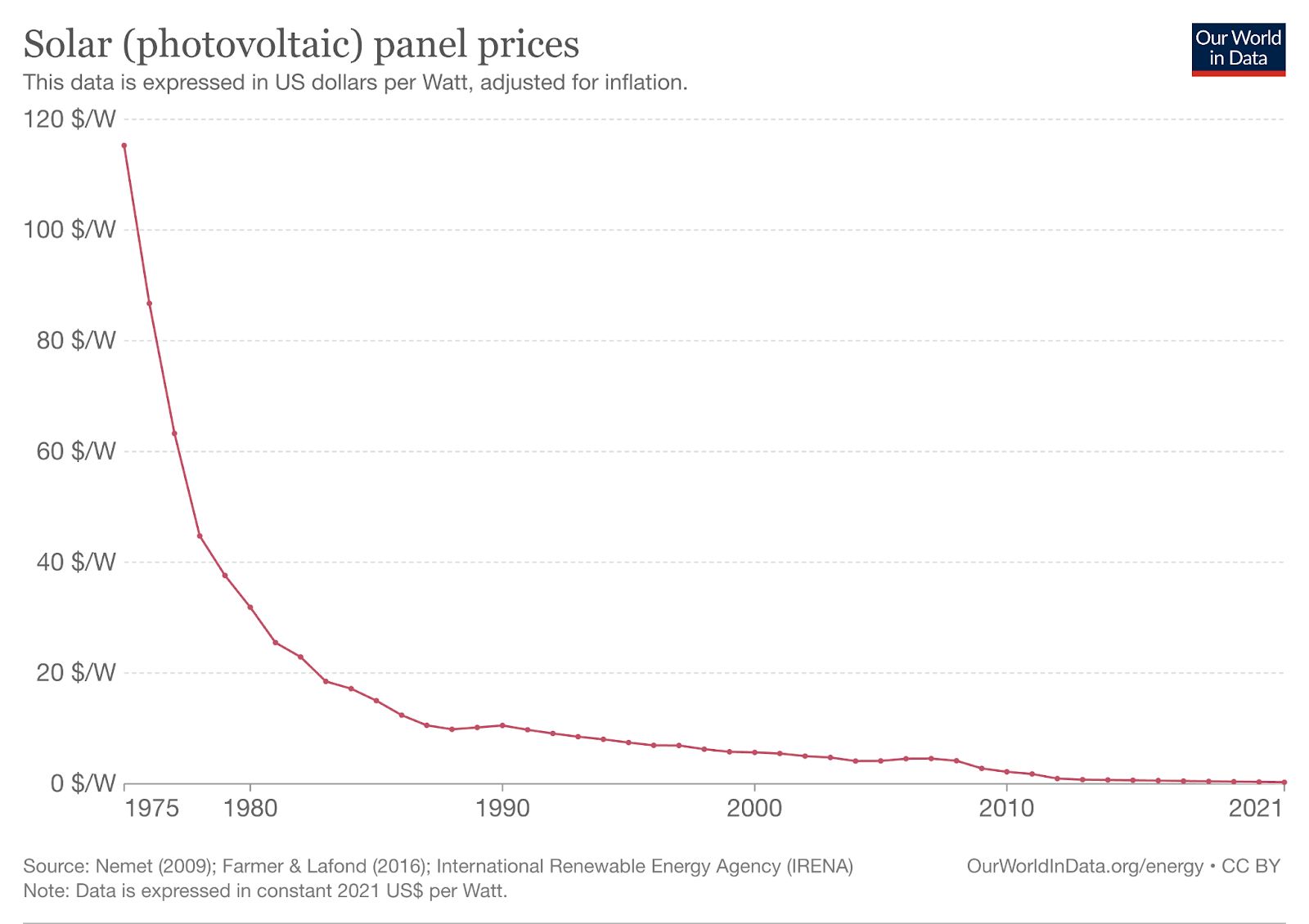
Note the trend line intersecting with the x axis in 1980. Now this:
https://yaleclimateconnections.org/2023/02/the-forgotten-sto...
The world was set to do everything we're doing today in the 80s. Except that the powers that be decided to extract every last dollar from fossil fuels, regardless of consequences like global warming. Decades of government subsidies for everything except solar and wind followed, creating a long tail of glacially slow price reductions for renewables. So we accept evolution and reject revolution because we can't see the strings controlling the marionette. <- writing this on a site dedicated to hacking around barriers is especially painful
I wrote about stuff like heat pumps and carbon capture in long emails to my friends in the 2000s, complete with prices and sources. Then had to wait 20 long years for the world to manifest those ideas in its own time. Which hinged on political close calls like Obama's reelection, which provided a brief safety net for electric car manufacturers among other things, and almost didn't happen. It took almost no time for his successor the former president to impose a 30% tariff on solar panels in 2018 in a last-ditch attempt to block us from cancelling our power bills.
The real challenge we're facing is that the wealthy of the world could have solved this yesterday for a relatively paltry investment but chose not to. The proof of that is in their continued downplaying of such causes as they play hard with rockets, Twitter, etc. This is the tragedy of the commons at scale. Similar to the problem of parents choosing for the good of their children individually but not collectively. In other words, unstoppable without a cultural awakening.
But I applaud the author's efforts.
Edit: just a little "proof" from Naked Gun 2 1/2, released in 1991 when this was already common knowledge: https://www.youtube.com/watch?v=M8Wk79i1gcg
Capitalism has had 40 years to do something climate disruption, and instead, the hottest average days ever recorded all occurred in the last week.
Why is it not regarded as a solution
Even if public perception weren't an obstacle, and even if you didn't have to deal with waste storage, and even if building nuclear plants wasn't a glacially slow process, it just doesn't make economic sense to focus on nuclear anymore.
As an example, consider the new Olkiluoto-3 nuclear plant built in Finland. That reactor was commission just a few months ago, but its build was 12 years behind schedule. The delay to that project saw the original 3 billion Euro price tag more than triple with a final cost closer to 11 billion.
https://www.abc.net.au/news/2023-07-05/zaporizhzhia-nuclear-...
https://www.washingtonpost.com/world/2023/07/08/japan-fukush...
Take example of Germany where they shut down the nuclear power plants just cos of popular pressure…
Nuclear weapons exist after all…