Use the heat to boil water to create steam, run the stream through a steam turbine, and condense the steam back to water. This water is continually recycled throughout the system.
The river water is used to condense the steam back to water and then the water is discharged back to the river - warmer than it came in. If the water coming in from the river is too warm then the condensation rate increases until you get to the point it's out of spec. You can't condense the water fast enough. You need to reduce the plant's output, i.e. reduce the heat.
On the other end the discharge water is always warmer than the intake water. As the intake water warms then the discharge water will also warm - all other things being equal. You'll get to the point the discharge water will raise the water temperature to the point where aquatic life is negatively impacted. There are also laws mandating the maximum temperature for the discharge water.
So, you have to reduce output. That's just how these plants work.
That's the nice thing about natural gas plants - the gas turbines are essentially jet engines - they're fueled directly, no steam or cooling required.
This is something rarely talked about in the solar and wind discussion. People love to point out that the wind and the sun provide intermittent power, while ignoring more and more traditional power plants are curtailing output as water temperatures rise or water levels lower (water intake pipes would be exposed).
Continuing adding more carbon to the atmosphere is only worsening the situation.
And of course the rightwing media starts the chorus of ‘those bloody renewables’ causing problems, even when solar especially is actually helping us ride through some of the coal unreliability!
It's not that there's any technical issues; it's that there's ecological issues. Though there's going to be much larger ecological issues if we have to replace it with coal.
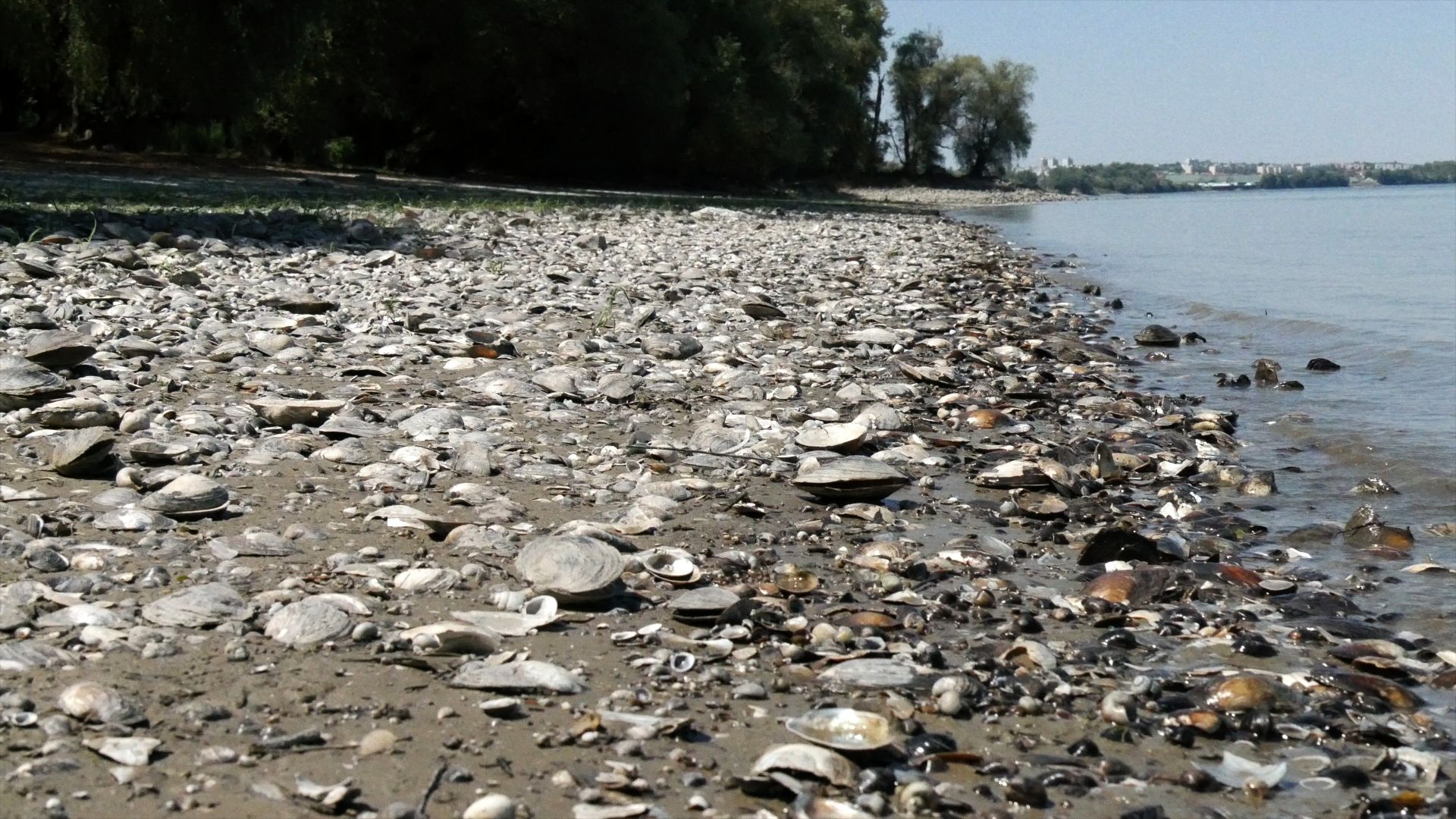
https://atlatszo.hu/wp-content/uploads/2022/08/kagylokpaks.j...
Even then, it _could_ have been designed to do so - through more flow - but it's just a design parameter that was optimized in a cost/performance trade-off.
These are rare anomalies and there's dry-cooling of nuclear power plants (although it's less efficient and costs more).
Trying to brush aside legitimate engineering challenges as "not real" seems far too common among nuclear advocates. Which is my guess that their construction projects fail so often; the engineering and logistics and construction are significant challenges that are not taken seriously enough.
If the nuclear industry took engineering and problem solving as seriously as those in solar and wind, we would probably have a lot more nuclear around, a lot more successful construction projects, and nuclear that was cheap enough to build.
A strawman is a false opposition argument set up to argue against, so, no, its not. I am not even sure what you are trying to say, but “strawman” isn’t it.
Also, most proposed new reactors a aren’t dry-cooled and the arguments, which include cost, for nuclear don’t assume that higher cost option.
It's _designed_ to not work at full power at this heat, because that was thought to be the ideal trade-off.
Maybe it still is, maybe they underestimated the occurrence of high water temperature incidents, but in any case it's a consciously designed safe state.
It’s clearly possible to make a great deal of nuclear power safely, just not as cheaply as similarly environmentally friendly alternatives. Electric utilities prefer to spend less on battery backed Solar etc because of all the little details that aren’t obvious until you really study what’s involved.
Only when you think building them, maintaining them, mining Uran, shipping Uran and shipping and storing the radioactive waste has no CO2 footprint.
Now sure, we still might have been better off, if we would have replaced all the coal plants with nuclear by now. But we did not and now we have to work with what we have.
Now that we’ve mastered the technology to turn ambient energy directly into electricity, traditional nuclear reactors are an overly complex technological dead end.
Check out the interconnection queue for new generation where there's price competition, and you will see it completely dominated by non-thermal tech.
And the thermal tech that is there, natural gas, is partially combustion turbine driven, and without that combustion turbine component it would likely not be competitive at all. It's likely that within a decade a lot of those new natural gas CCGT assets will be completely stranded and uneconomical.
And as with any high-capital established industry, there are a lot of dinosaurs that will not move until they die off. They will be victims of creative destruction, rather than survive and pivot sooner.
Note that partial shutdowns due to excessive heat happen regularly in France, e.g. in 2018, 2019 and 2022. The problem's been around for a while, see e.g. this article [1] from 2009 that also mentions the heatwave of 2003, where regulators had to grant special exemptions to allow discharging 30°C water into waterways, well past the 24°C limit.
[1] https://web.archive.org/web/20110612153407/http://business.t...
And they affect a very small number of plants and energy output. The largest disruption so far has been when French government finally got its head out of its butt and stopped a few plants for long overdue maintenance
[1] https://www.cre.fr/actualites/RTE-fait-appel-aux-industriels...
These rare anomalies could happen more often because of climate change and the existence of dry-cooling power plants doesn't help if yout already existing isn't
Will we call the rare anomalies rare until it they are the norm? And then?
green renewable should be our goals, we're bathed in power every day it just needs to be bottled. nuclear plants have their place, but its few and far between and i would argue less than desirable in general.
> green renewable should be our goals, we're bathed in power every day it just needs to be bottled.
There is a lot to unpack in this vague statement, but generally speaking, utility-scale power generation from nuclear has the lowest ecological footprint, not just in land area, but all-told. A solar farm is a big, complex, thing with a huge footprint.
Comfortable life for everyone is my goal.
> we're bathed in power every day it just needs to be bottled
That word "just" proves that you don't know what you are talking about.
But he is right about the botteling. Storing energy is the most important issue, because we have plenty of energy sources but still depend on production on demand.
The problem with storage is that we don't have it. Not now, not for forseeable future. Australia has had some headways into the problems though, and has been midly successful with storage at scale.
[1] And unbearably slow. There are examples of both.
if you go down enough the chain of anything you find something that is not so friendly. And anyway that is a call to review Uranium mining practices not a condamnation of nuclear tech. In sum nuclear power plants are friendlier that everything we have right now.
The production of renewable infrastructure, and mining for the materials required to produce them is also horrendously dirty.
90% of waste can be safely stored on-site, and is short-lived.
The remaining waste is ridiculously minuscule, and can probably fit in a few shipping containers. The main reason it's expensive to store is politics.
> it just needs to be bottled
"just".
some Seebeck thing?