I made this point several times on social media during the Titan incident but it fell on deaf ears; it seemed crazy to me that people were accusing the US Navy of some nefarious cover-up regarding possible acoustic detection of implosion.
Anyone who’s ever worked with any type of signal analysis would be aware of the huge uncertainty involved; the idea that we could positively identify the specific destruction of the Titan remotely was ludicrous on its face.
That aside, even if the Navy was 100% certain, would you want the search for your loved ones called off because someone heard a noise? Of course not. You search for people missing at sea until you find them or until the point where any reasonable hope of finding them is gone. That applies to billionaires as well as anyone else.
The timing of the announcement was based on a recovery vessel arriving at the site and very quickly finding the wreckage.
The fact that they happened to be close together is coincidence unless you can provide strong evidence otherwise.
Yes, because obviously you and us other media gawkers were the most important consideration here. Not you know, the families stuck essentially knowing their loved ones were dead, but still not having heard those words that finalize it. Also I don't know why they have to delay publicizing it to tell the families directly, when they could just hear it from the same news broadcast as everyone else </s>.
Toshiba wasn't allowed to export a 9-axis (C)NC-machine to the Soviet union, because it could (and would) be used to create ultra-silent submarine props, in the 80s.
Asianometry video about it: https://www.youtube.com/watch?v=uaRyqAVIkwI
Also, the punishment would be not to the executives, but to the company involved (Toshiba) and imposed externally. However:
>In response to the affair, Toshiba carried out lobbying activities in Congress between 1987 and 1989 to ease the sanctions. The amount of money invested by Toshiba, the number of lobbyists, and the scale of its activities were said to be the largest ever.
So, business as usual.
[1] https://en.wikipedia.org/wiki/Government-business_relations_...
- the exact kind of goods that we will use the machine for
- certify that we will not use it in any nuclear explosive activity, or unsafeguarded nuclear fuel-cycle activity, or the use of nuclear, chemical or biological weapons
- that we won't transfer the manufactured goods or the machine outside of specific countries without the consent of some kind of swiss economic affairs office.
I got the same kind of vibes.
The issue with nuclear weapons isn’t the weapon it’s the enrichment. The isotopic separation via centrifugal forces is the most efficient and technically challenging method of enrichment, and the hardware required involves extremely high RPMs and requires running them non stop round the clock in banks of hundreds of connected together so that the tiny fraction of a percentage each individual centrifuge can enrich the isotopes eventually ends up adding up to a significant enough to be useful for nuclear stuff.
As you can imagine building a 50 thousand RPM centrifuge to run 24/7 is quite challenging and involves a lot of high precision parts.
No idea if that's even possible.
https://www.wired.com/1996/12/ffglass/
"Mother Earth, Mother Board" (stories about laying undersea cable and the history of wiring the Earth up"
(or unpaywalled: https://archive.is/ICkHe)
Reminds me of the intro to The Expanse, where they wire up some celestial bodies as well:
https://www.youtube.com/watch?v=5Y4wuVfV5G4
The song also gives me the chills.
I still maintain it could have been anyone with about $300k. Work class ROVs capable of planting the explosives at that depth are commonplace in underwater construction and maintenance.
https://www.reuters.com/world/europe/germany-tells-un-nord-s...
Edit: I didn't read the link posted above but I see it states the same as me. Nothing to see here.
Of course unless you are tracking a submarine back to a submarine base all of this won't tell you exactly who it was. Any state actor can just rent a fishing ship and deploy a remote controlled submarine from it. That's where more traditional information gathering comes in.
Doesn’t identify the occupants but could perhaps identify the vessel, depending on how extensive these databases are. Of course that’s a massive open question and I don’t want to claim it extends to small rental vessels, but I also don’t want to claim it doesn’t!
The main thing to note is that OSINT types are working with poor quality manipulable data compared to what’s available to US/NATO, even if we focus only on larger vessels with AIS. Which is not to say US/NATO should be trusted in their public statements.
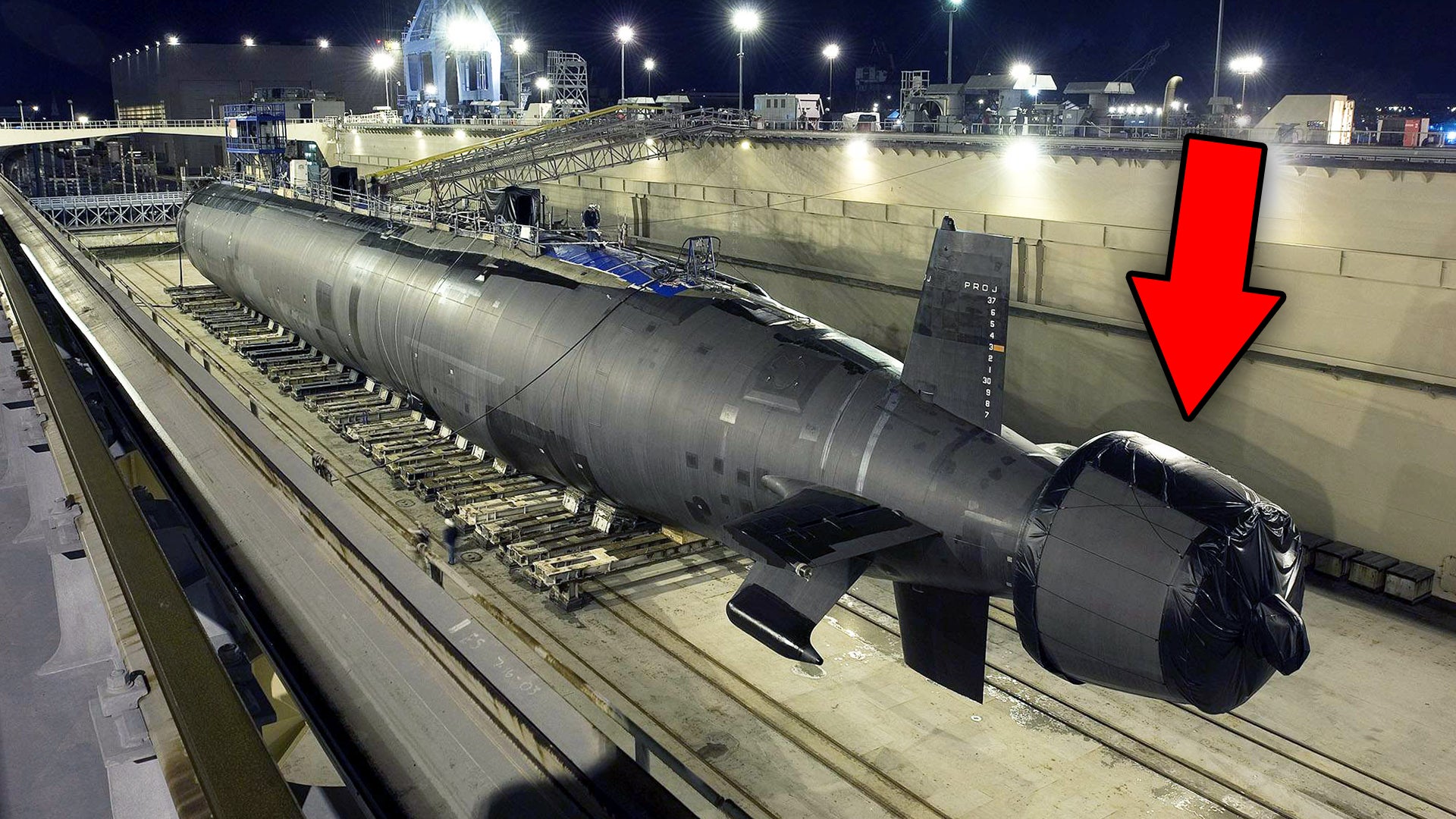
> Instead, the battle of submarine silence has mostly revolved around obscure technical problems of fluid dynamics, since one of the loudest noises made by submarines is the cavitation around the screw. I don't know if this is true today, but at least years ago the low-noise design of the screw on modern US submarines was classified, and so the screw was covered by a sheath whenever a submarine was out of the water.
I wander if they are Toroidal or "tipless" propellers? They create less turbulence and cavitation.
https://en.m.wikipedia.org/wiki/Toroidal_propeller
Previous posts on HN:
> Toroidal propellers turn your drones and boats into noiseless machines
https://news.ycombinator.com/item?id=34571282
> Sharrow MX-1: Tipless propeller
https://twitter.com/toughsf/status/1024083748407713792?lang=...
https://www.researchgate.net/publication/302920496_Numerical...
https://www.thedrive.com/the-war-zone/31708/veteran-sonarman...
https://www.globecomposite.com/blog/x-factor-columbia-class-...
https://www.sciencedirect.com/science/article/pii/S209267821...
Do the British know ?
Cavitation is loud, but usually only happens if they're running full out. What they're really listening for now are reactor plant noises.
> I don't know if this is true today, but at least years ago the low-noise design of the screw on modern US submarines was classified, and so the screw was covered by a sheath whenever a submarine was out of the water.
Many US fast attack (Virginia, Seawolf) and the upcoming Columbia SSBN use some sort of external pump jet. I'm not sure if they cover those up out of water like they did with more 'traditional' screws.
They're ducted propulsors, a direct evolution of the classic submarine prop that integrates a pressure-increasing shroud and stator vane assembly. A "pump jet" classically involves some sort of centrifugal pump element or at least a vectoring mechanism.
You typically wouldn't call a ducted fan (ex, on the X-22 [1]) a jet, but I guess in the water we do.
Which is why old timey diesel electric submarines still sometimes have the edge over modern subs. No plant noises at all if they are running silent.
This leads to some hilarity in joint naval exercises every now and then. e.g. when HNLMS Walrus managed to "sink" among others the USS Theodore Roosevelt before getting away, to great consternation of the Americans.
Not to mention the actual real sinkings that are a standard feature of pretty much every RIMPAC nav-mil-cosplay LARP event:
* https://gcaptain.com/australian-sub-sinks-us-navy-ship-pract...
* https://www.businessinsider.com/us-australia-japan-practice-...
* https://news.usni.org/2020/08/31/video-rimpac-2020-exercise-...
The thing about ships from the Netherlands though, they pretty much sink themselves locally:
https://en.wikipedia.org/wiki/Shipwrecks_of_Western_Australi...
Yep; a fanatical obsession with reducing plant noise is why US subs were so quiet compared to everyone else. The author knows fuck-all about what he's talking about going on about cavitation.
It's also why diesel hybrid subs from Sweden are nearly undetectable. There's virtually no plant noise - probably just a coolant pump or two - while running on battery. They are sometimes 'hired' by other navies for exercises because they're so incredibly quiet.
He's spouting pure bullshit about the Navy retroactively going back over their 'tapes'. He first explains that for decades the Navy has run computerized classification systems, but then we're supposed to believe that a highly sensitive listening array did not detect the extremely energetic implosion that would sound like nothing else?
Cameron said that buddies in the navy told him very quickly that they'd heard the implosion, but they were confirming what he already knew when he heard that telemetry was lost at the same time as comms; telemetry came from a completely separate external pressure vessel. It going silent means it was destroyed, and the only way that could have happened was the sub imploding.
The bit about it being unrecognizable as an implosion because of its unique construction is complete supposition.
This is what happens when you have an article about submarines written by a guy who checks is a github engineer who likes 80's and 90's phone technology.
the theory that it would have been correctly classified by the trained system seems an even less likely complete supposition - the only arguments I've seen in favor of it are argument ad incredulity fallacies
Would like to hear more about this! Assuming the reaction itself is silent (?) what kinds of sounds is the reactor making and what are the challenges in quieting them?
MH370 could be in a significantly wider area of the ocean so it's going to be much harder to find it. Although prices of it have already been found [1] and used to determine a crash location (35.6°S 92.8°E).
[1]: https://en.wikipedia.org/wiki/Malaysia_Airlines_Flight_370#M...
They seem to have gone right to it just about immediately.
How much credit do you want to give the USN? As far as I'm concerned, the Titan was found at a expectable rate with a blind search given its proximity to the Titanic. The Titan was found 1600ft from the Titanic so a 1600^2 area (at 100 sq/ft s; The Odysseus has a 4k camera after all) would take 7 hours so finding it within 4 hours seems entirely plausible even if you just did a blind search starting from the Titanic. But also if you knew the exact location it wouldn't take you 4 hours to find it.
But my original point is really we already have estimates of MH370's location even without using secretive methods. It's just going to be a lot harder because knowing where on the surface it crashed doesn't tell you where it'll be below the surface.
Now the first paragraph must contain an emotional human-interest style “hook” to rope in the reader, then bury the lede in some random spot in the remainder of the text, in an attempt to keep the reader searching for it, like a slot machine.
As soon as I realize that’s how something is written, I take that as signal it lacks the quality to stand alone and I discard it and move on.
So news sites have become a recipe site? Except, you’ve limited to a single paragraph vs 7/8 of the page
https://www.nirandfar.com/want-to-hook-your-users-drive-them...
> The Navy did not withhold information on the detection for four days out of some concern for secrecy.
I think it's more likely than not that the statement is correct, but what gives the author the authority to make the claim so definitively? The author's bio indicates he's a consultant and there is no indication of direct involvement in this or any other SAR effort.
While the workings of the SOSUS and IUSS systems may be declassified, the deployments and capabilities (mostly range and computation related) of such systems most likely are not. And there is always the possibility that there is yet another system the author simply isn't aware of.
IMO, it isn't negligence to value the secrecy of systems used for defense above some number of lives, in some situations.
Many aspects of IUSS are still classified, and for example we can assume that the actual data will never be released because of sensitivity of the collection system. But the news that the Navy detected the implosion is nothing new, it would probably be more surprising if the Navy didn't (I don't know that the sound levels associated with a vessel of this type imploding are well known, maybe it could be explained away as the implosion having somehow produced almost no acoustic signature). We know that in the '60s the Navy detected submarine implosions (admittedly of larger submarines) further afield, and we also know that IUSS has seen major upgrades including new sensor arrays since then.
I don't use Twitter so can't confirm, but what I've heard in the news is that the OceanGate lawyer tweeted some vague, borderline conspiratorial stuff about not getting proper cooperation from the Coast Guard. I think the commentary people you refer to then boosted and expounded upon that idea.
ETA: Partial confirmation here https://nypost.com/2023/06/20/oceangate-adviser-rips-us-gove...
The statements quoted here don't match the description "vague and borderline conspiratorial," but they could be misinterpreted that way, and maybe there were others.
But they confirmed it 4 days later - which would be admitting to its capabilities. The entire talk track of: "they kept it secret because of conspiracy theory X" makes no sense when they didn't actually keep it secret, they simply didn't make it public until AFTER the team was there to search - for the fairly obvious reasons the author stated. Mainly it creates unnecessary publicity that is hurtful to the relatives of the folks that are at the bottom of the ocean, and political pressure to "not spend money on the search" which was already coming from some circles even without the Navy's information.
It doesn't automatically, but literally everyone claiming the Navy was "hiding something" was going down the conspiracy theory route. I'm not talking about generalities, I'm talking about the specific situation in question which is the Titan sub.
>the information is OK to release publicly from a security standpoint.
What information are you referring to? It's already public that the navy has the system in question. It's already public that it is analyzing data realtime. Nothing about the system would have been compromised by publicly announcing they had detected an anomaly the day of the event vs 4 days later. The logical conclusion is that all of the aforementioned reasons are why they waited 4 days. You don't need clearance to get to the conclusion.
What could also be possible is that US has improved its sensory technology, and while its known that the US is capable of listening to the sea, they may have some new edge they want to keep obscured from the likes of russia.
I’m just some guy, but it struck me as a possible way for the US to flex on the russians, especially right now when Putin is threatening to use nukes, and the US, by the book wouldnt want to because the US may not know where all of russias nuclear subs are supposed to be. It was a great opportunity for the US military apparatus to turn on a sort of fog of war machine… for all we know intelligence may have told the likes of James Cameron and Rob Ballard to say they got early news from their navy friends.
There's a more interesting answer if you want one, although this is decidedly a conspiracy theory with, I would say, "medium" credibility within the realm of conspiracy theories. Some believe that both K-129 and Scorpion were sunk by enemy action, K-129 having been sunk by an accidental collision with the Swordfish and Scorpion having then been torpedoed in retaliation. The story goes that the admiralty of both countries, agreeing this situation could rapidly escalate into an undesirable war, agreed to suppress information on the cause of both incidents. The Soviet search for K-129 and American search for Scorpion could both have been cover operations.
Yeah, it doesn't make total sense, and the evidence supporting this theory is a combination of circumstantial and recollections of people in their 80s. Besides, in the later sinking of the Kursk, Russian leadership immediately blamed a collision with a US submarine. But obviously the Russian political climate of 2000 was very different from 1968. It's a fun conspiracy theory.
A more interesting conspiracy theory is that K-129 was on a rogue mission to launch nuclear weapons on the US and was torpedoed by the US (once again perhaps by Swordfish, it was in the right place at the time) to prevent this after being tipped off by by the USSR. If that sounds a bit like the plot of The Hunt for Red October, well, it does. The evidence for this story is not nonexistent but it's pretty limited, and no one takes it very seriously.
Still, it gets at one of the oddities of K-129: the Soviet Union searched for it in its assigned patrol area, but the wreck was ultimately found far away from its assigned patrol area. I don't think anyone has a really good explanation for this. It was not at all typical for Soviet submarines to go off on their own, Moscow kept very tight control of them. So it seems that either Moscow didn't know where K-129 was (perhaps suggesting some kind of plot, whether of defection or rogue attack who knows), or they knew where it was and searched elsewhere to avoid showing their hand (suggesting K-129 was on some sort of very secret mission). I tend to suspect the latter is more likely, K-129 may have been ordered to leave its patrol area and approach the US as a show of force (this happened at other points in the Cold War) and when it was lost the search was conducted in the normal patrol area to avoid revealing that had happened. All indications are that SOSUS was successfully kept secret from the USSR for quite some time, although certainly not all the way until 1991.
Tom Clancy seems to have based The Hunt for Red October at least in part on rumors about K-129. Yeah, I watched too many submarine movies and read too many submarine books as a kid. What can I say, I had a middle-aged father.
I think maybe I'm underestimating the complexity of the technology. It seems like it shouldn't be that hard, I'm kinda imagining something like a weather station or a seismometer. But one thing you've helped me realize is that, at minimum, that comparison fails to account for the complexities of operating in a marine environment.
And the undersea cables operative to passive sonar? Or are they more to prevent the stations from being identified and their signals intercepted, as would be the case of if it were over radio?
> The wreck was ultimately found far away from its assigned patrol area
Maybe I'm just naive to submarine stuff, I know very little, but this doesn't seem that weird to me. If everyone died onboard from, say, a fire, the vessel might keep steaming for a long time. Presumably, the CIA has a good idea if that's the case, for all the good that does us.
Between Bell Labs and Western Electric, AT&T had a lot of practical expertise in designing and manufacturing some really complex cable bundles with high voltage and sensitive communications pairs nearby. This pretty much all became obsolete as soon as fiber started taking over in the '80s, but it was pretty incredible how many coaxial pairs AT&T was cramming into a buried cable (along with power for all the en route equipment!) in the '70s. Hell, AT&T famously held off on fiber for years because they had a plan to bury long microwave waveguides like cables!
The cover-story to build the Glomar Explorer to recover K-129 was that Howard Hughes thought that it was economically feasible to mine manganese nodules from the deep sea. A lot of engineering research started that year (1974) that now, 2023, bears fruit in several large companies trying to mine the ocean floor with approvals to start probably happening this year: https://www.nature.com/articles/d41586-023-02290-5
Without the cover-story and Howard Hughes I wonder how many researchers would have ever looked at deep sea mining.
My experience is only in wildfire and structure fire, but everything I've heard is that the situation is much the same in SAR and I can only imagine the issues with needing to having resources prepared in advanced are only more significant at sea where integration is very complex.
I know distress calls aren't at all the same as search and rescue, but in some incidents both phases must occur.
I recall some comments saying that operators of a submersible that could hypothetically rescue a sub stranded on the bottom being discouraged from deploying for the Titan by the coast guard, which perhaps means they already knew the fate of the vessel. Although it could be that they already had a suitable submersible arranged already and didn’t want more in the area causing complications with coordination etc.
Experts in marine biology. Reminds me of the night vision camera the british military were showing off on BBC Countryfile program. Who would have thought the military are experts in biology, but probably explains why the brits took off sunglasses in Iraq when talking to people, but the US didnt. You should see the british scarecrows as well!
> Instead, the battle of submarine silence has mostly revolved around obscure technical problems of fluid dynamics, since one of the loudest noises made by submarines is the cavitation around the screw.
https://en.wikipedia.org/wiki/Toroidal_propeller Difference in cavitation. https://youtu.be/k0yzBTTqfzs?t=436
Dont know if these toroidal propellers scale up to submarine sizes, they keep them hidden under an large oily rag along with the front of the subs.
> did the Navy withhold information on the detection from searchers out of concern for secrecy
Location of sensors maybe, after all something like the titanic will attract treasure hunters, why wouldnt interested govt's deploy remote sensors to detect who is in the area? Submarines make it easy for crew to be kept in the dark on missions as not many can use the periscope or other sensors.
I read somewhere once that a sensor, sonar or hydrophone, in UK waters could detect the sounds come from a New York harbour, which gives an insight into the distance sounds can travel underwater, but considering all the noises that can be detected, having sound processing abilities, a little bit better than something like Dolby Noise Reduction, is the key part of the underwater arms race.
https://www.theguardian.com/environment/2023/may/15/listen-t...
https://news.sky.com/story/titanic-sub-search-what-are-the-s...
I didn't really get into this in the article but there's a phenomenon called SOFAR (I think this does stand for something but the acronym is sort of a joke). It's basically a specific static water pressure (and thus depth) in which sound "ducts" sort of like how HF radio can duct in the ionosphere. As I understand it, it's not at all unreasonable for a sound in the SOFAR channel to go clear around the world. I know there are cases where hydrophones have recorded a particularly loud sound multiple times because of it coming "the long way around" as well as echo effects. Some of these sounds have been things like "perhaps the loudest sound ever produced" and are attributed to seismic phenomenon, but there are a lot of strange things going on in the ocean and hydrophones continue to provide plenty of questions for marine researchers to answer. And, of course, at least some of the IUSS sensors are very intentionally placed within the SOFAR channel to capitalize on this effect.
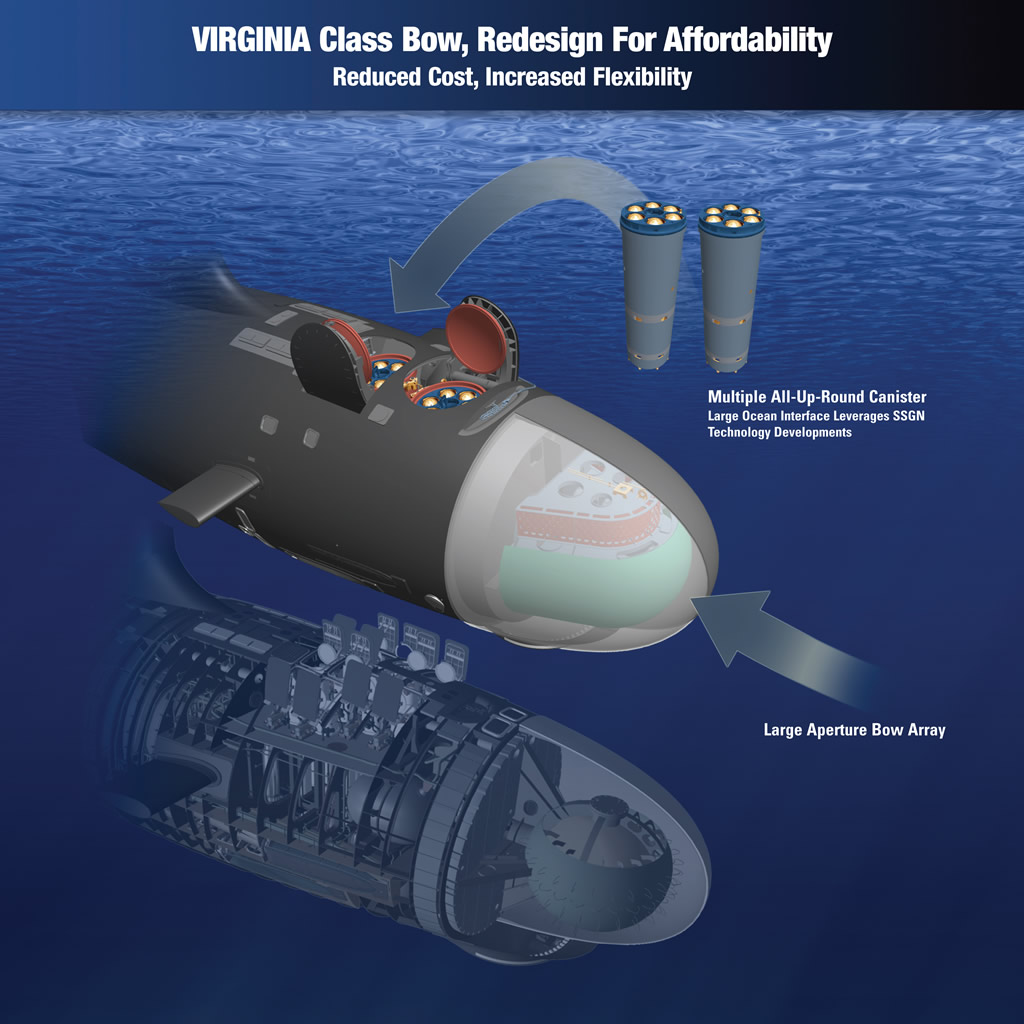
In a typical attack sumbarine, a substantial amount of the ship's volume is dedicated to acoustic sensors: https://media.defenceindustrydaily.com/images/SHIP_SSN_Virgi...
This arms race is very old, and the state of the art even 20 years ago is pretty impressive.
https://web.archive.org/web/20230123071023/https://media.def...
Detecting (background) radiation is the new state of the art and improvements in tech seen in peoples mobile phones.
https://icecube.wisc.edu/news/press-releases/2017/11/first-l...
https://www.youtube.com/watch?v=XwKKOPd-5cU
https://www.royalnavy.mod.uk/news-and-latest-activity/news/2...
I would love to learn more about the technology — are these wireless transmitters? Undersea cables all around the oceans of the world?
As I understand it most of the original SOSUS arrays are still in operation, but I think they're more useful for scientific research than submarine surveillance at this point just because the newer arrays are much more sensitive. The locations of the original SOSUS arrays aren't totally public but you can put together some pretty good inferences about a lot of them, for example based on the NAVFACs that had similar cover stories and then closed at around the same time. Each one would have been the landing station and control point for a '60s array.
I just finished reading Thunderstruck (Erik Larson, author of Devil in the White City), which I don't recommend. It ineffectively juxtaposes the story of Marconi with Hawley Crippen, a murderer in London whose case became famous around 1910. (I say "ineffectively" because their stories really don't intersect, IMHO) The book goes on and on about all the demos and tests he ran for years and years, to the point of being eye-glazingly boring. All that aside...
Anyhow: at the very end, the author tells us that Marconi discovered near the end of his life that higher frequencies obviate the need for the gigantic transmitters and receivers he'd been using. Yet he never tells us what frequencies Marconi was using! Does anyone know?
Marconi was working on developing microwave transmission at the time of his death. Microwave antenna are small but are only good for line of sight transmission.
People had household radios in the 20s. Marconi was still alive then. From this admittedly unscientific book, he seems to have been resolutely ignorant of other people's work in the field.
1: His first claimed transatlantic transmissions were definitely MF.
1: https://en.wikipedia.org/wiki/Spark-gap_transmitter#The_%22s...
What does this mean? Is it a reference I'm missing, a vague disclaimer for generated text, or am I reading too much into the footer?
> begrudgingly generated by the use of software
read the top of https://computer.rip/
"James H. ROGERS Underground & Underwater Radio ( Static-free Reception & Transmission Underwater & Underground )" http://rexresearch.com/rogers/1rogers.htm
I grew up in West Wales in the 80s, ‘everyone’ knew that the US Navy staff at RAF Brawdy were monitoring the cables that listened for submarines in the Atlantic
I've bookmarked the page and will definitely return.
It would be interesting to know what the compute power was there back when, let alone what kind of people worked there.
But meanwhile I think I figured out that such an array would be a major issue because once the locations of the beacons is known, they will effectively turn every passive sonar into active sonar. Therefore it can not provide an asymmetrical informational advantage even if the investment would be asymmetrical.
Covering all oceans with active sonar will probably kill a lot of marine wildlife.
Not to mention all your beacons in enemy waters will be destroyed, if not many more.
Was a fun read and I learned a bit too.
It would have been a lot worse if they'd announced that they heard noises that were consistent with an implosion but it turned out that wasn't what had happened.