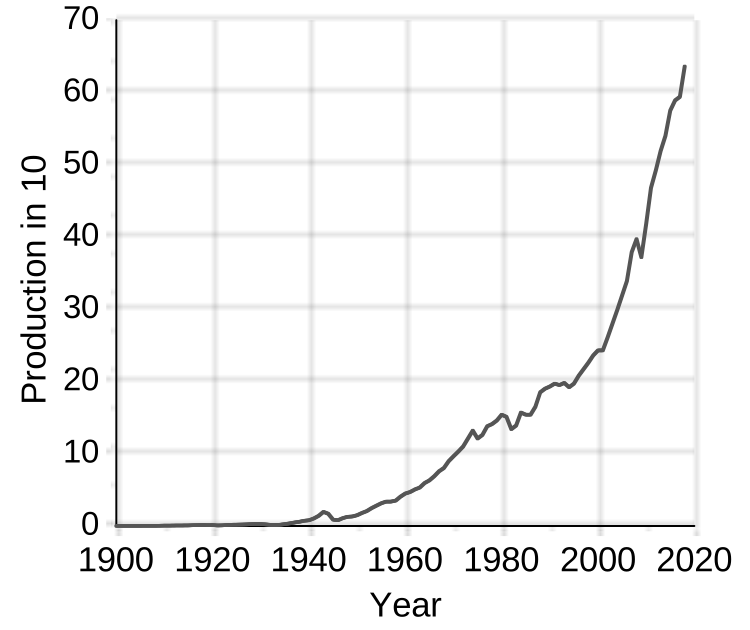
In fact most trends become quite preposterous, sooner rather than later. (Whole planet turned into ICs by the 22nd century, at this rate.) So all manner of wildness is sure to soon happen. This is certainly not stagnation, whatever it will ultimately mean:
https://upload.wikimedia.org/wikipedia/commons/f/f9/Copper_-...
https://upload.wikimedia.org/wikipedia/commons/4/43/Zinc_wor...
https://upload.wikimedia.org/wikipedia/commons/5/58/Nickel_w...
https://upload.wikimedia.org/wikipedia/commons/9/96/Aluminiu...
https://upload.wikimedia.org/wikipedia/commons/4/48/Vanadium...
Correct. Infinite Growth being the north star here, but it's not sustainable indefinitely.
https://www.dailymail.co.uk/sciencetech/article-12318767/NAS...
It's basically just wishful thinking and hand-waving away physics until we actually crack fusion and more or less free near-infinite energy.
Until then, it's just a pipe dream by techno-optimists.
Wanna go further? Proxima Centauri (the next star) is really, really far. Actually even a lot further than that. We definitely won't go there, unless we discover completely new physics (but it does not seem rational to count on that). So it's either Mars, or something that looks like Mars (I don't know, Venus maybe?), or living in a spaceship. Which is a bit like living on Mars, but worse.
Let's try to survive on Earth first, shall we? Because right now we (as a species) are failing. And not because of external factors: just because of us.
How can expansion into space mitigate pressure on Earth in any meaningful way?
Accelerate.
Renewables are extremely far from looking like they could remotely replace fossil fuels, and given that building nuclear plants takes decades, it's starting to be short on that end too.
More fossil energy is definitely not good: it's killing us (literally), and it will get worse.
It's really not clear at all, today, that we will be able to replace fossil fuels entirely with renewable energy (meaning that we are likely to face a forced degrowth). And anyway, the more energy we have, the more we behave like humans, and that's killing the Earth's biodiversity (no need to go to Mars: we are changing Earth into something that may look like Mars eventually).
The best thing that could happen in 2023 would be to realize that less is more.
Now say we realize that today (which is very not clear) and start building nuclear plants: still it is absolutely not clear that we can remotely compensate our addiction to fossil fuels. In other words, it may well be that we need more nuclear plants in order to control the forced degrowth that's coming.
> Fissionable resources are plentiful
Actually, and if I understood correctly, most nuclear plants today use uranium 235. Which is limited. New generations use uranium 238 (which is much less limited), but they still need some uranium 235. So even there we need to transition sooner than later. And given how much f** we give about moving away from fossil fuels in order to survive on Earth, I wouldn't bet that we give a lot about transitioning to newer gen nuclear plants.
Where are you going to store the waste? 200,000 years?
Nuclear is making future generations pay for current consumption
Don't get me wrong. Nuclear waste is a problem. But it is much, much less of a problem than fossil fuels. As in: fossil fuels are currently killing us (so nuclear waste won't be a problem for many if we continue like this with fossil fuels), and nuclear waste is manageable.
We don't have the luxury of finding something truly "clean" (nope, renewables don't remotely have the potential of nuclear power, which won't remotely replace fossil fuels. And technically they are not truly clean either).
What is making future generations pay is fossil fuel. And it is extremely expensive.
That is true, which is why we need to use much less fossil fuels. But nuclear is so much worse.
> nuclear waste is manageable.
That is my point. You are utterly wrong about that
> Nuclear is making future generations pay for current consumption
Yes, a fraction of the payment of any alternative power sources (pollution and climate change for fossil fuels; lost productivity for wind/solar; lost forests for biomass).
Where?
It has to geologically stable for a long time.
People 50,000 years from now need to understand your intentions
You cannot do that
In the future, I think they'll know exactly what happened in 2023. And it won't be thought of kindly.