For companies with most of their clients using their own personal computers (like for us), we could expect a fair share of Chrome over IE and hence the following: 1) Our QA should have a major focus on testing with these browsers. 2) Architecture needs to focus on this stat. as a guiding principle while deciding future architecture.
Another interesting statistics is the second screenshot with the Mobile Operating systems. 1) The highest share of internet browsers still run a Nokia Symbian phone. Most likely these are traffic from developing countries, where monetizing from these clients is extremely difficult. 2) iPhone and Android are tied and very close.
So focusing only on iPhone could be a mistake. We need to open up to focusing on Android just as much.
My hunch is that a lot of companies are locked into legacy internal web applications that were optimized for IE6 and look like crap in a modern browser.
Then we have some other ones that only support IE 6 and 7. My laptop only has 1GB of RAM. Yeah...
I think you're overlooking a third possibility: a large percentage of those using IE during the weekdays are people that just use the "default" Windows browser while at work. While at home, they just don't use computers or get online, or at least not near as much as they do while at work.
I wonder if this may be the more likely cause.
I think of interest to web startups would be the aspect of which browser is being used by those people who are willing to buy products based on the internet and those do not tend to be people who use IE. I am excluding buying things like ebay, amazon etc.
If you consider buying internet based things, like basecamp for e.g., you could see that this population would mostly use chrome, firefox or safari. This is purely my intuition, mainly because if people care about using an internet based product, they would want the product looks good, works well and is fast on their browsers and they will thus be using one of the better browsers.
And I have to develop to that, while all you folks get to build for WebKit. Not fair!
Anyways, I feel like those percentages don't tell a good story. Many of us are still locked into supporting IE6.
Disclaimer: I work for an MS partner, while I don't admin SharePoint our company does plenty of SharePoint work and our clients are happy.
They don't show up in Chrome. But that doesn't mean you can use Chrome. Just less productive.
Microsoft sure do have their work cut out for them!
    IE 8.0         18.86
    IE 9.0         12.08
    IE 7.0          3.32
    IE 6.0          1.48

    Chrome 16.0    13.39
    Chrome 15.0     0.35
    Chrome 14.0     0.35
    Chrome 12.0     0.27
    Chrome 13.0     0.25
Source:
[1] http://gs.statcounter.com/#browser_version-ww-monthly-201102... (from the CSV file)
[2] http://gs.statcounter.com/#browser-ww-monthly-201102-201203
Assuming the trend will continue until Chrome becomes dominant. Firefox's didn't.
http://gs.statcounter.com/#browser_version-ww-daily-20120221...
The older versions of IE all dip (including IE6), But IE9 rises.
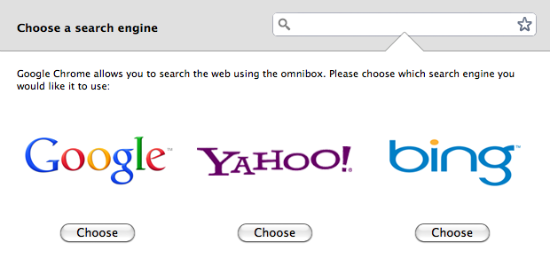
I'm pretty sure 99% choose Google not because they are already using Chrome, but because they probably trust or know Google more than Bing or Yahoo.
From my experience, IE users will usually either ignore the Bing search field, type "google.com" in and search manually, or change the search provider to Google anyway.
I would also speculate that a very large portion of Chrome users has no idea that the address bar is also a search field. They probably type in "google.com" manually every time.
If Bing, Yahoo or anyone else provides a more compelling search experience, these users will switch.
http://nyacomputing.com/wp-content/uploads/2012/02/chrome-se...
vs
I may be mistaken but, having happened to install Chrome several times recently, I'm pretty sur that they even randomize the order of the entries so as not to favor any one position. Can anyone confirm/disconfirm?
But maybe it was something else, as she's doesn't exactly knows what she's doing. Can anyone confirm that?
I was hoping that charging people money would lead them to finding their own solutions for trivial problems, but instead it has just padded my beer fund. C'est la vie.
Gosh this definitely screams monopoly abuse to me.
Out of all of Google's products, Chrome is the one that worries me the most. Using Chrome means that you just upped Google's reach on you by many fold, they now are running code directly tied to your machine and not within the constraints of a web page or app.
Are they invading your device privacy through Chrome? I dunno, probably not yet, but they can, and how long until they decide to? Given their history, specially their recent history, I don't plan on giving them the chance to do so.
The thing that pushed me over the edge was the way chrome insists I log in to my google account.
Granted, it doesn't force you to log in, but the version I recently installed on my Ubuntu based netbook kept popping up a dialog at launch, nagging me to do so. The options on the dialog were to log in or wait until later (no option for never).
I just looked now, and it appears that if I go in and manually disconnect my google account, it no longer bugs me. Hmm ... I could swear I tried that before switching back to FF.
Nice.
Still, I've recently switched back to FF as my primary, for other reasons.
Once enabled, go to wrench menu > Settings > Under the Bonnet > Advanced Settings > Privacy > Content Settings > Plug-ins
I believe it is fair to state, however, that one of the reasons that Chrome exists is that Google wants Google to be synonymous with the Web in the minds of consumers. When your browser is Google and your search engine is Google, the web to you is Google. This will dovetail quite nicely with all the other places they're trying to expand to once they manage to establish a dominant browser market share.
And everyone said I was nuts.
I'll give Apple credit for Darwin though.